
Orthodontic Headgear Market Size, Share and Forecast Report 2034

Orthodontic Headgear Market By Product (Cervical Pull, Reverse Pull (Facemask), and High Pull), By Age Group (Older Teens, Children/Young Teens, and Adults), By End-User (Hospitals, Dental Clinics, and Others), By Application (Class II Malocclusion Correction, Bite Alignment and Growth Modification, Orthodontic Retention and Post-Treatment Support, and Class III Malocclusion Correction), and By Region - Global and Regional Industry Overview, Market Intelligence, Comprehensive Analysis, Historical Data, and Forecasts 2026 - 2034
| Market Size in 2025 | Market Forecast in 2034 | CAGR (in %) | Base Year |
|---|---|---|---|
| USD 1.7 Billion | USD 3.0 Billion | 6.5% | 2025 |
Orthodontic Headgear Industry Perspective:
What will be the size of the global orthodontic headgear market during the forecast period?
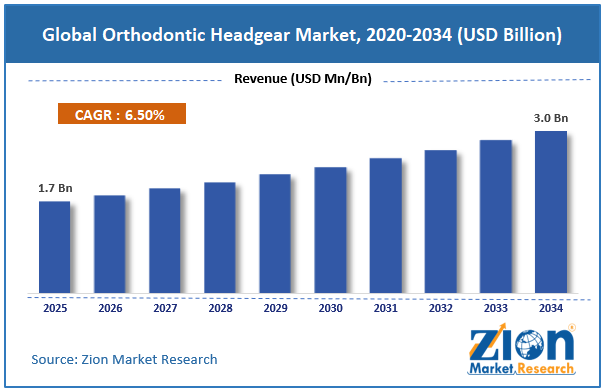
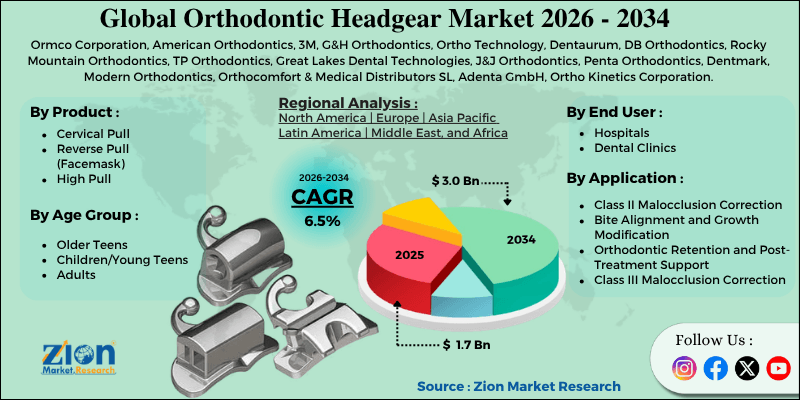
The global orthodontic headgear market size was worth around USD 1.7 billion in 2025 and is predicted to grow to around USD 3.0 billion by 2034, with a compound annual growth rate (CAGR) of roughly 6.5% between 2026 and 2034.
Orthodontic Headgear Market: Overview
The orthodontic headgear is an extraoral appliance used in orthodontics to direct jaw development and growth, and to correct bite problems. The appliance uses a metal bow that is placed on brackets or molar bands in the oral cavity, then attached to straps that wrap around the patient’s head or neck to apply external forces to the jaws and teeth. Orthodontic headgear can be recommended for children and teenagers whose jaws are still growing to address problems such as overbite, overjet, underbite, and crowding. Even though the use of orthodontic headgear is decreasing due to innovations in the field, such as TADs and clear aligners, orthodontic headgear remains one of the methods for treating skeletal and dental malocclusion.
Key Insights
- As per the analysis shared by our research analyst, the global orthodontic headgear market is estimated to grow annually at a CAGR of around 6.5% over the forecast period (2026-2034).
- In terms of revenue, the global orthodontic headgear market size was valued at around USD 1.7 billion in 2025 and is projected to reach USD 3.0 billion by 2034.
- Increasing investment in pediatric dental healthcare is expected to propel the orthodontic headgear market over the projected period.
- Based on the product, the cervical pull accounted for the highest market share of 48% in 2025.
- Based on the age group, the children/young teens segment held a prominent market share of 61% in 2025.
- Based on the end user, the hospital segment dominates the market.
- Based on the application, the Class II Malocclusion Correction is expected to garner the highest revenue share in 2025.
- Based on region, North America led the market with a revenue share of 39% in 2025.
Impact of the USA-Israel War on Iran on the Orthodontic Headgear Market
The effect of the USA-Israel War on Iran on the orthodontic headgear market is expected to be indirect and moderate, rather than structural, because orthodontic headgear is an optional dental instrument, not an urgent medical one. Nevertheless, ongoing geopolitical uncertainty in the region could affect the market through possible disruptions to the logistics chain, increased logistics costs, inflationary pressures, and low healthcare budget spending. In addition, the escalation of the war has increased fears of disruptions to energy supplies and, in particular, shipping routes, such as the Strait of Hormuz.
Orthodontic Headgear Market: Dynamics
Growth Drivers
Why does the rising prevalence of malocclusion among children and adolescents drive the orthodontic headgear market?
The growing number of cases of malocclusion (abnormal position of teeth and jaws) among children and teenagers is a key factor driving the growth of the orthodontic headgear market. As orthodontic headgear is more efficient in the period of active jaw development, it is often recommended for patients aged between children and teenagers suffering from Class II malocclusion, overjet, and skeletal bite problems. With an increasing number of diagnoses resulting from oral health screening programs implemented in schools, the number of growth-modulation appliances, such as orthodontic headgear, is also growing.
Data from government-sponsored surveys on the oral health of the population underscore the high prevalence of malocclusions. In particular, according to the results of the National Health and Nutrition Examination Survey (NHANES III) conducted by the U.S. Department of Health and Human Services, only 30% of children and teenagers suffer from normal occlusion;. In comparison, 50-55% have Class I malocclusion, 15% have Class II malocclusion, and less than 1% of children have Class III malocclusion.
Moreover, recent reports from the U.S. Centers for Disease Control and Prevention (CDC) indicate that the prevalence of oral health problems among children and teenagers is high, and the need for dental examinations and preventive care remains essential. The above-mentioned initiatives promote timely referrals to orthodontists, enabling growth guidance treatment, including orthodontic headgear, to begin at an early age.
Restraints
Risk of discomfort and treatment-related complications hamper the growth of the orthodontic headgear industry
The possibility of discomfort and potential complications from treatment is a major factor that restricts the development of the orthodontic headgear market. The appliance exerts continuous external force on the jaw and teeth, which may lead to facial pain, pressure on the teeth, inflammation of the cheeks and lips, and discomfort from the head or neck straps. These adverse effects prevent patients, especially children and teenagers, from wearing orthodontic headgear long enough. Moreover, orthodontic headgear may pose some risks of injury during treatment.
In case of improper use, the sudden detachment of the device or its recoil can lead to the occurrence of soft tissue trauma, damage to the teeth, or even eye injuries. Thus, the orthodontist should pay close attention to the patient's training and use locking devices and neck release straps to prevent complications. This makes the process more complex and increases the reluctance of both patients and clinicians to choose orthodontic headgear as the treatment method when other options are available.
Opportunities
Why does the growing demand in emerging markets offer a lucrative opportunity for the orthodontic headgear market?
An increase in the number of patients opting for orthodontic treatment is a major factor fueling the growth prospects of the global orthodontic headgear market. Urbanization, increased disposable income, better access to dental healthcare facilities, and greater awareness of oral and facial wellness are driving people in emerging nations to undergo orthodontic treatment. The number of dental clinics, orthodontic practitioners, and pediatric dental care services is on the rise in many countries across the Asia Pacific, Latin America, the Middle East, and Africa.
Hence, the use of orthodontic appliances, including orthodontic headgear, is becoming more prevalent in the region. Efforts by governments to improve the dental care infrastructure and access to dental care services are providing further impetus to the market. Dental screening programs conducted in schools and public awareness campaigns about oral health in various developing countries have led to an increase in the early diagnosis of malocclusion, enabling orthodontists to administer growth modification treatment at optimal growth stages. With rising awareness of the functional and aesthetic benefits of early orthodontic treatment, there is scope to increase the use of orthodontic headgear among pediatric patients with bite abnormalities.
Challenges
Does the presence of alternatives pose a significant challenge to the orthodontic headgear market?
The existence of alternative treatment methods to orthodontic headgear represents a major problem for the orthodontic headgear industry. Currently, there is a shift toward appliances that offer equivalent or even superior clinical results with increased comfort, better aesthetics, and reduced patient compliance requirements. Different methods including clear aligners, temporary anchorage devices (TADs), self-ligating braces, functional appliances (Twin Block and Herbst appliances), and advanced fixed orthodontic systems have made the use of conventional headgear less popular in some clinical situations since they offer the advantages of being less visible, more comfortable, and capable of reducing the treatment time or increasing anchorage without the necessity to wear bulky headgear for a number of hours every day.
Another problem is patient compliance, which is essential for orthodontic headgear to work properly, as this method is effective only if the appliance is worn for the required amount of time each day. Unlike fixed appliances and TADs, orthodontic headgear requires high patient compliance.
Orthodontic Headgear Market: Report Scope
| Report Attributes | Report Details |
|---|---|
| Report Name | Orthodontic Headgear Market |
| Market Size in 2025 | USD 1.7 Billion |
| Market Forecast in 2034 | USD 3.0 Billion |
| Growth Rate | CAGR of 6.5% |
| Number of Pages | 226 |
| Key Companies Covered | Ormco Corporation, American Orthodontics, 3M, G&H Orthodontics, Ortho Technology, Dentaurum, DB Orthodontics, Rocky Mountain Orthodontics, TP Orthodontics, Great Lakes Dental Technologies, J&J Orthodontics, Penta Orthodontics, Dentmark, Modern Orthodontics, Orthocomfort & Medical Distributors SL, Adenta GmbH, Ortho Kinetics Corporation, Henry Schein, Dentsply Sirona, Sino Dental Group, and others. |
| Segments Covered | By Product, By Age Group, By End User, By Application, and By Region |
| Regions Covered | North America, Europe, Asia Pacific (APAC), Latin America, Middle East, and Africa (MEA) |
| Base Year | 2025 |
| Historical Year | 2020 - 2024 |
| Forecast Year | 2026 - 2034 |
| Customization Scope | Avail customized purchase options to meet your exact research needs. Request For Customization |
Orthodontic Headgear Market: Segmentation
Product Insights
Why does the cervical pull segment dominate the orthodontic headgear market?
The cervical pull accounted for the highest share in the orthodontic headgear industry of 48% in 2025. The device is used for treating overbites and overjet problems. The large proportion of people affected by overbites is expected to boost the growth of the market segment. As per the statistics provided by Flower Mound Orthodontics in August 2024, around 70% of people suffer from overbites, of which a considerable number of people have mild or moderate problems.
Age Group Insights
How does the children/young teens segment capture the largest market share in the orthodontic headgear market?
The children/young teens segment held a prominent share in the orthodontic headgear market of 61% in 2025. The widespread use of headgear in orthodontics stems from recommendations by healthcare providers for patients with certain medical problems, such as overbite, underbite, and crossbite. For instance, according to a journal published by Schaefer Dental Group in July 2025, orthodontic headgear is widely recommended for children aged 7 to 13 years due to their growing jaws.
End-User Insights
Does the hospital segment capture the largest market share in the orthodontic headgear market?
The hospitals segment dominates the orthodontic headgear market. Orthodontic headgears are widely used in hospitals, particularly where a large number of orthodontic treatments are needed. Hospitals provide orthodontic treatments, including assessment, diagnosis, and treatment plans for orthodontic disorders that can be treated using headgear. The rise in awareness among consumers about the numerous options of treating malocclusions and the launch of more products of orthodontic headgear have led to the growth of the market.
Application Insights
How does the Class II Malocclusion Correction segment capture the largest market share in the orthodontic headgear market?
The Class II Malocclusion Correction garner a highest revenue share in 2025. The reasons behind this can be attributed to the prevalence of Class II malocclusion around the world, especially in young children and teenagers. The use of orthodontic headgears is prevalent across the globe owing to their effectiveness in the correction of jaw discrepancies through proper positioning of the jaws. There is increased awareness regarding early orthodontic treatment, and increasing demands for aesthetically pleasing dental corrections are the other factors contributing to the dominance of this segment.
Regional Insights
Why does North America lead the orthodontic headgear market?
North America led the orthodontic headgear market with a revenue share of 39% in 2025. Regional expansion will be facilitated by the high prevalence of malocclusions among children and adolescents, established orthodontic care facilities, good reimbursement for pediatric dental care services in select cases, and the availability of prominent players such as Ormco, G&H Orthodontics, Rocky Mountain Orthodontics, and Ortho Technology. Additionally, the use of early orthodontic care procedures and the availability of innovative orthodontic technologies drive the demand for headgear and other orthodontic appliances.
Further, innovations in products are expected to fuel growth in the North American market. For instance, Ormco announced on 17th April 2026 an extension of the Digital Bonding (ODB) platform to include a number of other orthodontic bracket systems, including Damon™ Clear, Mini Diamond™, Orthos™, Titanium Orthos™, and Mini-Twin™. The company has also demonstrated new EtchFree™ Bonding technology at the 2026 AAO New Product Showcase, which promises greater efficiency in clinical procedures, easier workflow in orthodontic care, and improved patient experience. Though these products are not headgear but only orthodontic accessories, they contribute to orthodontic innovations in the region.
Orthodontic Headgear Market: Competitive Analysis
The global orthodontic headgear market is dominated by players like:
- Ormco Corporation
- American Orthodontics
- 3M
- G&H Orthodontics
- Ortho Technology
- Dentaurum
- DB Orthodontics
- Rocky Mountain Orthodontics
- TP Orthodontics
- Great Lakes Dental Technologies
- J&J Orthodontics
- Penta Orthodontics
- Dentmark
- Modern Orthodontics
- Orthocomfort & Medical Distributors SL
- Adenta GmbH
- Ortho Kinetics Corporation
- Henry Schein
- Dentsply Sirona
- Sino Dental Group
The global orthodontic headgear market is segmented as follows:
By Product
- Cervical Pull
- Reverse Pull (Facemask)
- High Pull
By Age Group
- Older Teens
- Children/Young Teens
- Adults
By End User
- Hospitals
- Dental Clinics
- Others
By Application
- Class II Malocclusion Correction
- Bite Alignment and Growth Modification
- Orthodontic Retention and Post-Treatment Support
- Class III Malocclusion Correction
By Region
- North America
- The U.S.
- Canada
- Mexico
- Europe
- France
- The UK
- Spain
- Germany
- Italy
- Rest of Europe
- Asia Pacific
- China
- Japan
- India
- Australia
- South Korea
- Rest of Asia Pacific
- The Middle East & Africa
- Saudi Arabia
- UAE
- Egypt
- Kuwait
- South Africa
- Rest of the Middle East & Africa
- Latin America
- Brazil
- Argentina
- Rest of Latin America
Table Of Content
Methodology
FrequentlyAsked Questions
The orthodontic headgear is an extraoral appliance used in orthodontics to direct jaw development and growth, and to correct bite problems. The appliance uses a metal bow that is placed on brackets or molar bands in the oral cavity, then attached to straps that wrap around the patient’s head or neck to apply external forces to the jaws and teeth.
The key growth drivers for the orthodontic headgear market include the rising prevalence of malocclusion among children and adolescents, increasing awareness of early orthodontic intervention, growing demand for pediatric orthodontic treatments, expansion of orthodontic clinics and specialist dental services, advancements in more comfortable and ergonomic headgear designs, rising healthcare expenditure, government-supported oral health screening programs, and increasing demand for cost-effective orthodontic treatment options in emerging markets, all of which are contributing to sustained market growth.
The major challenges restraining the growth of the orthodontic headgear market include the increasing adoption of alternative orthodontic technologies such as clear aligners and temporary anchorage devices (TADs), low patient compliance due to the need for prolonged daily wear, discomfort and treatment-related complications, aesthetic concerns associated with visible extraoral appliances, declining use in adult orthodontics, and limited reimbursement for orthodontic treatments in several regions, all of which reduce the adoption of traditional orthodontic headgear.
Based on the product, the cervical pull segment is expected to dominate the orthodontic headgear market growth during the projected period.
Emerging trends and innovations impacting the orthodontic headgear market include the development of lighter, more ergonomic, and patient-friendly headgear designs, integration of digital orthodontic treatment planning and 3D imaging, adoption of advanced biocompatible materials, incorporation of enhanced safety features such as quick-release mechanisms, expansion of customized orthodontic solutions, and growing use of digital workflows and e-commerce platforms by manufacturers, all of which are improving treatment efficiency, patient comfort, and product accessibility while supporting the market's continued evolution.
According to the report, the global orthodontic headgear market size was worth around USD 1.7 billion in 2025 and is predicted to grow to around USD 3.0 billion by 2034.
The global orthodontic headgear market is expected to grow at a CAGR of 6.5% during the forecast period.
The global orthodontic headgear industry growth is expected to be led by North America over the forecast period.
The global orthodontic headgear market is dominated by players like Ormco Corporation, American Orthodontics, 3M, G&H Orthodontics, Ortho Technology, Dentaurum, DB Orthodontics, Rocky Mountain Orthodontics, TP Orthodontics, Great Lakes Dental Technologies, J&J Orthodontics, Penta Orthodontics, Dentmark, Modern Orthodontics, Orthocomfort & Medical Distributors SL, Adenta GmbH, Ortho Kinetics Corporation, Henry Schein, Dentsply Sirona, and Sino Dental Group, among others.
The orthodontic headgear market report covers the geographical market along with a comprehensive competitive landscape analysis. It also includes cash flow analysis, profit ratio analysis, market basket analysis, market attractiveness analysis, sentiment analysis, PESTLE analysis, trend analysis, SWOT analysis, trade area analysis, demand & supply analysis, Porter’s five forces analysis, and value chain analysis.

HappyClients