
Optical Transceivers Market Size, Share, Trends, Growth 2032

Optical Transceivers Market By Form (SFP+ and SFP28, SFF and SFP, CFP, CFP2, and CFP4, QSFP, QSFP+, QSFP14, and QSFP28, CXP, XFP, and others), By Data Rate (Greater Than 100 Gbps, Greater Than 40 Gbps and Less Than 100 Gbps, Greater Than 10 Gbps and Less Than 40 Gbps, and Less Than 10 Gbps), By Distance (Greater Than 100km, Greater Than 10km to Less Than 100km, Greater Than 1km to Less Than 10km, and Less Than 1km), By Wavelength (1550nm, 1310nm, 850nm, and Others), By Application (Telecom, Enterprises, and Data Center), And By Region - Global And Regional Industry Overview, Market Intelligence, Comprehensive Analysis, Historical Data, And Forecasts 2024 - 2032
| Market Size in 2023 | Market Forecast in 2032 | CAGR (in %) | Base Year |
|---|---|---|---|
| USD 3.21 Billion | USD 7.51 Billion | 9.9% | 2023 |
Description
How big is the Optical Transceivers Market?
According to the report published by Zion Market Research, the global Optical Transceiver Market size was valued at USD 3.21 Billion in 2023 and is predicted to reach USD 7.51 Billion by the end of 2032. The market is expected to grow with a CAGR of 9.9% during the forecast period.
The report analyzes the global Optical Transceiver Market's growth drivers, restraints, and impact on demand during the forecast period. It will also help navigate and explore the arising opportunities in the Optical Transceiver industry.
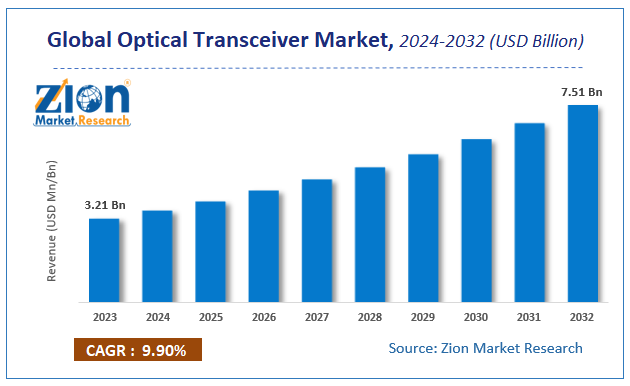
Global Optical Transceivers Market: Overview
The transceivers are devices that perform transmission as well as the reception of the signals over a network with the help of a common circuitry. The optical transceiver is also known as fiber optic transmitter and receiver and is used for completing the transmission operation by converting the light pulse into an electrical signal and vice versa.
Global Optical Transceivers Market: Growth Factors
For the efficient functioning of the network, optical transceivers play an important role. The key factor that is propelling the growth of the optical transceivers market is the minimized cost transport of the data over the network. There is an increased adoption rate of optical transceivers compared to the other conventional transceiver devices owing to its reduced maintenance cost. The main advantage of using optical transceivers is that it supports large bandwidth thus being used in the network infrastructure demanding high speed such as the broadband internet connections.
Other benefits of deploying the optical transceivers are they update the data center networks and the communication networks and improve the traffic management by improving the speed limit. Optical networks are vital in mobile communication network. Owing to the increasing demand for the high speed and reliable mobile communication network the popularity of the optical transceivers market is also growing.
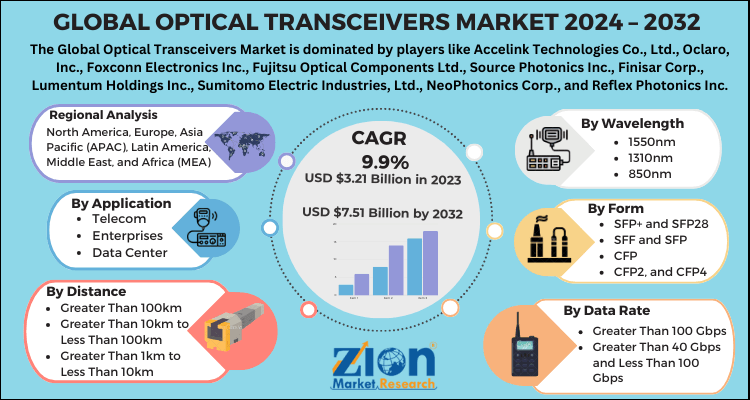
Global Optical Transceivers Market: Segmentation
The global optical transceivers market is segmented on the basis of the form, data rate, distance, wavelength, and by application.
Based on the form, the market is categorized into SFP+ and SFP28, SFF and SFP, CFP, CFP2, and CFP4, QSFP, QSFP+, QSFP14, and QSFP28, CXP, XFP, and others.
On the basis of the data rate, the optical transceivers market is segregated into greater than 100 Gbps, greater than 40 Gbps and less than 100 Gbps, greater than 10 Gbps and less than 40 Gbps, and less than 10 Gbps.
Based on the distance, the market is divided into greater than 100km, greater than 10km to less than 100km, greater than 1km to less than 10km, and less than 1km.
On the basis of wavelength, the market is fragmented into 1550nm, 1310nm, 850nm, and others.
Based on the application, the optical transceivers market is segmented into telecom, enterprises, and data center.
Optical Transceiver Market: Report Scope
| Report Attributes | Report Details |
|---|---|
| Report Name | Optical Transceiver Market |
| Market Size in 2023 | USD 3.21 Billion |
| Market Forecast in 2032 | USD 7.51 Billion |
| Growth Rate | CAGR of 9.9% |
| Number of Pages | 193 |
| Key Companies Covered | Accelink Technologies Co., Ltd., Oclaro, Inc., Foxconn Electronics Inc., Fujitsu Optical Components Ltd., Source Photonics Inc., Finisar Corp., Lumentum Holdings Inc., Sumitomo Electric Industries, Ltd., NeoPhotonics Corp., and Reflex Photonics Inc., among others |
| Segments Covered | By form, By data rate, By distance, By wavelength, By application and By Region |
| Regions Covered | North America, Europe, Asia Pacific (APAC), Latin America, Middle East, and Africa (MEA) |
| Base Year | 2023 |
| Historical Year | 2018 to 2022 |
| Forecast Year | 2024 - 2032 |
| Customization Scope | Avail customized purchase options to meet your exact research needs. Request For Customization |
Global Optical Transceivers Market: Regional Analysis
The highly attractive market for the optical transceivers is North America owing to the growing demand for the advanced communication network. Another major factor influencing the optical transceivers market in North America is the increased deployment of the 100G transceivers.
North America is followed by Europe. Growing adoption of the 100G transceivers is increasing the demand for the optical transceivers in the region. There is an increased demand for the 40G and 100G modules in regions such as North America and Europe thus growing the popularity of the optical transceivers market. Asia Pacific optical transceivers market is also developing significantly in the developing nations. China is expected to hold a major share in the Asia Pacific optical transceivers market owing to the increased deployment of the 100G equipment. Another factor favoring the market growth in the Asia Pacific is the increased focus on upgrading the existing communication networks.
Optical Transceivers Market: Competitive Analysis
The global optical transceivers market is led by players like:
- Accelink Technologies Co., Ltd
- Oclaro, Inc
- Foxconn Electronics Inc
- Fujitsu Optical Components Ltd
- Source Photonics Inc
- Finisar Corp
- Lumentum Holdings Inc
- Sumitomo Electric Industries, Ltd
- NeoPhotonics Corp
- Reflex Photonics Inc
The global optical transceivers market is segmented as follows:
By Form
- SFP+ and SFP28
- SFF and SFP
- CFP
- CFP2, and CFP4
- QSFP
- QSFP+
- QSFP14, and QSFP28
- CXP
- XFP
- Others
By Data Rate
- Greater Than 100 Gbps
- Greater Than 40 Gbps and Less Than 100 Gbps
- Greater Than 10 Gbps and Less Than 40 Gbps
- Less Than 10 Gbps
By Distance
- Greater Than 100km
- Greater Than 10km to Less Than 100km
- Greater Than 1km to Less Than 10km
- Less Than 1km
By Wavelength
- 1550nm
- 1310nm
- 850nm
- Others
By Application
- Telecom
- Enterprises
- Data Center
By Region
- North America
- The U.S.
- Canada
- Mexico
- Europe
- France
- The UK
- Spain
- Germany
- Italy
- Rest of Europe
- Asia Pacific
- China
- Japan
- India
- Australia
- South Korea
- Rest of Asia Pacific
- The Middle East & Africa
- Saudi Arabia
- UAE
- Egypt
- Kuwait
- South Africa
- Rest of the Middle East & Africa
- Latin America
- Brazil
- Argentina
- Rest of Latin America
What Reports Provides
- Full in-depth analysis of the parent market
- Important changes in market dynamics
- Segmentation details of the market
- Former, on-going, and projected market analysis in terms of volume and value
- Assessment of niche industry developments
- Market share analysis
- Key strategies of major players
- Emerging segments and regional markets
- Testimonials to companies in order to fortify their foothold in the market.
Table Of Content

FrequentlyAsked Questions
Optical transceivers transmit and receive data using light signals. They are essential for high-speed fiber optic communication.
The global Optical Transceivers market is expected to be driven by the Growth is fueled by rapid data center expansion, cloud computing growth, and increasing bandwidth needs for 5G and fiber networks. Upgrades to higher-speed standards (100G/400G/800G) accelerate demand.
According to study, the global Optical Transceivers market size was worth around USD 3.21 Billion in 2023 and is predicted to grow to around USD 7.51 Billion By 2032.
The global Optical Transceivers market is expected to grow at a Compound Annual Growth Rate (CAGR) of around CAGR 9.9% during the forecast period from 2024-2032.
The global Optical Transceivers industry is projected to be challenged by Challenges include rapid standard changes, supply constraints for photonics components, and pricing pressure as volumes scale in hyperscale data centers.
The Opportunities include surging data center traffic, 5G/FTTx rollouts, and adoption of higher-speed modules (400G/800G+) for AI and cloud infrastructure will offer significant growth opportunities in the Optical Transceivers market.
Transition to 400G/800G and co-packaged optics; silicon photonics and pluggables (QSFP-DD/OSFP); power/thermal optimization for data centers are the emerging trends and innovations impacting the Optical Transceivers market.
The global Optical Transceivers market is expected to be led by APAC during the forecast period.
Some of the prominent players operating in the global Optical Transceivers market are; Accelink Technologies Co., Ltd., Oclaro, Inc., Foxconn Electronics Inc., Fujitsu Optical Components Ltd., Source Photonics Inc., Finisar Corp., Lumentum Holdings Inc., Sumitomo Electric Industries, Ltd., NeoPhotonics Corp., and Reflex Photonics Inc., among others and others.
The report explores crucial aspects of the Optical Transceivers market, including a detailed discussion of existing growth factors and restraints, while also browsing future growth opportunities and challenges that impact the market.
HappyClients