
Global Oncology Drug Market Size, Share, Analysis, Trends, Growth, Forecasts 2032

Oncology Drug Market Analysis by Therapeutic Models (Chemotherapy, Targeted Therapy, Immunotherapy, Hormonal Therapy, Others), by Cancer Type (Breast Cancer, Blood Cancer, Prostate Cancer, Skin Cancer, Lung Cancer, Others), and by Region: Global Industry Perspective, Comprehensive Analysis and Forecast 2024 - 2032
| Market Size in 2023 | Market Forecast in 2032 | CAGR (in %) | Base Year |
|---|---|---|---|
| USD 146.9 Billion | USD 473.1 Billion | 14.0% | 2023 |
What is the oncology drug market size?
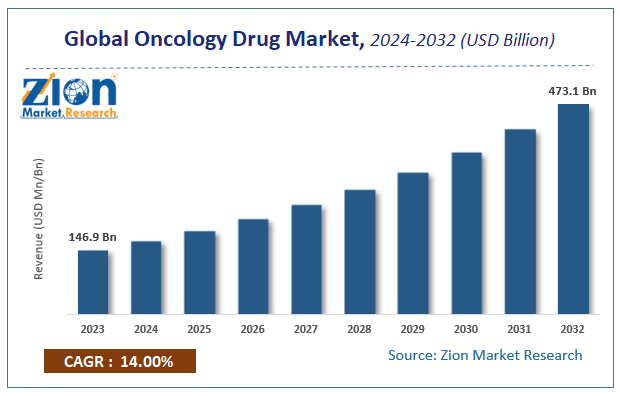
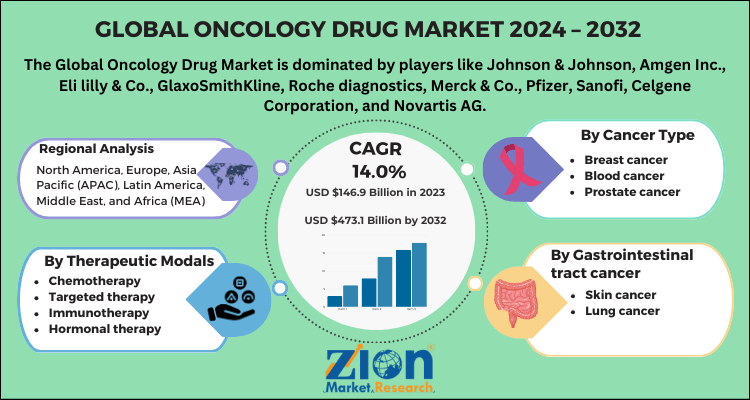
The size of the global oncology drug market was estimated to be approximately $146.9 billion in 2023 and is anticipated to reach $473.1 billion by 2032, represented by a projected compound annual growth rate of 14.0%.
Oncology Drug Market Overview
Cancer is a class of chronic illness characterized by uncontrolled cell growth. The common types of cancer are breast cancer, cancer of the lung, colorectal cancer, uterine cancer and cancer of the thyroid. The three main drugs used for cancer are cytotoxic drugs, targeted drugs, and hormonal drugs based on their mechanism of action. The investment dynamics has increased which has propelled the growth for oncology rug market.
Oncology is a branch of therapeutic science that study malignancy and treatment and prevention of malignancy. Segments of oncology include radiation oncology (the use of radiation therapy to treat cancer), medical oncology (the use of chemotherapy, hormone therapy and other drugs to treat cancer), and surgical oncology (the use of surgeries to treat cancer).
Cancer is the uncontrolled growth of abnormal cells anywhere in an individual’s body. These cells are termed as tumor cells or malignant cells. Frequently, cancer cells can detach from this original mass of cells, travel along the blood and lymph systems, and lodge in other organs where they can repeat the uncontrolled growth cycle. This process of cancer cells, leaving an area and growing in another area of the body is termed as metastatic spread or metastasis.
Cancer stage is often determined by biopsy results which also helps to determine the cancer type and the extent to which cancer has spread in an individual. Staging also helps doctors to determine treatment protocols.
Oncology Drug Market: Market Dynamics
Major drivers in the oncology drug market include growing prevalence of various types of cancer, increasing demand of biological and targeted drug therapies, technological advancements in the healthcare sector, continuous patent expiry of key cancer drugs, rise in need for R&D activities in cancer, growing concerns over high death rates due to cancer and the rising impact of biosimilars.
The threat of failure and the adverse effects of cancer drug therapy; particularly chemotherapy, strict government regulations, the high cost of drug development is expected to hinder the growth of the global oncology drugs market over the forecast period.
Oncology treatments are rapidly evolving with the latest innovations emerging from immunotherapy research, thus creating new grounds for R&D for the competing firms, cancer vaccines is also seeing a genetic engineering of living immune cells and reinfusing them into cancer patients, re-emerged when combined with checkpoint inhibitors, yet another kind of immunotherapy, is swiftly advancing. The recent discovery of genes linked to ovarian cancer risk (RAD51C and RAD51D0), new pancreatic cancer susceptibility genes (CDKN2A, BRCA1/2, PALB2), and the discovery that many cases of pediatric cancer are associated with hereditary gene mutations, may lead to new kinds of targeted therapies.
Oncology Drug market: Report Scope
| Report Attributes | Report Details |
|---|---|
| Report Name | Oncology Drug market |
| Market Size in 2023 | USD 146.9 Billion |
| Market Forecast in 2032 | USD 473.1 Billion |
| Growth Rate | CAGR of 14.0% |
| Number of Pages | 204 |
| Key Companies Covered | Johnson & Johnson, Amgen Inc., Eli lilly & Co., GlaxoSmithKline, Roche diagnostics, Merck & Co., Pfizer, Sanofi, Celgene Corporation, and Novartis AG. |
| Segments Covered | Therapeutic Modals, By Cancer Type, By Gastrointestinal tract cancer, and By Regions |
| Regions Covered | North America, Europe, Asia Pacific (APAC), Latin America, Middle East, and Africa (MEA) |
| Base Year | 2023 |
| Historical Year | 2018 - 2022 |
| Forecast Year | 2024 - 2032 |
| Customization Scope | Avail customized purchase options to meet your exact research needs. Request For Customization |
Segmentation based on Regions:
North America dominates the oncology drug market over the forecast period, attributed to high presence of the cancer drugs development companies in the U.S. Additionally, high disposable incomes of consumers and compulsory health insurance cover for life-threatening diseases leads to increasing the affordability of cancer treatment in the U.S. Europe is the second largest revenue generating region in oncology drugs market over the forecast period. The research for cancer drugs in developing economies including Asia Pacific, Latin America, and the Middle East and Africa is emerging with the focus towards the development of biosimilars. The prevalence of various cancer types is high in developing countries which generates interest for these regions to conduct clinical trials. In addition, the cost of research is low in these regions due to favorable government policies and the availability of a huge population base contributing to the oncology drug market growth in the developing countries. This, in turn, results in the significant growth of oncology drug market in the developing region over the forecast period.
Oncology Drug Market: Competitors
Some of the key players in the global oncology drug market include
- Johnson & Johnson
- Amgen Inc.
- Eli lilly & Co.
- GlaxoSmithKline
- Roche diagnostics
- Merck & Co.
- Pfizer
- Sanofi
- Celgene Corporation
- and Novartis AG.
The report segments of the Oncology Drug market into:
By Therapeutic Modals
- Chemotherapy
- Targeted therapy
- Immunotherapy
- Hormonal therapy
- Others
By Cancer Type
- Breast cancer
- Blood cancer
- Prostate cancer
By Gastrointestinal tract cancer
- Skin cancer
- Lung cancer
- Others
By Region
- North America
- The U.S.
- Canada
- Mexico
- Europe
- France
- The UK
- Spain
- Germany
- Italy
- Rest of Europe
- Asia Pacific
- China
- Japan
- India
- Australia
- South Korea
- Rest of Asia Pacific
- The Middle East & Africa
- Saudi Arabia
- UAE
- Egypt
- Kuwait
- South Africa
- Rest of the Middle East & Africa
- Latin America
- Brazil
- Argentina
- Rest of Latin America
What Reports Provides
- Full in-depth analysis of the parent market
- Important changes in market dynamics
- Segmentation details of the market
- Former, on-going, and projected market analysis in terms of volume and value
- Assessment of niche industry developments
- Market share analysis
- Key strategies of major players
- Emerging segments and regional markets
- Testimonials to companies in order to fortify their foothold in the market.
Table Of Content
Methodology
FrequentlyAsked Questions
An oncology drug is a medication used to treat cancer. It targets cancer cells to slow or stop disease progression.
The global oncology drug market is expected to be driven by the increasing cancer incidence, targeted therapy adoption, and advancements in oncology drug development.
According to study, the global oncology drug market size was worth around USD 146.9 Billion in 2023 and is predicted to grow to around USD 473.1 Billion By 2032.
The global oncology drug market is expected to grow at a Compound Annual Growth Rate (CAGR) of around CAGR 14.0% during the forecast period from 2024-2032.
The global oncology drug industry is projected to be challenged by Key challenges include long R&D timelines, high clinical trial costs, and complex regulatory approvals. Pricing pressure and reimbursement uncertainty impact commercialization.
The Opportunities include targeted therapies, immuno-oncology combinations, and biomarker-driven treatment. Accelerated approvals and expanded indications fuel pipeline growth will offer significant growth opportunities in the oncology drug market.
Targeted therapies and immuno-oncology drugs; personalized cancer treatment approaches; accelerated regulatory pathways are the emerging trends and innovations impacting the oncology drug market.
The global oncology drug market is expected to be led by North America during the forecast period.
Some of the prominent players operating in the global oncology drug market are; Johnson & Johnson, Amgen Inc., Eli lilly & Co., GlaxoSmithKline, Roche diagnostics, Merck & Co., Pfizer, Sanofi, Celgene Corporation, and Novartis AG. and others.
The report explores crucial aspects of the oncology drug market, including a detailed discussion of existing growth factors and restraints, while also browsing future growth opportunities and challenges that impact the market.

HappyClients

