
Global Millimeter Wave Equipment Market Size, Share, Trends, Growth, Forecast 2032

Millimeter Wave Equipment Market By Product Type (Satellite Communication, Telecommunication Equipment, Millimeter Scanners, and Millimeter Radars), By Frequency (8 GHz to 57 GHz Band, 58 GHz to 86 GHz Band, and 87 GHz to 300 GHz Band), By Application (Telecommunication, Aerospace, Defense, and Consumer Electronics), and By Region - Global and Regional Industry Overview, Market Intelligence, Comprehensive Analysis, Historical Data, and Forecasts 2024 - 2032
| Market Size in 2023 | Market Forecast in 2032 | CAGR (in %) | Base Year |
|---|---|---|---|
| USD 3.68 Billion | USD 73.88 Billion | 39.68% | 2023 |
Millimeter Wave Equipment Industry Perspective
What will be the global millimeter wave equipment market size during the forecast period?
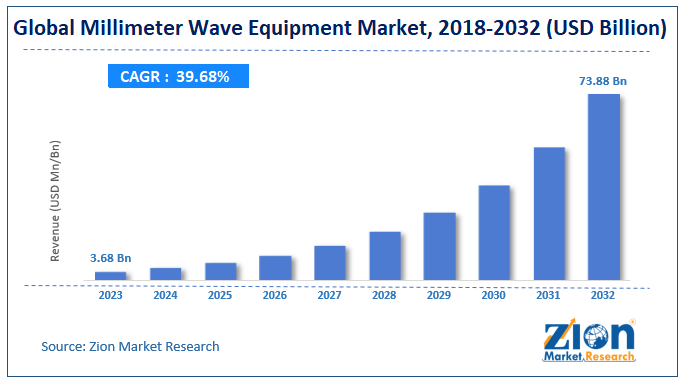
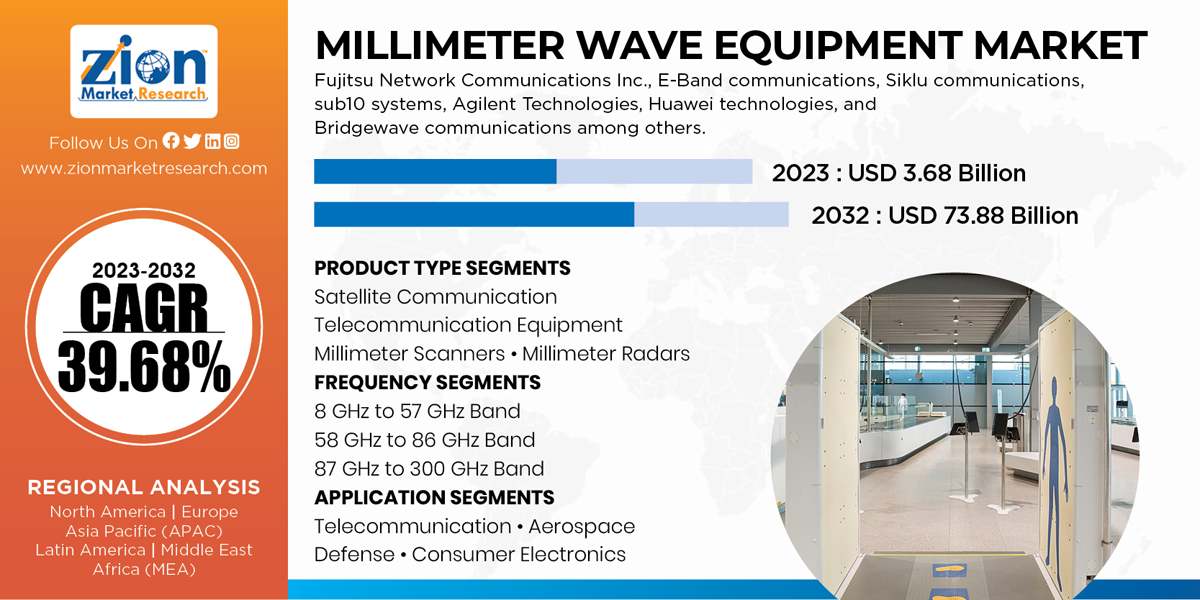
The global millimeter wave equipment market size was worth around USD 3.68 billion in 2023 and is predicted to grow to around USD 73.88 billion by 2032 with a compound annual growth rate (CAGR) of roughly 39.68% between 2024 and 2032.
This report provides a comprehensive analysis of the growth drivers, restraints, and challenges shaping demand across the global millimeter wave equipment market throughout the forecast period, while highlighting high-potential emerging opportunities within the industry.
Key Insights
- As per the analysis shared by our research analyst, the global millimeter wave equipment market is estimated to grow annually at a CAGR of around 39.68% over the forecast period (2024-2032).
- In terms of revenue, the global millimeter wave equipment market size was valued at around USD 3.68 billion in 2023 and is projected to reach USD 73.88 billion by 2032.
- The market is driven by higher bandwidth, low cost, high speed, and advanced features of millimeter waves, increasing numbers of broadband and mobile data users, technological advancement encouraging adoption, rise in cellular and broadband speeds, use in small-cell backhaul networks, and substantial demand for security and radar applications.
- Based on the product type, telecommunication equipment remains central to demand due to the role of millimeter waves in delivering higher data rates for mobile and wireless networks and supporting high-capacity communications.
- Based on the frequency, bands across 8 GHz to 57 GHz support diverse applications, with higher frequency ranges enabling greater bandwidth for telecommunications and advanced sensing uses.
- Based on the application, telecommunications is a primary demand driver because millimeter waves offer higher data rates of up to 10 Gbps and serve as an alternative to fiber optics in terms of speed, performance, and cost for broadband and mobile services.
- Regionally, Asia Pacific is expected to lead the global millimeter wave equipment market during the forecast period, supported by rapid telecom infrastructure expansion, 5G deployment activity, and growing adoption across communication and related verticals.
Millimeter Wave Equipment Market: Overview
Millimeter (MM) wave is the band of the spectrum that ranges from 30 GHz to 300 GHz (Millimeter Band), with a wavelength of range 1-10mm. MM waves find their use in high-speed wireless broadband communications; the International Telecommunication Union (ITU) also refers to it as Very High Frequency (VHF) or Extremely High Frequency (EHF). Millimeter wave technology is a type of electromagnetic wave technology that is recently being used across various applications in industries. It is used extensively in the telecommunications industry as it can offer higher data rates of up to 10 Gbps for a number of services on mobile and wireless networks. Various components used in millimeter wave equipment are antennas, transceivers, interface components, imaging components, communication components, and networking components.
The report covers forecast and analysis for the millimeter wave equipment Market on a global and regional level. The study includes drivers and restraints for the millimeter wave equipment market along with the impact they have on the demand over the forecast period. Additionally, the report includes the study of opportunities available in the millimeter wave equipment market on a global level.
Millimeter Wave Equipment Market: Growth Dynamics
Factors offered by MM waves such as higher bandwidth, low cost, high speed, advanced and suitable features are expected to drive the adoption of MM-wave equipment in the coming years. In the telecommunication sector, MM waves are considered an alternative to fiber optics in terms of speed, performance, and low cost. With increasing numbers of broadband end-users as well as mobile data users, the market is anticipated to witness significant growth in the forecast period. The technological advancement that encourages adoption of mmWave technology is expected to be another factor that will drive this market. On the other hand, restraining factors for this market are its limited range and monopolies of product manufacturers in application fields. In addition, the MM-wave band is affected by rain, snow, and fog, which ultimately affect the quality of operations, resulting in less adoption of this technology in some fields. Nonuniform licensing is also a major restraining factor for the growth of this market. Due to the high adoption rate of MM wave technology in different verticals such as aerospace, defense, radar, and telecommunication industries, there are tremendous growth opportunities in the global millimeter wave equipment market.
The increase in cellular and broadband speeds, rise in the use of millimeter-wave in small-cell backhaul networks, and substantial demand for the use of Millimeter Wave Equipment in security and radar applications are the main factors driving the growth of the Millimeter Wave Equipment Market. The Global Millimeter Wave Market report provides a holistic evaluation of the market. The report offers a comprehensive analysis of key segments, trends, drivers, restraints, competitive landscape, and factors that are playing a substantial role in the market.
This report offers comprehensive coverage of the global millimeter wave equipment market, along with market trends, drivers, and restraints of the millimeter wave equipment market. This report includes a detailed competitive scenario and the product portfolio of key vendors. To understand the competitive landscape in the market, an analysis of Porter’s five forces model for the millimeter wave equipment market has also been included. The study encompasses a market attractiveness analysis, wherein all segments are benchmarked based on their market size, growth rate, and general attractiveness. This report is prepared using data sourced from in-house databases, secondary and primary research by a team of industry experts.
Millimeter Wave Equipment Market: Report Scope
| Report Attributes | Report Details |
|---|---|
| Report Name | Millimeter Wave Equipment Market Size Report |
| Market Size in 2023 | USD 3.68 Billion |
| Market Forecast in 2032 | USD 73.88 Billion |
| Growth Rate | CAGR of 39.68% |
| Number of Pages | 255 |
| Forecast Units | Value (USD Billion) and Volume (Units) |
| Key Companies Covered | Fujitsu Network Communications Inc., E-Band Communications, Siklu Communications, Sub-10 Systems, Agilent Technologies, Huawei Technologies, and Bridgewave Communications, among others. |
| Segments Covered | By Product Type, By Frequency, By Application, and By Region |
| Base Year | 2023 |
| Historical Year | 2018 - 2022 |
| Forecast Year | 2024 - 2032 |
| Customization Scope | Avail customized purchase options to meet your exact research needs. Request For Customization |
Millimeter Wave Equipment Market: Segmentation
The millimeter wave equipment market is segmented by product type, frequency, application, and region. All the segments of the millimeter wave equipment market have been analyzed based on present and future trends and the market is estimated from 2024 to 2032.
Based on Product Type, the market is divided into satellite communication, telecommunication equipment, millimeter scanners, and millimeter radars. Telecommunication equipment plays a central role because millimeter waves enable higher data rates for mobile and wireless networks and support high-capacity links that can complement or substitute fiber in certain deployments. This demand drives overall market growth by anchoring volume in network infrastructure and backhaul. Millimeter radars and scanners form important secondary categories that expand applications in security, sensing, and specialized imaging.
On the basis of Frequency, the market is segmented into the 8 GHz to 57 GHz band, the 58 GHz to 86 GHz band, and the 87 GHz to 300 GHz band. Higher frequency bands within the millimeter wave spectrum support greater bandwidth and are particularly relevant for high-capacity telecommunication and advanced radar uses. This capability drives market expansion by enabling multi-gigabit links and dense network architectures. Lower bands within the defined ranges continue to support established communication and sensing applications that broaden the overall addressable base.
Based on Application, the millimeter wave equipment market is divided into telecommunications, aerospace, defense, and consumer electronics. Telecommunication is a primary demand driver because millimeter waves offer higher data rates of up to 10 Gbps and serve as an alternative to fiber optics for speed, performance, and cost in broadband and mobile services. This leadership accelerates market growth through ongoing network densification and 5G-related deployments. Defense and aerospace applications form strong secondary demand areas through radar, security, and specialized communication requirements, while consumer electronics contribute incremental growth as high-frequency capabilities expand into new devices and services.
Millimeter Wave Equipment Market: Regional Analysis
Why will Asia Pacific continue to dominate the global market during the projection period?
Asia Pacific is expected to lead the global millimeter wave equipment market during the forecast period. Rapid expansion of telecom infrastructure, active 5G and advanced wireless network deployments, and strong demand for high-capacity backhaul and small-cell solutions support regional leadership. Growing adoption across communication, industrial, and related verticals, together with significant investments by operators and equipment providers, further reinforces demand. These factors enable Asia Pacific to drive overall market growth, accelerate technology adoption, and shape innovation and expansion trends in millimeter wave equipment worldwide.
North America maintains a substantial presence through advanced telecommunications networks, defense and aerospace activity, and ongoing investment in high-speed wireless and radar systems. Focus on next-generation connectivity and security applications sustains regional contribution.
Europe supports steady demand through established telecom operators, research activity, and applications in defense, aerospace, and industrial communications. Regulatory and spectrum initiatives influence the pace of deployment and product development.
Millimeter Wave Equipment Market: Competitive Analysis
Some of the major players in the global millimeter wave equipment market include:
- Fujitsu Network Communications Inc.
- E-Band Communications
- Siklu Communications
- Sub10 Systems
- Agilent Technologies
- Huawei Technologies
- Bridgewave Communications
Segments Covered
The report segments the global millimeter wave equipment market as follows:
By Product Type
- Satellite Communication
- Telecommunication Equipment
- Millimeter Scanners
- Millimeter Radars
By Frequency
- 8 GHz to 57 GHz Band
- 58 GHz to 86 GHz Band
- 87 GHz to 300 GHz Band
By Application
- Telecommunication
- Aerospace
- Defense
- Consumer Electronics
By Region
- North America
- The U.S.
- Canada
- Mexico
- Europe
- France
- The UK
- Spain
- Germany
- Italy
- Rest of Europe
- Asia Pacific
- China
- Japan
- India
- Australia
- South Korea
- Rest of Asia Pacific
- The Middle East & Africa
- Saudi Arabia
- UAE
- Egypt
- Kuwait
- South Africa
- Rest of the Middle East & Africa
- Latin America
- Brazil
- Argentina
- Rest of Latin America
Table Of Content
Methodology
FrequentlyAsked Questions
Millimeter wave equipment operates at very high radio frequencies. It is used in 5G communication and advanced radar systems
The global Millimeter Wave Equipment market is expected to be driven by the 5G deployment, high-speed data demand, and applications in defense and imaging. Expansion of telecom infrastructure drives adoption.
According to study, the global Millimeter Wave Equipment market size was worth around USD 3.68 Billion in 2023 and is predicted to grow to around USD 73.88 Billion By 2032.
The global Millimeter Wave Equipment market is expected to grow at a Compound Annual Growth Rate (CAGR) of around CAGR 39.68% during the forecast period from 2024-2032.
The global Millimeter Wave Equipment industry is projected to be challenged by Challenges include high deployment costs, limited range, and complex installation.
The Opportunities include 5G/6G rollout, high-speed wireless backhaul, defense applications, and smart city connectivity will offer significant growth opportunities in the Millimeter Wave Equipment market.
High-frequency components for 5G/6G; compact beamforming antennas; applications in backhaul, radar, and sensing are the emerging trends and innovations impacting the Millimeter Wave Equipment market.
The global Millimeter Wave Equipment market is expected to be led by APAC during the forecast period.
Some of the prominent players operating in the global Millimeter Wave Equipment market are Fujitsu Network Communications Inc., E-Band Communications, Siklu Communications, Sub10 Systems, Agilent Technologies, Huawei Technologies, and Bridgewave Communications, among others. and others.
The report explores crucial aspects of the Millimeter Wave Equipment market, including a detailed discussion of existing growth factors and restraints, while also browsing future growth opportunities and challenges that impact the market.

HappyClients

