
Metal Additive Manufacturing Market Size, Share, Value and Forecast 2034

Metal Additive Manufacturing Market By Type (Electron Beam Melting (EBM), Selective Laser Melting (SLM), Directed Energy Deposition, Powder Bed Fusion, Binder Jetting, and Sheet Lamination), By Application (Academic Institutions, Healthcare & Dental Industry, Aerospace Industry, Automotive Industry, and Others), and By Region - Global and Regional Industry Overview, Market Intelligence, Comprehensive Analysis, Historical Data, and Forecasts 2025 - 2034
| Market Size in 2024 | Market Forecast in 2034 | CAGR (in %) | Base Year |
|---|---|---|---|
| USD 6.44 Billion | USD 18.87 Billion | 12.70% | 2024 |
Metal Additive Manufacturing Industry Perspective:
What is the anticipated CAGR for the metal additive manufacturing market during the projection period?
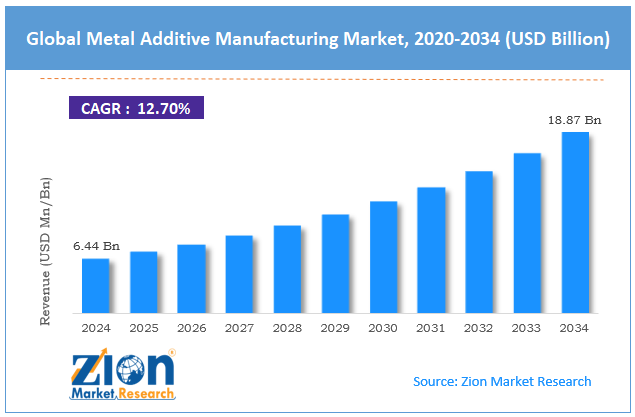
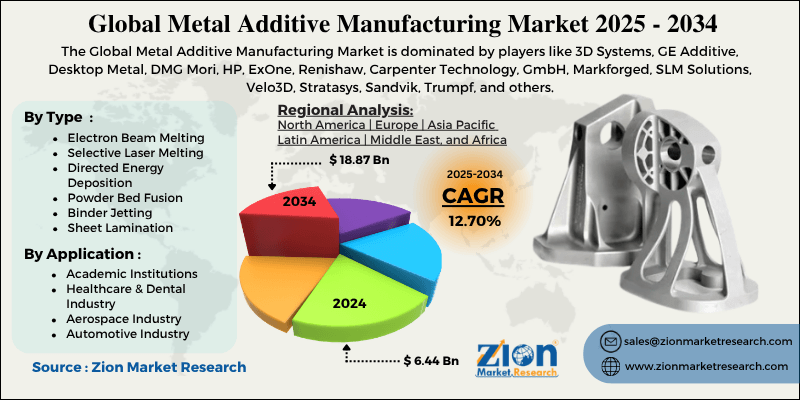
The global metal additive manufacturing market size was worth around USD 6.44 billion in 2024 and is predicted to grow to around USD 18.87 billion by 2034 with a compound annual growth rate (CAGR) of roughly 12.70% between 2025 and 2034.
Key Insights:
- As per the analysis shared by our research analyst, the global metal additive manufacturing market is estimated to grow annually at a CAGR of around 12.70% over the forecast period (2025-2034)
- In terms of revenue, the global metal additive manufacturing market size was valued at around USD 6.44 billion in 2024 and is projected to reach USD 18.87 billion by 2034.
- The market is projected to grow at a significant rate due to the growing applications of 3D production techniques in the aerospace industry.
- Based on the type, the selective laser melting (SLM) segment is growing at a high rate and will continue to dominate the global market, as per industry projections.
- Based on the application, the aerospace industry segment is anticipated to command the largest market share.
- Based on region, the Asia-Pacific is projected to dominate the global market during the forecast period.
Metal Additive Manufacturing Market: Overview
Metal additive manufacturing (AM), also known as 3D printing, refers to the novel process of producing highly complex parts without the limitations of traditional manufacturing techniques. The process involves joining materials to produce parts using 3D model data. As opposed to subtractive manufacturing, metal additive procedures usually deal with layer-by-layer manufacturing solutions. According to industry research, metal additive manufacturing allows the production of lightweight, highly complex, and personalized solutions since materials can be deposited wherever required. During the forecast period, the industry for metal additive manufacturing is expected to witness high growth due to rising applications in the aerospace and automotive sectors.
In addition, the healthcare industry is one of the leading revenue generators for metal additive manufacturing procedures due to the growing demand for customized implants and surgical tools. However, high initial investment, expenses associated with raw materials and operational procedures, and slow production speed will impact business revenue in the long run.
Metal Additive Manufacturing Market: Dynamics
Growth Drivers
How will aerospace applications influence the metal additive manufacturing market growth?
The global metal additive manufacturing market is expected to benefit from the growing applications of 3D production techniques in the aerospace industry. Aircraft makers are increasingly investing in metal additive manufacturing technologies since they can help produce lightweight and complex aircraft parts. In March 2026, GE Aerospace, one of the most prominent players in the aerospace industry, announced an additional investment of 110 million EUR into the company’s European manufacturing sites. The company will be expanding its additive manufacturing capabilities in the coming years.
In September 2025, Oerlikon, a global leader in surface engineering and advanced materials, announced that it had joined the Finnish Additive Manufacturing Ecosystem (FAME). The latter is a collaborative ecosystem built around advancing additive manufacturing in Finland. Oerlikon will provide expertise in essential metal additive manufacturing technologies, including Directed Energy Deposition (DED) and Laser Powder Bed Fusion (LPBF). Such strategic collaborations will encourage higher use of metal AM across the global aerospace sector.
Increasing military and defense spending worldwide is expected to work in favor of the market players
Military and defense spending worldwide has witnessed a steady increase driven by growing concerns over territorial disputes and geopolitical tension. For instance, the Indian government announced its record-high defense spending in the fiscal year 2026-2027. The government will spend 15.19% more than its defense expenditure in 2025-2026. Similar statistics can be witnessed in other parts of the world, especially European and Asian countries. The solutions available in the global metal additive manufacturing market provide excellent technologies to produce custom-made and complex satellite components and ammunition parts, helping the market thrive.
Restraints
Why will cost barriers affect revenue in the metal additive manufacturing market?
The global metal additive manufacturing industry is expected to be restricted due to the high cost of investment associated with the market. Metal additive manufacturing equipment can cost more than USD 1.1 million since they are supposed to deliver extreme precision. In addition, the use of high-powered lasers further adds to the overall cost of equipment ownership. The overall expense of metal AM may further increase due to installation charges restricting market expansion trends.
Opportunities
Healthcare industry is to offer renewed growth opportunities to the market leaders
The global metal additive manufacturing market is projected to generate growth opportunities due to rising applications in the healthcare industry. The rising demand for personalized implants and surgical tools has created an additional need to use metal AM. In March 2025, Eplus3D, a China-based designer and manufacturer of 3D printers, announced that the company was working on leveraging metal AM for producing metal implant solutions. The company used the EP-M260 AM machine for producing shoulder arthrodesis plates, which are difficult to produce using traditional manufacturing techniques.
Why will technological advancements in the industry work in favor of the industry players?
Recent developments, such as the use of advanced alloys and multi-material printing, have opened new avenues for extended growth in the industry. These developments are directed toward improving metal AM performance and overall applications. In October 2025, EOS, a global supplier of responsible manufacturing solutions for industrial 3D printing, introduced 4 new metal AM materials called EOS FeNi36, EOS NickelAlloy C22, EOS Steel 42CrMo4, and EOS StainlessSteel 316L-4404. Each material is optimized for EOS Laser Powder Bed Fusion (LPBF) systems.
Challenges
Issues with quality consistency and design limitations to challenge market growth trends
The global metal additive manufacturing industry is projected to be challenged by issues concerning quality consistency. For instance, metal AM can lead to warping, cracks, and porosity, limiting technology applications in the medical and aerospace sectors. Furthermore, metal additive manufacturing requires special skills, and traditional designers may not deliver optimal results, further affecting overall market revenue.
Metal Additive Manufacturing Market: Report Scope
| Report Attributes | Report Details |
|---|---|
| Report Name | Metal Additive Manufacturing Market |
| Market Size in 2024 | USD 6.44 Billion |
| Market Forecast in 2034 | USD 18.87 Bllion |
| Growth Rate | CAGR of 12.70% |
| Number of Pages | 229 |
| Key Companies Covered | 3D Systems, GE Additive, Desktop Metal, DMG Mori, HP, ExOne, Renishaw, Carpenter Technology, GmbH, Markforged, SLM Solutions, Velo3D, Stratasys, Sandvik, Trumpf, and others. |
| Segments Covered | By Type, By Application, and By Region |
| Regions Covered | North America, Europe, Asia Pacific (APAC), Latin America, Middle East, and Africa (MEA) |
| Base Year | 2024 |
| Historical Year | 2019 to 2023 |
| Forecast Year | 2025 - 2034 |
| Customization Scope | Avail customized purchase options to meet your exact research needs. Request For Customization |
Metal Additive Manufacturing Market: Segmentation
The global metal additive manufacturing market is segmented based on type, application, and region.
Why will the selective laser melting (SLM) segment lead the metal additive manufacturing industry revenue during the forecast period?
Based on type, the global market segments are electron beam melting (EBM), selective laser melting (SLM), directed energy deposition, powder bed fusion, binder jetting, and sheet lamination. In 2024, the highest growth was listed in the selective laser melting (SLM) segment, accounting for 62% of the global revenue. It will continue to generate the highest CAGR of 12.01% during the forecast period. SLM allows the production of high-resolution parts at low volume and hence enjoys higher popularity.
Which will be the fastest-growing application during the forecast period in the metal additive manufacturing market?
Based on application, the global market divisions are academic institutions, the healthcare & dental industry, the aerospace industry, the automotive industry, and others. In 2024, the highest growth rate was listed in the aerospace industry, contributing up to 40.05% of the global market share. However, the healthcare industry is expected to emerge as the fastest-growing segment during the forecast period with a CAGR of 16.01% due to growing demand for customized medical implants that are difficult to produce using traditional methods.
Metal Additive Manufacturing Market: Regional Analysis
What does North America lead in the metal additive manufacturing market?
The global metal additive manufacturing market is led by North America. In 2024, it accounted for 39% of the global revenue. It is projected to deliver a CAGR of 18.02% during the forecast period. The presence of leading aerospace companies in the US region, along with the growing use of metal AM in the production of complex elements of spacecraft, has helped the region thrive. In addition, supportive government policies along with robust metal AM infrastructure will aid accelerated growth across North America during the forecast period.
Why is Asia-Pacific growing at the fastest CAGR in the metal additive manufacturing market?
Asia-Pacific is set to emerge as the fastest-growing region in the metal additive manufacturing market during the forecast period, growing at a CAGR of 20.5%. In 2024, it accounted for 26% of the global revenue. Growth in Asia-Pacific will be led by rapid industrial modernization and increasing use of metal AM techniques across industries such as automotive and industrial machinery. Moreover, access to affordable and skilled labor, along with growing defense expenditure, will work in favor of the regional players.
Metal Additive Manufacturing Market: Competitive Analysis
The global metal additive manufacturing market is led by players like:
- 3D Systems
- GE Additive
- Desktop Metal
- DMG Mori
- HP
- ExOne
- Renishaw
- Carpenter Technology
- GmbH
- Markforged
- SLM Solutions
- Velo3D
- Stratasys
- Sandvik
- Trumpf
What are the latest key trends in the metal additive manufacturing market?
Applications in mass production
The growing use of metal AM techniques in mass production for end-user industries instead of low-volume manufacturing is a promising market trend. It will help deliver high quantities of superior-quality machinery in a short time.
Artificial Intelligence (AI) integrations
The ongoing integration of Artificial Intelligence and other smart technologies in metal additive manufacturing will allow improved quality control and predictive maintenance, thus aiding accelerated production cycles.
The global metal additive manufacturing market is segmented as follows:
By Type
- Electron Beam Melting (EBM)
- Selective Laser Melting (SLM)
- Directed Energy Deposition
- Powder Bed Fusion
- Binder Jetting
- Sheet Lamination
By Application
- Academic Institutions
- Healthcare & Dental Industry
- Aerospace Industry
- Automotive Industry
- Others
By Region
- North America
- The U.S.
- Canada
- Mexico
- Europe
- France
- The UK
- Spain
- Germany
- Italy
- Rest of Europe
- Asia Pacific
- China
- Japan
- India
- Australia
- South Korea
- Rest of Asia Pacific
- The Middle East & Africa
- Saudi Arabia
- UAE
- Egypt
- Kuwait
- South Africa
- Rest of the Middle East & Africa
- Latin America
- Brazil
- Argentina
- Rest of Latin America
Table Of Content
Methodology
FrequentlyAsked Questions
Metal additive manufacturing (AM), also known as 3D printing, refers to the novel process of producing highly complex parts without the limitations of traditional manufacturing techniques.
The global metal additive manufacturing market is expected to benefit from the growing applications of 3D production techniques in the aerospace industry.
According to study, the global metal additive manufacturing market size was worth around USD 6.44 billion in 2024 and is predicted to grow to around USD 18.87 billion by 2034.
The CAGR value of the metal additive manufacturing market is expected to be around 12.70% during 2025-2034.
The global metal additive manufacturing industry is projected to be challenged by issues concerning quality consistency.
The healthcare industry will offer significant growth opportunities in the metal additive manufacturing market.
The global metal additive manufacturing market has performed well so far and will offer similar trends in the coming years.
Asia-Pacific is set to emerge as the fastest-growing region in the metal additive manufacturing market during the forecast period, growing at a CAGR of 20.5%.
The global metal additive manufacturing market is led by players like 3D Systems, GE Additive, Desktop Metal, DMG Mori, HP, ExOne, Renishaw, Carpenter Technology, GmbH, Markforged, SLM Solutions, Velo3D, Stratasys, Sandvik, and Trumpf.
The report explores crucial aspects of the metal additive manufacturing market including detailed discussion of existing growth factors and restraints while also browsing future growth opportunities and challenges that impact the market.

List of Contents
Metal Additive ManufacturingIndustry Perspective:Key Insights:OverviewDynamicsReport ScopeSegmentationRegional AnalysisCompetitive AnalysisWhat are the latest key trends in the metal additive manufacturing market?The global metal additive manufacturing market is segmented as follows:HappyClients

