
Lung Cancer Screening Software Market Size, Share, Trends, Growth and Forecast 2034

Lung Cancer Screening Software Market By Mode of Delivery (On-Premises, Cloud-Based, and Web-Based), By Product (Nodule Management Software, Lung Cancer Screening Radiology Solution, Pathology and Cancer Staging, Lung Cancer Screening Patient Management Software, Patient Coordination and Workflow, Practice Management, Lung Nodule Computer Aided Detection, and Others), By Application (Small Cell Lung Cancer (SCLC) and Non-Small Cell Lung Cancer (NSCLC)), By Platform (Integrated and Standalone), By End-User (Ambulatory Surgical Centers, Hospitals, Oncology Centers, and Others), and By Region - Global and Regional Industry Overview, Market Intelligence, Comprehensive Analysis, Historical Data, and Forecasts 2025 - 2034
| Market Size in 2024 | Market Forecast in 2034 | CAGR (in %) | Base Year |
|---|---|---|---|
| USD 159.29 Million | USD 650.4 Million | 16.63% | 2024 |
Lung Cancer Screening Software Industry Perspective:
What is the anticipated size of the lung cancer screening software market during the projection period?
The global lung cancer screening software market size was worth around USD 159.29 million in 2024 and is predicted to grow to around USD 650.4 million by 2034 with a compound annual growth rate (CAGR) of roughly 16.63% between 2025 and 2034.
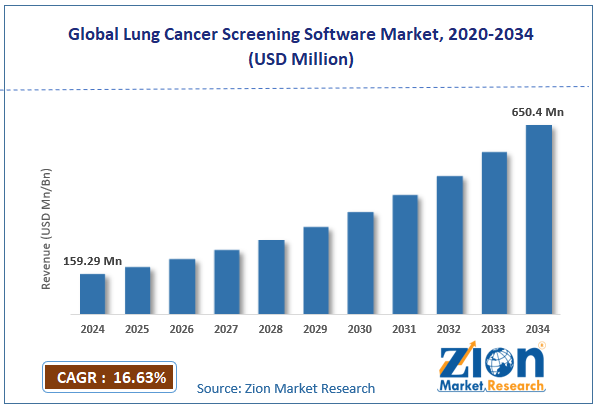
Lung Cancer Screening Software Market: Overview
Lung cancer screening software is a modern application designed to automate the process of lung cancer screening. The industry deals with specialized computer programs that assist in detecting early signs of lung cancer. The software is designed to reduce manual work by medical professionals and leverages medical images for cancer detection. Some of the most prominent advantages of lung cancer screening software include early detection, reduced human error, and accelerated diagnosis. During the forecast period, demand for lung cancer screening software is expected to grow due to the rising prevalence of the disease, increased awareness, and higher demand for early detection. However, the high cost of software development and implementation, the lack of skilled professionals, and regulatory barriers will limit market expansion trends in the future.
Key Insights:
- As per the analysis shared by our research analyst, the global lung cancer screening software market is estimated to grow annually at a CAGR of around 16.63% over the forecast period (2025-2034)
- In terms of revenue, the global lung cancer screening software market size was valued at around USD 159.29 million in 2024 and is projected to reach USD 650.4 million by 2034.
- The market is projected to grow at a significant rate due to the rising prevalence of the disease.
- Based on the mode of delivery, the cloud-based segment is growing at a high rate and will continue to dominate the global market, as per industry projections
- Based on the product, the lung nodule computer-aided detection segment is anticipated to command the largest market share.
- Based on the application, the non-small cell lung cancer (NSCLC) segment is expected to lead the market growth trends.
- Based on the platform, the integrated segment is projected to influence revenue in the market.
- Based on the end-user, the oncology centers will emerge as the fastest-growing segment.
- Based on region, Europe is projected to dominate the global market during the forecast period.
Impact of the USA-Israel and Iran War on the Lung Cancer Screening Software Market:
The USA-Israel and Iran war has significantly affected the lung cancer screening software market primarily due to the impact on medical tourism. International travel for all purposes has become more difficult at present times, thus impacting market revenue. In addition, economic volatility due to escalating geopolitical conflict has further resulted in limited use of expensive mechanical technologies such as cancer screening applications.
Lung Cancer Screening Software Market: Dynamics
Growth Drivers
How will the rising prevalence of the disease influence demand in the lung cancer screening software market?
The global lung cancer screening software market is expected to benefit from the rising prevalence of the disease. According to official research, lung cancer is the most prominent form of cancer worldwide. In 2022, more than 2.49 million new cases of lung cancer were reported across the globe. Damage to lung cells is the main cause of lung cancer. The damage can be a result of several factors. For instance, over 79% of all lung cancer cases are reported among frequent smokers. Other reasons include long-term exposure to carcinogens such as air pollution, radon gas, and secondhand smoke. A rising number of chain smokers across the globe and high air pollution levels have resulted in a surge in the number of lung cancer patients.
Emphasis on early cancer detection to promote market expansion trends in the future
Medical professionals are actively seeking technologies that can assist in early cancer detection. According to the research institutes, the 5-year survival rate is over 90% if the cancer is diagnosed in the early stages. Apart from improved survival chances, early detection can help improve quality of life and lower treatment complexity. The solutions available in the global lung cancer screening software market help early detection by diagnosing subtle signs of cancer that may be otherwise missed by medical professionals. Additionally, the software can track changes over time, allowing healthcare givers an accurate idea of cancer progression. Medical treatments can thus be drafted to deliver optimal and effective results.
Restraints
Which is the most prominent growth barrier in the lung cancer screening software market?
The global lung cancer screening software industry is limited by the high cost of technology development and implementation. Lung cancer screening software is a specialized tool developed using advanced technologies such as medical image processing algorithms and machine learning (ML). For instance, the average cost of an annual subscription to a lung cancer screening software can cost over USD 21,000, and licensing may be even higher.
Opportunities
Ongoing technological advancements are reported in the market to generate growth opportunities
The global lung cancer screening software market is anticipated to generate growth opportunities due to ongoing technological advancements. Integration of Artificial Intelligence (AI) in screening software has helped market players deliver more effective solutions. In April 2026, India’s Telangana Government announced a novel partnership with AstraZeneca India, a pharmaceutical giant. The partnership will facilitate the deployment of AI-powered lung cancer screening to public hospitals in the state. AstraZeneca will deploy Qure.ai's AI-powered chest X-ray solution, which will be integrated with routine workflows.
In February 2026, the US Food and Drug Administration (FDA) announced marketing clearance for an artificial intelligence-powered software program by Eyonis LCS to assist with lung cancer screening. Similar advancements in other parts of the world will help the market thrive.
Challenges
How will the lack of skilled professionals and regulatory hurdles challenge the lung cancer screening software market expansion?
The global lung cancer screening software industry is projected to be challenged by a lack of skilled professionals and regulatory complexities. Insufficient medical experts capable of handling modern medical software solutions limit market adoption trends. In addition, lung cancer screening applications must undergo strict regulatory approvals and compliance to ensure accuracy, reliability, and safety. These procedures are time-consuming and resource-intensive, thus affecting the market expansion rate.
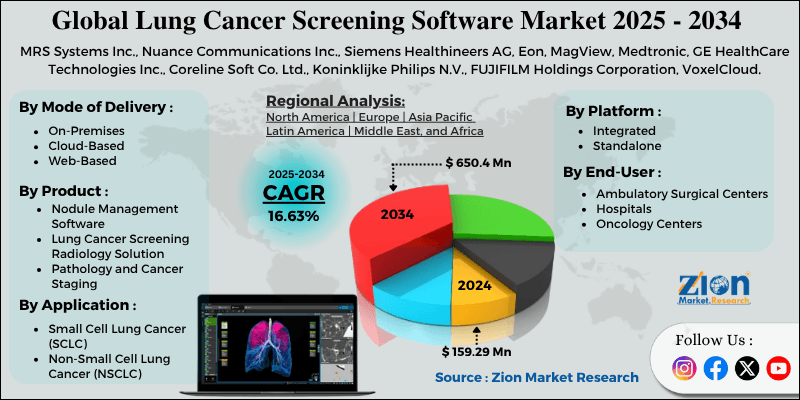
Lung Cancer Screening Software Market: Report Scope
| Report Attributes | Report Details |
|---|---|
| Report Name | Lung Cancer Screening Software Market |
| Market Size in 2024 | USD 159.29 Million |
| Market Forecast in 2034 | USD 650.4 Million |
| Growth Rate | CAGR of 16.63% |
| Number of Pages | 228 |
| Key Companies Covered | MRS Systems Inc., Nuance Communications Inc., Siemens Healthineers AG, Eon, MagView, Medtronic, GE HealthCare Technologies Inc., Coreline Soft Co. Ltd., Koninklijke Philips N.V., FUJIFILM Holdings Corporation, VoxelCloud, Optellum Ltd, HealthMyne, Qure.ai, PenRad Technologies Inc., and others. |
| Segments Covered | By Mode of Delivery, By Product, By Application, By Platform, By End-User, and By Region |
| Regions Covered | North America, Europe, Asia Pacific (APAC), Latin America, Middle East, and Africa (MEA) |
| Base Year | 2024 |
| Historical Year | 2019 - 2023 |
| Forecast Year | 2025 - 2034 |
| Customization Scope | Avail customized purchase options to meet your exact research needs. Request For Customization |
Lung Cancer Screening Software Market: Segmentation
The global lung cancer screening software market is segmented based on mode of delivery, product, application, platform, and end-user.
Why will the cloud-based segment deliver faster CAGR in the lung cancer screening software industry revenue during the forecast period?
Based on mode of delivery, the global market divisions are on-premises, cloud-based, and web-based. In 2024, the highest growth was listed in the cloud-based segment, accounting for 53% of the global revenue. It will continue growing at a CAGR of 12.09% during the forecast period as cloud-based systems are scalable, flexible, and cost-effective.
Which will be the fastest-growing product segment during the forecast period in the lung cancer screening software market?
Based on product, the global market is fragmented into nodule management software, lung cancer screening radiology solution, pathology and cancer staging, lung cancer screening patient management software, patient coordination and workflow, practice management, lung nodule computer-aided detection, and others. In 2024, the largest part of the total market share was held by the lung nodule computer-aided detection segment, contributing up to 31%. During the forecast period, it will grow at a CAGR of 11% as demand for early diagnosis is expected to grow.
Why will the non-small cell lung cancer (NSCLC) continue to lead the lung cancer screening software industry in the coming years?
Based on application, the global lung cancer screening software industry is fragmented into small cell lung cancer (SCLC) and non-small cell lung cancer (NSCLC). In 2024, the market witnessed the highest growth in the non-small cell lung cancer (NSCLC) segment. It contributed up to 86% of the global revenue and will grow at a CAGR of 12.7% during the forecast period. Higher prevalence of non-small cell lung cancer is the leading segmental growth driver.
What will be the contribution of the integrated segment in the lung cancer screening software market during the projection period?
Based on the platform, the global market divisions are integrated and standalone. During the forecast period, the integrated segment is anticipated to emerge as the prominent platform growing at a CAGR of 12.7%. In 2024, it contributed up to 72% of the global revenue since integrated systems offer end-to-end workflow and are preferred among healthcare providers.
Which end-user area will emerge as a leading revenue generator in the lung cancer screening software market?
Based on end-users, the global market is fragmented into ambulatory surgical centers, hospitals, oncology centers, and others. The highest growth rate was led by the oncology centers in 2024, holding up to 54% of the total revenue. It is anticipated to grow at a CAGR of 13.07% due to the rapid expansion of affordable oncology centers aided by government efforts.
Lung Cancer Screening Software Market: Regional Analysis
Why will Europe continue leading the lung cancer screening software market?
The global lung cancer screening software market is currently led by Europe. In 2024, it accounted for 50% of the global revenue. It will grow at a CAGR of 13.5%, driven by the presence of a comprehensive and thriving healthcare sector with special focus on cancer detection and treatment. Countries such as Germany, Spain, the Netherlands, the UK, and others have been at the forefront of early cancer diagnosis. In the coming years, higher demand for healthcare in the region will drive market demand.
How is the Asia-Pacific expected to perform in the lung cancer screening software market during the projection period?
Asia-Pacific is projected to emerge as the fastest-growing region with a CAGR of 16% during the forecast period. In 2024, it accounted for 21% of the global revenue. Rising regulatory approvals of lung cancer screening software across India, South Korea, China, and other countries will drive regional growth trends. In addition, a surge in healthcare investments, rising medical tourism, and a higher focus on developing affordable diagnostic facilities will work in favor of the regional players.
Lung Cancer Screening Software Market: Competitive Analysis
The global lung cancer screening software market is led by players like:
- MRS Systems Inc.
- Nuance Communications Inc.
- Siemens Healthineers AG
- Eon
- MagView
- Medtronic
- GE HealthCare Technologies Inc.
- Coreline Soft Co. Ltd.
- Koninklijke Philips N.V.
- FUJIFILM Holdings Corporation
- VoxelCloud
- Optellum Ltd
- HealthMyne
- Qure.ai
- PenRad Technologies Inc.
What are the latest key trends in the lung cancer screening software market?
Demand for predictive screening
Risk-based and predictive screening have become an integral part of early cancer detection. Software that can detect cancer risk using patient history and genetic information is gaining attention in the medical research world.
Remote screening initiatives
The ongoing proliferation of telehealth has created scope for the expansion of remote screening initiatives. This trend is enabled by cloud platforms and remote diagnostic tools. Remote screening initiatives will be exceptionally helpful for consumers across remote locations.
The global lung cancer screening software market is segmented as follows:
By Mode of Delivery
- On-Premises
- Cloud-Based
- Web-Based
By Product
- Nodule Management Software
- Lung Cancer Screening Radiology Solution
- Pathology and Cancer Staging
- Lung Cancer Screening Patient Management Software
- Patient Coordination and Workflow
- Practice Management
- Lung Nodule Computer Aided Detection
- Others
By Application
- Small Cell Lung Cancer (SCLC)
- Non-Small Cell Lung Cancer (NSCLC)
By Platform
- Integrated
- Standalone
By End-User
- Ambulatory Surgical Centers
- Hospitals
- Oncology Centers
- Others
By Region
- North America
- The U.S.
- Canada
- Mexico
- Europe
- France
- The UK
- Spain
- Germany
- Italy
- Rest of Europe
- Asia Pacific
- China
- Japan
- India
- Australia
- South Korea
- Rest of Asia Pacific
- The Middle East & Africa
- Saudi Arabia
- UAE
- Egypt
- Kuwait
- South Africa
- Rest of the Middle East & Africa
- Latin America
- Brazil
- Argentina
- Rest of Latin America
Table Of Content
Methodology
FrequentlyAsked Questions
Lung cancer screening software is a modern application designed to automate the process of lung cancer screening.
The global lung cancer screening software market is expected to benefit from the rising prevalence of the disease.
According to study, the global lung cancer screening software market size was worth around USD 159.29 million in 2024 and is predicted to grow to around USD 650.4 million by 2034.
The CAGR value of lung cancer screening software market is expected to be around 16.63% during 2025-2034.
The global lung cancer screening software industry is projected to be challenged by lack of skilled professionals and regulatory complexities.
Market trends and consumer preferences in the lung cancer screening software market are shifting toward cloud-based and AI-driven technologies.
The global lung cancer screening software market has performed well so far and will offer similar trends in the coming years.
Asia-Pacific is projected to emerge as the fastest-growing region with a CAGR of 16% during the forecast period.
The global lung cancer screening software market is led by players like MRS Systems Inc., Nuance Communications, Inc., Siemens Healthineers AG, Eon, MagView, Medtronic, GE HealthCare Technologies Inc., Coreline Soft Co., Ltd., Koninklijke Philips N.V., FUJIFILM Holdings Corporation, VoxelCloud, Optellum Ltd, HealthMyne, Qure.ai, and PenRad Technologies Inc.
The report explores crucial aspects of the lung cancer screening software market including detailed discussion of existing growth factors and restraints while also browsing future growth opportunities and challenges that impact the market.

List of Contents
Lung Cancer Screening SoftwareIndustry Perspective:OverviewKey Insights:DynamicsReport ScopeSegmentationRegional AnalysisCompetitive AnalysisWhat are the latest key trends in the lung cancer screening software market?The global lung cancer screening software market is segmented as follows:HappyClients

