Global Lubrication Systems Market Size, Share, And Growth Report 2032

Lubrication Systems Market By Type (Centralized Or Automated and Manual), By Process (Direct Sales and Distributor), By Application (Automobile, Cement, Mining & Mineral Processing, and Steel), and By Region - Global and Regional Industry Overview, Market Intelligence, Comprehensive Analysis, Historical Data, and Forecasts 2024 - 2032
| Market Size in 2023 | Market Forecast in 2032 | CAGR (in %) | Base Year |
|---|---|---|---|
| USD 4.35 Billion | USD 5.92 Billion | 3.5% | 2023 |
Lubrication Systems Industry Perspective
What will be the global Lubrication Systems market size during the forecast period?
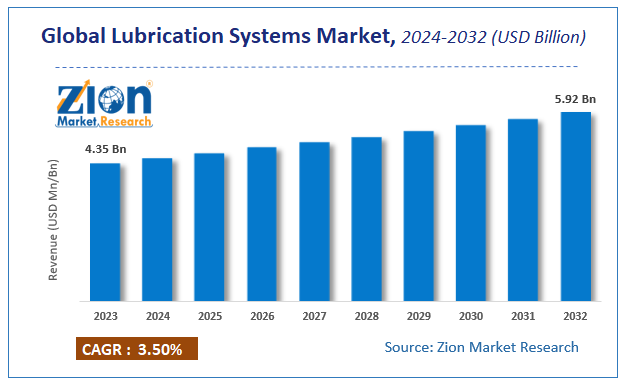
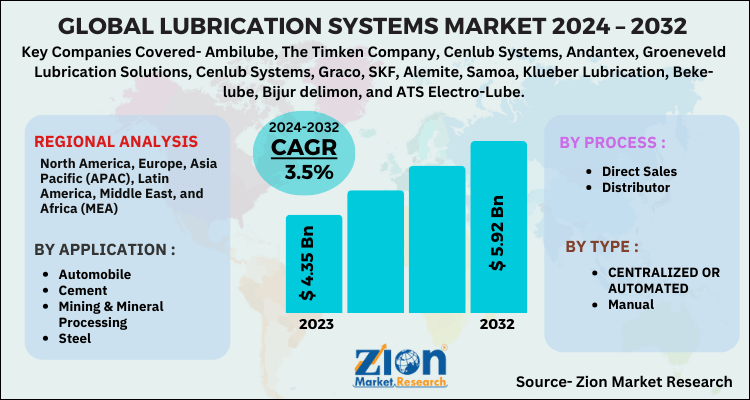
According to a report from Zion Market Research, the global lubrication systems market was valued at USD 4.35 billion in 2023 and is projected to hit USD 5.92 billion by 2032, with a compound annual growth rate (CAGR) of 3.5% during the forecast period 2024-2032.
This report provides a comprehensive analysis of the growth drivers, restraints, and challenges shaping demand across the global lubrication systems market throughout the forecast period, while highlighting high-potential emerging opportunities within the industry.
Key Insights
- According to our research analyst, the global Lubrication Systems market is estimated to grow at a CAGR of around 3.5% over the forecast period (2024-2032).
- In terms of revenue, the global Lubrication Systems market size was valued at around USD 4.35 billion in 2023 and is projected to reach USD 5.92 billion by 2032.
- The market is driven by the growing necessity to reduce friction between moving surfaces, improve machine reliability, and lower maintenance costs across industrial applications.
- Based on the Type, the Centralized or Automated systems segment is growing at a high rate and is projected to dominate the global market.
- Based on the Process, the Direct Sales segment held the largest market share in 2023 and is expected to grow at a significant rate over the forecast period
- Based on the Application, the Steel segment dominates with a significant share because lubrication is required at nearly every stage of steel production and processing
- By region, Asia Pacific is expected to dominate the global Lubrication Systems market with the largest regional share
Lubrication Systems Market: Overview
A lubrication system is a means by which oil, grease, and other lubricants are used between two rubbing surfaces to reduce friction, heat, and wear. Machines like manufacturing equipment, pumps, turbines, cutting tools, motors, pistons, bearings, cams, chains, and vehicles make use of lubrication systems to reduce the heat and friction generated; therefore, preventing from getting damaged. The lubricants used in the machines reduce the friction generated between the parts and thus increase the longevity of all the components. Lubrication system benefits in reducing the power consumption due to less friction, thus ensuring the safe operation of machinery, which, in turn, extends component life, reduces maintenance costs, and increases the overall productivity of the system.
The advancement of novel products, which includes synthetic lubricants coupled with easy availability are strong factor anticipated to fuel the lubrication systems market growth in upcoming years. In addition to this, growing industrialization and the rising automobile sector are also considered to be the major factors driving the lubrication systems market across the globe. Moreover, a rising trend for automated processes leads to the increasing demand for lubricants, which also influences the lubrication systems market during the forecast period. Rapid urbanization has also provoked market growth. However, lack of awareness among end-user industries regarding the new products can hamper the growth of the market.
Lubrication Systems Market: Growth Factors
What factors are primarily accelerating the expansion of the Lubrication Systems market?
Growing necessity for reducing friction between two moving surfaces will promote growth of the lubrication systems market over upcoming years. In addition to this, breakthroughs in technology resulting in the development of many monitoring & controlling tools are predicted to support lubrication of many machine parts, thereby driving market trends. Furthermore, lubrication systems help in improving reliability of machines and enhance their performance. Moreover, lubrication systems are used for reducing wear & tear of operating equipment. This is projected to create lucrative growth avenues for the lubrication systems market in years to come.
Lubrication Systems Market: Restraints
What challenges are limiting faster adoption of advanced Lubrication Systems?
A key restraint is the limited awareness among certain end-user industries regarding the benefits and availability of newer lubrication products and automated systems. This knowledge gap slows the transition from traditional manual methods to more efficient centralized solutions in some markets.
High initial investment costs associated with advanced automated systems can also deter smaller operators and facilities with constrained capital budgets. In addition, the need for skilled personnel to install, maintain, and optimize complex lubrication systems adds to operational barriers in regions with limited technical expertise.
Lubrication Systems Market: Report Scope
| Report Attributes | Report Details |
|---|---|
| Report Name | Lubrication Systems Market |
| Market Size in 2023 | USD 4.35 Billion |
| Market Forecast in 2032 | USD 5.92 Billion |
| Growth Rate | CAGR of 3.5% |
| Number of Pages | 220 |
| Key Companies Covered | Ambilube, The Timken Company, Cenlub Systems, Andantex, Groeneveld Lubrication Solutions, Cenlub Systems, Graco, SKF, Alemite, Samoa, Klueber Lubrication, Beke-lube, Bijur delimon, and ATS Electro-Lube, among others. |
| Segments Covered | By Type, By Process, By Application, and By Region |
| Regions Covered | North America, Europe, Asia Pacific (APAC), Latin America, Middle East, and Africa (MEA) |
| Base Year | 2023 |
| Historical Year | 2018 - 2022 |
| Forecast Year | 2024 - 2032 |
| Customization Scope | Avail customized purchase options to meet your exact research needs. Request For Customization |
Lubrication Systems Market: Segmentation
The lubrication systems market is segmented by type, process, application, and region.
Based on the type, the lubrication systems market is bifurcated into centralized or automated and manual. Centralized or Automated systems represent the most dominant sub-segment because they deliver precise, continuous lubrication to multiple points, significantly reducing human error, labor costs, and equipment downtime. These systems improve overall machine reliability and are increasingly preferred in high-volume manufacturing and heavy industrial environments.
On the basis of process, the market is bifurcated into direct sales and distributors. Direct Sales constitute the most dominant channel because large industrial customers and original equipment manufacturers prefer direct engagement with system providers for customized solutions, technical consultation, installation support, and long-term service agreements. This approach strengthens customer relationships and allows manufacturers to capture higher-value contracts.
Based on the application, the market is bifurcated into automobile, cement, mining & mineral processing, and steel. The Steel segment stands as the most dominant application because lubrication is essential at virtually every stage of steel production, from upstream processing to downstream finishing operations. Continuous operation under extreme loads and temperatures makes reliable lubrication critical for maintaining productivity and equipment longevity in steel plants.
Lubrication Systems Market: Regional Analysis
Why will Asia Pacific continue to dominate the global market during the projection period?
Growth of regional market over forecast timespan is owing to increase in use of passenger vehicles in sub-continent. In addition to this, Asia Pacific is the largest producer as well as consumer of cement, automotive, and steel. China is a major producer of paper and cement. This will contribute significantly towards regional market size in forecasting years. Presence of key manufacturing firms in the sub-continent is predicted to make humongous contributions towards growth of lubrication systems market in Asia Pacific zone. Strong infrastructure and rise in per capita income of population in sub-continent will drive regional market trends.
North America benefits from a mature industrial base, advanced manufacturing practices, and high emphasis on equipment reliability and predictive maintenance. The United States remains a key contributor, supported by ongoing investments in automation and strict operational standards that favor advanced lubrication solutions. Steady demand from automotive, aerospace, and general manufacturing sectors sustains regional growth.
Lubrication Systems Market: Competitive Players
Key players impacting growth of lubrication systems market and profiled in study are:
- Ambilube
- The Timken Company
- Cenlub Systems
- Andantex
- Groeneveld Lubrication Solutions
- Cenlub Systems
- Graco
- SKF
- Alemite
- Samoa
- Klueber Lubrication
- Beke-lube
- Bijur delimon
- ATS Electro-Lube
The global Lubrication Systems Market is segmented as follows:
By Type
- Centralized Or Automated
- Manual
By Process
- Direct Sales
- Distributor
By Application
- Automobile
- Cement
- Mining & Mineral Processing
- Steel
By Region
- North America
- The U.S.
- Canada
- Mexico
- Europe
- France
- The UK
- Spain
- Germany
- Italy
- Rest of Europe
- Asia Pacific
- China
- Japan
- India
- Australia
- South Korea
- Rest of Asia Pacific
- The Middle East & Africa
- Saudi Arabia
- UAE
- Egypt
- Kuwait
- South Africa
- Rest of the Middle East & Africa
- Latin America
- Brazil
- Argentina
- Rest of Latin America
Table Of Content
Methodology
FrequentlyAsked Questions
Lubrication systems are mechanisms designed to deliver lubricants, such as oil or grease, to machinery components to reduce friction, wear, and overheating. They are essential in industries like automotive, manufacturing, and aerospace to ensure smooth operation and prolong equipment life.
According to study, the Lubrication Systems Market size was worth around USD 4.35 billion in 2023 and is predicted to grow to around USD 5.92 billion by 2032.
The CAGR value of Lubrication Systems Market is expected to be around 3.5% during 2024-2032.
Asia Pacific has been leading the Lubrication Systems Market and is anticipated to continue on the dominant position in the years to come.
The Lubrication Systems Market is led by players like Ambilube, The Timken Company, Cenlub Systems, Andantex, Groeneveld Lubrication Solutions, Cenlub Systems, Graco, SKF, Alemite, Samoa, Klueber Lubrication, Beke-lube, Bijur delimon, and ATS Electro-Lube.
Key growth drivers include the growing necessity for reducing friction between two moving surfaces, technological breakthroughs resulting in monitoring and controlling tools, the need to improve machine reliability and performance, and rising industrialization along with expansion of the automobile sector.
The report provides a comprehensive analysis of market size, growth drivers, restraints, opportunities, segmentation by type, process, application, and region, competitive landscape, recent developments, and detailed forecasts to support strategic decision-making.

HappyClients