
Laboratory Plasticware Market Size, Growth, Global Trends, Forecast 2034

Laboratory Plasticware Market By Material (Polystyrene, High-Density Polyethylene (HDPE), Low-Density Polyethylene (LDPE), Polymethylpentene (PMP), Polyvinyl Chloride (PVC), and Others), By End-User (Pharmaceutical & Biotechnology Companies, Diagnostic Centers, Research & Academic Institutes, Hospitals, and Others), and By Region - Global and Regional Industry Overview, Market Intelligence, Comprehensive Analysis, Historical Data, and Forecasts 2025 - 2034
| Market Size in 2024 | Market Forecast in 2034 | CAGR (in %) | Base Year |
|---|---|---|---|
| USD 2.25 Billion | USD 2.99 Billion | 4.72% | 2024 |
Laboratory Plasticware Industry Perspective:
What will be the global laboratory plasticware market size during the forecast period?
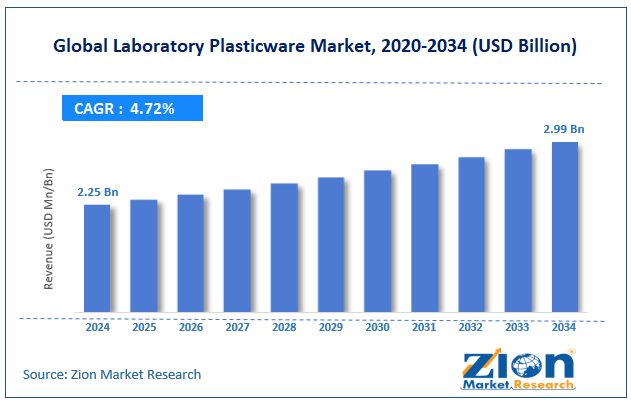
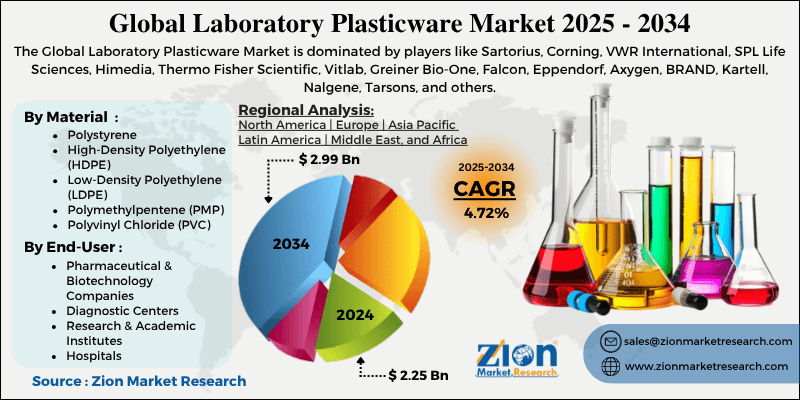
The global laboratory plasticware market size was worth around USD 2.25 billion in 2024 and is predicted to grow to around USD 2.99 billion by 2034, with a compound annual growth rate (CAGR) of roughly 4.72% between 2025 and 2034.
Key Insights:
- As per the analysis shared by our research analyst, the global laboratory plasticware market is estimated to grow annually at a CAGR of around 4.72% over the forecast period (2025-2034)
- In terms of revenue, the global laboratory plasticware market size was valued at around USD 2.25 billion in 2024 and is projected to reach USD 2.99 billion by 2034.
- The laboratory plasticware market is projected to grow at a significant rate due to the rising expansion of clinical and diagnostic centers worldwide.
- Based on the material, the low-density polyethylene (LDPE) segment is growing at a high rate and will continue to dominate the global market, as per industry projections
- Based on the end-user industry, the diagnostic centers segment is anticipated to command the largest market share
- Based on region, the Asia-Pacific is projected to dominate the global market during the forecast period
Laboratory Plasticware Market: Overview
Laboratory plasticware refers to the wide range of plastic-based containers and equipment used across scientific laboratories, such as research & development (R&D) facilities and diagnostic centers. They are used for conducting different laboratory-based operations, such as storing liquids, mixing, and transporting stored chemicals. Laboratory plasticware is of different types, including plastic beakers, reagent bottles, plastic cylinders, plastic flasks, test tubes, and wash bottles, among others. The global demand for laboratory plasticware is expected to continue growing, driven by several favorable factors. For instance, the expansion of clinical and diagnostic labs worldwide, along with growing R&D in the pharmaceutical industry, will propel the market demand rate.
Furthermore, growing investments in the development of sustainable and eco-friendly laboratory plasticware are expected to gain higher growth momentum during the projection period. However, rising concerns over the environmental impact of non-biodegradable plastic and competition from glass-based laboratory equipment may impede industry expansion trends in the future.
Laboratory Plasticware Market: Dynamics
Growth Drivers
How will the increased expansion of clinical and diagnostic settings influence the laboratory plasticware market growth?
The global laboratory plasticware market is expected to witness high growth due to the expansion of clinical and diagnostic centers worldwide. The rapidly evolving global health trends, including the growing prevalence of chronic medical conditions and rising cases of drug resistance among patients, have influenced the demand for more effective diagnostic laboratories. Furthermore, the evolving epidemiology of diseases and heightened transmission of infectious conditions have further propelled demand for clinical and diagnostic centers worldwide.
For instance, in September 2025, HealthTrackRx, a US-based leading provider of next-morning molecular diagnostic testing, announced the opening of its new campus at UPS Healthcare Labport facility in Louisville. The new unit, made with an investment of USD 45.5 million, has doubled the company’s testing capacity to 5 million patient samples annually. Laboratory plasticware is an essential element of all diagnostic and clinical centers, as it is used in the majority of the operations. The surge in the number of diagnostic centers will propel demand for efficient laboratory plasticware in the near future.
Emerging markets and their increased healthcare expenditure are expected to offer renewed growth to the industry players
Emerging markets such as Latin America, Asia-Pacific, and African countries are witnessing an accelerated increase in healthcare expenditure. The existing medical care infrastructure in these regions is failing to keep up with the mounting pressure due to the rising geriatric population, increased number of patients with serious illnesses, and general lack of adequate, quality medical care.
However, in recent times, emerging countries, along with regional governments and private players, have invested heavily in upgrading healthcare systems by launching new hospitals, clinical facilities, diagnostic centers, and R&D units. These investments are likely to fuel increased demand for products available in the global laboratory plasticware in the coming years.
Restraints
Why will environmental concerns limit the expansion of the laboratory plasticware market?
The global industry for laboratory plasticware is expected to be limited due to the rising concerns over the environmental impact of single-use plastic. According to the National Institutes of Health (NIH), more than 1.7 million tonnes of plastic waste are generated every year in the US from the healthcare sector alone. Similar statistics are observed in other parts of the world as well. The severe and irreversible environmental damage caused by non-biodegradable plastic has limited the adoption of plasticware across laboratory-based settings.
Opportunities
Will the introduction of eco-friendly plasticware create new growth opportunities for the laboratory plasticware market players?
The global laboratory plasticware market is expected to present growth opportunities as eco-friendly solutions gain traction. In April 2024, Eppendorf, a leading life science company focusing on laboratory instruments, announced the launch of bio-based Polymerase Chain Reaction (PCR) plates. The company has launched Twin.tec® Trace Plates made using biobased polymers. It is an automated, two-component, skirted, and semi-skirted PCR offering equipped with 96-well capacity.
Expansion of point-of-care testing and home-based medical care to open new avenues for extended growth
According to industry analysis, the rapid expansion of point-of-care testing and home-based or remote medical care facilities has widened the industry's expansion possibilities. The emergence of decentralized care models has created growth scope for companies providing highly durable, lightweight plasticware that remains contamination-free throughout the process and is easy to transport.
Challenges
Which challenges will glass-based equipment create for the laboratory plasticware market?
The global laboratory plasticware industry is expected to be challenged by the growing demand for glass-based equipment. These alternatives have superior chemical resistance compared to plasticware. Additionally, they are considered more sustainable and limit chemical interaction with the stored solution. The rising introduction of more effective laboratory glassware will fragment revenue for plastic-based components.
Laboratory Plasticware Market: Report Scope
| Report Attributes | Report Details |
|---|---|
| Report Name | Laboratory Plasticware Market |
| Market Size in 2024 | USD 2.25 Billion |
| Market Forecast in 2034 | USD 2.99 Bllion |
| Growth Rate | CAGR of 4.72% |
| Number of Pages | 224 |
| Key Companies Covered | Sartorius, Corning, VWR International, SPL Life Sciences, Himedia, Thermo Fisher Scientific, Vitlab, Greiner Bio-One, Falcon, Eppendorf, Axygen, BRAND, Kartell, Nalgene, Tarsons, and others. |
| Segments Covered | By Material, By End-User, and By Region |
| Regions Covered | North America, Europe, Asia Pacific (APAC), Latin America, Middle East, and Africa (MEA) |
| Base Year | 2024 |
| Historical Year | 2019 to 2023 |
| Forecast Year | 2025 - 2034 |
| Customization Scope | Avail customized purchase options to meet your exact research needs. Request For Customization |
Laboratory Plasticware Market: Segmentation
The global laboratory plasticware market is segmented based on material, end-user, and region.
Why does the low-density polyethylene segment lead the laboratory plasticware market?
Based on material, the global market is divided into polystyrene, high-density polyethylene (HDPE), low-density polyethylene (LDPE), polymethylphenate (PMP), polyvinyl chloride (PVC), and others. In 2024, around 29% of total revenue was attributed to the low-density polyethylene (LDPE) segment, driven by its greater versatility and broader use in laboratory settings. Furthermore, low-density polyethylene is more cost-effective than other materials, which will help influence segmental demand in the future.
Why will the diagnostic centers dominate the laboratory plasticware industry?
Based on end-user industry, the global market is divided into pharmaceutical & biotechnology companies, diagnostic centers, research & academic institutes, hospitals, and others. Around 37% of total revenue in 2024 was listed in the diagnostic centers. The growing demand for accurate diagnostic tests across the globe has influenced segmental dominance in the past and will continue to drive revenue in the coming years. The pharmaceutical & biotechnology companies segment is expected to generate an improved CAGR during the projection period.
Laboratory Plasticware Market: Regional Analysis
Why will Asia-Pacific lead the laboratory plasticware market during the forecast period?
The global laboratory plasticware market is expected to be led by Asia-Pacific during the forecast period with a CAGR of around 5.01%. The region dominated nearly 32.05% of global revenue in 2024, and similar trends may emerge during the projection period. Regional dominance results from multiple factors.
For instance, countries such as China and India are home to massive manufacturing infrastructure with high capacity to produce millions of pieces of plasticware for laboratory use every year. In addition, favorable government policies and increased domestic demand for efficient laboratory plastic will further help regional prominence in the coming years.
What position will North America hold in the laboratory plasticware industry?
North America is the second-highest revenue generator in the laboratory plasticware market during the forecast period. It is anticipated to deliver a CAGR of 4.61% during the projection period. The presence of a well-established clinical and diagnostic research architecture across the US and Canada will help accelerate regional revenue.
Additionally, increasing government pressure to maintain safety standards across research facilities and the rapid expansion of the regional pharmaceutical industry will aid in the increased CAGR being recorded in North America. The region is expected to see higher demand for eco-friendly and sustainable laboratory plasticware amid growing environmental consciousness.
Laboratory Plasticware Market: Competitive Analysis
The global laboratory plasticware market is led by players like:
- Sartorius
- Corning
- VWR International
- SPL Life Sciences
- Himedia
- Thermo Fisher Scientific
- Vitlab
- Greiner Bio-One
- Falcon
- Eppendorf
- Axygen
- BRAND
- Kartell
- Nalgene
- Tarsons
What are the key trends in the global laboratory plasticware market?
Smart laboratory plastic
End consumers are actively seeking laboratory plasticware that is compatible with automated laboratories. Smart plasticware equipped with technologies such as digital tracking and barcodes is preferred for its accuracy.
Customized solutions
An emerging trend in the laboratory plasticware industry is the increased use of customized solutions. The evolving demand and requirements of end buyers have created growth scope for plasticware with tailored sizes and features.
The global laboratory plasticware market is segmented as follows:
By Material
- Polystyrene
- High-Density Polyethylene (HDPE)
- Low-Density Polyethylene (LDPE)
- Polymethylpentene (PMP)
- Polyvinyl Chloride (PVC)
- Others
By End-User
- Pharmaceutical & Biotechnology Companies
- Diagnostic Centers
- Research & Academic Institutes
- Hospitals
- Others
By Region
- North America
- The U.S.
- Canada
- Mexico
- Europe
- France
- The UK
- Spain
- Germany
- Italy
- Rest of Europe
- Asia Pacific
- China
- Japan
- India
- Australia
- South Korea
- Rest of Asia Pacific
- The Middle East & Africa
- Saudi Arabia
- UAE
- Egypt
- Kuwait
- South Africa
- Rest of the Middle East & Africa
- Latin America
- Brazil
- Argentina
- Rest of Latin America
Table Of Content
Methodology
FrequentlyAsked Questions

HappyClients

