
Intelligent Process Orchestration (IPO) Market Size, Share, Trends, Growth 2034

Intelligent Process Orchestration (IPO) Market By Component (Platform/Software and Services), By Deployment Mode (On-Premises, Hybrid and Cloud-Based), By Application (IT Process Automation, Customer Support & Service Management, Business Process Management (BPM), Data & Analytics Integration, Workflow Automation and Regulatory Compliance & Risk Management), By Industry Vertical (Banking, Financial Services & Insurance (BFSI), Information Technology & Telecommunications, Healthcare & Life Sciences, Manufacturing, Retail & E-commerce, Energy & Utilities, Government & Public Sector and Others) and By Region - Global and Regional Industry Overview, Market Intelligence, Comprehensive Analysis, Historical Data, and Forecasts 2025 - 2034
| Market Size in 2024 | Market Forecast in 2034 | CAGR (in %) | Base Year |
|---|---|---|---|
| USD 9.2 Billion | USD 75.9 Billion | 23.5% | 2024 |
Intelligent Process Orchestration (IPO) Industry Perspective:
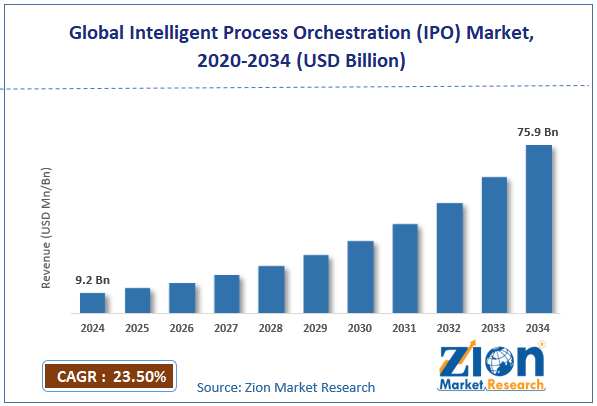
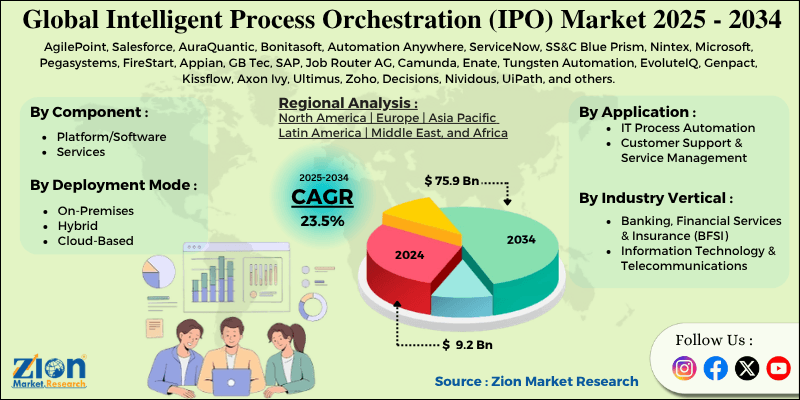
The global Intelligent Process Orchestration (IPO) market size was worth around USD 9.2 billion in 2024 and is predicted to grow to around USD 75.9 billion by 2034 with a compound annual growth rate (CAGR) of roughly 23.5% between 2025 and 2034.
Intelligent Process Orchestration (IPO) Market: Overview
What will be the size of the global Intelligent Process Orchestration (IPO) market during the forecast period?
The Intelligent Process Orchestration (IPO) is a sophisticated method used for automating, managing, and optimizing processes throughout organizations using technology. Intelligent Process Orchestration leverages AI, ML, RPA, BPM, workflow automation, and real-time analytics to automate processes and enable decision-making. As compared to conventional automation, the IPO differs because while the latter deals with automating simple tasks, the former allows coordination and management of complex processes, people, systems, and artificial intelligence in a unified way, resulting in efficient execution of work, increased efficiency, better customer experience, flexibility, and compliance. It is applied across sectors, including banking, healthcare, manufacturing, retail, telecommunications, and the government.
Key Insights
- As per the analysis shared by our research analyst, the global Intelligent Process Orchestration (IPO) market is estimated to grow annually at a CAGR of around 23.5% over the forecast period (2025-2034).
- In terms of revenue, the global Intelligent Process Orchestration (IPO) market size was valued at around USD 9.2 billion in 2024 and is projected to reach USD 75.9 billion by 2034.
- Increasing healthcare IT investments are expected to propel the Intelligent Process Orchestration (IPO) market over the projected period.
- Based on the component, the platform/software segment accounted for the largest revenue share in 2024.
- Based on the deployment mode, the cloud-based segment accounted for the largest revenue share in 2024.
- Based on the application, the IT process automation segment held the largest market share in 2024.
- Based on the industry vertical, the BFSI market segment is likely to see considerable revenue growth in the Intelligent Process Orchestration market.
- Based on region, North America led the Intelligent Process Orchestration (IPO) market in 2024.
Impact of the USA-Israel War on Iran on the Intelligent Process Orchestration (IPO) Market
The war between the USA-Israeli coalition and Iran has presented a mixed picture for Intelligent Process Orchestration (IPO) markets. First of all, geopolitical tensions, rising energy prices, inflationary pressures, and supply chain disruptions will lead some companies to reconsider investments in IT and digitalization projects. These factors increase operating expenses and make the deployment of new orchestration tools and automation initiatives less likely. In turn, this conflict revealed the necessity for organizations to operate their business with resilience, agility, and automation. In addition, the use of artificial intelligence to run processes can improve risk management and business continuity. Therefore, although there may be short-term obstacles to the development of this industry, long-term growth is expected to continue as interest in automation tools grows.
Intelligent Process Orchestration (IPO) Market: Dynamics
Growth Drivers
Why does the growing demand for end-to-end business process automation drive the Intelligent Process Orchestration (IPO) market?
The growing need for end-to-end automation of business processes drives the Intelligent Process Orchestration (IPO) market, as many businesses seek to automate their entire workflows rather than discrete tasks. The problem with traditional automation is that the software typically works in isolation and cannot be integrated into other business systems, leaving room for inefficiencies in process execution. The intelligent process orchestration platforms solve the aforementioned issues by merging together people, applications, AI-powered solutions, and automation software to create a comprehensive workflow that allows for coordinated actions of all organizational participants and, thus, helps organizations become more efficient by reducing manual intervention, cutting down on process delays, improving the precision of decisions, and accelerating overall decision-making. Businesses' digitalization efforts, desire to optimize costs, and a desire to provide better customer experience result in increased adoption in industries such as banking, healthcare, manufacturing, retail, and telecommunications.
Restraints
High Implementation and Integration Costs hamper the growth of the Intelligent Process Orchestration (IPO) industry
The high costs of adopting and integrating IPO solutions are a significant factor restraining the development of the Intelligent Process Orchestration (IPO) market. Indeed, implementing the technology may entail high costs, including the purchase of expensive software licenses, integration with various systems and data sources, and consultation and training. Some companies, such as small and medium businesses, may have trouble justifying these high expenditures in case there is no immediate return on investment. The difficulty of integrating technology into legacy systems and enterprise applications is also among the restraints of the IPO market.
Opportunities
Why does the increasing launch of innovative solution offer a lucrative opportunity for the Intelligent Process Orchestration (IPO) market?
The launch of innovative solution is expected to offer a lucrative opportunity to the Intelligent Process Orchestration (IPO) market over the projected period. For instance, in October 2025, Oracle launched the Oracle Intelligent Communications Orchestration Network Cloud Service. The cutting-edge technology allows users to significantly simplify their network configurations and management by combining separate communication networks into a single integrated network, with centralized network traffic and policies managed across voice services, collaboration tools, artificial intelligence, and other technologies operating in on-premises, cloud, or hybrid environments. Due to this development, enterprises and managed service providers can eliminate the complications and costs associated with establishing and maintaining mission-critical processes that require constant network connectivity. In particular, the tool will facilitate the operation of call centers where multiple systems coexist alongside real-time AI services.
Challenges
Why does the shortage of skilled automation and AI professionals pose a significant challenge to the Intelligent Process Orchestration (IPO) market?
There is a shortage of automation and AI professionals who can play a vital role in IPOs, as IPO success depends heavily on the capabilities of those who can effectively handle processes in artificial intelligence, machine learning, RPA, workflow design, data analysis, cloud computing, and business process management. The lack of such professionals may be problematic for organizations, as they cannot find enough people capable of successfully creating and managing IPO platforms. As a result, IPO projects will cost more money and time, involve hiring external experts who can make organizations dependent on them, and limit the full use of potential. Thus, IPOs will be delayed or reduced in number.
Intelligent Process Orchestration (IPO) Market: Report Scope
| Report Attributes | Report Details |
|---|---|
| Report Name | Intelligent Process Orchestration (IPO) Market |
| Market Size in 2024 | USD 9.2 Billion |
| Market Forecast in 2034 | USD 75.9 Billion |
| Growth Rate | CAGR of 23.5% |
| Number of Pages | 228 |
| Key Companies Covered | AgilePoint, Salesforce, AuraQuantic, Bonitasoft, Automation Anywhere, ServiceNow, SS&C Blue Prism, Nintex, Microsoft, Pegasystems, FireStart, Appian, GB Tec, SAP, Job Router AG, Camunda, Enate, Tungsten Automation, EvoluteIQ, Genpact, Kissflow, Axon Ivy, Ultimus, Zoho, Decisions, Nividous, UiPath, and others. |
| Segments Covered | By Component, By Deployment Mode, By Application, By Industry Vertical, and By Region |
| Regions Covered | North America, Europe, Asia Pacific (APAC), Latin America, Middle East, and Africa (MEA) |
| Base Year | 2024 |
| Historical Year | 2019 - 2023 |
| Forecast Year | 2025 - 2034 |
| Customization Scope | Avail customized purchase options to meet your exact research needs. Request For Customization |
Intelligent Process Orchestration (IPO) Market: Segmentation
Component Insights
Why does the platform/software dominate the Intelligent Process Orchestration (IPO) market?
The platform/software segment accounted for the largest revenue share in 2024. The growth is owing to the rising product launch with addition of AI drives the segment growth. For instance, in May 2025, at its Celonis: Next conference, Celonis, one of the world’s leading players in Process Mining, showed how its Process Intelligence (PI) software could help businesses achieve maximum returns on investments in enterprise AI implementations—something that will be essential in the future, when working with AI agents. As it would be impossible for people to operate without relevant information, does it follow that AI should know the business? Through improvements in its AgentC software, acquisitions of the Orchestration Engine, and many other upgrades, Celonis has shown how it can provide the information needed for the development of effective AI.
Deployment Mode Insights
How does the cloud-based segment capture the largest market share in the Intelligent Process Orchestration (IPO) market?
The cloud-based segment accounted for the largest revenue share in 2024. This is largely because of the increasing adoption of cloud computing and SaaS applications, along with organizations’ shift towards hybrid working. By using cloud-based IPO software, organizations can enjoy the advantages of lower initial infrastructure purchase costs, faster implementation, scalability, flexibility, and easy integration with artificial intelligence, analytics, and automation. More and more companies are transitioning to the cloud to coordinate their processes, including employees, teams, applications, and operations that are dispersed, while still maintaining real-time visibility.
Application Insights
Does the IT process automation segment capture the largest market share in the Intelligent Process Orchestration (IPO) market?
There would be substantial growth in revenues from the IT Process Automation category in the IPO market, as organizations become increasingly concerned about automating their IT operations, managing hybrid and multi-cloud environments, and improving the efficiency of service delivery. Companies are implementing IPO solutions to manage IT processes across applications, including incident management, infrastructure provisioning, application deployment, system monitoring, and cybersecurity response. The increasing complexity of the IT landscape and the desire for increased flexibility and quick problem resolution have been driving forces behind the growth of intelligent IT automation.
Industry Vertical Insights
Why does the Banking, Financial Services & Insurance (BFSI) segment capture the largest market share in the Intelligent Process Orchestration (IPO) market?
The BFSI market segment is likely to see considerable revenue growth in the Intelligent Process Orchestration market due to increased demand for efficiency, regulatory compliance, fraud prevention, and improved customer experience. The BFSI sector is implementing intelligent process orchestration solutions to automate and streamline complex tasks such as customer onboarding, loan processing, claims handling, risk analysis, compliance, AML, and transaction management. Growth in online transaction volume, increased use of AI-based banking services, and demand for real-time decision-making further fuel the need for workflow orchestration.
Regional Insights
Why does North America lead the Intelligent Process Orchestration (IPO) market?
It is expected that North America will generate substantial income from the IPO market, as several advanced technology vendors are available and high levels of automation across AI, RPA, and cloud computing are prevalent across industries. Besides, several firms across industries, including banking, healthcare, manufacturing, retail, and telecommunications, are adopting IPO platforms to automate and optimize their business operations. The adoption of the intelligent process orchestration platform is driven by factors such as advanced IT infrastructure and the use of hyper automation. Besides, the growing adoption of multi- and hybrid-cloud computing environments, combined with the rising demand for real-time decision-making and greater business flexibility, is driving the adoption of IPO platforms.
Intelligent Process Orchestration (IPO) Market: Competitive Analysis
The global Intelligent Process Orchestration (IPO) market is dominated by players like:
- AgilePoint
- Salesforce
- AuraQuantic
- Bonitasoft
- Automation Anywhere
- ServiceNow
- SS&C Blue Prism
- Nintex
- Microsoft
- Pegasystems
- FireStart
- Appian
- GB Tec
- SAP
- Job Router AG
- Camunda
- Enate
- Tungsten Automation
- EvoluteIQ
- Genpact
- Kissflow
- Axon Ivy
- Ultimus
- Zoho
- Decisions
- Nividous
- UiPath
The global Intelligent Process Orchestration (IPO) market is segmented as follows:
By Component
- Platform/Software
- Services
By Deployment Mode
- On-Premises
- Hybrid
- Cloud-Based
By Application
- IT Process Automation
- Customer Support & Service Management
- Business Process Management (BPM)
- Data & Analytics Integration
- Workflow Automation
- Regulatory Compliance & Risk Management
By Industry Vertical
- Banking, Financial Services & Insurance (BFSI)
- Information Technology & Telecommunications
- Healthcare & Life Sciences
- Manufacturing
- Retail & E-commerce
- Energy & Utilities
- Government & Public Sector
- Others
By Region
- North America
- The U.S.
- Canada
- Mexico
- Europe
- France
- The UK
- Spain
- Germany
- Italy
- Rest of Europe
- Asia Pacific
- China
- Japan
- India
- Australia
- South Korea
- Rest of Asia Pacific
- The Middle East & Africa
- Saudi Arabia
- UAE
- Egypt
- Kuwait
- South Africa
- Rest of the Middle East & Africa
- Latin America
- Brazil
- Argentina
- Rest of Latin America
Table Of Content
Methodology
FrequentlyAsked Questions
The Intelligent Process Orchestration (IPO) is a sophisticated method used for automating, managing, and optimizing processes throughout organizations using technology.
Key growth drivers for the Intelligent Process Orchestration (IPO) market include the rising demand for end-to-end business process automation, increasing adoption of AI and hyper automation technologies, growing digital transformation initiatives, and the need for improved operational efficiency and real-time decision-making across enterprises.
Major challenges restraining the growth of the Intelligent Process Orchestration (IPO) market include high implementation and integration costs, shortage of skilled automation and AI professionals, complexity of integrating legacy systems, data security and privacy concerns, and difficulties in managing governance and compliance requirements.
Based on the application, the IT Process Automation segment is expected to dominate the Intelligent Process Orchestration (IPO) market growth during the projected period.
Emerging trends and innovations impacting the Intelligent Process Orchestration (IPO) market include the integration of generative AI and agentic AI, expansion of hyperautomation initiatives, adoption of low-code/no-code orchestration platforms, increased use of predictive analytics and real-time decision intelligence, growth of cloud-native orchestration solutions, and the orchestration of multi-agent AI systems across enterprise workflows.
According to the report, the global Intelligent Process Orchestration (IPO) market size was worth around USD 9.2 billion in 2024 and is predicted to grow to around USD 75.9 billion by 2034.
The global Intelligent Process Orchestration (IPO) market is expected to grow at a CAGR of 23.5% during the forecast period.
The global Intelligent Process Orchestration (IPO) industry growth is expected to be led by North America over the forecast period.
The global Intelligent Process Orchestration (IPO) market is dominated by players like AgilePoint, Salesforce, AuraQuantic, Bonitasoft, Automation Anywhere, ServiceNow, SS&C Blue Prism, Nintex, Microsoft, Pegasystems, FireStart, Appian, GB Tec, SAP, Job Router AG, Camunda, Enate, Tungsten Automation, EvoluteIQ, Genpact, Kissflow, Axon Ivy, Ultimus, Zoho, Decisions, Nividous and UiPath among others.
The market report covers the geographical market along with a comprehensive competitive landscape analysis. It also includes cash flow analysis, profit ratio analysis, market basket analysis, market attractiveness analysis, sentiment analysis, PESTLE analysis, trend analysis, SWOT analysis, trade area analysis, demand & supply analysis, Porter’s five forces analysis, and value chain analysis.

HappyClients

