
Industrial Smart Sensors Market Size, Share, Value and Forecast 2034

Industrial Smart Sensors Market By Product (Flow Sensors, Touch Sensors, Position Sensors, Pressure Sensors, Temperature Sensors, Image Sensors and Motion, and Occupancy Sensors), By Application (Factory Automation, Consumer Electronics, Healthcare, Public Infrastructure, and Safety and Security), and By Region - Global and Regional Industry Overview, Market Intelligence, Comprehensive Analysis, Historical Data, and Forecasts 2025 - 2034
| Market Size in 2024 | Market Forecast in 2034 | CAGR (in %) | Base Year |
|---|---|---|---|
| USD 37.5 Billion | USD 121.7 Billion | 12.5% | 2024 |
Industrial Smart Sensors Industry Perspective:
What will be the size of the global industrial smart sensors market during the forecast period?
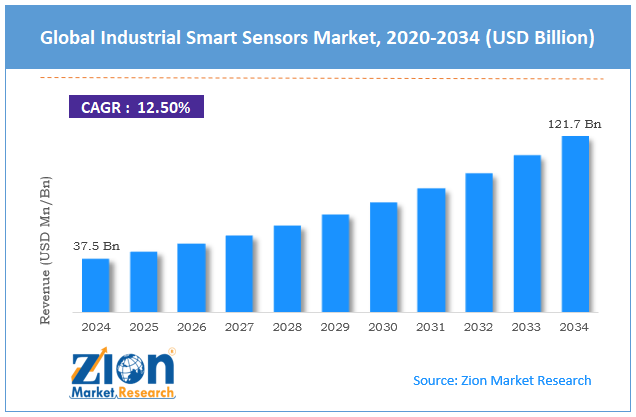
The global industrial smart sensors market size was worth around USD 37.5 billion in 2024 and is predicted to grow to around USD 121.7 billion by 2034 with a compound annual growth rate (CAGR) of roughly 12.5% between 2025 and 2034.
Key Insights
- As per the analysis shared by our research analyst, the global industrial smart sensors market is estimated to grow annually at a CAGR of around 12.5% over the forecast period (2025-2034).
- In terms of revenue, the global industrial smart sensors market size was valued at around USD 37.5 billion in 2024 and is projected to reach USD 121.7 billion by 2034.
- Advent of industry 4.0 is expected to drive the industrial smart sensors market.
- Based on the product, the pressure sensors generate the highest market share of 29% in 2024.
- Based on the application, factory automation dominates the industry growth.
- Based on region, North America captures the largest revenue share in 2024.
Industrial Smart Sensors Market: Overview
An Industry smart sensor is a type of smart sensor used in industrial applications, integrating sensing, signal conditioning, communication, and microcontrollers into a single modular sensor device. In addition to sensing physical sensors, including temperature, vibration, pressure, flow, level, proximity, humidity, or gas, the rest of the sensor provides embedded processing, communication, and diagnostics. Rather than just providing a signal, Industry smart sensors can be made self-calibrating, noise filtering, or fault detecting. These sensors can talk to a control system, cloud, or mobile edge device through wired or wireless communications. Industry smart sensors are one of the core components of Industry 4.0 and the Industrial Internet of Things (IIoT). They will be used for real-time monitoring, predictive maintenance, control, automation, process control, safety monitoring, and data collection in the manufacturing, energy, automotive, pharmaceutical, oil and gas, and logistics industries.
Industrial Smart Sensors Market: Dynamics
Growth Drivers
Why does the rapid growth of Industrial IoT (IIoT) stimulate the expansion of the industrial smart sensors market?
The emerging footprint of IIoT is rapidly fueling growth in the industrial smart sensors market, as they constitute the primary data-gathering layer of the connected industrial ecosystem. To be precise, IIoT involves the interconnection of machinery, production lines, utilities, and other industrial assets in real time to drive operational efficiency and productivity enhancements. However, the entire network infrastructure relies heavily on the quality and transparency of the data produced at the source to make the analytics meaningful.
More IIoT-based production and manufacturing plants are increasing demand for smart sensors across all equipment to provide digital measurements like pressure, temperature, flow, vibration, and light, which are then processed and sent to edge devices and advanced analytics/cloud systems. The rise in predictive maintenance, automation, digital twins, automated control, and data-driven decision support is quickly increasing the need for smart sensing devices. The widespread use of wireless communication and edge computing in IIoT networks clearly requires replacing old analog sensors with smart sensors that can do things like remote diagnostics and monitoring, perform calculations on-site, and self-calibrate. Accordingly, as IIoT is significantly scaling up across the petrochemical, manufacturing, power, water, and transport sectors worldwide, the utility of intelligent sensing devices is proportionally becoming popular.
Restraints
How do the high upfront costs & complex integration hamper the industrial smart sensors market's growth?
High initial costs and the complexity of integration act as barriers to the development of the industrial smart sensors market, as they increase the financial and operational requirements for investing in industrial smart sensors and for implementing the system. Deployment of industrial smart sensors involves not just purchasing the sensors; other costs include edge computing, gateways, cloud platforms, cybersecurity systems, software licensing, and higher-skilled system integrator services. Existing equipment is either replaced or retrofitted to work with other devices of the system. Other new equipment is purchased to ensure flexibility and future enhancements, which increases the initial capital cost and makes the ROI uncertain. Complexity of system integration pushes back the quick development of the market as technical challenges arise during the integration of heterogeneous systems: irregular, corporate, or outdated PLCs; SCADA platforms; and embedded communication protocols.
Opportunities
How does the rising company's facility expansion offer a potential opportunity for the industrial smart sensors market growth?
The strategic expansion by key market players offers a potential opportunity for the industrial smart sensors market over the projected period. For instance, in October 2025, OMRON, the world’s top industrial automation company, announced the inauguration of its new Automation Center in Bengaluru, marking a significant milestone in advancing its long-term vision for smart manufacturing in India. The center, which is a part of OMRON ‘s global network of 10 automation Centers and 34 Proof of Concept (POC) labs, is thoughtfully positioned to serve manufacturers in South India as well as the rest of India, including micro, small, and medium enterprises (MSMEs), to help them get ‘world-class inside India.'
The center includes an extensive lineup of automation demonstrations focused on manufacturing challenges, support for proof-of-concept development, and technical training for manufacturers, machine builders, and system integrators, in line with the Indian government’s manufacturing vision—Make in India and India Industry 4.0. This center clearly exemplifies the ever-growing India-Japan relationship by further strengthening the India-Japan Partnership in technology, talent, and resilient supply chains through the creation of more industry and technology alliances. With Japanese companies investing Rs 10 trillion (approximately $135 billion) over the next 10 years across sectors like semiconductors and digital industries, the Center will anchor the aligned endeavor to take India to the forefront of the strategic sunrise sector of smart manufacturing and innovation.
Challenges
Cybersecurity & data-privacy concerns pose a major challenge to the market growth
Cybersecurity, data privacy, and protection issues are barriers to the industry's growth in the industrial smart sensor market. Growth is hindered by the proliferation of industrial devices, increasing the likelihood of cyberattacks. Sensors integrated into IIoT/ICS environments continuously broadcast operational information received from sensors to run edge systems, cloud, or centrally operated control rooms. This proliferation of sensors connected to networks provides opportunities for cyberattacks, causing penetration of sensitive ICS networks, espionage, data interception, introduction of malware or ransomware, firmware modification, or operational systems and equipment disruption.
In industrial environments such as manufacturing, power plants, oil and gas, and transportation, the consequences of a cyberattack are downtime, damage to equipment, safety issues, penalties, outages, and costs. So, most businesses are reluctant to extend digital implementation or enhance smart sensor operations until cybersecurity practices are put in place. Moreover, industrial organizations are concerned about the security of the data collected.
Industrial Smart Sensors Market: Report Scope
| Report Attributes | Report Details |
|---|---|
| Report Name | Industrial Smart Sensors Market |
| Market Size in 2024 | USD 37.5 Billion |
| Market Forecast in 2034 | USD 121.7 Bllion |
| Growth Rate | CAGR of 12.5% |
| Number of Pages | 225 |
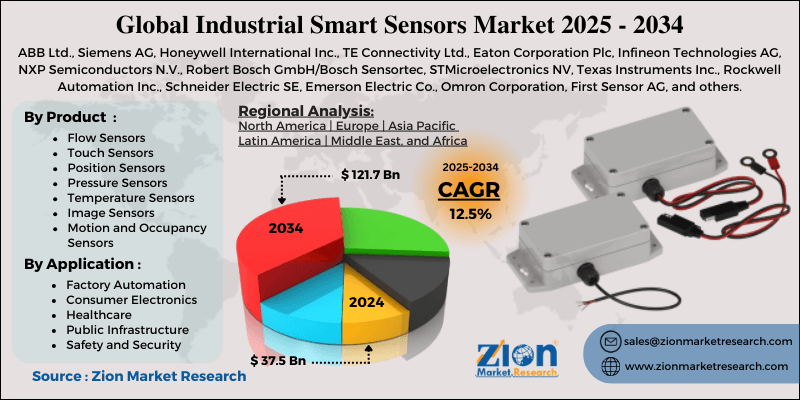
| Key Companies Covered | ABB Ltd., Siemens AG, Honeywell International Inc., TE Connectivity Ltd., Eaton Corporation Plc, Infineon Technologies AG, NXP Semiconductors N.V., Robert Bosch GmbH/Bosch Sensortec, STMicroelectronics NV, Texas Instruments Inc., Rockwell Automation Inc., Schneider Electric SE, Emerson Electric Co., Omron Corporation, First Sensor AG, and others. |
| Segments Covered | By Product, By Application, and By Region |
| Regions Covered | North America, Europe, Asia Pacific (APAC), Latin America, Middle East, and Africa (MEA) |
| Base Year | 2024 |
| Historical Year | 2019 to 2023 |
| Forecast Year | 2025 - 2034 |
| Customization Scope | Avail customized purchase options to meet your exact research needs. Request For Customization |
Industrial Smart Sensors Market: Segmentation
Product Insights
Why do pressure sensors hold the dominant position in the industrial smart sensors market?
The pressure sensors generate the highest market share of 29% in 2024. Pressure measurement plays a crucial role in monitoring pipelines, boilers, hydraulic systems, compressors, and storage tanks. As industries get smarter and start employing Industrial IoT (IIoT) platforms, traditional analog pressure instruments are being replaced by intelligent digital pressure transmitters at a faster pace, leading to faster segment revenue growth.
Application Insights
Why does factory automation hold the largest share in the industrial smart sensors industry?
The factory automation dominates the industry growth. Throughout the world, suppliers are rapidly transforming the manufacturing landscape to Industry 4.0 as they ramp up digitalization. With this, revenue generated from smart sensors in automated manufacturing settings is expected to continue growing at a healthy rate. Broader adoption of robotics, PLC, machine vision, automated material flow systems, and real-time monitoring platforms is all contributing to this expansion.
Smart sensors enable automation across manufacturing facilities and systems by allowing machinery to sense, measure, analyze, and respond without human intervention. With each increased degree of automation applied to a manufacturing line, there is a corresponding increase in the number of sensors per site, thus contributing positively to market revenue.
Regional Insights
Why does North America lead the industrial smart sensors market?
North America captures the largest revenue share in 2024. This strong growth is driven by extreme investments in IIoT build-up, early adoption of Industry 4.0-enabled solutions, and an emphasis on upgrading existing facilities in high-value-added manufacturing industries in North America, such as components for automobiles and aeronautics, oil & gas, pharmaceuticals, food processing, and power generation. To ensure more efficient use of production capacity, plant operators update and upgrade their plants with automation and real-time monitoring solutions, creating an increase in demand for intelligent sensors such as motion, pressure, vibration, and temperature monitors.
Industrial Smart Sensors Market: Competitive Analysis
The global industrial smart sensors market is dominated by players like:
- ABB Ltd.
- Siemens AG
- Honeywell International Inc.
- TE Connectivity Ltd.
- Eaton Corporation Plc
- Infineon Technologies AG
- NXP Semiconductors N.V.
- Robert Bosch GmbH/Bosch Sensortec
- STMicroelectronics NV
- Texas Instruments Inc.
- Rockwell Automation Inc.
- Schneider Electric SE
- Emerson Electric Co.
- Omron Corporation
- First Sensor AG
The global industrial smart sensors market is segmented as follows:
By Product
- Flow Sensors
- Touch Sensors
- Position Sensors
- Pressure Sensors
- Temperature Sensors
- Image Sensors
- Motion and Occupancy Sensors
By Application
- Factory Automation
- Consumer Electronics
- Healthcare
- Public Infrastructure
- Safety and Security
By Region
- North America
- The U.S.
- Canada
- Mexico
- Europe
- France
- The UK
- Spain
- Germany
- Italy
- Rest of Europe
- Asia Pacific
- China
- Japan
- India
- Australia
- South Korea
- Rest of Asia Pacific
- The Middle East & Africa
- Saudi Arabia
- UAE
- Egypt
- Kuwait
- South Africa
- Rest of the Middle East & Africa
- Latin America
- Brazil
- Argentina
- Rest of Latin America
Table Of Content
Methodology
FrequentlyAsked Questions

HappyClients

