
Home Ventilator Market Size, Share, Trends, Growth and Forecast 2034

Home Ventilator Market By Type (Invasive Ventilators and Non-Invasive Ventilators), By Mode (Pressure-Controlled, Volume-Controlled, and Hybrid), By Application (Chronic Obstructive Pulmonary Disease, Sleep Apnea, Neuromuscular Disorders, Post-Acute Care, and Others), and By Region – Global and Regional Industry Overview, Market Intelligence, Comprehensive Analysis, Historical Data, and Forecasts 2025 - 2034-
| Market Size in 2024 | Market Forecast in 2034 | CAGR (in %) | Base Year |
|---|---|---|---|
| USD 3.42 Billion | USD 7.99 Billion | 12.77% | 2024 |
Home Ventilator Industry Perspective:
What will be the size of the global home ventilator market during the forecast period?
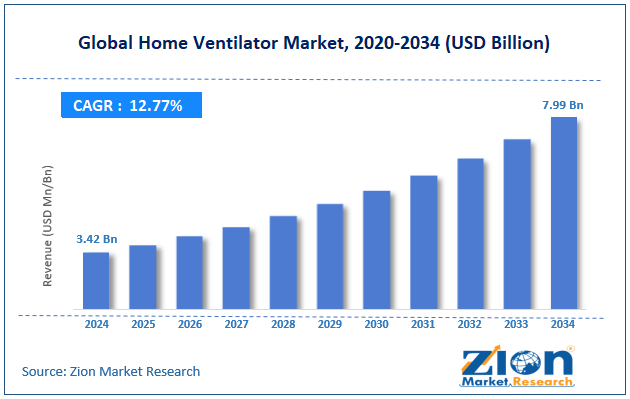
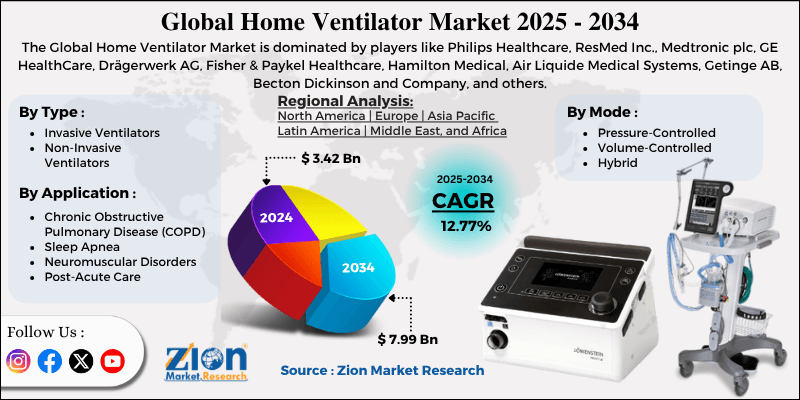
The global home ventilator market size was worth around USD 3.42 billion in 2024 and is predicted to grow to around USD 7.99 billion by 2034, with a compound annual growth rate (CAGR) of roughly 12.77% between 2025 and 2034.
Key Insights:
- As per the analysis shared by our research analyst, the global NAME market is estimated to grow annually at a CAGR of around 12.77% over the forecast period (2025-2034)
- In terms of revenue, the global NAME market size was valued at around USD 3.42 billion in 2024 and is projected to reach USD 7.99 billion by 2034.
- The home ventilator market is projected to grow at a significant rate due to the growing worldwide burden of chronic respiratory disease (COPD, asthma, and sleep apnea.
- Based on the type, the non-invasive ventilators segment is growing at a high rate and will continue to dominate the global market, as per industry projections
- Based on the application, the chronic obstructive pulmonary disease (COPD) segment is anticipated to command the largest market share
- Based on region, North America is projected to dominate the global market during the forecast period
Home Ventilator Market: Overview
Ventilators designed for non-hospitalized patients are used to provide respiratory support or replace spontaneous breathing in severe respiratory insufficiency by delivering O₂ via a controlled flow of air into the lungs. The use of home ventilators enables patients to receive long-term ventilation in the comfort of their own homes. The increased emphasis on healthcare delivery in the home setting has led to the development of smaller, more user-friendly ventilators with advanced monitoring capabilities. Further enhancements to battery life, noise reduction, interoperability, and adaptive ventilation modes for home ventilators have created a viable option for pregnant women and those recovering from an ICU stay to receive respiratory therapy at home rather than in an expensive, hospital-based environment. Home ventilators are mostly used for patients suffering from chronic pulmonary disorders, recovering from the ICU, suffering from a neuromuscular physical disorder, or experiencing sleep apnea.
During the forecast period, the demand for home ventilators will continue to grow as healthcare organizations seek to contain costs and encourage patients to consider alternative means of receiving treatment, such as home ventilators.
Home Ventilator Market: Dynamics
Growth Drivers
How will the rising prevalence of chronic respiratory diseases drive the home ventilator market?
The global home ventilator market is projected to grow due to the growing worldwide burden of chronic respiratory disease (COPD, asthma, and sleep apnea. The aging population, combined with the issues related to unhealthy lifestyles, such as tobacco use and environmental pollution, is a significant contributor to the need for increased long-term respiratory care.
Home mechanical ventilators enable individuals to manage chronic health conditions at home, thereby lowering hospitalization costs as well as increasing the overall quality of life for those individuals. As demand for home-scenario continuous respiratory support grows, there has been increasing adoption of home mechanical ventilation devices in both the developing world and developed countries.
Growing preference for home healthcare and remote patient monitoring to influence industry demand
Countries around the world are moving toward greater use of home-based healthcare services to lower hospitalization and treatment costs. With remotely monitored home ventilators, healthcare providers can monitor patients' performance, adjust ventilators' settings, and respond to potential issues without requiring multiple visits to hospitals. As telehealth and digital connection capabilities have improved, the solutions available in the global home ventilators market have become increasingly important for longitudinal patient management, resulting in additional growth opportunities in this market.
Restraints
Why will device costs and reimbursement limitations restrict home ventilator market growth?
The global home ventilator industry is expected to be limited due to the high price of home ventilators and their accessories. It is a major obstacle against home ventilator adoption, especially in lower- and middle-income areas of the world. Also, the lack of reimbursement for home ventilation therapy in some healthcare systems negatively impacts patient access to home ventilators. The devices require continual maintenance and ongoing technical support. Such costs add to the total cost of ownership and may slow market penetration in those markets that have price-sensitive consumers.
Opportunities
How are technological advancements in portable and smart ventilators are creating novel growth opportunities for the home ventilator industry?
The global home ventilator market is expected to benefit from sustained advances in portable and smart, lightweight ventilators, opening significant growth opportunities for manufacturers in this area. Manufacturers are now developing products with adaptive ventilation modes, battery life improvements, and cloud data monitoring to help enhance patient comfort and compliance. In 2025, various manufacturers launched next-generation home ventilation systems that incorporate AI technology to automatically adjust pressures and provide improved alarm functionality. These new technologies will allow for increased usage amongst a wider variety of patients in the future.
Challenges
Clinical complexity and patient compliance to affect market expansion
The global home ventilator industry is projected to be challenged by clinical complexity and lack of patient compliance. In order for home ventilation therapy to work correctly, there must be an accurate device setup, as well as an educated patient and some form of ongoing support. A lack of adherence by patients or improper use by carers can complicate treatment and reduce the benefit to the patient. Research indicates that, due to differences in age and severity of conditions, there is variability in patient needs; therefore, this creates challenges for achieving uniformity among patients. The manufacturers should provide clinical training to their staff as well as customize their devices to help alleviate these issues.
Home Ventilator Market: Report Scope
| Report Attributes | Report Details |
|---|---|
| Report Name | Home Ventilator Market |
| Market Size in 2024 | USD 3.42 Billion |
| Market Forecast in 2034 | USD 7.99 Bllion |
| Growth Rate | CAGR of 12.77% |
| Number of Pages | 225 |
| Key Companies Covered | Philips Healthcare, ResMed Inc., Medtronic plc, GE HealthCare, Drägerwerk AG, Fisher & Paykel Healthcare, Hamilton Medical, Air Liquide Medical Systems, Getinge AB, Becton Dickinson and Company, and others. |
| Segments Covered | By Type, By Mode, By Application, and By Region |
| Regions Covered | North America, Europe, Asia Pacific (APAC), Latin America, Middle East, and Africa (MEA) |
| Base Year | 2024 |
| Historical Year | 2019 to 2023 |
| Forecast Year | 2025 - 2034 |
| Customization Scope | Avail customized purchase options to meet your exact research needs. Request For Customization |
Home Ventilator Market: Segmentation
The global home ventilator market is segmented based on type of ventilator, mode of ventilation, type of application, and region.
Why does the non-invasive ventilators segment lead the home ventilator market?
Based on type, the global home ventilator market is divided into invasive ventilators and non-invasive ventilators. In 2024, the highest growth was recorded in the non-invasive ventilators segment, as these devices offer greater patient comfort. Some of the prominent advantages of non-invasive ventilators include precise oxygen delivery, better carbon dioxide management, and reliable airway control. The segment will continue to lead in the coming years.
Based on mode, the global home ventilator industry is divided into pressure-controlled, volume-controlled, and hybrid.
Why does chronic obstructive pulmonary disease lead the home ventilator industry?
Based on application, the global market is divided into chronic obstructive pulmonary disease, sleep apnea, neuromuscular disorders, post-acute care, and others. In 2024, chronic obstructive pulmonary disease (COPD) emerged as the highest revenue generator. It will continue to be the dominant application segment due to the growing number of people with chronic respiratory diseases across the globe.
Home Ventilator Market: Regional Analysis
Why will North America dominate the home ventilator market during the forecast period?
According to current estimates, North America will be the prevailing area for the global home ventilator market during the forecast period with a CAGR of more than 5.91%. Regional revenue will be driven by a strong healthcare system, a high level of awareness of diseases and conditions, and a greater number of favorable reimbursement programs that support this region's high level of home ventilation package use compared with other countries globally. Additionally, the growing presence of some of the leading providers of advanced home ventilators may further help the region ensure sustained growth.
What position will Asia Pacific hold in the home ventilator industry?
Asia-Pacific is expected to emerge as the fastest-growing region in the home ventilator market in the coming years, with a CAGR of 15.92%. The rising healthcare expenditure across major Asian countries, along with an ageing population, will aid regional expansion. Additionally, rising access to home healthcare services will facilitate a higher CAGR in the Asia-Pacific as compared to other regions. In the last few years, awareness around the importance of early diagnosis and preventive care, along with the expansion of diagnostic infrastructure, may further propel the regional revenue to new heights.
Home Ventilator Market: Competitive Analysis
The global home ventilator market is led by players such as:
- Philips Healthcare
- ResMed Inc.
- Medtronic plc
- GE HealthCare
- Drägerwerk AG
- Fisher & Paykel Healthcare
- Hamilton Medical
- Air Liquide Medical Systems
- Getinge AB
- Becton Dickinson and Company
What are the key trends in the global home ventilator market?
Decentralized care
A promising trend driving the demand for home ventilators is the growing acceptance of decentralized care. Community-based care models are gaining rapid momentum, creating demand for home ventilators.
Digitally advanced ventilators
The last few years have seen an increase in the production of digitally advanced ventilators equipped with data analytics and remote monitoring. This helps elevate the quality of medical care given to the patients.
The global home ventilator market is segmented as follows:
By Type
- Invasive Ventilators
- Non-Invasive Ventilators
By Mode
- Pressure-Controlled
- Volume-Controlled
- Hybrid
By Application
- Chronic Obstructive Pulmonary Disease (COPD)
- Sleep Apnea
- Neuromuscular Disorders
- Post-Acute Care
- Others
By Region
- North America
- The U.S.
- Canada
- Mexico
- Europe
- France
- The UK
- Spain
- Germany
- Italy
- Rest of Europe
- Asia Pacific
- China
- Japan
- India
- Australia
- South Korea
- Rest of Asia Pacific
- The Middle East & Africa
- Saudi Arabia
- UAE
- Egypt
- Kuwait
- South Africa
- Rest of the Middle East & Africa
- Latin America
- Brazil
- Argentina
- Rest of Latin America
Table Of Content
Methodology
FrequentlyAsked Questions

HappyClients