
Global HEOR Services Market Size, Share, Growth, Opportunities, and Forecasts 2034

HEOR Services (Health Economics and Outcomes Research) Market By Service Type (Real World Evidence Studies, Cost Effectiveness Analysis, Systematic Literature Review, Patient Reported Outcomes Research, Budget Impact Modeling), By Therapeutic Area (Oncology, Cardiovascular Disorders, Neurological Conditions, Immunology and Rare Diseases, Infectious Diseases), By End-User (Pharmaceutical and Biotechnology Companies, Medical Device Manufacturers, Government and Regulatory Agencies, Payers and Insurance Providers), By Service Provider (In House Research Teams, Contract Research Organizations, Specialized Health Economics Consultancies, Academic Research Partnerships), and By Region - Global and Regional Industry Overview, Market Intelligence, Comprehensive Analysis, Historical Data, and Forecasts 2026 - 2034
| Market Size in 2025 | Market Forecast in 2034 | CAGR (in %) | Base Year |
|---|---|---|---|
| USD 1.5 Billion | USD 5.32 Billion | 15.10% | 2025 |
HEOR Services Industry Perspective:
What will be the size of the HEOR services market during the forecast period?
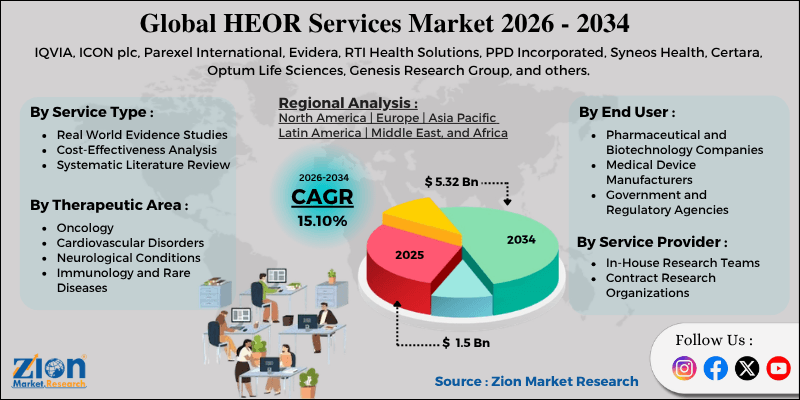
The global HEOR services market size was valued at approximately USD 1.5 billion in 2025 and is projected to reach around USD 5.32 billion by 2034, growing at a compound annual growth rate of approximately 15.10% between 2026 and 2034.
-market.png)
Key Insights
- As per the analysis shared by our research team, the global HEOR services market is estimated to grow at a compound annual growth rate of approximately 15.10% during the forecast period from 2026 to 2034.
- In terms of revenue, the global HEOR services market was valued at approximately USD 1.5 billion in 2025 and is projected to reach USD 5.32 billion by 2034.
- The HEOR services market is expected to grow strongly due to rising drug development costs, stricter reimbursement requirements from payers, growing use of real-world data, and increasing pressure on pharmaceutical companies to prove the economic value of their products.
- Based on service type, real-world evidence studies lead the market because payers and regulators increasingly demand proof of how treatments perform outside clinical trial settings, while patient-reported outcomes research is gaining strong momentum as patient experience becomes central to treatment evaluation.
- Based on therapeutic area, oncology leads the market due to the high cost of cancer treatments requiring strong economic justification. At the same time, neurological conditions are the fastest-growing segment because of rising prevalence and expensive emerging therapies.
- Based on end-user, pharmaceutical and biotechnology companies lead the market due to their constant need for evidence to support product launches, while payers and insurance providers are steadily increasing their own use of HEOR research to guide coverage decisions.
- Based on service provider, specialized health economics consultancies lead the market because they offer deep expertise and dedicated resources that many companies prefer not to build internally.
- Based on region, North America leads the global HEOR services market, while the Asia Pacific is the fastest-growing region due to expanding pharmaceutical research activity and growing regulatory sophistication.
HEOR Services Market: Overview
Health Economics and Outcomes Research (HEOR) is a research approach that evaluates the clinical, economic, and real-world value of medicines, medical devices, and healthcare treatments. It helps healthcare companies, governments, insurers, and hospitals understand whether a treatment improves patient health while providing good value for its cost. Instead of only measuring how well a treatment works, HEOR also examines treatment costs, quality of life, patient outcomes, and how it compares with other available therapies. HEOR services include real-world evidence studies, cost-effectiveness analysis, budget impact analysis, systematic literature reviews, and patient-reported outcomes research. These studies help decision-makers make informed choices about drug approvals, reimbursement, pricing, and healthcare policies.
As healthcare costs continue to rise worldwide, organizations increasingly rely on HEOR to ensure that new treatments deliver both clinical benefits and economic value. Pharmaceutical companies and medical device manufacturers now integrate HEOR strategies early in product development to support regulatory submissions, market access, and reimbursement decisions. Growing demand for value-based healthcare, evidence-based decision-making, and cost-effective treatment options has made HEOR an essential part of the global healthcare and life sciences industry, supporting better patient care and more efficient healthcare spending.
The HEOR services industry is expanding steadily as healthcare organizations increasingly rely on strong economic evidence to guide pricing, reimbursement, and treatment decisions.
Impact of the USA-Israel War on Iran on the HEOR Services Market
The HEOR services market may experience minor short-term disruptions in cross-border research collaborations and data collection activities due to ongoing geopolitical tensions involving the United States, Israel, and Iran. However, most HEOR work is conducted through digital platforms and global research networks that are less dependent on physical supply chains, which limits the overall impact. Continued demand for value-based healthcare evidence and increasing outsourcing of research work by pharmaceutical companies are expected to keep supporting the market's long-term expansion.
HEOR Services Market: Technology Roadmap 2026–2034
What is the projected development roadmap of the HEOR services market over the forecast period?
The HEOR services market is advancing through greater use of artificial intelligence in data analysis, expanded access to real-world data sources, more standardized research methods, and growing integration of patient-generated data, making health economics research faster and more precise. The market is expected to grow at a compound annual growth rate of approximately 15.10% over the forecast period, driven by accelerating demand from payers, developing global reimbursement frameworks, and continuous refinement of research methodologies and digital data collection tools.
The following roadmap outlines key development phases expected through 2034.
2026–2028: Digital Transformation and Methodology Standardization Phase
- Artificial intelligence and machine learning tools are expected to speed up literature reviews, data extraction, and statistical modeling, reducing the time needed to complete complex health economics studies.
- Research organizations are expected to develop more standardized frameworks for real-world evidence collection, making study results more comparable and trustworthy across different markets.
- Growing partnerships between pharmaceutical companies and specialized research firms are expected to strengthen early-stage health economics planning during drug development.
2029–2032: Real World Data Maturity and Expanded Global Adoption Phase
- Real-world data collection is expected to become a standard part of every major drug launch, helping companies build stronger cases for reimbursement and pricing in multiple countries at once.
- Growing acceptance of digital health records and wearable device data is expected to give researchers richer information about how treatments perform in everyday patient life.
- Integration of patient-reported outcomes with clinical and economic data is expected to improve treatment value assessments and support more personalized care decisions.
2033–2034: Predictive Analytics and Value-Based Healthcare Phase
- HEOR services are expected to expand into predictive modeling that forecasts long-term treatment outcomes and costs before therapies even reach the market.
- Cloud-based research platforms are expected to make advanced health economics tools accessible to smaller biotechnology companies and research institutions with limited budgets.
- Fully integrated evidence generation systems are expected to combine clinical trial results, real-world data, and economic modeling into a single continuous research process, supporting faster regulatory and reimbursement decisions worldwide.
HEOR Services Market: Dynamics
Growth Drivers
What is driving growth in the HEOR services market as demand for value-based evidence rises?
The HEOR services market is growing rapidly as healthcare systems worldwide focus on paying for treatments based on the value they provide rather than only their clinical effectiveness. Governments, insurance providers, and healthcare organizations increasingly require strong evidence that new medicines and medical devices improve patient outcomes and offer good value for their cost. This has encouraged pharmaceutical and medical device companies to invest in Health Economics and Outcomes Research early in the product development process. Rising costs of developing innovative therapies, especially for cancer, rare diseases, and chronic conditions, have further increased the need for cost-effectiveness studies and real-world evidence. The growing use of electronic health records, insurance claims databases, patient registries, and digital health data is also helping researchers generate more reliable insights. Many countries are introducing stricter reimbursement policies that require economic and clinical evidence before approving new treatments for public healthcare programs.
As healthcare spending continues to rise, demand for value-based healthcare, evidence-based decision-making, and affordable treatment options is increasing. These factors are driving the need for advanced HEOR services, supporting better healthcare decisions, improved patient outcomes, and sustainable healthcare spending worldwide.
Growing pressure from payers and regulators to prove treatment value is driving the HEOR services market.
The HEOR services market is growing as health insurance companies, government healthcare programs, and regulatory agencies become more selective about approving and paying for new treatments. They now require strong evidence showing how well a treatment works, its long-term costs, and how it compares with existing therapies. This is increasing demand for Health Economics and Outcomes Research services across the healthcare industry. Pharmaceutical and medical device companies are investing in HEOR early in product development or partnering with specialized research firms to generate the required evidence before product launches.
In many countries, new medicines and medical technologies cannot receive reimbursement without clear cost-effectiveness studies, budget impact analyses, and real-world evidence. HEOR also helps companies support product pricing, strengthen market access, and remain competitive as new treatments enter the market. As governments focus on reducing healthcare costs and improving patient outcomes, demand for value-based healthcare and evidence-based decision-making continues to grow.
Restraints
Shortage of skilled professionals and high research costs remain significant barriers in the HEOR services market.
The HEOR services industry faces several challenges that may slow its growth. One of the biggest challenges is the shortage of skilled professionals with expertise in healthcare, economics, statistics, and data analysis. Finding experts with knowledge in all these areas is difficult, increasing the cost of hiring or outsourcing research projects. Smaller pharmaceutical, biotechnology, and medical device companies often struggle to afford detailed HEOR studies because of limited budgets. Another challenge is that reimbursement requirements and healthcare regulations vary across countries, requiring companies to prepare different economic evaluations for each market. This increases both time and development costs. Strict data privacy regulations can also limit access to real-world patient data, making research more complex.
In addition, collecting accurate and high-quality healthcare data remains a challenge in many regions. Despite these obstacles, advancements in automation, artificial intelligence, digital health technologies, and standardized research methods are helping simplify HEOR processes. Growing investments in workforce training and data analytics are also expected to improve research quality and make HEOR services more accessible in the coming years.
Opportunities
How are expanding therapeutic applications and emerging markets creating opportunities in the HEOR services market?
The HEOR services market offers significant growth opportunities as healthcare systems worldwide increasingly require strong evidence of treatment value before approving reimbursement for new therapies. Pharmaceutical and medical device companies are investing more in HEOR to demonstrate the clinical, economic, and real-world benefits of their products. In oncology, HEOR studies help show how new cancer treatments improve survival rates, quality of life, and overall healthcare value compared with existing therapies. In rare diseases and neurological disorders, cost-effectiveness analyses are becoming essential because treatment costs are often very high. Growing demand for patient-centered healthcare is also increasing the use of patient-reported outcomes to understand treatment impact on daily life better. Emerging economies such as China, India, Brazil, and several Middle Eastern countries are expanding healthcare infrastructure, improving reimbursement systems, and increasing investments in evidence-based healthcare.
At the same time, advances in artificial intelligence, real-world evidence, data analytics, and digital health technologies are making HEOR services faster, more accurate, and affordable. These developments are creating new opportunities for research providers while supporting better healthcare decisions, improved patient outcomes, and sustainable healthcare spending worldwide.
Challenges
What challenges does the HEOR services market face in sustaining growth and achieving widespread adoption?
The HEOR services market faces several challenges that may slow its growth. One major issue is the lack of globally accepted standards for conducting and reporting health economics studies, making it difficult to compare research findings across different countries and regulatory agencies. Companies also face pressure to complete HEOR studies quickly to match fast-paced drug development timelines, even though high-quality research requires careful planning and detailed analysis. Limited access to reliable real-world data remains another challenge, especially in developing countries where digital health records and data systems are still evolving. Smaller healthcare organizations and biotechnology companies may also hesitate to invest in HEOR because of limited budgets and uncertainty about its long-term benefits.
In addition, intense competition among HEOR service providers creates pricing pressure and reduces profit margins. Despite these challenges, rising demand for value-based healthcare, real-world evidence, and advanced digital technologies is expected to drive the steady growth of the HEOR services market.
HEOR Services (Health Economics and Outcomes Research) Market: Report Scope
| Report Attributes | Report Details |
|---|---|
| Report Name | HEOR Services (Health Economics and Outcomes Research) Market |
| Market Size in 2025 | USD 1.5 Billion |
| Market Forecast in 2034 | USD 5.32 Billion |
| Growth Rate | CAGR of 15.10% |
| Number of Pages | 228 |
| Key Companies Covered | IQVIA, ICON plc, Parexel International, Evidera, RTI Health Solutions, PPD Incorporated, Syneos Health, Certara, Optum Life Sciences, Genesis Research Group, and others. |
| Segments Covered | By Service Type, By Therapeutic Area, By End User, By Service Provider, and By Region |
| Regions Covered | North America, Europe, Asia Pacific (APAC), Latin America, Middle East, and Africa (MEA) |
| Base Year | 2025 |
| Historical Year | 2020 to 2024 |
| Forecast Year | 2026 - 2034 |
| Customization Scope | Avail customized purchase options to meet your exact research needs. Request For Customization |
HEOR Services Market: Segmentation
The global HEOR services market is segmented by service type, therapeutic area, end user, service provider, and region.
What makes real-world evidence studies the dominant service type in the HEOR services market?
Based on service type, the global HEOR services market is divided into real-world evidence studies, cost-effectiveness analysis, systematic literature review, patient-reported outcomes research, and budget impact modeling. Real-world evidence studies hold about 32% of the market share, leading because payers and regulators increasingly rely on data collected from actual patient use rather than controlled clinical trial settings alone. Patient-reported outcomes research holds around a 21% share. It is among the fastest-growing segments due to increasing focus on how treatments affect patients' daily lives and overall well-being.
How does oncology maintain its leading position in the HEOR services market?
Based on therapeutic area, the HEOR services market is classified into oncology, cardiovascular disorders, neurological conditions, immunology and rare diseases, and infectious diseases. Oncology accounts for approximately 29% of the global market share, driven by the extremely high cost of cancer treatments, which require detailed justification for pricing and reimbursement. Neurological conditions hold around a 22% share. It is the fastest-growing segment due to rising cases of conditions such as Alzheimer's disease and the arrival of costly new treatment options.
What makes pharmaceutical companies the dominant end users in the HEOR services market?
Based on end-user, the market is segregated into pharmaceutical and biotechnology companies, medical device manufacturers, government and regulatory agencies, and payers and insurance providers. Pharmaceutical and biotechnology companies lead with about a 58% share because they consistently need strong evidence to support new product approvals and pricing negotiations. Payers and insurance providers hold around a 20% share. They are growing steadily as they build their own internal research capabilities to evaluate treatments independently.
How do specialized consultancies shape the service provider landscape of the HEOR services market?
Based on service provider, the HEOR services industry is categorized into in-house research teams, contract research organizations, specialized health economics consultancies, and academic research partnerships. Specialized health economics consultancies account for about 41% of the market, leading because they offer focused expertise, dedicated staff, and proven methodologies that many companies find more efficient than building large internal teams. Contract research organizations hold around a 27% share. They are expanding steadily as they add health economics capabilities alongside their existing clinical trial services.
HEOR Services Market: Regional Analysis
Why is North America leading the global HEOR services market?
The North American HEOR services market leads the global market and is expected to grow at a CAGR of around 9.1% during the forecast period. The region holds the largest market share because of its advanced healthcare system, strong pharmaceutical industry, and increasing focus on value-based healthcare. The United States dominates the regional market due to the presence of leading pharmaceutical, biotechnology, and medical device companies that invest heavily in Health Economics and Outcomes Research to support pricing, reimbursement, and market access decisions.
Health insurance providers, government healthcare programs, and regulatory agencies increasingly require cost-effectiveness studies and real-world evidence before approving new treatments. Canada also plays an important role through its well-established health technology assessment processes, which emphasize economic evidence for public healthcare funding. Mexico is gradually expanding its HEOR capabilities as healthcare infrastructure improves and global life sciences companies increase investments in the country. The availability of advanced healthcare databases, electronic health records, skilled research professionals, and strong data analytics capabilities further strengthens the regional market. Rising adoption of real-world evidence, growing demand for evidence-based healthcare decisions, supportive regulatory policies, and continuous investments in healthcare innovation are expected to drive long-term growth across North America.
What makes Asia Pacific the fastest-growing region in the HEOR services market?
The Asia Pacific HEOR services market is one of the fastest-growing regional markets and is expected to grow at a CAGR of around 11.4% during the forecast period. The region is expanding rapidly because of increasing healthcare spending, a growing pharmaceutical industry, and rising demand for value-based healthcare decisions. China leads the regional market due to its expanding pharmaceutical sector, government initiatives to improve healthcare affordability, and increasing use of health economics evidence in reimbursement decisions. Japan is another key market, supported by its aging population, high healthcare expenditure, and well-established health technology assessment framework for evaluating new treatments.
South Korea is also witnessing steady growth as its national health insurance system increasingly requires cost-effectiveness studies and real-world evidence before approving reimbursement. India offers strong long-term growth opportunities because of its expanding pharmaceutical and biotechnology industries, rising clinical research activities, and growing interest in evidence-based healthcare policies. Australia, Singapore, Thailand, Indonesia, and other emerging economies are also strengthening their HEOR capabilities through healthcare reforms, digital health investments, and improved reimbursement systems. Increasing adoption of real-world evidence, supportive government policies, and continuous investments in healthcare innovation are expected to drive sustained growth across the Asia Pacific region.
Recent Market Developments
- In June 2026, Certara was reappointed by the European Medicines Agency (EMA) and the European Center for Disease Prevention and Control (ECDC) under a four-year framework agreement to generate real-world evidence supporting regulatory decision-making, strengthening its capabilities in pharmacoepidemiology, HEOR, and market access services.
HEOR Services Market: Competitive Analysis
The leading players in the global HEOR services market are:
- IQVIA
- ICON plc
- Parexel International
- Evidera
- RTI Health Solutions
- PPD Incorporated
- Syneos Health
- Certara
- Optum Life Sciences
- Genesis Research Group
The global HEOR services market is segmented as follows:
By Service Type
- Real World Evidence Studies
- Cost-Effectiveness Analysis
- Systematic Literature Review
- Patient Reported Outcomes Research
- Budget Impact Modeling
By Therapeutic Area
- Oncology
- Cardiovascular Disorders
- Neurological Conditions
- Immunology and Rare Diseases
- Infectious Diseases
By End User
- Pharmaceutical and Biotechnology Companies
- Medical Device Manufacturers
- Government and Regulatory Agencies
- Payers and Insurance Providers
By Service Provider
- In-House Research Teams
- Contract Research Organizations
- Specialized Health Economics Consultancies
- Academic Research Partnerships
By Region
- North America
- The U.S.
- Canada
- Mexico
- Europe
- France
- The UK
- Spain
- Germany
- Italy
- Rest of Europe
- Asia Pacific
- China
- Japan
- India
- Australia
- South Korea
- Rest of Asia Pacific
- The Middle East & Africa
- Saudi Arabia
- UAE
- Egypt
- Kuwait
- South Africa
- Rest of the Middle East & Africa
- Latin America
- Brazil
- Argentina
- Rest of Latin America
Table Of Content
Methodology
FrequentlyAsked Questions
Health Economics and Outcomes Research (HEOR) is a research approach that evaluates the clinical, economic, and real-world value of medicines, medical devices, and healthcare treatments. It helps healthcare companies, governments, insurers, and hospitals understand whether a treatment improves patient health while providing good value for its cost.
The global HEOR services market is expected to grow due to rising drug development costs, stricter payer reimbursement requirements, growing availability of real-world data, and increasing government demand for proof of treatment value before providing coverage.
According to research, the global HEOR services market was valued at approximately USD 1.5 billion in 2025 and is projected to reach approximately USD 5.32 billion by 2034.
The compound annual growth rate of the HEOR services market is expected to be approximately 15.10% from 2026 to 2034.
North America is expected to lead the global HEOR services market throughout the forecast period, driven by its complex reimbursement system, strong pharmaceutical industry presence, and well-established demand for economic evidence from insurers and regulators.
The major players in the global HEOR services market include IQVIA, ICON plc, Parexel International, Evidera, RTI Health Solutions, PPD Incorporated, Syneos Health, Certara, Optum Life Sciences, and Genesis Research Group.
The report examines key aspects of the HEOR services market, including growth drivers, adoption barriers, therapeutic application opportunities, competitive landscape dynamics, detailed regional market performance analysis, and a comprehensive forward-looking outlook across all major service types, therapeutic areas, end user segments, service providers, and geographic regions through 2034.
The HEOR services market offers strong investment opportunities in real-world evidence, artificial intelligence-driven analytics, digital health data platforms, and value-based healthcare solutions. Partnerships between pharmaceutical companies, contract research organizations, technology providers, and healthcare institutions are expanding to improve evidence generation and market access.
The HEOR services market is highly competitive, with global contract research organizations, consulting firms, data analytics companies, and specialized HEOR providers competing through advanced analytics, real-world evidence capabilities, regulatory expertise, strategic partnerships, and comprehensive end-to-end research services.
The HEOR services market is being shaped by artificial intelligence, machine learning, real-world evidence, predictive analytics, patient-reported outcomes, and digital health data integration. These innovations are improving evidence generation, accelerating reimbursement decisions, and supporting value-based healthcare worldwide.

List of Contents
HEOR ServicesIndustry Perspective:Key InsightsHEOR Services OverviewHEOR Services Technology Roadmap 20262034HEOR Services Dynamics Research) Report ScopeHEOR Services SegmentationHEOR Services Regional AnalysisRecent Market DevelopmentsThe global HEOR services market is segmented as follows:HappyClients

