
Healthcare Education Solutions Market Size, Share, Value and Forecast 2034

Healthcare Education Solutions Market By Delivery (Classroom-based and E-learning), By Application (Cardiology, Neurology, Pediatrics, Radiology, and Others), By End-User (Physician and Non-physician), and Region - Global and Regional Industry Overview, Market Intelligence, Comprehensive Analysis, Historical Data, and Forecasts 2026 - 2034
| Market Size in 2025 | Market Forecast in 2034 | CAGR (in %) | Base Year |
|---|---|---|---|
| USD 8.9 Billion | USD 17.5 Billion | 7.80% | 2025 |
Healthcare Education Solutions Industry Perspective:
What will be the size of the global healthcare education solutions market during the forecast period?
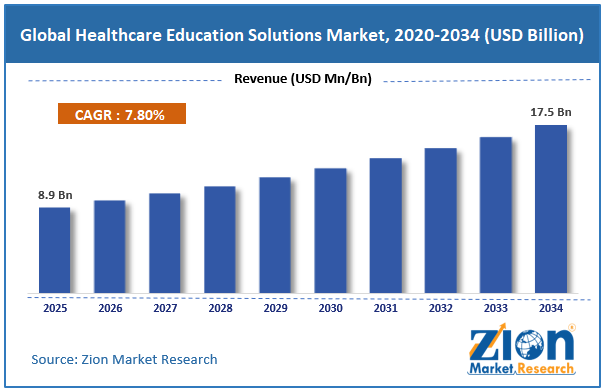
The global healthcare education solutions market size was worth around USD 8.9 billion in 2025 and is predicted to grow to around USD 17.5 billion by 2034, with a compound annual growth rate (CAGR) of roughly 7.8% between 2026 and 2034.
Key Insights
- As per the analysis shared by our research analyst, the global healthcare education solutions market is estimated to grow annually at a CAGR of around 7.8% over the forecast period (2026-2034).
- In terms of revenue, the global healthcare education solutions market size was valued at around USD 8.9 billion in 2025 and is projected to reach USD 17.5 billion by 2034.
- Rapid adoption of digital learning platforms is expected to propel the healthcare education solutions market over the projected period.
- Based on the delivery, the classroom-based segment held the largest revenue share in 2025 of 68%.
- Based on the application, the radiology segment holds a majority of market share in 2025.
- Based on the end-user, the physician segment holds a majority of market share in 2025.
- Based on region, North America dominates the healthcare education solutions market with a revenue share of 39% in 2025.
Healthcare Education Solutions Market: Overview
Healthcare education solutions are an aggregate of digital products, services, simulators, software, learning management systems (LMS), and curriculum management systems used to train, educate, and provide ongoing professional development to healthcare professionals, medical students, nurses, caregivers, and patients. It includes solutions for undergraduate medical education, continuing education, and clinical skills training, as well as compliance, patient education, and various certifications through classroom, online, blended, simulation-based, and virtual training modes. In short, healthcare education solutions aim to improve the clinical knowledge, competency, and proficiency of students, practitioners, caregivers, and patients to enhance healthcare delivery and outcomes.
Impact of the USA-Israel War on Iran on the Healthcare Education Solutions Market
The healthcare education solutions market is unlikely to be directly impacted by the conflict between the US, Israel, and Iran. The region-specific education market may see a short-term decrease in demand due to reduced government spending and investment during periods of geopolitical unrest. Nevertheless, the indirect impact of the conflict on the healthcare education solutions market is likely to be positive as it creates an increased need for training healthcare professionals in emergency preparedness, disaster management, telemedicine, and related fields. Therefore, the overall healthcare education solutions market is expected to remain resilient despite the indirect impact of the geopolitical conflict between the abovementioned countries.
Healthcare Education Solutions Market: Dynamics
Growth Drivers
How does the growing demand for skilled healthcare professionals drive the healthcare education solutions market?
The increasing demand for medical professionals is one of the key factors driving growth in the healthcare education solutions market. The growing prevalence of chronic illnesses, an aging population, the development of the healthcare industry, and the rising number of patients are propelling the need for medical professionals and nursing personnel. Healthcare education solutions offer academic institutions, hospitals, and universities critical insight into the best ways of training medical professionals. These solutions also facilitate the professional development of pharmacists, doctors, nurses, and other healthcare professionals through enhanced training and technological competencies. Healthcare education solutions play a critical role in ensuring healthcare professionals are well-trained and acquire the necessary technical know-how to offer their services. As a result, these solutions play a fundamental role in promoting the long-term growth of the healthcare industry and the market under consideration.
Restraints
Why do data privacy and cybersecurity concerns act as a major restraint to the healthcare education solutions industry's growth?
Data privacy and cybersecurity concerns are a major restraint to the healthcare education solutions market, as such platforms handle sensitive information such as student records, faculty resources, examination results, clinical training details, and sometimes patient data relevant to the healthcare education program. The transition to cloud-based learning management systems, virtual simulation software, and AI-driven healthcare training tools increases the risk of ransomware, cyberattacks, data leaks, and unauthorized access to sensitive information. Healthcare organizations must also meet strict data privacy regulations like HIPAA and GDPR, which increases the cost of using such systems while presenting additional administrative and infrastructural challenges. As a result, many hospitals, medical institutions, and smaller education-specific organizations are deterred from investing in healthcare education solutions due to the additional expenditures and liabilities that come with it.
Opportunities
How does the launch of an innovative product by the key market players offer a lucrative opportunity for the healthcare education solutions market?
The introduction of an innovative product is expected to offer a potential opportunity to the healthcare education solutions market over the projected period. For instance, in August 2025, FDB (First Databank, Inc.), the leading provider of drug knowledge that helps healthcare professionals make precise medication decisions, announced the launch of its Meducation® Bedside Solution, a streamlined medication education tool integrated directly into the electronic medication administration record (MAR). Based on FDB’s industry-leading Meducation® patient education solution for inpatient discharge, pharmacy and ambulatory settings, Meducation Bedside has been optimized for inpatient bedside care.
The solution equips nurses with immediate access to patient-focused medication information required to deliver important first dose education to every patient during their hospital stay, in accordance with The Joint Commission and Centers for Medicare & Medicaid Services (CMS) requirements. The medication education information—presented at a 5th- to 8th-grade reading level, in more than 30 languages, and in scalable font sizes—is designed to reduce the burden on frontline nurses while enhancing patient comprehension and satisfaction. The tool transforms a once manual and time-consuming process into a seamless, in-workflow experience.
Challenges
Shortage of skilled faculty and technical expertise poses a significant threat to the growth of the healthcare education solutions industry
The healthcare education solutions market faces a significant challenge due to inadequate faculty skills and technical expertise. Digital learning platforms, AI-driven education tools, virtual simulations, and advanced training solutions require experienced personnel to operate, manage, and implement effectively. Medical colleges, hospitals, and training centers often struggle to attract and retain qualified educators and specialists who can teach and train students using modern technologies.
Moreover, the shortage of IT professionals to maintain and support advanced systems reduces the adoption of innovative solutions and causes underperformance of healthcare education technologies. Insufficient faculty skills and technical expertise impede progress in the global healthcare education solutions market.
Healthcare Education Solutions Market: Report Scope
| Report Attributes | Report Details |
|---|---|
| Report Name | Healthcare Education Solutions Market |
| Market Size in 2025 | USD 8.9 Billion |
| Market Forecast in 2034 | USD 17.5 Billion |
| Growth Rate | CAGR of 7.8% |
| Number of Pages | 228 |
| Key Companies Covered | 3M Co., Erbe Elektromedizin GmbH, Canon Inc., B.Braun SE, Becton Dickinson and Co., Boston Scientific Corp., Bruker Corp., General Electric Co., FUJIFILM Holdings Corp., Johnson and Johnson Services Inc., Koninklijke Philips NV, Medtronic Plc, Perkin Elmer Inc., Siemens AG, Stryker Corp., Smith and Nephew plc, Thermo Fisher Scientific Inc., Zimmer Biomet Holdings Inc., and others. |
| Segments Covered | By Delivery, By Application, By End-User, and By Region |
| Regions Covered | North America, Europe, Asia Pacific (APAC), Latin America, Middle East, and Africa (MEA) |
| Base Year | 2025 |
| Historical Year | 2020 to 2024 |
| Forecast Year | 2026 - 2034 |
| Customization Scope | Avail customized purchase options to meet your exact research needs. Request For Customization |
Healthcare Education Solutions Market: Segmentation
Delivery Insights
Why does the classroom-based segment hold a prominent position in the healthcare education solutions market?
The classroom-based segment held the largest revenue share of the healthcare education solutions industry in 2025, at 68%. The growth of the medical education market has been attributed to the provision of quality services in classroom-based medical instruction, instructor training, and clinical skills development. Medical schools, nursing schools, and healthcare training institutions worldwide offer classroom-based education and training programs where students interact directly with faculty members to better understand anatomy, physiology, pharmacology, and other pertinent skills. Classroom-based education facilitates the attainment of cognitive and psychomotor skills and abilities through direct and collaborative learning, practice, and demonstration in a controlled environment.
As such, classroom-based education and training programs are often supplemented with lecture-based talks, simulations, and lab skills practice sessions. The need for classroom-based education is further complemented by accreditation and licensing requirements for clinical practice and skills acquisition. These factors contribute to the growth of the medical education market as providers continue to generate substantial revenues from classroom-based programs despite the proliferation of digital media and hybrid solutions.
Application
How does the radiology segment capture the largest share in the healthcare education solutions market?
The radiology segment holds a majority of the healthcare education solutions market share in 2025. The growth is attributed to high demand for qualified personnel in the field and rapid technological advances in diagnostic imaging. The rising adoption of digital radiography, computed tomography (CT), magnetic resonance imaging (MRI), ultrasound, and artificial intelligence-enabled imaging is further driving demand for education and training to build stronger skill sets. Healthcare education companies offer radiologists, technologists, and students practical and interactive training modules, virtual simulations and labs, case studies, and image interpretation sessions to improve their skills in the field.
End-User
How does the physician segment capture the largest share in the healthcare education solutions market?
The physician segment holds a majority of the healthcare education solutions market share in 2025. The growth is attributed to the need for medical education, clinical skills development, and certification throughout a physician’s career. Medical practice requires physicians to constantly update their skills through continued medical education, simulations, and online platforms for accreditation. Solutions to healthcare education are needed in developing countries since they provide access to evidence-based learning, virtual patient models, and artificial intelligence solutions, which enhance accurate diagnosis and treatment.
Regional Insights
What factors drive the North America region in the healthcare education solutions market?
North America dominates the healthcare education solutions market with a revenue share of 39% in 2025. The growth of the healthcare market in the region is attributed to a highly developed healthcare infrastructure and investment in the education and training of medical professionals. The region’s network of premier medical institutions, cutting-edge research facilities, and hospitals offers a fertile ground for clinicians to receive quality training and gain exposure to diverse medical practices.
In addition to world-class medical education and training environments, healthcare education in the region benefits from generous public and private investment in medical education. Moreover, the need for continued medical education and maintenance of licensure also contributes to the growth of the healthcare market in the region.
Healthcare Education Solutions Market: Competitive Analysis
The global healthcare education solutions market is dominated by players like:
- 3M Co.
- Erbe Elektromedizin GmbH
- Canon Inc.
- B.Braun SE
- Becton Dickinson and Co.
- Boston Scientific Corp.
- Bruker Corp.
- General Electric Co.
- FUJIFILM Holdings Corp.
- Johnson and Johnson Services Inc.
- Koninklijke Philips NV
- Medtronic Plc
- Perkin Elmer Inc.
- Siemens AG
- Stryker Corp.
- Smith and Nephew plc
- Thermo Fisher Scientific Inc.
- Zimmer Biomet Holdings Inc.
The global healthcare education solutions market is segmented as follows:
By Delivery
- Classroom-based
- E-learning
By Application
- Cardiology
- Neurology
- Pediatrics
- Radiology
- Others
By End-User
- Physician
- Non-physician
By Region
- North America
- The U.S.
- Canada
- Mexico
- Europe
- France
- The UK
- Spain
- Germany
- Italy
- Rest of Europe
- Asia Pacific
- China
- Japan
- India
- Australia
- South Korea
- Rest of Asia Pacific
- The Middle East & Africa
- Saudi Arabia
- UAE
- Egypt
- Kuwait
- South Africa
- Rest of the Middle East & Africa
- Latin America
- Brazil
- Argentina
- Rest of Latin America
Table Of Content
Methodology
FrequentlyAsked Questions
Healthcare education solutions are an aggregate of digital products, services, simulators, software, learning management systems (LMS), and curriculum management systems used to train, educate, and provide ongoing professional development to healthcare professionals, medical students, nurses, caregivers, and patients.
The healthcare education solutions market is primarily driven by the growing demand for skilled healthcare professionals, increasing adoption of digital learning platforms, and rising emphasis on continuing medical education (CME) and professional certification. Advancements in simulation technologies, artificial intelligence (AI), virtual reality (VR), and cloud-based learning management systems are enhancing the quality and accessibility of medical training.
The healthcare education solutions market faces several challenges, including the high cost of implementing and maintaining advanced digital learning platforms and simulation technologies, which can limit adoption among smaller institutions. Data privacy and cybersecurity concerns, integration complexities with existing healthcare IT systems, and limited digital infrastructure in developing regions further restrain market growth.
Based on the application, the radiology segment is expected to dominate the healthcare education solutions market growth during the projected period.
Emerging trends in the healthcare education solutions market include the increasing adoption of artificial intelligence (AI) for personalized learning, virtual reality (VR) and augmented reality (AR) for immersive clinical training, and high-fidelity simulation technologies for hands-on skill development. Cloud-based learning management systems, mobile learning platforms, and adaptive e-learning solutions are improving accessibility and flexibility for healthcare professionals.
According to the report, the global healthcare education solutions market size was worth around USD 8.9 billion in 2025 and is predicted to grow to around USD 17.5 billion by 2034.
The global healthcare education solutions market is expected to grow at a CAGR of 7.8% during the forecast period.
The global healthcare education solutions industry growth is expected to be led by North America over the forecast period.
The global healthcare education solutions market is dominated by players like 3M Co., Erbe Elektromedizin GmbH, Canon Inc., B.Braun SE, Becton Dickinson and Co., Boston Scientific Corp., Bruker Corp., General Electric Co., FUJIFILM Holdings Corp., Johnson and Johnson Services Inc., Koninklijke Philips NV, Medtronic Plc, Perkin Elmer Inc., Siemens AG, Stryker Corp., Smith and Nephew plc, Thermo Fisher Scientific Inc., and Zimmer Biomet Holdings Inc., among others.
The healthcare education solutions market report covers the geographical market along with a comprehensive competitive landscape analysis. It also includes cash flow analysis, profit ratio analysis, market basket analysis, market attractiveness analysis, sentiment analysis, PESTLE analysis, trend analysis, SWOT analysis, trade area analysis, demand & supply analysis, Porter’s five forces analysis, and value chain analysis.

HappyClients

