
Green Preservatives Market Size, Growth, Global Trends, Forecast 2034

Green Preservatives Market By Type (Organic Acid, Natural Extracts, Fermentation-Based Preservatives, and Others), By Form (Liquid, Powder, and Granules), By Application (Pharmaceutical, Cosmetic & Personal Care, Food & Beverages, and Others), and By Region - Global and Regional Industry Overview, Market Intelligence, Comprehensive Analysis, Historical Data, and Forecasts 2026 - 2034
| Market Size in 2025 | Market Forecast in 2034 | CAGR (in %) | Base Year |
|---|---|---|---|
| USD 1.48 Billion | USD 3.71 Billion | 10.78% | 2025 |
Green Preservatives Industry Perspective:
What is the anticipated size of the green preservatives market during the projection period?
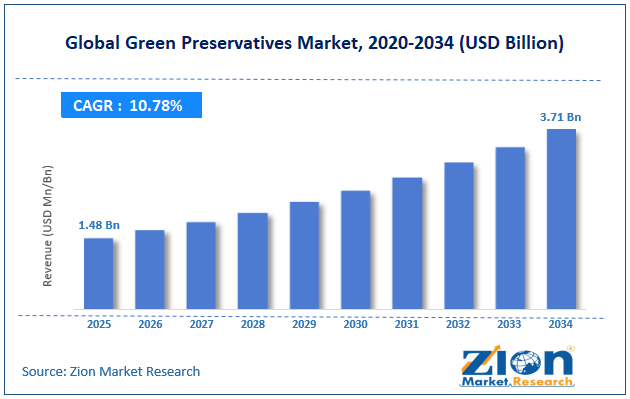
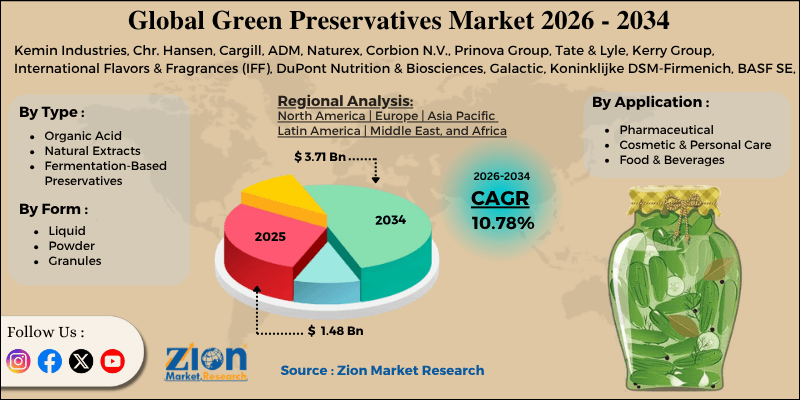
The global green preservatives market size was worth around USD 1.48 billion in 2025 and is predicted to grow to around USD 3.71 billion by 2034, with a compound annual growth rate (CAGR) of roughly 10.78% between 2026 and 2034.
Key Insights:
- As per the analysis shared by our research analyst, the global green preservatives market is estimated to grow annually at a CAGR of around 10.78% over the forecast period (2026-2034)
- In terms of revenue, the global green preservatives market size was valued at around USD 1.48 billion in 2025 and is projected to reach USD 3.71 billion by 2034.
- The green preservatives market is projected to grow at a significant rate due to the rising demand for organic goods.
- Based on the type, the organic acid segment is growing at a high rate and will continue to dominate the global market as per industry projections.
- Based on the form, the powder segment is anticipated to command the largest market share.
- Based on region, Europe is projected to dominate the global market during the forecast period.
Green Preservatives Market: Overview
Green preservatives are eco-friendly variants of their synthetic counterparts. They are used for extending the shelf life of a product, ranging from cosmetic care to pharmaceutical items. Green preservatives are designed to fight against microbial growth without using chemical elements. Some of the most prominent benefits of green preservatives include higher consumer safety, eco-friendliness, and health advantages. Natamycin, nisin, rosemary extract, vinegar, essential oils, and tocopherols are some examples of green preservatives with applications across industries. During the forecast period, demand for green preservatives will be led by the growing popularity of organic food and consumer goods. In addition, strict regulations governing synthetic preservatives will aid accelerated market growth. However, the high cost of green preservatives, limited availability, and performance limitations will restrict future market trends.
Impact of the USA-Israel and Iran war on the Green Preservatives Market:
The USA-Israel and Iran war is anticipated to significantly affect the production and distribution of green preservatives. The impact will be primarily seen on the international distribution of the raw materials and final goods. The food and chemical ingredient industry will register higher investments in domestic production of green preservatives and on development of robust distribution networks.
Green Preservatives Market: Dynamics
Growth Drivers
How will the growing popularity of organic goods influence the green preservatives market?
The global green preservatives market is expected to be driven by rising demand for organic goods. Chemical-free consumer goods are most popular in the fields of food & beverages (F&B) and personal care & cosmetics. These industries have registered staggering revenue from the organic goods segment in the last few years. According to official reports, the global organic and natural cosmetics industry was valued at over USD 20 billion in 2025. The clean-label movement is the primary driver of demand for chemical-free goods. Industry analysis suggests that over 50% of the world population actively seeks out clean-label goods across prominent industries. Green preservatives are essential components of organic goods, driving market revenue.
Growing health and eco-consciousness among the population to promote industry revenue
Rising health consciousness and environmental awareness are fueling demand for organic goods. Green preservatives, due to a lack of chemical components, do not have a lasting impact on the environment. They are derived from renewable plant sources. In addition to being biodegradable, green preservatives do not contain toxic elements. These eco-friendly and health consciousness attributes of the products available in the global green preservatives market will propel final revenue to new heights.
Restraints
Why will cost barriers affect the green preservatives market growth during the forecast period?
The global green preservatives industry is expected to be restricted due to the high cost of production as compared to synthetic preservatives. The latter have an existing, mature market base and mass production lines. Large-scale manufacturing and distribution infrastructure reduces the overall cost of business ownership. However, the limited number of green preservative producers worldwide and overall availability increases total cost, ultimately affecting market revenue.
Opportunities
Strict regulatory frameworks governing synthetic preservatives to create new growth avenues
The global green preservatives market is projected to generate growth opportunities due to strict regulatory frameworks and guidelines affecting the production and sale of synthetic preservatives. For instance, food regulatory bodies worldwide have launched new and stringent initiatives to identify and limit the manufacturing of harmful food-grade chemical preservatives affecting regional and international brands. Similar trends can be observed across other industries as well. Growing concerns over the environmental impact of synthetic preservatives have further intensified efforts toward curbing the introduction of chemical preservatives in the commercial market. Such incidents will shift focus toward green preservatives as companies will seek ways to sustain their businesses. The addition of new flavors will help lower the cost of green preservatives, ensuring higher market adoption in the long run.
Challenges
Which performance limitations will challenge the green preservatives market?
The global green preservatives industry will be challenged by performance limitations of the compounds. Green preservatives have a limited antimicrobial spectrum and overall efficacy as compared to synthetic preservatives. For instance, nisin works excellently against Gram-positive bacteria but fails to deliver the same performance against Gram-negative bacteria.
Green Preservatives Market: Report Scope
| Report Attributes | Report Details |
|---|---|
| Report Name | Green Preservatives Market |
| Market Size in 2025 | USD 1.48 Billion |
| Market Forecast in 2034 | USD 3.71 Billion |
| Growth Rate | CAGR of 10.78% |
| Number of Pages | 228 |
| Key Companies Covered | Kemin Industries, Chr. Hansen, Cargill, ADM, Naturex, Corbion N.V., Prinova Group, Tate & Lyle, Kerry Group, International Flavors & Fragrances (IFF), DuPont Nutrition & Biosciences, Galactic, Koninklijke DSM-Firmenich, BASF SE, Jungbunzlauer, and others. |
| Segments Covered | By Type, By Form, By Application, and By Region |
| Regions Covered | North America, Europe, Asia Pacific (APAC), Latin America, Middle East, and Africa (MEA) |
| Base Year | 2025 |
| Historical Year | 2020 - 2024 |
| Forecast Year | 2026 - 2034 |
| Customization Scope | Avail customized purchase options to meet your exact research needs. Request For Customization |
Green Preservatives Market: Segmentation
The global green preservatives market is segmented based on type, form, application, and region.
Why will the fermentation-based preservatives segment lead the green preservatives industry revenue during the forecast period?
Based on type, the global market segments are organic acid, natural extracts, fermentation-based preservatives, and others. In 2024, the highest growth was listed in the organic acid segment. It accounted for 46% of the global revenue. During the forecast period, fermentation-based preservatives are projected to generate a CAGR of 10.52% owing to rising investments in biotechnology and demand for high-end organic goods.
Which will be the fastest-growing form during the forecast period in the green preservatives market?
Based on form, the global green preservatives industry is fragmented into liquid, powder, and granules. The highest growth rate in 2024 was listed in the powder segment. It contributed 62% of the total market revenue. During the forecast period, liquid green preservatives will generate the highest CAGR of 9.12%. Growing applications of liquid preservatives in the F&B sector and cosmetic care industry will aid segmental expansion.
Which factors drive demand in the food & beverages segment in the green preservatives industry?
Based on application, the global market is segmented into pharmaceutical, cosmetic & personal care, food & beverages, and others. During the forecast period, the food & beverages segment will continue to lead market growth trends with a CAGR of 9%. In 2024, it accounted for over 67% of global revenue. Increasing demand for organic food, rising health consciousness, and regulatory restrictions will encourage segmental growth.
Green Preservatives Market: Regional Analysis
Why will Europe lead the green preservatives market in the coming years?
The global green preservatives market is currently led by Europe. In 2024, it accounted for 37% of the global revenue and will grow at a CAGR of 7.25% during the forecast period. The European green preservatives market is mature, driven by strict regulations ensuring public health and environmental safety. Rising consumer awareness, a higher number of green preservative providers, and a strong sense of sustainability will work in favor of the regional players.
Why will Asia-Pacific generate the fastest CAGR in the green preservatives market during the forecast period?
Asia-Pacific is expected to emerge as the fastest-growing region in the green preservatives industry with a CAGR of 8.67% during the forecast period. In 2024, it accounted for 26.07% of the global revenue. Higher applications of green preservatives in organic personal care & cosmetic products and stricter protocols limiting the use of harmful synthetic preservatives in food products will encourage regional growth trends. Countries such as China, India, South Korea, and Japan are expected to witness the highest growth in the region.
Green Preservatives Market: Competitive Analysis
The global green preservatives market is led by players like:
- Kemin Industries
- Chr. Hansen
- Cargill
- ADM
- Naturex
- Corbion N.V.
- Prinova Group
- Tate & Lyle
- Kerry Group
- International Flavors & Fragrances (IFF)
- DuPont Nutrition & Biosciences
- Galactic
- Koninklijke DSM-Firmenich
- BASF SE
- Jungbunzlauer
What are the latest key trends in the green preservatives market?
Do-it-yourself (DIY)
DIY trends using green preservatives have shown promising results. This includes consumers focusing on homemade cosmetics made with ingredients readily available to them. DIY trends are expected to encourage a sustainable economy in the coming years.
Domestic production
Growing geopolitical volatility worldwide has amplified investments in domestic production. Regional manufacturing of green preservatives will deliver a more resilient supply chain of raw materials and final goods.
The global green preservatives market is segmented as follows:
By Type
- Organic Acid
- Natural Extracts
- Fermentation-Based Preservatives
- Others
By Form
- Liquid
- Powder
- Granules
By Application
- Pharmaceutical
- Cosmetic & Personal Care
- Food & Beverages
- Others
By Region
- North America
- The U.S.
- Canada
- Mexico
- Europe
- France
- The UK
- Spain
- Germany
- Italy
- Rest of Europe
- Asia Pacific
- China
- Japan
- India
- Australia
- South Korea
- Rest of Asia Pacific
- The Middle East & Africa
- Saudi Arabia
- UAE
- Egypt
- Kuwait
- South Africa
- Rest of the Middle East & Africa
- Latin America
- Brazil
- Argentina
- Rest of Latin America
Table Of Content
Methodology
FrequentlyAsked Questions
Green preservatives are eco-friendly variants of synthetic counterparts. They are used for extending the shelf life of a product, ranging from cosmetic care to pharmaceutical items.
The global green preservatives market is expected to be driven by rising demand for organic goods.
According to study, the global green preservatives market size was worth around USD 1.48 billion in 2025 and is predicted to grow to around USD 3.71 billion by 2034.
The CAGR value of the green preservatives market is expected to be around 10.78% during 2026-2034.
The global green preservatives industry will be challenged by performance limitations of the compounds.
Do-it-yourself (DIY) and domestic production are the emerging trends and innovations impacting the green preservatives market.
The global green preservatives market has performed well so far and will offer similar trends in the coming years.
Europe will contribute notably towards the green preservatives market value.
The global green preservatives market is led by players like Kemin Industries, Chr. Hansen, Cargill, ADM, Naturex, Corbion N.V., Prinova Group, Tate & Lyle, Kerry Group, International Flavors & Fragrances (IFF), DuPont Nutrition & Biosciences, Galactic, Koninklijke DSM-Firmenich, BASF SE, and Jungbunzlauer.
The report explores crucial aspects of the green preservatives market, including a detailed discussion of existing growth factors and restraints, while also browsing future growth opportunities and challenges that impact the market.

HappyClients

