
Food Color Market Size, Share, Trends, Growth and Forecast 2032

Food Color Market: By Application (Confectionery and Bakery, Meat Products, and Beverages), By Type (Nature-Identical, Natural, and Synthetic), By Solubility (Lakes and Dye), By Form (Liquid Gel, Powder, Liquid, and Gel Paste): Global Industry Perspective, Comprehensive Analysis and Forecast, 2024 - 2032
| Market Size in 2023 | Market Forecast in 2032 | CAGR (in %) | Base Year |
|---|---|---|---|
| USD 4.50 Billion | USD 7.28 Billion | 5.5% | 2023 |
Global Food Color Market Insights
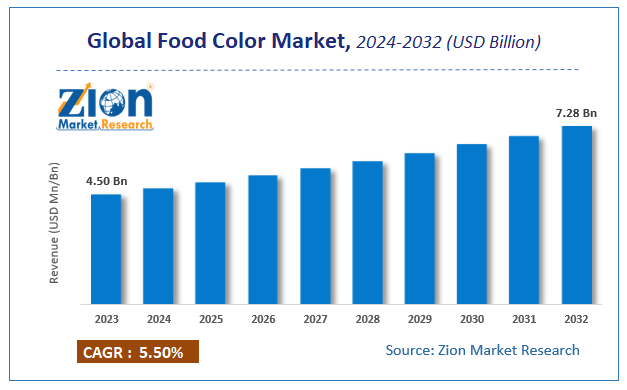
According to Zion Market Research, the global Food Color Market was worth USD 4.50 Billion in 2023. The market is forecast to reach USD 7.28 Billion by 2032, growing at a compound annual growth rate (CAGR) of 5.5% during the forecast period 2024-2032. The report offers a comprehensive analysis of the market, highlighting the factors that will determine growth, potential challenges, and opportunities that could emerge in the Food Color industry over the next decade.
Global Food Color Market: Overview
Food colors are pigments, dyes, and food additives. They improve the appearance of processed and fresh food. Food colors also make up for the color losses caused by exposure to air, light, fluctuation in temperature, and moisture. They comprise components such as synthetic colors and natural colors. Food colors are extensively used in pharmaceutical, confectionery, dairy and dairy product, packaged foods, bakery, beverages, cosmetics, and others.
Global Food Color Market: Growth Factors
Changing lifestyle and globalization have led to a rise in the utilization of food colors in the growing markets. The food colors market is assumed to grow with the rising food demand. The natural colors market segment growth is determined by the consumer’s inclination for healthy and natural food colors. The growth is anticipated to sustain in the coming years with the establishment of new products, new raw material sources, and color production using advanced technology.
Global Food Color Market: Segmentation
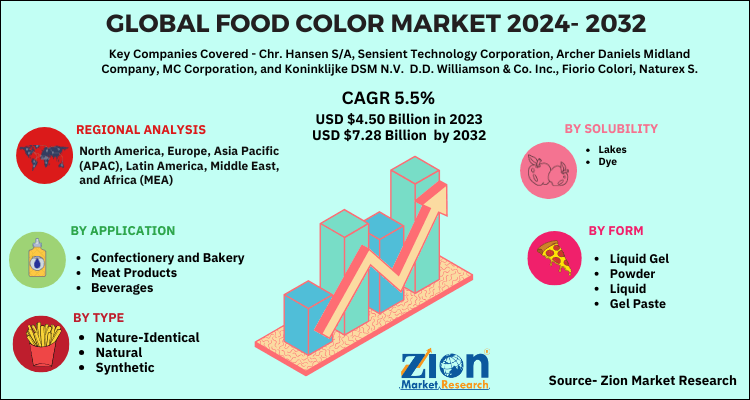
The global food color market may be segmented based on application, type, solubility, and form. All the segments have been analyzed based on present and future trends and the market is estimated from 2024 to 2032.
The application segment is divided into confectionery and bakery, meat products, and beverages. The beverages segment is expected to grow owing to the increased usage of food colors in different beverage applications such as nutritional drinks, flavored drinks, and soft drinks such as nectars and fruit juices.
The type segment of the global food color market is classified into nature-identical, natural, and synthetic. The natural colors segment market is assumed to grow at a fast pace due to the increasing demand for food color obtained naturally and health advantages of specific natural colors.
The solubility segment of food color market is diversified into lakes and dyes. The dyes segment is estimated to grow in the near future owing to the broad use in various applications such as dry mixes, dairy products, confections, beverages, pet foods, baked goods, and various other products, due to their characteristics such as brighter coloring with regard to natural colorings and greater stability.
The form segment of the global food color market is segmented into liquid gel, powder, liquid, and gel paste.
The regional segment includes the current and forecast demand for North America, Europe, Asia Pacific, Latin America, and the Middle East and Africa.
Food Color Market: Report Scope
| Report Attributes | Report Details |
|---|---|
| Report Name | Food Color Market |
| Market Size in 2023 | USD 4.50 Billion |
| Market Forecast in 2032 | USD 7.28 Billion |
| Growth Rate | CAGR of 5.5% |
| Number of Pages | 110 |
| Key Companies Covered | Chr. Hansen S/A, Sensient Technology Corporation, Archer Daniels Midland Company, MC Corporation, and Koninklijke DSM N.V. Other key players of the global market are D.D. Williamson & Co. Inc., Fiorio Colori, Naturex S.A., and Döhler Group, and Kalsec Inc. among others |
| Segments Covered | By Application, By Type, By Solubility, By Form And By Region |
| Regions Covered | North America, Europe, Asia Pacific (APAC), Latin America, Middle East, and Africa (MEA) |
| Base Year | 2023 |
| Historical Year | 2018 - 2022 |
| Forecast Year | 2024 - 2032 |
| Customization Scope | Avail customized purchase options to meet your exact research needs. Request For Customization |
Global Food Color Market: Regional Analysis
The global food colour market in the Asia-Pacific region is projected to rise more in the coming years due to factors such as high levels of production in countries such as New Zealand and Australia, rising population, increasing demand for natural goods, evolving lifestyles and the consumer spending on food and beverage. The growth of this region is boosted by the food industry in Japan, Australia and New Zealand, and China and widely increased food color products trade from these countries.
Global Food Color Market: Competitive Players
Some main participants of the food color market are-
- Chr. Hansen S/A
- Sensient Technology Corporation
- Archer Daniels Midland Company
- MC Corporation
- and Koninklijke DSM N.V.
- D.D. Williamson & Co. Inc.
- Fiorio Colori
- Naturex S.A.
- Döhler Group
- Kalsec Inc.
- Among others
This report segments the Global Food Color Market as follows:
Global Food Color Market: Application Analysis
- Confectionery And Bakery
- Meat Products
- Beverages
Global Food Color Market: Types Analysis
- Nature-Identical
- Natural
- Synthetic
Global Food Color Market: Solubility Analysis
- Lakes
- Dyes
By Region
- North America
- The U.S.
- Canada
- Mexico
- Europe
- France
- The UK
- Spain
- Germany
- Italy
- Rest of Europe
- Asia Pacific
- China
- Japan
- India
- Australia
- South Korea
- Rest of Asia Pacific
- The Middle East & Africa
- Saudi Arabia
- UAE
- Egypt
- Kuwait
- South Africa
- Rest of the Middle East & Africa
- Latin America
- Brazil
- Argentina
- Rest of Latin America
Table Of Content
Methodology
FrequentlyAsked Questions
Food color is an additive used to enhance or restore food appearance. It can be natural or synthetic in origin.
The global Food Color market is expected to be driven by the demand for visually appealing food products and increasing preference for natural colors. Expansion of processed and packaged food industries supports adoption.
According to study, the global Food Color market size was worth around USD 4.50 Billion in 2023 and is predicted to grow to around USD 7.28 Billion By 2032.
The global Food Color market is expected to grow at a Compound Annual Growth Rate (CAGR) of around CAGR 5.5% during the forecast period from 2024-2032.
The global Food Color industry is projected to be challenged by Challenges include regulatory restrictions on synthetic colors, stability issues, and higher costs for natural alternatives.
The Opportunities include demand for natural food colors, clean-label trends, innovation in plant-based pigments, and growth in processed foods will offer significant growth opportunities in the Food Color market.
Natural and plant-based color innovations; clean-label and allergen-free formulations; stability enhancement for processed foods are the emerging trends and innovations impacting the Food Color market.
The global Food Color market is expected to be led by APAC during the forecast period.
Some of the prominent players operating in the global Food Color market are; Chr. Hansen S/A, Sensient Technology Corporation, Archer Daniels Midland Company, MC Corporation, and Koninklijke DSM N.V. Other key players of the global market are D.D. Williamson & Co. Inc., Fiorio Colori, Naturex S.A., and Döhler Group, and Kalsec Inc. among others and others.
The report explores crucial aspects of the Food Color market, including a detailed discussion of existing growth factors and restraints, while also browsing future growth opportunities and challenges that impact the market.

HappyClients

