
Fireclay Tiles Market Size, Trend, Growth, Industry Analysis 2034

Fireclay Tiles Market By Product Type (Glazed Fireclay Tiles, Unglazed Fireclay Tiles, Textured Fireclay Tiles), By Design Style (Traditional, Contemporary, Rustic, Art Deco), By Application (Residential, Commercial, Industrial, Institutional), By End-Use (Flooring, Wall Cladding, Countertops, Backsplashes), and By Region - Global and Regional Industry Overview, Market Intelligence, Comprehensive Analysis, Historical Data, and Forecasts 2025 - 2034
| Market Size in 2024 | Market Forecast in 2034 | CAGR (in %) | Base Year |
|---|---|---|---|
| USD 3.73 Billion | USD 5.71 Billion | 5.48% | 2024 |
Fireclay Tiles Industry Perspective:
What will be the size of the global fireclay tiles market during the forecast period?
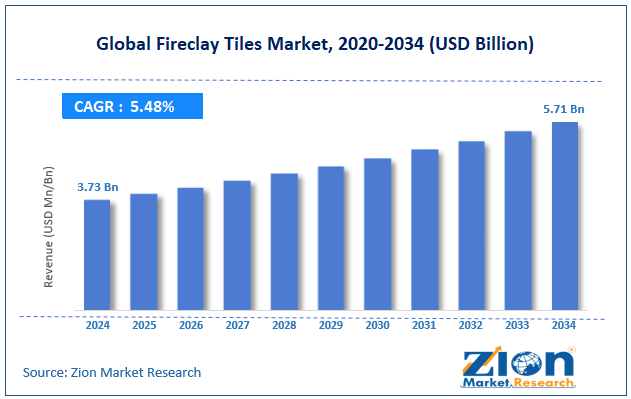
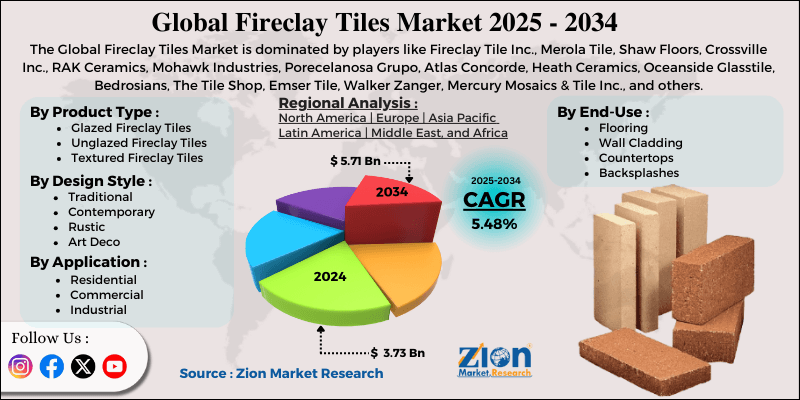
The global fireclay tiles market size was around USD 3.73 billion in 2024 and is projected to reach USD 5.71 billion by 2034, with a compound annual growth rate (CAGR) of roughly 5.48% between 2025 and 2034.
Key Insights:
- As per the analysis shared by our research analyst, the global fireclay tiles market is estimated to grow annually at a CAGR of around 5.48% over the forecast period (2025-2034)
- In terms of revenue, the global fireclay tiles market size was valued at around USD 3.73 billion in 2024 and is projected to reach USD 5.71 billion by 2034.
- The fireclay tiles market is projected to grow significantly owing to rising residential construction activity, expansion of the hospitality and commercial sectors, and growing consumer preference for premium and aesthetic finishes.
- Based on product type, the glazed fireclay tiles segment is expected to lead the market, while the unglazed fireclay tiles segment is expected to grow considerably.
- Based on design style, the rustic segment is the dominating segment, while the traditional segment is projected to witness sizeable revenue over the forecast period.
- Based on application, the residential segment leads, while the commercial segment is expected to gain share in the coming years.
- Based on end use, the flooring segment is expected to lead the market, followed by the wall cladding segment.
- By region, North America is projected to dominate the global market during the forecast period, followed by Europe.
Fireclay Tiles Market: Overview
Fireclay Tile is a California-based company known for its handcrafted glass and ceramic tiles, with a focus on sustainability. They use eco-friendly manufacturing practices and recycled materials to produce vibrant, durable, and highly varied-colored tiles. They are valued for their artisanal look, commitment to responsible design, and custom options. The global fireclay tiles market is poised for notable growth, driven by rising residential activity, the preference for handmade and artisanal products, and the expansion of hospitality and commercial spaces. Increasing home renovation and remodeling projects are driving the use of premium tiles in bathrooms, kitchens, and living spaces. Fireclay tiles are highly used for their visual appeal and durability in high-use areas. This trend is robust in high-income and urban households.
Moreover, consumers are now attracted to handcrafted materials that offer character and uniqueness. Fireclay tiles offer exceptional textures, custom designs, and glaze variations not present in mass-produced tiles. This backs demand in bespoke and luxury interior projects. Restaurants, hotels, and retail spaces prioritize aesthetic differentiation to improve brand identity. Fireclay tiles help create visually striking interiors without compromising durability. Their use backs premium positioning in competitive environments.
Nevertheless, the global market faces limitations, including high production costs and limited manufacturing scalability. Fireclay tiles need an energy-intensive firing process and skilled labor. These factors majorly increase manufacturing costs compared to conventional tiles. High prices restrict adoption among budget-conscious consumers. Likewise, small-batch and artisanal production techniques limit large-scale output. This creates supply constraints and longer lead times for bigger projects.
Hence, mass-market penetration is still hampered. Still, the global fireclay tiles industry benefits from several favorable factors, such as customization and bespoke design demand, as well as improvements in production. Increasing demand for personalized interiors creates opportunities for custom tiles. Fireclay tiles can be customized in size, finish, and color, enhancing their appeal for high-end projects. Additionally, innovations in kiln efficacy and glazing methods may improve consistency and reduce costs. Advanced manufacturing supports better scalability. This helps balance craftsmanship with efficacy.
Fireclay Tiles Market: Dynamics
Growth Drivers
How are customization and design flexibility driving consumer preferences and fueling the growth of the fireclay tiles market?
Designers and consumers increasingly prefer unique, personalized tile designs, which benefits fireclay tiles. They offer a wider range of shapes, colors, and textures, allowing bespoke solutions for bathrooms, kitchens, and commercial spaces. Customization improves the perceived value of projects and aesthetic appeal. Digital preview tools and advanced glazing make tailored options easier to deliver. This trend allows manufacturers to command higher margins and price points. The design flexibility of fireclay tiles ensures they remain relevant amid evolving interior trends.
How do technological advancements reduce production costs and improve quality, thereby driving the growth of the fireclay tiles industry?
Technological advancements in tile manufacturing are improving the quality and affordability of fireclay tiles. Digital glazing, automation, and precision kilns enhance design options and surface efficiency. Increased production efficiency lowers costs and shortens lead times, enabling broader distribution. Advanced technology also backs larger formats, anti-slip finishes, and improved durability. Manufacturers can now compete with substitute materials without compromising premium appeal. This blend of quality and efficacy boosts the growth of the fireclay tiles industry.
Restraints
Vulnerability to supply chain disruptions unfavorably impacts the market progress
Fireclay tile production depends on a consistent supply of chemicals, energy, and quality clay. Disturbances caused by geopolitical tensions, natural disasters, or logistical challenges may affect output. Heavy reliance on raw materials from certain regions increases exposure to risk. Price variations in energy and clay costs may further strain manufacturers. Supply instability may cause delays, affecting large construction and renovation projects. Consequently, supply chain vulnerabilities could be a significant market constraint.
Opportunities
How is the escalating demand for sustainable, green buildings offering advantageous conditions for the development of the fireclay tiles market?
Worldwide adoption of construction and eco-friendly practices continues to grow. Fireclay tiles, being recyclable and natural, fit sustainability needs. Green certifications and corporate ESG initiatives increase demand for eco-conscious materials. Awareness campaigns underscoring ecological benefits may further drive adoption. Sustainability-based construction projects are often ready to pay premium prices. This trend offers a long-term opportunity for the fireclay tiles industry to expand its market share in eco-conscious sectors.
Challenges
Market fragmentation and intense competition restrict the market growth
The fireclay tile industry is split with multiple medium-sized and small manufacturers. Strong competition from cheaper substitutes puts pressure on margins and pricing. Building brand recognition and differentiating products is a complex task. The entry of international players with modern technology adds competitive pressure. Key manufacturers should actively invest in innovation, marketing, and distribution to remain viable. Competition and fragmentation offer current barriers to growth.
Fireclay Tiles Market: Report Scope
| Report Attributes | Report Details |
|---|---|
| Report Name | Fireclay Tiles Market |
| Market Size in 2024 | USD 3.73 Billion |
| Market Forecast in 2034 | USD 5.71 Billion |
| Growth Rate | CAGR of 5.48% |
| Number of Pages | 217 |
| Key Companies Covered | Fireclay Tile Inc., Merola Tile, Shaw Floors, Crossville Inc., RAK Ceramics, Mohawk Industries, Porecelanosa Grupo, Atlas Concorde, Heath Ceramics, Oceanside Glasstile, Bedrosians, The Tile Shop, Emser Tile, Walker Zanger, Mercury Mosaics & Tile Inc., and others. |
| Segments Covered | By Product Type, By Design Style, By Application, By End-Use, and By Region |
| Regions Covered | North America, Europe, Asia Pacific (APAC), Latin America, Middle East, and Africa (MEA) |
| Base Year | 2024 |
| Historical Year | 2019 to 2023 |
| Forecast Year | 2025 - 2034 |
| Customization Scope | Avail customized purchase options to meet your exact research needs. Request For Customization |
Fireclay Tiles Market: Segmentation
The global fireclay tiles market is segmented based on product type, design style, application, end-use, and region.
Why will the glazed fireclay tiles segment dominate the fireclay tiles market?
Based on product type, the global fireclay tiles industry is divided into glazed fireclay tiles, unglazed fireclay tiles, and textured fireclay tiles. The glazed fireclay tiles segment holds a leading share with 62% of the overall market. These tiles are broadly used for their moisture resistance, aesthetic versatility, and ease of cleaning in both commercial and residential applications.
Conversely, the unglazed fireclay tiles segment held a second-leading share of 38%. They are preferred primarily for their slip resistance, natural texture, and suitability for high-traffic, outdoor, and rustic design settings.
What share does the rustic segment hold in the fireclay tiles market?
Based on design style, the global market is segmented into traditional, contemporary, rustic, and Art Deco. The rustic segment captures 40.1% of the total market due to strong consumer preference for its textured, natural, and warm finish. It complements prominent interior styles, currently in trend.
However, the traditional segment leads after rustic design with 35% market share. It is preferred for its classic, timeless appeal across a broader range of renovation and architectural projects.
What position will the residential segment hold in the fireclay tiles market?
Based on application, the global fireclay tiles market is segmented into residential, commercial, industrial, and institutional. The residential segment dominates with 50% of the market. This growth is backed by the extensive use of fireclay tiles in bathrooms, patios, kitchens, fireplaces, and other interior design and renovation projects, where durability and aesthetics are prized.
Nonetheless, the commercial segment holds second rank with 32% market share. They comprise retail spaces, restaurants, boutique hotels, offices, and other commercial places. They are largely adopting fireclay tiles for their design flexibility, performance, and long-lasting surface solutions.
Will the flooring segment continue its dominance in the fireclay tiles market?
Based on end-use, the global market is segmented into flooring, wall cladding, countertops, and backsplashes. The flooring segment dominates the market at 45%, driven by its broad use for aesthetics and durability, primarily in commercial and residential settings.
On the other hand, the wall cladding segment takes second place with 28% market share, as homeowners and designers increasingly use fireclay tiles for functional and decorative wall surfaces that enhance interior aesthetics.
Fireclay Tiles Market: Regional Analysis
What enables North America strong foothold in the global Fireclay Tiles Market?
North America is projected to maintain its dominant position, with a 5.8% CAGR in the global fireclay tiles market, driven by strong construction demand and residential renovation. North America dominates the market due to a large number of residential renovation and new construction activities. Developers and homeowners frequently choose premium fireclay tiles for bathrooms, kitchens, and flooring. This consistent demand fuels regional market share worldwide. Designers and consumers in North America prefer handcrafted, customizable, and eco-friendly tiles. Fireclay’s sustainable composition and artisanal finishes support these preferences. This trend augments adoption as compared to porcelain or ceramic alternatives.
Furthermore, the region holds a mature tile manufacturing and distribution infrastructure with several local producers. This promises broader availability, design variety, and fast delivery for both commercial and residential projects. It strengthens regional rank in the global industry.
What helps Europe to emerge as the second-leading region in the fireclay tiles market?
Europe maintains its position as the second-largest region, with a 4.9% CAGR in the global fireclay tiles industry, driven by a well-developed architectural and design culture, growth in renovation and urban development, and rising sustainability awareness. Europe’s robust deep design culture and architectural heritage drive demand for stylish, premium finishes such as fireclay tiles. Designers and homeowners value materials that blend tradition with appearance. This broader aesthetic preference backs the regional high industry share.
Moreover, a significant share of European construction activity comprises the renovation of modern and historic buildings. Fireclay is usually specified for both performance and decorative qualities in these upgrades. This trend backs steady adoption in commercial and residential projects. Additionally, European regulators and consumers emphasize sustainable materials and environmental standards. Fireclay tiles, with their low environmental impact and natural components, comply with these values. This alignment drives regional adoption and market growth.
Fireclay Tiles Market: Competitive Analysis
The leading players in the global fireclay tiles market are:
- Fireclay Tile Inc.
- Merola Tile
- Shaw Floors
- Crossville Inc.
- RAK Ceramics
- Mohawk Industries
- Porecelanosa Grupo
- Atlas Concorde
- Heath Ceramics
- Oceanside Glasstile
- Bedrosians
- The Tile Shop
- Emser Tile
- Walker Zanger
- Mercury Mosaics & Tile Inc.
What are the key trends in the global Fireclay Tiles Market?
Rise in digital visualization tools and online sales:
The global market is experiencing more sales through online channels, where consumers can explore a broader range of fireclay tile options. Digital tools like 3D visualization and augmented reality help buyers preview tiles in their own spaces before purchase. This digital shift is widening access and boosting decision-making.
Expansion into emerging geographic markets:
Regions like the Middle East and Asia Pacific are advancing in the adoption of fireclay tiles as disposable incomes and urbanization rise. These markets are heavily investing in interior finishes and premium construction, thus creating fresh demand. Hence, fireclay tile manufacturers are expanding their geographic reach beyond traditional markets.
The global fireclay tiles market is segmented as follows:
By Product Type
- Glazed Fireclay Tiles
- Unglazed Fireclay Tiles
- Textured Fireclay Tiles
By Design Style
- Traditional
- Contemporary
- Rustic
- Art Deco
By Application
- Residential
- Commercial
- Industrial
- Institutional
By End-Use
- Flooring
- Wall Cladding
- Countertops
- Backsplashes
By Region
- North America
- The U.S.
- Canada
- Europe
- France
- The UK
- Spain
- Germany
- Italy
- Rest of Europe
- Asia Pacific
- China
- Japan
- India
- South Korea
- Southeast Asia
- Rest of Asia Pacific
- Latin America
- Brazil
- Mexico
- Rest of Latin America
- Middle East & Africa
- GCC
- South Africa
- Rest of Middle East & Africa
Table Of Content
Methodology
FrequentlyAsked Questions

HappyClients