
Energy Consulting Service Market Size, Share, Trends, Growth and Forecast 2034

Energy Consulting Service Market By End-User (Industrial, Commercial, Government, Utilities, Residential), By Service Type (Energy Auditing, Energy Management, Regulatory Compliance, Renewable Energy Advisory, Carbon Management, Risk Assessment), By Delivery Mode (On-Site Consulting, Remote Consulting, Hybrid Consulting), and By Region - Global and Regional Industry Overview, Market Intelligence, Comprehensive Analysis, Historical Data, and Forecasts 2025 - 2034
| Market Size in 2024 | Market Forecast in 2034 | CAGR (in %) | Base Year |
|---|---|---|---|
| USD 18.36 Billion | USD 29.98 Billion | 5.60% | 2024 |
Energy Consulting Service Industry Perspective:
What will be the size of the energy consulting service market during the forecast period?
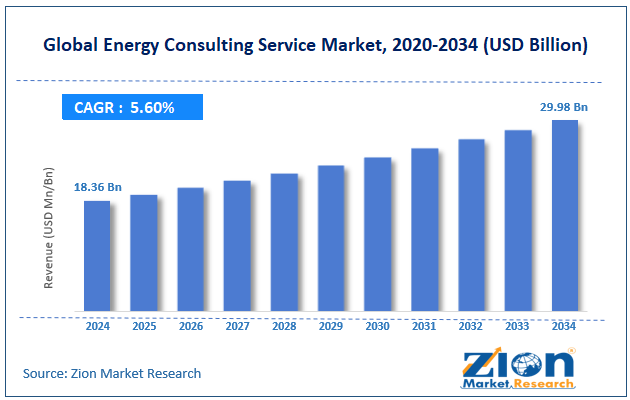
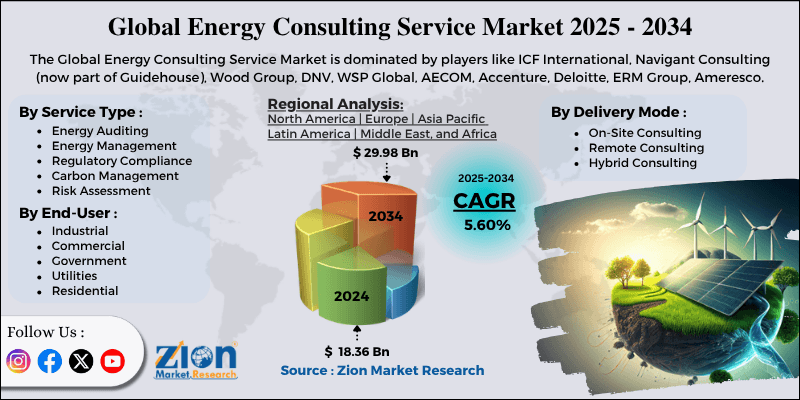
The global energy consulting service market size was worth approximately USD 18.36 billion in 2024 and is projected to grow to around USD 29.98 billion by 2034, with a compound annual growth rate (CAGR) of roughly 5.60% between 2025 and 2034.
Key Insights
- As per the analysis shared by our research analyst, the global energy consulting service market is estimated to grow annually at a CAGR of around 5.60% over the forecast period (2025-2034).
- In terms of revenue, the global energy consulting service market size was valued at approximately USD 18.36 billion in 2024 and is projected to reach USD 29.98 billion by 2034.
- The energy consulting service market is projected to grow significantly due to tightening government regulations on carbon emissions, increasing corporate sustainability commitments, rising energy costs, the rapid expansion of renewable energy projects, and growing demand for energy-efficient building and industrial systems.
- Based on end-user, the industrial segment is expected to lead the energy consulting service market, while the commercial segment is anticipated to grow rapidly.
- Based on service type, the energy auditing segment is expected to lead the energy consulting service market, while the renewable energy advisory segment is anticipated to grow significantly.
- Based on delivery mode, the on-site consulting segment is the dominating segment, while the remote consulting segment is projected to witness sizeable revenue over the forecast period.
- Based on region, North America is projected to dominate the global energy consulting service market during the estimated period, followed by Europe.
Energy Consulting Service Market: Overview
Energy consulting services are expert services that help businesses understand their energy use and identify ways to reduce energy consumption and costs. These services include assessing how electricity and fuel are used in buildings, offices, and factories, as well as identifying areas where energy is wasted. Consultants review energy bills, assess equipment performance, and develop simple plans to improve energy efficiency and reduce power consumption. They help companies build long-term energy plans that support business needs and stay within budget limits. The work often includes reviewing heating, cooling, and lighting systems, as well as factory machinery, to reduce electricity use without disrupting daily operations. Energy consultants also explain government rules, emission limits, and energy reporting requirements in clear, easy-to-understand language. They guide organizations in selecting renewable energy solutions, such as solar, wind, or geothermal, based on location and energy demand.
Many companies depend on consultants to measure carbon emissions and prepare sustainability and environmental reports. Risk evaluation services also help businesses plan for changes in energy prices and possible supply shortages. Rising pressure to reduce greenhouse gas emissions while controlling business expenses is driving global demand for professional energy consulting services.
The growing global push for energy efficiency, decarbonization, and renewable energy adoption is expected to be the primary driver of growth in the energy consulting services market over the forecast period.
Energy Consulting Service Market: Technology Roadmap 2025–2034
What is the projected development roadmap of the energy consulting service market over the forecast period?
The energy consulting service market is growing rapidly due to digital transformation, stricter environmental policies, and advances in data analytics and smart energy monitoring tools. The market is expected to grow at a CAGR of around 5.60% over the forecast period, driven by rising demand across industrial operations, commercial buildings, and public sector energy management programs. The following roadmap outlines key development phases expected through 2034.
2025–2027: Digital Tools and Data Analytics Integration Phase
- New energy data software helps consultants analyze large volumes of electricity and fuel consumption records and identify waste areas where businesses can reduce energy use and costs.
- Artificial intelligence tools generate energy forecasts and alert companies to inefficiencies or rising energy costs.
- Cloud-based energy management systems enable consultants to remotely monitor multiple client facilities and provide faster technical support when performance issues arise.
2028–2031: Renewable Energy and Decarbonization Strategy Phase
- Energy consultants guide organizations in shifting from fossil fuels toward renewable energy sources such as solar and wind power.
- Carbon-emission tracking and reporting services are growing as governments require companies to measure greenhouse gas emissions and comply with stricter climate regulations.
- Consultants help businesses access government incentives, green financing programs, and sustainability investments linked to verified energy savings.
2032–2034: Integrated Sustainability and Net-Zero Advisory Phase
- Long-term net-zero planning becomes common as companies commit to reducing carbon emissions and require structured sustainability strategies.
- Energy consultants collaborate with architects, planners, and technology providers to design energy-efficient buildings and low-carbon industrial facilities.
- Advanced monitoring software and real-time energy-tracking tools enable consultants to deliver continuous energy improvement services rather than one-time advisory projects.
Energy Consulting Service Market: Dynamics
Growth Drivers
How is increasing government regulation on carbon emissions driving the expansion of the energy consulting service market?
The energy consulting service market is growing as governments introduce stricter rules to control carbon dioxide emissions and other greenhouse gas pollution across industries worldwide. Many businesses find it difficult to understand complex environmental rules, emission measurement methods, and reporting deadlines required under modern climate policies. Energy consulting companies help organizations manage carbon reporting, conduct energy audits, plan efficiency improvements, and develop sustainability strategies to reduce emissions and energy costs. Important regulations include the European Union carbon trading system, the United States Environmental Protection Agency emission standards, and new climate rules spreading across Asia and Latin America. Financial penalties for violating environmental rules can be very high, increasing demand for skilled energy consultants with knowledge of carbon management and regulatory compliance. Many companies prefer to prepare early for future climate regulations rather than rush to make changes under legal pressure.
Energy consulting firms create practical plans to improve energy efficiency, reduce emissions, and implement cost-effective operational improvements. Government contracts often require certified energy efficiency reporting, encouraging businesses of all sizes to use professional energy consulting services. Expanding climate regulations and sustainability commitments continue driving long-term demand for energy consulting services worldwide.
Rising energy costs are boosting demand for energy consulting services.
The energy consulting service industry is growing as changes in global energy prices create pressure on businesses facing rising electricity, natural gas, and industrial fuel costs. Companies in manufacturing, logistics, healthcare, and commercial sectors seek expert advice to manage energy spending without reducing production levels or service quality. Energy consulting firms conduct detailed energy audits, cost analyses, and efficiency reviews to identify clear opportunities to reduce energy waste and lower operating expenses. Many manufacturers invest in energy-efficient machines, improved insulation, automated control systems, and modern LED lighting, with guidance from consultants.
Owners of commercial buildings also request energy checks to identify inefficient heating, cooling, ventilation, and electrical systems in offices, shopping centers, and large facilities. Utility companies work with energy consultants to create demand-response programs that reward businesses for reducing electricity use during peak demand hours. Large campuses, such as hospitals, universities, and government buildings, seek consulting services because even small efficiency improvements can create significant yearly cost savings.
Restraints
The shortage of qualified energy consultants is limiting growth in the energy consulting service market.
The energy consulting service market faces a major challenge because the number of skilled professionals remains limited across many regions and industries. Energy consulting requires an understanding of electrical systems, building energy use, environmental rules, sustainability planning, and financial analysis used to control energy costs. Finding professionals with both technical knowledge and business advisory skills is difficult for consulting firms seeking to expand their energy management services. This shortage is more pronounced in developing economies, where energy transition programs are growing rapidly but trained experts remain in short supply.
Energy consulting companies find it difficult to expand because training new consultants requires several years of learning, mentoring, and significant financial investment. Many universities and technical institutes still do not offer specialized energy management programs that prepare students for consulting careers. Experienced consultants, therefore, handle multiple projects simultaneously, which can affect response speed and service depth. Technology companies also offer software-based energy management tools, further intensifying competition with traditional consulting firms.
Opportunities
How are corporate sustainability commitments and ESG reporting driving growth in the energy consulting service market?
The energy consulting services market is growing as many companies worldwide set clear environmental goals, such as reducing carbon emissions, increasing renewable energy use, and achieving long-term net-zero targets. These goals are influenced by investor expectations, customer awareness, employee values, and environmental, social, and governance ratings that measure corporate responsibility beyond financial performance. Achieving sustainability goals requires careful tracking of energy use, accurate measurement of carbon emissions, and structured plans to reduce emissions across business operations. Companies also need investment plans for renewable energy projects and energy efficiency upgrades, as well as clear sustainability reporting aligned with global standards. Energy consulting firms help organizations by conducting energy baseline studies, carbon footprint analyses, and sustainability planning to support long-term environmental performance. Consultants create practical strategies to help companies improve energy efficiency, reduce emissions, and comply with international environmental reporting rules. Public companies, banks, and multinational corporations generate strong demand as regulations and investor expectations continue to increase worldwide. Growing sustainability commitments create strong opportunities for energy consulting firms to expand services and build long-term client partnerships.
Challenges
How are inconsistent data quality and measurement standards creating challenges for the energy consulting service industry?
The energy consulting industry faces challenges in creating accurate energy baselines, as many companies maintain incomplete records and poorly organized energy data systems. Reliable energy baseline measurements require detailed information on electricity use, fuel consumption, operating hours, and equipment performance across different facilities. Many organizations keep separate records for offices, factories, warehouses, and service centers, which creates scattered, difficult-to-manage energy data. Utility companies also use different billing systems, reporting formats, and measurement cycles, making it harder to combine energy information from multiple locations. Industrial operations depend on electricity, natural gas, steam, compressed air, and process heat, which are sometimes measured inconsistently. The lack of globally standardized energy measurement and verification systems creates confusion for companies working across different regulatory environments. Energy consultants, therefore, spend significant time checking data accuracy before starting efficiency analysis and strategic planning. Smart meters, energy-monitoring tools, and digital reporting platforms help improve measurement reliability, although adoption levels remain uneven across many industries.
Energy Consulting Service Market: Report Scope
| Report Attributes | Report Details |
|---|---|
| Report Name | Energy Consulting Service Market |
| Market Size in 2024 | USD 18.36 Billion |
| Market Forecast in 2034 | USD 29.98 Bllion |
| Growth Rate | CAGR of 5.60 |
| Number of Pages | 229 |
| Key Companies Covered | ICF International, Navigant Consulting (now part of Guidehouse), Wood Group, DNV, WSP Global, AECOM, Accenture, Deloitte, ERM Group, Ameresco, and others. |
| Segments Covered | By End-User, By Service Type, By Delivery Mode, and By Region |
| Regions Covered | North America, Europe, Asia Pacific (APAC), Latin America, Middle East, and Africa (MEA) |
| Base Year | 2024 |
| Historical Year | 2019 to 2023 |
| Forecast Year | 2025 - 2034 |
| Customization Scope | Avail customized purchase options to meet your exact research needs. Request For Customization |
Energy Consulting Service Market: Segmentation
The global energy consulting services market is segmented based on end-user, service type, delivery mode, and region.
Why does the industrial segment lead the energy consulting service market?
Based on end-user, the market is divided into industrial, commercial, government, utilities, and residential. The industrial segment accounts for around 43% of the total market share. It is expected to lead throughout the forecast period, as factories, processing plants, and manufacturing facilities consume enormous amounts of energy and face the greatest pressure to demonstrate efficiency improvements and emissions reductions. The commercial segment holds about 28% of the market share, driven by offices, retail centers, hotels, and hospitals investing in energy efficiency to lower operating costs and meet green building standards.
Why does the energy auditing segment lead the energy consulting service market?
Based on service type, the global energy consulting service industry is categorized into energy auditing, energy management, regulatory compliance, renewable energy advisory, carbon management, and risk assessment. The energy auditing segment holds about 34% of the market share because energy audits provide the first clear assessment of energy use and identify inefficiencies before companies plan efficiency improvements or regulatory compliance actions. The renewable energy advisory segment is the second-largest category, with nearly 24% market share, driven by surging corporate and government interest in transitioning from fossil-fuel-based energy systems to solar, wind, and other clean energy sources.
Why does the on-site consulting segment lead the energy consulting service market?
Based on delivery mode, the global energy consulting services market is segmented into on-site, remote, and hybrid consulting. The on-site consulting segment accounts for nearly 51% of the overall market share. It continues to lead because complex industrial and commercial energy assessments require physical inspection of equipment, systems, and facilities to produce reliable findings and recommendations. The remote consulting segment holds about 29% market share, driven by digital communication tools and cloud-based energy monitoring platforms enabling consultants to provide services without on-site visits.
Energy Consulting Service Market: Regional Analysis
What factors enable North America to dominate the global energy consulting service market during the forecast period?
North America is expected to account for 36.4% of global demand and remain the leading revenue-generating region in the energy consulting services market. The region leads because of its large industrial base, strict environmental rules at the federal and state levels, strong corporate focus on sustainability, and a well-developed professional consulting industry. The United States is the largest individual market, supported by major investments in renewable energy projects, active carbon-trading systems, and growing investor expectations for clear climate strategies. Canada also creates a strong demand because the mining, oil sands, and forestry industries must comply with strict emissions reporting and reduction targets. Many North American companies have announced net-zero goals, creating steady demand for long-term consulting partnerships instead of short-term advisory projects.
Government clean energy incentives, energy efficiency grants, and infrastructure upgrade programs further expand consulting opportunities across industries. The presence of advanced technology companies allows consultants to use artificial intelligence, predictive analytics, and digital monitoring tools in energy management services. Financial institutions are also increasing their environmental reporting requirements, encouraging companies to seek expert consulting support for compliance and accurate disclosure. Growing pressure from investors and sustainability rating agencies increases demand for reliable carbon accounting services. As climate regulations become stricter and corporate accountability increases, North America continues to offer strong, growing opportunities for energy consulting companies.
Why is Europe expected to be the second leading region in the global energy consulting service market?
Europe is expected to account for about 29.7% of the global energy consulting services market and remain the second-largest regional contributor. The European Union leads global climate policy through programs such as the Green Deal, carbon pricing via the Emissions Trading System, and strict sustainability reporting rules under the Corporate Sustainability Reporting Directive. These regulations create a steady demand for energy consulting services across industries and public institutions. Germany, the United Kingdom, France, and the Netherlands are major markets due to strong industrial activity and strict environmental compliance requirements. Energy security concerns after fossil fuel supply disruptions have also increased demand for renewable energy planning and energy diversification strategies. Large building renovation programs focused on improving energy efficiency in homes and commercial buildings generate strong demand for energy audits and retrofit planning. Consulting firms specializing in carbon trading, sustainable finance, and environmental regulations continue expanding as policies become more complex.
Financial institutions across Europe also require stronger climate risk assessments, encouraging companies to seek expert advisory support. Many businesses have also announced net-zero targets and science-based emission-reduction goals, which increases demand for long-term consulting guidance. As climate regulations grow stricter and green investments increase, Europe remains a strong and stable market for energy consulting services.
Recent Market Developments
- In September 2025, Accenture announced plans to acquire Orlade Group, a project advisory and consulting firm, to expand its consulting services supporting large energy infrastructure and capital projects such as power grids and nuclear facilities.
- In October 2025, Schneider Electric launched SE Advisory Services, a global consulting brand designed to help organizations improve energy efficiency, electrification, digitalization, and sustainability strategies through integrated energy consulting solutions.
- In December 2025, WSP Global announced an agreement to acquire TRC Companies for approximately $3.3 billion to expand its power, energy, and environmental consulting services in response to rising demand for energy infrastructure and sustainability advisory.
Energy Consulting Service Market: Competitive Analysis
The leading players in the global energy consulting service market are:
- ICF International
- Navigant Consulting (now part of Guidehouse)
- Wood Group
- DNV
- WSP Global
- AECOM
- Accenture
- Deloitte
- ERM Group
- Ameresco
The global energy consulting service market is segmented as follows:
By End-User
- Industrial
- Commercial
- Government
- Utilities
- Residential
By Service Type
- Energy Auditing
- Energy Management
- Regulatory Compliance
- Renewable Energy Advisory
- Carbon Management
- Risk Assessment
By Delivery Mode
- On-Site Consulting
- Remote Consulting
- Hybrid Consulting
By Region
- North America
- The U.S.
- Canada
- Mexico
- Europe
- France
- The UK
- Spain
- Germany
- Italy
- Rest of Europe
- Asia Pacific
- China
- Japan
- India
- Australia
- South Korea
- Rest of Asia Pacific
- The Middle East & Africa
- Saudi Arabia
- UAE
- Egypt
- Kuwait
- South Africa
- Rest of the Middle East & Africa
- Latin America
- Brazil
- Argentina
- Rest of Latin America
Table Of Content
Methodology
FrequentlyAsked Questions
Energy consulting services are expert services that help businesses understand how they use energy and find ways to reduce energy use and energy costs.
The global energy consulting services market is projected to grow due to tightening carbon regulations, rising corporate sustainability commitments, rising energy costs, growing renewable energy adoption, and greater demand for support with environmental, social, and governance reporting.
According to a study, the global energy consulting services market size was around USD 18.36 billion in 2024 and is projected to reach USD 29.98 billion by 2034.
The CAGR value of the energy consulting service market is expected to be around 5.60% during 2025-2034.
North America is expected to lead the global energy consulting service market during the forecast period.
The major players profiled in the global energy consulting service market include ICF International, Navigant Consulting (now part of Guidehouse), Wood Group, DNV, WSP Global, AECOM, Accenture, Deloitte, ERM Group, and Ameresco.
The report examines key aspects of the energy consulting service market, including a detailed analysis of current growth drivers and constraints, as well as future growth opportunities and challenges.
In the energy consulting service market, macroeconomic factors such as rising energy prices, stricter environmental regulations, and government spending on clean energy increase demand for consulting services as companies seek help to control costs, improve efficiency, and meet sustainability goals.
In the energy consulting service market, investment opportunities include digital energy management platforms, renewable energy advisory services, carbon management solutions, and ESG reporting tools. Firms also form partnerships with technology providers, renewable energy developers, and financial institutions to deliver integrated energy transition services.
In the energy consulting service market, the value chain includes client identification, energy assessment and auditing, strategy development, implementation support, performance monitoring, reporting, and long-term advisory services that help organizations improve energy efficiency and achieve sustainability targets.

HappyClients

