
Edge Analytics Market Size, Share, Trends, Growth and Forecast 2032

Edge Analytics Market By solution (service and software), By deployment model (predictive analytics, historical analysis, and prescriptive analytics), By industry vertical (on-premise and cloud), By type (retail, transportation, public sector, IT & telecom, manufacturing, healthcare, energy & utility, and others) And By Region: - Global And Regional Industry Overview, Market Intelligence, Comprehensive Analysis, Historical Data, And Forecasts, 2024-2032
| Market Size in 2023 | Market Forecast in 2032 | CAGR (in %) | Base Year |
|---|---|---|---|
| USD 10.87 Billion | USD 75.86 Billion | 24.1% | 2023 |
Description
What is the projected value for the Edge Analytics Market during 2024 to 2032?
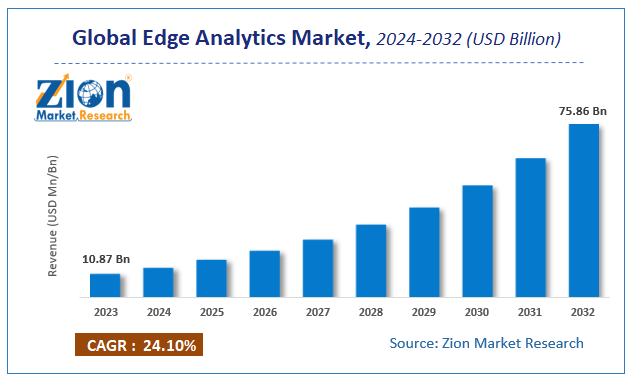
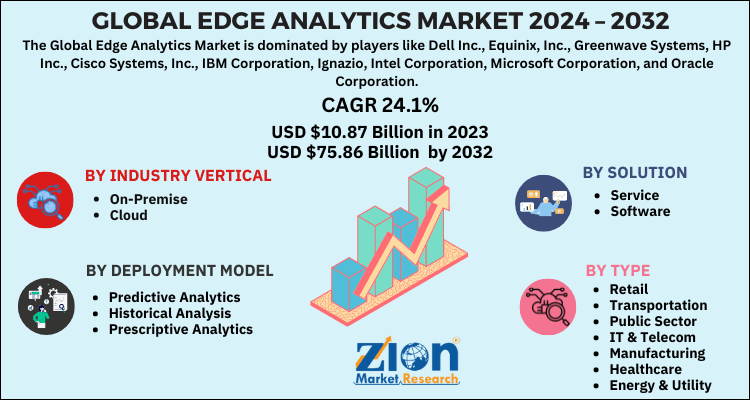
According to the report published by Zion Market Research, the global Edge Analytics Market size was valued at USD 10.87 Billion in 2023 and is predicted to reach USD 75.86 Billion by the end of 2032. The market is expected to grow with a CAGR of 24.1% during the forecast period. The report analyzes the global Edge Analytics Market's growth drivers, restraints, and impact on demand during the forecast period. It will also help navigate and explore the arising opportunities in the Edge Analytics industry.
 Request Free SampleRequest Free Sample
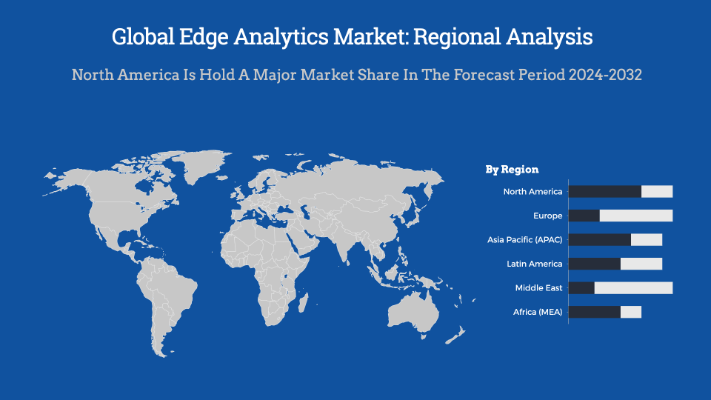
North America Edge Analytics Market Sales and Revenue: The North America Edge Analytics Market was valued at USD 3,677.65 million in 2023 and is projected to reach USD 25,442.50 million by 2032, growing at a CAGR of 24.00% during 2024–2032.
Europe Edge Analytics Market Sales and Revenue: The Europe Edge Analytics Market was valued at USD 3,142.69 million in 2023 and is expected to reach USD 20,738.90 million by 2032, registering a CAGR of 23.32% during 2024–2032.
Asia Pacific Edge Analytics Market Sales and Revenue: The Asia Pacific Edge Analytics Market was valued at USD 2,872.64 million in 2023 and is projected to reach USD 22,486.74 million by 2032, expanding at a CAGR of 25.74% during 2024–2032.
Latin America Edge Analytics Market Sales and Revenue: The Latin America Edge Analytics Market was valued at USD 554.86 million in 2023 and is forecast to reach USD 3,418.06 million by 2032, growing at a CAGR of 22.17% during 2024–2032.
Middle East Edge Analytics Market Sales and Revenue: The Middle East Edge Analytics Market was valued at USD 389.54 million in 2023 and is projected to reach USD 2,370.06 million by 2032, registering a CAGR of 22.33% during 2024–2032.
Africa Edge Analytics Market Sales and Revenue: The Africa Edge Analytics Market was valued at USD 233.11 million in 2023 and is expected to reach USD 1,435.70 million by 2032, growing at a CAGR of 21.51% during 2024–2032.
Global Edge Analytics Market: Overview
The examining analysis surveys edge computing specially as an analytic proposal and also as an advance for analyzing information closely along with its source, other than sending it to an inaccessible server for cloud-level examination. These are computing tasks that can be done possibly also in the cloud. In a wider sense of the term, edge analytics can be also seen as connecting tasks. Edge analytics market is mainly a substitute to big data Analytics. It gives the real-time study of data produced on the edge of system devices. Edge Analytics presents the automated analytical computation of composed facts in real time as an alternative to sending the information back to the centralized information store.
Edge analytics is considered as one of the most important movements in the Internet of Things, it is the shifting balance between cloud computing and edge computing. The early days of conceptual precursor and the IoT, M2M have been classified by the significant role of cloud platforms also act as application enablers. Intelligent systems have mostly depended on the cloud level for their acumen, and the real devices of which they have been comparatively ingenuous. This old assertion is presently being shaken up, as the computing competence on the edge level proceeds faster as compared to the cloud level.
Key Insights
- As per the analysis shared by our research analyst, the edge analytics market is anticipated to grow at a CAGR of 24.1% during the forecast period.
- The global edge analytics market was estimated to be worth approximately USD 10.87 billion in 2023 and is projected to reach a value of USD 75.86 billion by 2032.
- The growth of the edge analytics market is being driven by rising adoption of IoT devices, 5G networks, and real-time data processing needs across industries.
- Based on the solution, the service segment is growing at a high rate and is projected to dominate the market.
- On the basis of deployment model, the predictive analytics segment is projected to swipe the largest market share.
- In terms of industry vertical, the on-premise segment is expected to dominate the market.
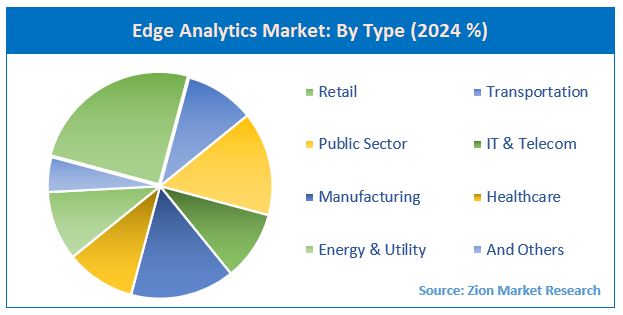
- Based on the type, the retail segment is expected to dominate the market.
- By region, North America is expected to dominate the global market during the forecast period.
Global Edge Analytics Market: Growth Factors
Initiation of IoT and proliferation of huge amount of information through related devices and the augmented acceptance of edge analytics market due to its scalability and expenditure optimizations have increased the development of the global edge analytics market. On the other hand, concerns pertaining to protection and security and lack of unanimously accepted standards are also acting as the limiting features for the global edge analytics market. An edge analytics solution is organized on the edge of the system devices to obtain the real-time analysis of the information produced, projecting, and prescriptive, as well as analytic to the data. The solutions are planned to meet inter-operability challenges that occurs due to several heterogeneous devices linked together and are incorporated within the tool.
 Request Free SampleRequest Free Sample
Recent Development
- In February 2025, NXP Semiconductors announced its acquisition of Kinara for approximately US$307 million. Kinara specializes in high-performance, energy-efficient neural processing units (NPUs) for edge AI. The deal strengthens NXP’s edge computing capabilities, particularly across industrial and automotive applications.
- In July 2024, C5i (formerly Course5 Intelligence) acquired Singapore-based Analytic Edge, expanding its AI-driven marketing analytics portfolio. The acquisition, valued between US$30–40 million, adds advanced capabilities in real-time pricing intelligence and marketing spend optimization.
- In 2024, Siemens launched its Industrial Edge Analytics platform, tailored for manufacturing environments. The solution enables real-time data processing at the edge, helping reduce latency and enhance operational efficiency across factory and industrial settings.
- In 2024, NVIDIA and Microsoft formed a strategic partnership to integrate NVIDIA’s edge AI hardware with Microsoft Azure’s cloud and edge analytics services. The collaboration targets enterprise customers seeking scalable, real-time analytics at the edge.
- In 2024, Belden advanced its industrial IoT capabilities by integrating CloudRail software with AWS IoT SiteWise Edge. The integration streamlines edge-to-cloud data workflows, enhancing asset monitoring and predictive maintenance across industrial operations.
Global Edge Analytics Market: Report Scope
| Report Attributes | Report Details |
|---|---|
| Report Name | Edge Analytics Market |
| Market Size in 2023 | USD 10.87 Billion |
| Market Forecast in 2032 | USD 75.86 Billion |
| Growth Rate | CAGR of 24.1% |
| Number of Pages | 192 |
| Key Companies Covered | Dell Inc., Equinix, Inc., Greenwave Systems, HP Inc., Cisco Systems, Inc., IBM Corporation, Ignazio, Intel Corporation, Microsoft Corporation, and Oracle Corporation |
| Segments Covered | By Solution, By Deployment Model, By Industry Vertical, By Type And By Region |
| Regions Covered | North America, Europe, Asia Pacific (APAC), Latin America, Middle East, and Africa (MEA) |
| Base Year | 2023 |
| Historical Year | 2018 - 2022 |
| Forecast Year | 2024 - 2032 |
| Customization Scope | Avail customized purchase options to meet your exact research needs. Request For Customization |
Global Edge Analytics Market: Segmentation
 Request Free SampleRequest Free Sample
The global edge analytics market is divided based on the solution, deployment model, industry vertical, type, and geography. All the segments have been analyzed based on present and future trends and the market is estimated from 2024 to 2032.
Based on the Solution, it is divided into service and software.
Based on the Type, it is divided into predictive analytics, historical analysis, and prescriptive analytics.
On the basis of Deployment Model, it is divided into on-premise and cloud.
Based on Industry Vertical, it is classified as retail, transportation, public sector, IT & telecom, manufacturing, healthcare, energy & utility, and others.
The Regional segment includes the current and forecast demand for North America, Europe, Asia Pacific, Latin America, and the Middle East and Africa.
Edge Analytics Market Dynamics
Key Growth Drivers
The Edge Analytics market is experiencing significant growth, primarily driven by the proliferation of IoT devices and the resulting explosion of data generated at the network's edge. This creates a critical need for real-time data processing and analysis to reduce latency, optimize bandwidth usage, and enable faster decision-making. The widespread deployment of 5G networks further accelerates this trend by providing the high bandwidth and low-latency connectivity required for advanced edge analytics applications, such as autonomous vehicles and smart cities. Additionally, the increasing focus on data privacy and security regulations, like GDPR and HIPAA, is compelling organizations to process sensitive data locally, which is a core capability of edge analytics.
Restraints
Despite the market's strong growth, several restraints challenge its widespread adoption. One of the primary concerns is the high cost of initial implementation and the complexity of deploying and managing a distributed network of edge devices. This can be a significant barrier, especially for small and medium-sized businesses. Another major restraint is the shortage of skilled professionals with expertise in edge computing, distributed systems, and real-time analytics. This talent gap can hinder project implementation and scalability. Security and data governance are also major challenges, as a decentralized edge infrastructure increases the attack surface and makes it more difficult to apply consistent security controls and data management practices.
Opportunities
The Edge Analytics market presents numerous opportunities for innovation and growth. The integration of advanced technologies like Artificial Intelligence (AI) and Machine Learning (ML) at the edge is a key opportunity, enabling more sophisticated applications such as predictive maintenance, real-time computer vision, and anomaly detection. There's also a growing opportunity to expand into new industry verticals beyond traditional sectors like manufacturing and energy. Healthcare, retail, logistics, and smart city initiatives are increasingly recognizing the benefits of edge analytics for applications like remote patient monitoring, supply chain optimization, and traffic management. The continued development of open-source frameworks and standardized protocols will also help to overcome interoperability issues and create a more accessible ecosystem for a wider range of players.
Challenges
The challenges in the Edge Analytics market are closely tied to its distributed nature. Managing and orchestrating a vast number of heterogeneous edge devices from different manufacturers, each with its own software and protocols, is a significant technical challenge. Data overload and storage limitations at the edge are also persistent issues, requiring advanced data reduction techniques to ensure that only the most relevant insights are transmitted or stored. Moreover, ensuring data sovereignty and compliance with local regulations across a decentralized network can be complex. Finally, the sustainability of edge deployments is becoming a more prominent concern, as the energy consumption of distributed computing raises environmental questions that need to be addressed as the market scales.
Global Edge Analytics Market: Regional Analysis
 Request Free SampleRequest Free Sample
The global edge analytics market is examined across Europe, North America, and Asia-Pacific. Development in a number of associated devices in IoT and rush in demand for real-time and advanced analytics add up to the market development in Europe and North America and. In addition, the Middle East and Latin America are anticipated to gain grip, but the development is anticipated to be constant in the coming years.
Global Edge Analytics Market: Competitive players
The key players for the global edge analytics market are:
- Dell Inc.
- Equinix, Inc.
- Greenwave Systems
- HP Inc.
- Cisco Systems, Inc.
- IBM Corporation
- Ignazio
- Intel Corporation
- Microsoft Corporation
- Oracle Corporation.
Edge Analytics Market: Segmentation
The Global Edge Analytics Market is segmented as follows:
By Solution
- Service
- Software
By Deployment Model
- Predictive Analytics
- Historical Analysis
- Prescriptive Analytics
By Industry Vertical
- On-Premise
- Cloud
By Type
- Retail
- Transportation
- Public Sector
- IT & Telecom
- Manufacturing
- Healthcare
- Energy & Utility
- And Others
By Region
What Reports Provides
- Full in-depth analysis of the parent market
- Important changes in market dynamics
- Segmentation details of the market
- Former, on-going, and projected market analysis in terms of volume and value
- Assessment of niche industry developments
- Market share analysis
- Key strategies of major players
- Emerging segments and regional markets
- Testimonials to companies in order to fortify their foothold in the market.
Table Of Content

FrequentlyAsked Questions
Edge analytics processes data near the source instead of a central server. It enables faster decision-making and reduced data transfer.
The global Edge Analytics market is expected to be driven by the Driven by growth of IoT devices, need for real-time data processing, and reduced latency requirements. Adoption is increasing across manufacturing, healthcare, and smart infrastructure.
According to study, the global Edge Analytics market size was worth around USD 10.87 Billion in 2023 and is predicted to grow to around USD 75.86 Billion By 2032.
The global Edge Analytics market is expected to grow at a Compound Annual Growth Rate (CAGR) of around CAGR 24.1% during the forecast period from 2024-2032.
The global Edge Analytics industry is projected to be challenged by Challenges include device and platform fragmentation, data security and governance at the edge, and complexity in deploying models across distributed endpoints.
The Opportunities include real-time industrial monitoring, reduced cloud bandwidth costs, and growth in smart cities, retail, and autonomous systems requiring low-latency insights will offer significant growth opportunities in the Edge Analytics market.
Real-time AI inference at the edge with low latency; federated learning and privacy-preserving analytics; integration with 5G/private networks and OT systems are the emerging trends and innovations impacting the Edge Analytics market.
The global Edge Analytics market is expected to be led by North America during the forecast period.
Some of the prominent players operating in the global Edge Analytics market are; Dell Inc., Equinix, Inc., Greenwave Systems, HP Inc., Cisco Systems, Inc., IBM Corporation, Ignazio, Intel Corporation, Microsoft Corporation, and Oracle Corporation and others.
The report explores crucial aspects of the Edge Analytics market, including a detailed discussion of existing growth factors and restraints, while also browsing future growth opportunities and challenges that impact the market.
HappyClients

