
Drug Designing Tools Market Size, Share & Growth Report 2032

Drug Designing Tools Market By Solution (Virtual Screening Tools, Multi-Databases, Structure Building/Designing Tools, Model Building Tools, Predictive Analytics, Others), By End-Users (Biotechnology Companies, Pharmaceutical Companies, Contract Research Organizations, Academic And Research Institutions, Others), By Application (Homology Modeling/Molecular Modeling, Binding Site Prediction, Chemical Screening, Target Prediction, Energy Minimization, Docking, Others), and Region: Global Industry Analysis, Size, Share, Growth, Trends, and Forecast, 2024-2032
| Market Size in 2023 | Market Forecast in 2032 | CAGR (in %) | Base Year |
|---|---|---|---|
| USD 3.22 Billion | USD 6.89 Billion | 8.8% | 2023 |
Description
How big is the Drug Designing Tools Market?
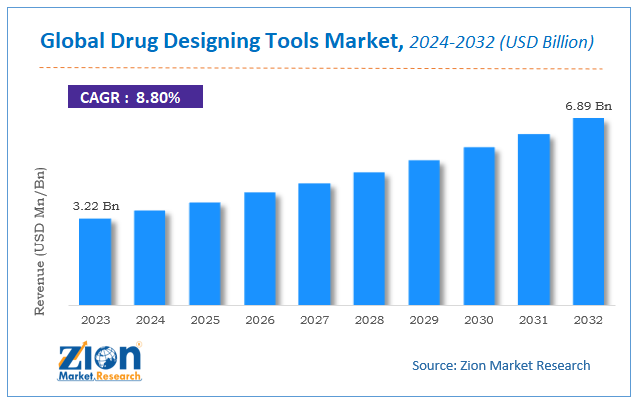
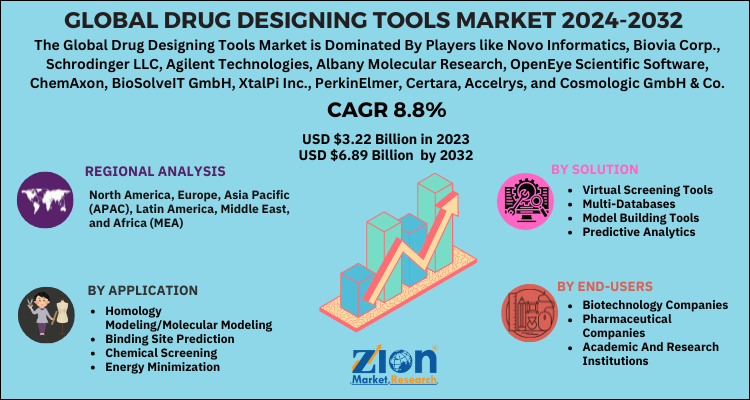
According to the report published by Zion Market Research, the global Drug Designing Tools Market size was valued at USD 3.22 Billion in 2023 and is predicted to reach USD 6.89 Billion by the end of 2032. The market is expected to grow with a CAGR of 8.8% during the forecast period. The report analyzes the global Drug Designing Tools Market's growth drivers, restraints, and impact on demand during the forecast period. It will also help navigate and explore the arising opportunities in the Drug Designing Tool industry.
 Request Free SampleRequest Free Sample
Global Drug Designing Tools Market: Overview
Drug designing tools refer to computer modeling proficiencies that offer insights into findings of experimental nature. These tools utilize computational chemistry for discovering, enhancing, and studying varied drugs and their related active biological molecules. The process of drug designing can be performed in two ways ligand-based drug designing and structure-based drug designing. Drug designing tools are used in various stages of drug development, which contributes to the increasing popularity of the global drug designing tools market.
Global Drug Designing Tools Market: Growth Factors
The major growth drivers in the global drug designing tools market are the growing need for cost- and time-effective drug designing tools and increased usage of advanced technologies in the drug designing tools. Due to the rising use of intelligent enterprise techniques for the purposes of drug designing, drug designing tools involving predictive analytics are anticipated to experience the highest market growth in the upcoming years. Owing to increased investments made in the field of research and innovation, contract research organizations are expected to hold a substantial market share, as they use drug designing tools for conducting various research projects. Hence, this will fuel the growth of the global drug designing tools market. Various biotechnology and pharmaceutical companies use drug designing tools to limit the use of resources and reduce the time for their drug development processes. This also contributes to the growth of the market for drug designing tools.
Incompatible infrastructure regarding drug designing tools might prove to be a hindrance in the expansion of the global drug designing tools market.
 Request Free SampleRequest Free Sample
Global Drug Designing Tools Market: Segmentation
The global drug designing tools market can be divided based on the solution, end-users, and application.
On the basis of the solution, the market for drug designing tools can be fragmented into virtual screening tools, multi-databases, structure building/designing tools, model building tools, and predictive analytics, among others.
Based on end-users, the drug designing tools market can be categorized into biotechnology companies, pharmaceutical companies, contract research organizations, and academic and research institutions, among others.
On the basis of application, the market for drug designing tools can be divided into homology modeling/molecular modeling, binding site prediction, chemical screening, target prediction, energy minimization, and docking, among others.
Recent Developments:
- In November 2025, Johnson & Johnson announced its intent to acquire Halda Therapeutics, a biotech firm with the RIPTAC™ platform for computational drug design, focused on developing targeted cancer therapies.
- In September 2022, CytoReason expanded its collaboration with Pfizer to apply AI in drug discovery, develop additional disease models, and create high-resolution models across multiple therapeutic areas.
Drug Designing Tools Market: Report Scope
| Report Attributes | Report Details |
|---|---|
| Report Name | Drug Designing Tools Market |
| Market Size in 2023 | USD 3.22 Billion |
| Market Forecast in 2032 | USD 6.89 Billion |
| Growth Rate | CAGR of 8.8% |
| Number of Pages | 200 |
| Key Companies Covered | Novo Informatics, Biovia Corp., Schrodinger LLC, Agilent Technologies, Albany Molecular Research, OpenEye Scientific Software, ChemAxon, BioSolveIT GmbH, XtalPi Inc., PerkinElmer, Certara, Accelrys, and Cosmologic GmbH & Co., among several others |
| Segments Covered | By Solution, By End-Users, By Application, and By Region |
| Regions Covered | North America, Europe, Asia Pacific (APAC), Latin America, Middle East, and Africa (MEA) |
| Base Year | 2023 |
| Historical Year | 2018 to 2022 |
| Forecast Year | 2024 - 2032 |
| Customization Scope | Avail customized purchase options to meet your exact research needs. Request For Customization |
Global Drug Designing Tools Market: Regional Analysis
Based on regions, the global drug designing tools market can be divided into five main regions: North America, Europe, Asia Pacific, Latin America, and the Middle East and Africa. The North American region is anticipated to dominate the global market for drug designing tools in the upcoming years. This is due to the region’s advanced capabilities and pace regarding research and development. In the Asia Pacific region, developed countries, like Japan, show good growth potential in the market for drug designing tools due to growing number of academic institutes, which are an end-user of drug designing tools. The European drug designing tools market also shows high potential, owing to huge investments made in the drug designing tools.
Global Drug Designing Tools Market: Competitive Players
The key market players in the global market for drug designing tools include;
- Novo Informatics
- Biovia Corp.
- Schrodinger LLC
- Agilent Technologies
- Albany Molecular Research
- OpenEye Scientific Software
- ChemAxon
- BioSolveIT GmbH
- XtalPi Inc.
- PerkinElmer
- Certara
- Accelrys
- Cosmologic GmbH & Co.
The global drug designing tools market is segmented as follows;
Global Drug Designing Tools Market: By Solution Segment Analysis
- Virtual Screening Tools
- Multi-Databases
- Structure Building/Designing Tools
- Model Building Tools
- Predictive Analytics
- Others
Global Drug Designing Tools Market: By End-Users Segment Analysis
- Biotechnology Companies
- Pharmaceutical Companies
- Contract Research Organizations
- Academic And Research Institutions
- Others
Global Drug Designing Tools Market: By Application Segment Analysis
- Homology Modeling/Molecular Modeling
- Binding Site Prediction
- Chemical Screening
- Target Prediction
- Energy Minimization
- Docking
- Others
By Region
- North America
- The U.S.
- Canada
- Mexico
- Europe
- France
- The UK
- Spain
- Germany
- Italy
- Rest of Europe
- Asia Pacific
- China
- Japan
- India
- Australia
- South Korea
- Rest of Asia Pacific
- The Middle East & Africa
- Saudi Arabia
- UAE
- Egypt
- Kuwait
- South Africa
- Rest of the Middle East & Africa
- Latin America
- Brazil
- Argentina
- Rest of Latin America
What Reports Provides
- Full in-depth analysis of the parent market
- Important changes in market dynamics
- Segmentation details of the market
- Former, on-going, and projected market analysis in terms of volume and value
- Assessment of niche industry developments
- Market share analysis
- Key strategies of major players
- Emerging segments and regional markets
- Testimonials to companies in order to fortify their foothold in the market.
Table Of Content

FrequentlyAsked Questions
Drug designing tools are software and technologies used to develop new drugs. They help analyze molecular interactions and speed up drug discovery.
The global Drug Designing Tools market is expected to be driven by the Driven by increasing R&D spending, adoption of AI/ML in discovery, and need to cut drug development time and cost. Growth in cloud computing and high-throughput screening accelerates software demand.
According to study, the global Drug Designing Tools market size was worth around USD 3.22 Billion in 2023 and is predicted to grow to around USD 6.89 Billion By 2032.
The global Drug Designing Tools market is expected to grow at a Compound Annual Growth Rate (CAGR) of around CAGR 8.8% during the forecast period from 2024-2032.
The global Drug Designing Tools industry is projected to be challenged by Challenges include high software and licensing costs, data quality and interoperability issues, and need for skilled computational chemistry and AI talent.
The Opportunities include accelerated AI-based drug discovery adoption, growth of cloud and SaaS platforms, increased biotech R&D funding, and integration with real-world and omics datasets for better prediction will offer significant growth opportunities in the Drug Designing Tools market.
AI/ML-driven virtual screening and de novo design; cloud-based platforms with scalable compute; better ADMET prediction and lab integration are the emerging trends and innovations impacting the Drug Designing Tools market.
The global Drug Designing Tools market is expected to be led by North America during the forecast period.
Some of the prominent players operating in the global Drug Designing Tools market are; Novo Informatics, Biovia Corp., Schrodinger LLC, Agilent Technologies, Albany Molecular Research, OpenEye Scientific Software, ChemAxon, BioSolveIT GmbH, XtalPi Inc., PerkinElmer, Certara, Accelrys, and Cosmologic GmbH & Co., among several others and others.
The report explores crucial aspects of the Drug Designing Tools market, including a detailed discussion of existing growth factors and restraints, while also browsing future growth opportunities and challenges that impact the market.
HappyClients

