
Global Dehydrating Breather Market Size, Share, Trends, Growth & Forecast 2032

Dehydrating Breather Market By Type (Conventional Breather and Self-Dehydrating Breather), By Desiccant Volume (<2.0 Kg, 2.0 to 4.0 Kg, and >4.0 Kg), By End-User (Utilities, Industrial, and Heavy-Duty Vehicles), and By Region - Global and Regional Industry Overview, Market Intelligence, Comprehensive Analysis, Historical Data, and Forecasts 2024 - 2032
| Market Size in 2023 | Market Forecast in 2032 | CAGR (in %) | Base Year |
|---|---|---|---|
| USD 428.34 Million | USD 604.4 Million | 3.9% | 2023 |
What is the Market size of the Dehydrating Breather Industry?
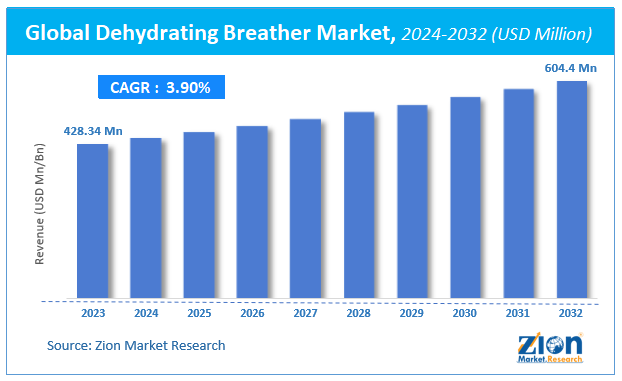
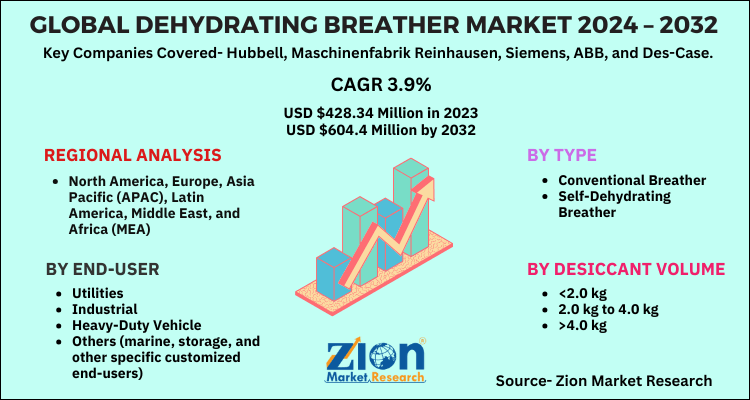
The global dehydrating breather market size was worth around USD 428.34 million in 2023 and is predicted to reach around USD 604.4 million by 2032, with a compound annual growth rate (CAGR) of roughly 3.90% between 2024 and 2032. This report provides a comprehensive analysis of the growth drivers, restraints, and challenges shaping demand across the global dehydrating breather market throughout the forecast period, while highlighting high-potential emerging opportunities within the industry.
Key Insights
- According to our research analyst, the global dehydrating breather market is estimated to grow at a CAGR of around 3.90% over the forecast period (2024-2032).
- In terms of revenue, the global dehydrating breather market size was valued at around USD 428.34 million in 2023 and is projected to reach USD 604.4 million by 2032.
- The dehydrating breather market is projected to grow at a significant rate due to escalating need for protecting electric equipment, rising investment in power transmission and distribution infrastructure, focus on asset optimization, and demand for higher transformer efficacy and durability.
- Based on the type segment, conventional breathers remain widely used while self-dehydrating (maintenance-free) designs are gaining importance for reduced maintenance and longer service life.
- Based on the end-user segment, utilities represent a major demand center driven by large transformer fleets and grid infrastructure requirements, with industrial applications also contributing strongly.
- Based on region, Asia Pacific is expected to create a dominant position over the forecast period due to favorable government policies supporting transmission and distribution investment, network refurbishment needs, and expanding power infrastructure.
Dehydrating Breather Market: Overview
Dehydrating breathers are utilized to prevent air moisture from polluting the oil in an electric device or transformer. They are generally deployed on either the oil compartment of a tap changer or on the air side of a transformer conservator. The product comprises silica gel having the ability to scrub air moisture after it goes through the breather that is provided with an oil trap, helping in the prevention of constant interaction between silica & moist air. The product is easy to deploy on any new device and can be used for the purpose of renovation.
Dehydrating Breather Market: Growth Drivers
What factors are propelling the expansion of the dehydrating breather market?
Escalating need for protecting electric equipment along with rise in the funding to improve power transmission & distribution infrastructure will propel the expansion of dehydrating breather market in the years ahead. The production of dehydrating breathers with advanced features will boost business trends. Additionally, a huge focus on optimization of assets through a surge in the number of transformers, along with the need to increase device efficacy as well as durability, will embellish the market size. Introduction of new kinds of desiccants and equipment modelling to sustain against extreme temperatures will provide new growth opportunities for the market over the years to come.
Rise in the power generating capacity as well as thriving power utility sector will translate into humongous need for transformers, thereby driving product demand. However, large-scale acceptance of dry-type transformers can retard the growth of the dehydrating breather industry in the years ahead. Nonetheless, low costs of maintenance for dehydrating breathers and their efficient functioning will create new facades of growth for the market in the upcoming years.
Dehydrating Breather Market: Restraints
What factors are limiting the growth of the dehydrating breather market?
Large-scale acceptance of dry-type transformers can reduce demand for oil-filled units that typically require dehydrating breathers, thereby moderating overall market expansion in some segments. Limited awareness in certain end-user groups and the need for application-specific customization can also slow adoption.
Dependency on industrial and utility equipment demand means that fluctuations in capital spending on power infrastructure or heavy industrial projects may temporarily affect order volumes.
Dehydrating Breather Market: Report Scope
| Report Attributes | Report Details |
|---|---|
| Report Name | Dehydrating Breather Market |
| Market Size in 2023 | USD 428.34 Million |
| Market Forecast in 2032 | USD 604.4 Million |
| Growth Rate | CAGR of 3.9% |
| Number of Pages | 220 |
| Key Companies Covered | Hubbell, Maschinenfabrik Reinhausen, Siemens, ABB, and Des-Case |
| Segments Covered | By Type, By Desiccant Volume, By End-User, and By Region |
| Regions Covered | North America, Europe, Asia Pacific (APAC), Latin America, Middle East, and Africa (MEA) |
| Base Year | 2023 |
| Historical Year | 2018 - 2022 |
| Forecast Year | 2024 - 2032 |
| Customization Scope | Avail customized purchase options to meet your exact research needs. Request For Customization |
Dehydrating Breather Market: Segmentation
The dehydrating breather market is segmented by type, desiccant volume, end-user, and region. All the segments of the dehydrating breather market have been analyzed based on present and future trends and the market is estimated from 2024 to 2032.
Based on Type Segment, the dehydrating breather market is divided into conventional breather and self-dehydrating breather. Conventional breathers have long been the standard solution for moisture protection on transformers and related equipment, offering proven performance and broad availability. Self-dehydrating (maintenance-free) breathers are gaining importance because they automatically regenerate the desiccant, reducing labor, silica gel replacement, and associated operating costs while supporting longer transformer service life. The combination of established conventional products and the rising preference for lower-maintenance self-dehydrating designs helps drive overall market growth by serving both cost-sensitive and reliability-focused applications across utilities and industry.
Based on Desiccant Volume Segment, the dehydrating breather market is divided into <2.0 kg, 2.0 kg to 4.0 kg, and >4.0 kg. Mid-range and higher desiccant volume options support a wide spectrum of transformer sizes and duty cycles common in utility and industrial settings. Smaller capacities suit compact or lower-load applications, while larger volumes address more demanding moisture-control requirements. The availability of multiple capacity ranges enables manufacturers and end-users to match product selection to specific equipment needs, supporting broader adoption and contributing to steady market expansion across diverse installation environments.
Based on End-User Segment, the dehydrating breather market is divided into utilities, industrial, heavy-duty vehicle, and others. Utilities represent a major demand center because of the large installed base of power transformers and the critical importance of moisture control for grid reliability and asset longevity. Industrial applications also contribute significantly where transformers, gearboxes, and other oil-filled equipment require protection against moisture ingress. Heavy-duty vehicle and other specialized uses, including marine and storage applications, add further volume. Strong demand from utilities and industrial sectors underpins overall market growth and encourages continued product improvement focused on reliability and reduced maintenance.
Dehydrating Breather Market: Regional Analysis
Why will Asia Pacific continue to dominate the global market during the projection period?
The growth of the market in Asia Pacific over the estimated timeline is due to favorable government policies promoting large-scale funding of transmission & distribution activities for enhancing the continuous supply of electricity in the region. In addition to this, the need for refurbishment of old & outdated power distribution networks to fulfill the massive power supply requirement of the consistently growing population will drive the regional market trends.
In addition to this, regular blackouts and power outages & interruptions in power supply witnessed in the remote regions as well as rural areas across the emerging economies in Asia Pacific will expedite the growth rate of the industry in the sub-continent over the ensuing years. Furthermore, an increase in investment across utilities, power grids, and power substation infrastructure sectors in the region will create lucrative growth avenues for the business in the Asia Pacific zone.
North America maintains an important presence supported by advanced industrial and utility infrastructure and ongoing attention to equipment reliability and predictive maintenance. Europe continues to contribute through established power networks and industrial applications that value moisture protection and asset longevity. Latin America and the Middle East and Africa are expected to register gradual progress as power infrastructure investment and industrial activity expand.
Dehydrating Breather Market: Competitive Analysis
The global dehydrating breather market is dominated by players:
- Hubbell
- Maschinenfabrik Reinhausen
- Siemens
- ABB
- Des-Case
The global dehydrating breather market is segmented as follows:
By Type
- Conventional Breather
- Self-Dehydrating Breather
By Desiccant Volume
- <2.0 kg
- 2.0 kg to 4.0 kg
- >4.0 kg
By End-User
- Utilities
- Industrial
- Heavy-Duty Vehicle
- Others (marine, storage, and other specific customized end-users)
By Region
- North America
- The U.S.
- Canada
- Mexico
- Europe
- France
- The UK
- Spain
- Germany
- Italy
- Rest of Europe
- Asia Pacific
- China
- Japan
- India
- Australia
- South Korea
- Rest of Asia Pacific
- The Middle East & Africa
- Saudi Arabia
- UAE
- Egypt
- Kuwait
- South Africa
- Rest of the Middle East & Africa
- Latin America
- Brazil
- Argentina
- Rest of Latin America
Table Of Content
Methodology
FrequentlyAsked Questions
A dehydrating breather removes moisture from air entering equipment. It protects transformers and machinery from moisture damage by using silica gel to scrub moisture from the air that passes through the unit, typically installed on transformer conservators or related oil compartments.
Key growth drivers include escalating need for protecting electric equipment, rising funding for power transmission and distribution infrastructure, focus on asset optimization and transformer efficacy and durability, growth in power-generating capacity and the utility sector, and demand for advanced features and extreme-temperature-capable designs.
According to the study, the global dehydrating breather market size was worth around USD 428.34 million in 2023 and is predicted to grow to around USD 604.4 million by 2032.
The global dehydrating breather market is expected to grow at a compound annual growth rate (CAGR) of around 3.9% during the forecast period from 2024 to 2032.
Major challenges include large-scale acceptance of dry-type transformers that can reduce demand for oil-filled units, limited awareness in some segments, customization needs, and dependency on industrial and utility equipment demand cycles.
Emerging trends include moisture-controlling breathers focused on equipment protection, extended service life for transformers and gearboxes, growth of maintenance-free self-dehydrating designs, and demand from heavy industries and utilities seeking lower maintenance and higher reliability.
The value chain typically includes design and engineering of conventional and self-dehydrating units, desiccant and component supply, manufacturing and assembly, distribution to utilities and industrial customers, installation on new or existing transformers, and after-sales support including monitoring and replacement or regeneration services.
Asia Pacific is expected to create a dominant position over the forecast period, supported by transmission and distribution investment, network refurbishment, and expanding power infrastructure.
Some of the prominent players operating in the global dehydrating breather market are Hubbell, Maschinenfabrik Reinhausen, Siemens, ABB, and Des-Case, among others.
The report explores crucial aspects of the dehydrating breather market, including a detailed discussion of existing growth factors and restraints, while also examining future growth opportunities and challenges that impact the market.

HappyClients

