
Global Data Wrangling Market Size, Share, Analysis, Trends, Growth 2032

Data Wrangling Market by Business Function (Finance, Marketing and Sales, Operations, Human Resources, and Legal), by Component (Tools, and Services), by Deployment (On-Premises and Cloud), and by Vertical (BFSI, Government and Public Sector, Healthcare and Life Science, Retail and E-commerce, Telecommunication and IT, Travel and Hospitality, Manufacturing, Energy & Utilities, and Others), and By Region: Global Industry Perspective, Comprehensive Analysis, and Forecast 2024-2032
| Market Size in 2023 | Market Forecast in 2032 | CAGR (in %) | Base Year |
|---|---|---|---|
| USD 1.72 Billion | USD 4.25 Billion | 10.68% | 2023 |
What is Data Wrangling Market Size?
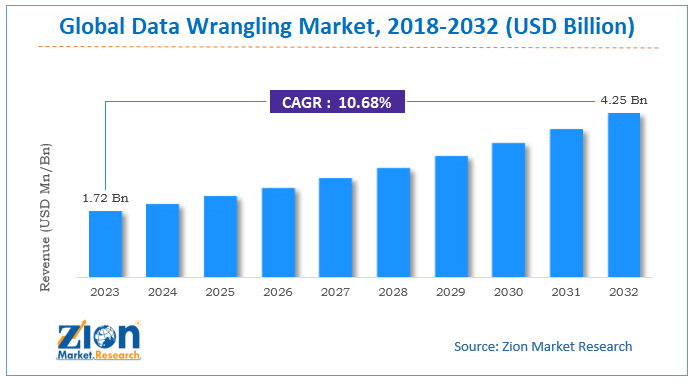
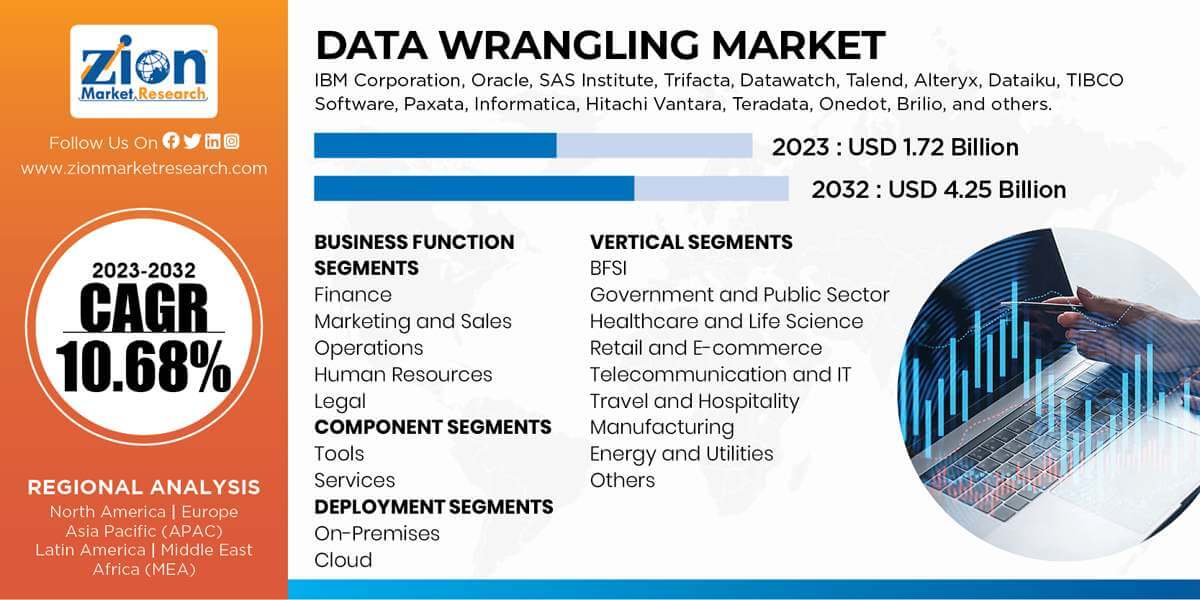
The global Data Wrangling market size accrued earnings worth approximately USD 1.72 Billion in 2023 and is predicted to gain revenue of about USD 4.25 Billion by 2032, is set to record a CAGR of nearly 10.68% over the period from 2024 to 2032.
 Request Free SampleRequest Free Sample
Key Insights
- As per the analysis shared by our research analyst, the data wrangling market is anticipated to grow at a CAGR of 10.68% during the forecast period.
- The global data wrangling market was estimated to be worth approximately USD 1.72 billion in 2023 and is projected to reach a value of USD 4.25 billion by 2032.
- The growth of the data wrangling market is being driven by the increasing need for organizations to clean, structure, and enrich raw data to support advanced analytics, artificial intelligence (AI), and machine learning (ML) applications.
- Based on the business function, the finance segment is growing at a high rate and is projected to dominate the market.
- On the basis of component, the tools segment is projected to swipe the largest market share.
- In terms of deployment, the on-premises segment is expected to dominate the market.
- Based on the vertical, the BFSI segment is expected to dominate the market.
- By region, North America is expected to dominate the global market during the forecast period.
Data Wrangling Market Overview
Data wrangling is defined as a process of mapping or transforming raw data into a valuable one for different applications such as analytics and forecasting. It is also known as data munging. It can also be defined as a process of unifying and cleaning complex and messy data sets for easy analysis and access. Iterative steps for data wrangling include discovering, structuring, cleansing, enriching, validating, and publishing. Different types of data problems faced by data analyzer are missing data, incorrect data, inconsistent representations of the same data, requirement of human intervention for data problems, and overly sanitizing data. With the use of visualization raw data or data issues can be detected, some of the visual representations are node-link diagram, matrix view, and sorted matrix view. The oldest tools used for data wrangling are SQL and Excel but recently, new tools have evolved for fast and powerful wrangling.
Some new tools can be listed as Tabula, OpenRefine, “R” packages, DataWrangler, CSVKit, Python and Pandas, Trifacta Wrangler, and Mr. Data Converter. Big data analytics industry is frequently using data wrangling solutions for fast data analysis. Data wrangling aims to reveal deeper intelligence within data, provide actionable and accurate data to business analysts, reduce time in collecting and organizing the data, enable data scientist to concentrate on analysis rather than wrangling or transformation of data and outsource better decision-making skills. Some of the frameworks used frequently for data wrangling are “R”, Python, Julia, Java, Hadoop and Hive, Scala, and Kafka and Storm. Leading organizations such as PepsiCo, Royal Bank of Scotland, and Kaiser Permanente are utilizing the benefits of data wrangling solutions with Big Data to accelerate the analysis processes and also to incorporate new data sources that were difficult to work earlier.
Data Wrangling Market Growth Analysis
Increasing pace and volume of data and advancements in machine learning and AI technologies are some of the major factors which are catering to the data wrangling market growth. Lacking awareness regarding data wrangling tools in SMEs, and focus on maintaining data quality are hindering the market prospect in the forecast period. Increasing regulatory pressure and growth of edge computing are the major opportunities for the data wrangling market growth. However, serious factor curtailing the market growth is reluctance in shifting from traditional ETL tools to automated tools.
This report offers comprehensive coverage on global data wrangling market along with, market trends, drivers, and restraints of the data wrangling market. This report includes a detailed competitive scenario and the product portfolio of key vendors. To understand the competitive landscape in the market, an analysis of Porter’s Five Forces model for the data wrangling market has also been included. The study encompasses a market attractiveness analysis, wherein all segments are benchmarked based on their market size, growth rate, and general attractiveness. This report is prepared using data sourced from in-house databases, secondary and primary research team of industry experts.
 Request Free SampleRequest Free Sample
Data Wrangling Market: Report Scope
| Report Attributes | Report Details |
|---|---|
| Report Name | Data Wrangling Market |
| Market Size in 2023 | USD 1.72 Billion |
| Market Forecast in 2032 | USD 4.25 Billion |
| Growth Rate | CAGR of 10.68% |
| Number of Pages | 201 |
| Key Companies Covered | IBM Corporation, Oracle, SAS Institute, Trifacta, Datawatch, Talend, Alteryx, Dataiku, TIBCO Software, Paxata, Informatica, Hitachi Vantara, Teradata, Onedot, Brilio, and others. |
| Segments Covered | By Application, By Sales Channel, By End-Use, By Material Type, and By Region |
| Regions Covered | North America, Europe, Asia Pacific (APAC), Latin America, Middle East, and Africa (MEA) |
| Base Year | 2023 |
| Historical Year | 2018 - 2022 |
| Forecast Year | 2024 - 2032 |
| Customization Scope | Avail customized purchase options to meet your exact research needs. Request For Customization |
Data Wrangling Market Segmentation Analysis
The study provides a decisive view of the data wrangling market by segmenting the market based on business function, component, deployment, verticals, and regions. All the segments have been analyzed based on present and future trends and the market is estimated from 2024 to 2032.
On the basis of the business function, the market is categorized into finance, sales and marketing, operations, human resources, and legal.
Further by the component type, the global data wrangling market is segmented into tools and services.
Furthermore, by deployment type, the market is divided into on-premises and cloud. BFSI, government and public sector, healthcare and life science, retail and e-commerce, telecommunication and IT, travel and hospitality, manufacturing, energy & utilities, and others are the major end-user verticals using data wrangling.
In terms of geographic region, North America is expected to dominate the market with highest market share due to the presence of developed economies. Asia Pacific region is expected to grow at the highest CAGR during the forecast period owing to the increasing manufacturing business in the region. Being a manufacturing hub, Asia Pacific region is expected to adopt the data wrangling solutions more substantially to export high-quality goods in a cost-efficient manner.
The regional segmentation includes the current and forecast demand for North America, Europe, Asia Pacific, Latin America, and the Middle East and Africa.
The report covers a detailed competitive outlook including the market share and company profiles of some of the key participants operating in the global data wrangling market include
- IBM Corporation
- Oracle
- SAS Institute
- Trifacta
- Datawatch
- Talend
- Alteryx
- Dataiku
- TIBCO Software
- Paxata
- Informatica
- Hitachi Vantara
- Teradata
- Onedot
- Brilio, and others.
The report segments the global data wrangling market as follows:
By Business Function
- Finance
- Marketing and Sales
- Operations
- Human Resources
- Legal
By Component
- Tools
- Services
By Deployment
- On-Premises
- Cloud
By Vertical
- BFSI
- Government and Public Sector
- Healthcare and Life Science
- Retail and E-commerce
- Telecommunication and IT
- Travel and Hospitality
- Manufacturing
- Energy and Utilities
- Others
By Region
- North America
- The U.S.
- Canada
- Mexico
- Europe
- France
- The UK
- Spain
- Germany
- Italy
- Rest of Europe
- Asia Pacific
- China
- Japan
- India
- Australia
- South Korea
- Rest of Asia Pacific
- The Middle East & Africa
- Saudi Arabia
- UAE
- Egypt
- Kuwait
- South Africa
- Rest of the Middle East & Africa
- Latin America
- Brazil
- Argentina
- Rest of Latin America
Table Of Content
Methodology
FrequentlyAsked Questions
Data wrangling is the process of cleaning and organizing raw data. It prepares data for analysis and decision-making.
The global data wrangling market is expected to be driven by the big data adoption, need for data quality improvement, and demand for faster analytics and insights.
According to study, the global data wrangling market size was worth around USD 1.72 Billion in 2023 and is predicted to grow to around USD 4.25 Billion By 2032.
The global data wrangling market is expected to grow at a Compound Annual Growth Rate (CAGR) of around CAGR 10.68% during the forecast period from 2024-2032.
The global data wrangling industry is projected to be challenged by Key challenges include handling unstructured data, data quality issues, and time-consuming preparation processes. Tool fragmentation and skills gaps reduce efficiency.
The Opportunities include analytics and AI readiness, automated data preparation tools, and self-service BI adoption. Enterprises seek faster insights from complex data sources will offer significant growth opportunities in the data wrangling market.
AI-assisted data preparation tools; automated cleansing and integration; real-time analytics-ready data pipelines are the emerging trends and innovations impacting the data wrangling market.
The global data wrangling market is expected to be led by North America during the forecast period.
Some of the prominent players operating in the global data wrangling market are; IBM Corporation, Oracle, SAS Institute, Trifacta, Datawatch, Talend, Alteryx, Dataiku, TIBCO Software, Paxata, Informatica, Hitachi Vantara, Teradata, Onedot, Brilio, and others. and others.
The report explores crucial aspects of the data wrangling market, including a detailed discussion of existing growth factors and restraints, while also browsing future growth opportunities and challenges that impact the market.

HappyClients

