
Global Connected Living Room Market Size, Share, Trends, Growth and Forecast 2032

Connected Living Room Market By Product (Home Theatre, Smart/3D, LED/OLED/LCD TV, Set-Top Box, Gaming Console, and Blu-Ray), By Technology (CLR Technology, Processors, Sensors, Chipsets for Wireless Connectivity, Memory IC, and LED Driver IC), and By Region - Regional Industry Overview, Market Intelligence, Comprehensive Analysis, Historical Data, and Forecasts 2024 - 2032
| Market Size in 2023 | Market Forecast in 2032 | CAGR (in %) | Base Year |
|---|---|---|---|
| USD 48.29 Billion | USD 235.55 Billion | 17.2% | 2023 |
Connected Living Room Industry Perspective
What will be the global connected living room market size during the forecast period?
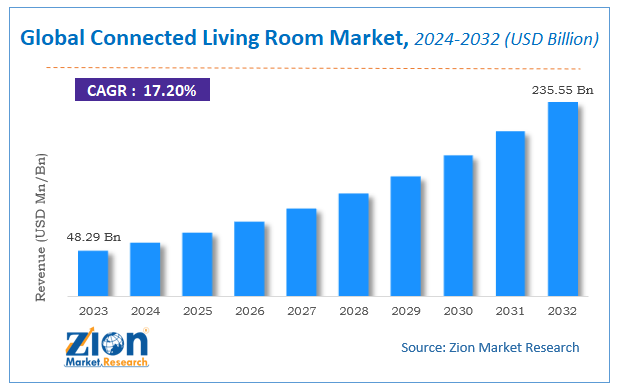
Zion Market Research has published a report on the global connected living room market size was valued at around USD 48.29 billion in 2023 and is projected to reach about USD 235.55 billion by 2032, with a compound annual growth rate (CAGR) of roughly 17.20% between 2024 and 2032.
This report provides a comprehensive analysis of the growth drivers, restraints, and challenges shaping demand across the global connected living room market throughout the forecast period, while highlighting high-potential emerging opportunities within the industry.
Key Insights
- As per the analysis shared by our research analyst, the global connected living room market is estimated to grow annually at a CAGR of around 17.20% over the forecast period (2024-2032).
- In terms of revenue, the global connected living room market size was valued at around USD 48.29 billion in 2023 and is projected to reach USD 235.55 billion by 2032.
- The connected living room market is driven by growing preferences for customer entertainment, escalating innovative display equipment, advanced platforms for information sharing and entertainment, rising digitization trends, user interactive features, content streaming popularity, network integration, and demand for smart equipment such as smart televisions.
- Based on the product, LED/OLED/LCD TV forms the core of the connected living room ecosystem, with smart televisions and related display solutions playing a central role in driving integration and demand.
- Based on the technology, the Chipsets for wireless connectivity segment held the largest market share in 2023 and is expected to grow at a significant rate over the forecast period.
- By Region, North America dominated the global market owing to technology advancements and novel product launches, while Asia Pacific is projected to experience rapid growth driven by urbanization, rising living standards, and increasing disposable income in countries such as India and China.
Connected Living Room Market: Overview
Growing preferences for customer entertainment are slated to contribute remarkably towards the connected living room market trends over the ensuing years. TV systems, set-top boxes, home theatre systems, multimedia devices, computers, gaming consoles, and smartphones are the primary electronic goods that are present in a living room.
A connected living room integrates these devices together for better and more efficient performance, as well as enhances their operational efficiency. Escalating innovative display equipment, advanced platform development for information sharing & entertainment, and rising demand digitization trends are a few of the major factors that are anticipated to drive up the connected living room market size.
Connected Living Room Market: Dynamics
User-interactive feature integration into home infotainment devices in recent years is expected to boost the connected living room market growth over the next few years. Increase in popularity of content streaming, software technologies, and network integration is expected to generate a greater scope for the connected living room market over the estimated span.
Significant breakthroughs witnessed across the wireless and wired connectivity technologies are further predicted to lucratively leverage the business space. Escalating demand for electronic items including home theatre systems, digital video recorders, and set-top boxes owing to their ability to offer better entertainment, personalized services, and communication opportunities is predicted to supplement connected living room market growth over the forecast timeline. Growing demand for smart equipment such as smart televisions with an ability to perform manifold functionalities is forecast to spur connected living room market trends.
Change in consumer purchasing behaviour favouring natural interfaces, high functionality, and low maintenance are key factors expected to play a significant role in influence the market growth in the near future. The increase in demand for better quality digital entertainment devices, coupled with declining product costs in the connected living room market, is foreseen to account for a significant share of connected living room market earnings over the years ahead.
Compatibility issues are the major restraining factor for this market and are projected to impact the business adversely over the estimated time span. Rise in deployment costs and low awareness level about the new concept in the developing regions are anticipated to hamper market progress. Nevertheless, massive penetration of new technologies into previously untapped markets is expected to offer numerous growth avenues for the market players. This, in turn, will minimize the hindrances to connected living room market growth.
Connected Living Room Market: Report Scope
| Report Attributes | Report Details |
|---|---|
| Report Name | Connected Living Room Market |
| Market Size in 2023 | USD 48.29 Billion |
| Market Forecast in 2032 | USD 235.55 Billion |
| Growth Rate | CAGR of 17.20% |
| Number of Pages | 255 |
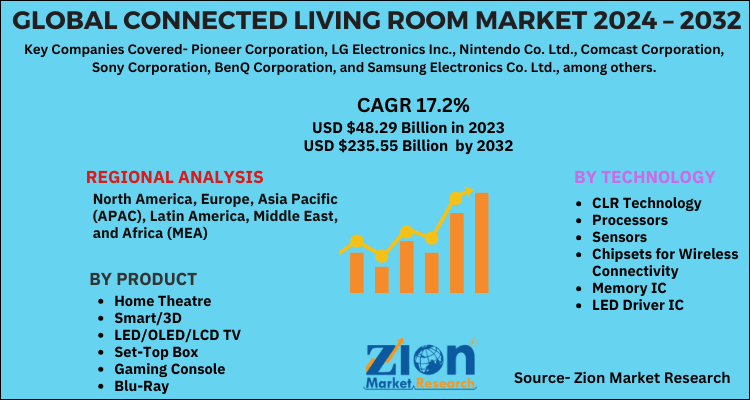
| Key Companies Covered | Pioneer Corporation, LG Electronics Inc., Nintendo Co. Ltd., Comcast Corporation, Sony Corporation, BenQ Corporation, and Samsung Electronics Co. Ltd., among others |
| Segments Covered | By Products, By Technology, and By Region |
| Regions Covered | North America, Europe, Asia Pacific (APAC), Latin America, Middle East, and Africa (MEA) |
| Base Year | 2023 |
| Historical Year | 2018 - 2022 |
| Forecast Year | 2024 - 2032 |
| Customization Scope | Avail customized purchase options to meet your exact research needs. Request For Customization |
Connected Living Room Market: Segmentation
The connected living room market is segmented by product, technology, and region. All the segments of the connected living room market have been analyzed based on present and future trends and the market is estimated from 2024 to 2032.
Based on Product, the connected living room market is divided into home theatre, smart/3D, LED/OLED/LCD TV, set-top box, gaming console, and Blu-ray. LED/OLED/LCD TVs and related smart display solutions play a central role in the connected living room ecosystem by serving as the primary interface for content, streaming, and device control. This leadership helps drive overall market growth through high consumer adoption and continuous innovation in picture quality and smart features. Home theatre systems, set-top boxes, gaming consoles, and Blu-ray devices form important complementary categories that expand entertainment options and deepen device integration within the living room environment.
Based on Technology, the connected living room market is divided into CLR technology, processors, sensors, chipsets for wireless connectivity, memory ICs, and LED driver ICs. Chipsets for wireless connectivity are particularly important for enabling seamless device communication, responsive performance, and intelligent control features. These technologies support market expansion by underpinning interoperability and advanced functionality across connected entertainment systems. Memory IC and LED driver IC further contribute by supporting efficient data handling and display performance that enhance the overall user experience.
Connected Living Room Market: Regional Analysis
Developed regions such as North America dominated the global market owing to technology advancements and novel product launches. These areas are expected to show positive growth over the forecast period. Developing regions such as Asia Pacific and Central & South America are projected to experience rapid growth in the industry owing to several key factors.
Emerging economies including India and China are estimated to witness positive growth due to rapid urbanization, an increase in living standards, and rise in disposable income over the coming years. Product innovation strategies implemented by the firms to product superior products are foreseen to further enhance regional and overall market growth in the near future. The developed regions are expected to provide lucrative opportunities for the industry participants to explore its untapped market growth potential.
Connected Living Room Market: Competitive Players
The key market players of the global connected living room market include:
- Pioneer Corporation
- LG Electronics Inc.
- Nintendo Co. Ltd.
- Comcast Corporation
- Sony Corporation
- BenQ Corporation
- Samsung Electronics Co. Ltd.
Segments Covered
The global connected living room market is segmented as follows:
By Product
- Home Theatre
- Smart/3D
- LED/OLED/LCD TV
- Set-Top Box
- Gaming Console
- Blu-Ray
By Technology
- CLR Technology
- Processors
- Sensors
- Chipsets for Wireless Connectivity
- Memory IC
- LED Driver IC
By Region
- North America
- The U.S.
- Canada
- Mexico
- Europe
- France
- The UK
- Spain
- Germany
- Italy
- Rest of Europe
- Asia Pacific
- China
- Japan
- India
- Australia
- South Korea
- Rest of Asia Pacific
- The Middle East & Africa
- Saudi Arabia
- UAE
- Egypt
- Kuwait
- South Africa
- Rest of the Middle East & Africa
- Latin America
- Brazil
- Argentina
- Rest of Latin America
Table Of Content
Methodology
FrequentlyAsked Questions
A connected living room integrates smart devices and entertainment systems such as TVs, set-top boxes, home theatre systems, gaming consoles, and related electronics to enable seamless digital control, better performance, and enhanced operational efficiency.
Key growth drivers include growing preferences for customer entertainment, innovative display equipment, advanced platforms for information sharing, rising digitization, user interactive features, content streaming popularity, network integration, demand for smart televisions, and declining product costs alongside higher functionality expectations.
The global connected living room market size was valued at approximately USD 48.29 billion in 2023 and is projected to reach around USD 235.55 billion by 2032.
The global connected living room market is expected to grow at a compound annual growth rate (CAGR) of approximately 17.2% during the forecast period from 2024 to 2032.
North America is expected to lead the connected living room market during the forecast period, supported by technology advancements and novel product launches.
Major players include Pioneer Corporation, LG Electronics Inc., Nintendo Co. Ltd., Comcast Corporation, Sony Corporation, BenQ Corporation, and Samsung Electronics Co. Ltd.
The report explores crucial aspects of the connected living room market, including a detailed discussion of existing growth factors and restraints, as well as future growth opportunities and challenges.

HappyClients

