
Global Clean Label Starch Market Size, Share, Trends, Growth and Forecasts 2034

Clean Label Starch Market By Product Type (Starch Blends, Modified, Native Starch, Resistant Starch, Pre-Gelatinized Starch, and Others), By Source (Rice, Tapioca, Potato, Legume-Based, Wheat, and Others), By Application (Pharmaceutical, Animal Feed Industry, Food & Beverage, and Others), By End-User (Contract Manufacturers, Specialty & Organic Food Brands, Food & Beverage Manufacturers, Pet Food Manufacturers, Cosmetic & Personal Care Companies, and Others), and By Region - Global and Regional Industry Overview, Market Intelligence, Comprehensive Analysis, Historical Data, and Forecasts 2026 - 2034
| Market Size in 2025 | Market Forecast in 2034 | CAGR (in %) | Base Year |
|---|---|---|---|
| USD 1.58 Billion | USD 3.48 Billion | 9.62% | 2025 |
Clean Label Starch Industry Perspective:
What is the anticipated size of the clean label starch market during the projection period?
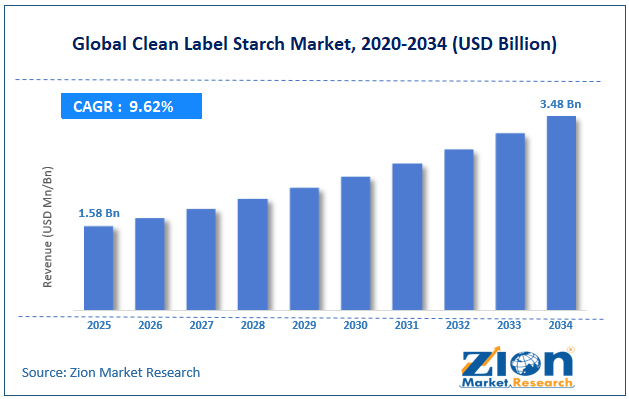
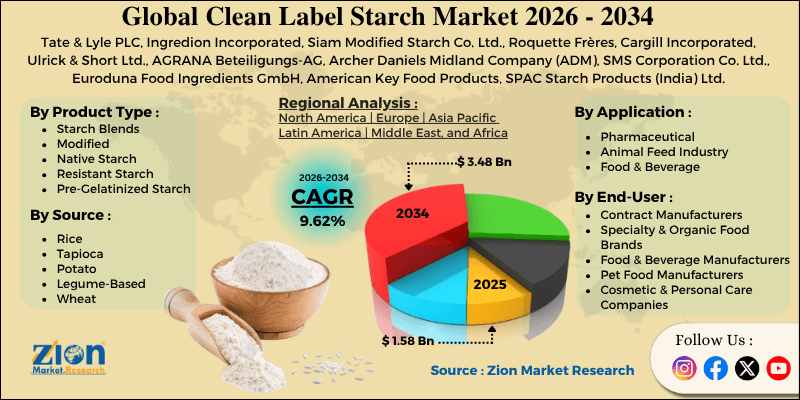
The global clean label starch market size was worth around USD 1.58 billion in 2025 and is predicted to grow to around USD 3.48 billion by 2034, with a compound annual growth rate (CAGR) of roughly 9.62% between 2026 and 2034.
Key Insights:
- As per the analysis shared by our research analyst, the global clean label starch market is estimated to grow annually at a CAGR of around 9.62% over the forecast period (2026-2034)
- In terms of revenue, the global clean label starch market size was valued at around USD 1.58 billion in 2025 and is projected to reach USD 3.48 billion, by 2034.
- The clean label starch market is projected to grow at a significant rate due to growing health consciousness among the population and demand for allergen-free and gluten-free food.
- Based on the product type, the native starch segment is growing at a high rate and will continue to dominate the global market as per industry projections.
- Based on the source, in 2025, potato was the leading revenue-generating segment. However, during the forecast period, tapioca is expected to emerge as the fastest-growing segment with a CAGR of 8%.
- Based on the application, the food & beverage industry segment is expected to lead the market growth trends.
- Based on the end-user, the food & beverage manufacturers segment is projected to influence revenue in the market.
- Based on region, North America is projected to dominate the global market during the forecast period.
Clean Label Starch Market: Overview
Clean-label starch is a familiar, simple, and minimally processed food ingredient. Common examples of clean-label starch are produced from known food items such as potato, corn, wheat, rice, and tapioca. Consumers are seeking more recognition of food ingredients. This trend has intensified the popularity of clean-label starch. It offers the same functionalities as conventionally used, highly processed starch. However, clean-label variants do not have e-numbers associated with them, which means they have not been chemically, enzymatically, or physically modified. During the forecast period, demand for clean-label starch is expected to grow due to rising health consciousness among the general population. Moreover, growing consumer awareness, higher product availability, emergence of quick commerce, and regulatory pressure will drive market revenue in the coming years. However, high cost, functional limitations, raw material supply and price volatility, and lack of standard regulations will affect market growth trends during the forecast period.
Impact of the USA-Israel and Iran war on the Clean Label Starch Market:
The USA-Israel and Iran war has affected the raw material supply chain. Transport disruptions in the Strait of Hormuz have increased freight charges and insurance premiums, leading to higher costs of final goods. During the forecast period, the war is expected to shape new and more resilient trade routes. Furthermore, domestic raw material sourcing will gain more investments in the future.
Clean Label Starch Market: Dynamics
Growth Drivers
How will growing health consciousness among the population shape the clean label starch market?
The global clean label starch market is expected to benefit from the rising health consciousness among the general population. Clean-label starch is minimally processed. It is produced using mechanical modification processes, such as enzymatic modification or extrusion. These processes allow clean-label starches to adhere to regulatory standards. In addition, clean-label starch maintains its natural integrity. Health-conscious consumers are actively seeking food items with minimally processed ingredients. Market research shows that these ingredients retain their nutrition while keeping the natural food structure intact. Moreover, since minimally processed food ingredients have fewer additives, they are a preferred choice among people who prioritize health.
Why is demand for allergen-free and gluten-free food driving revenue in the clean label starch market?
Public health awareness worldwide has improved significantly in the last few years. Consumers are more aware of which food items suit their overall health and which items should be avoided. According to the Cleveland Clinic, 1 in every 20 people in the US suffers from gluten intolerance. The demand for allergen- and gluten-free food items has witnessed steady growth. The global clean label starch market is expected to benefit as consumption of naturally gluten-free starch sources, such as rice and potato, grows.
Restraints
High cost of production and functional limitations to affect industry revenue during the projection period
The global clean label starch industry is expected to be restricted due to high cost of production and functional limitations. Clean-label starch is more expensive to produce as compared to traditional starch solutions. The high cost of production is due to extensive research and specialized equipment required to develop clean-label starch. Moreover, clean-label starch suffers from functional limitations. They may fail to deliver expected levels of processing stability or acid as compared to chemically modified starch.
Opportunities
Which opportunities will the quick commerce industry offer to the clean label starch market players?
The global clean label starch market players are anticipated to generate growth opportunities due to the emergence and rapid proliferation of the quick commerce industry. Grocery delivery applications delivering items within 10 to 30 minutes of order are reshaping consumer buying behavior. Market research suggests that these applications are encouraging more impulsive buying as compared to traditional planned weekly or monthly bulk shopping.
In addition, the growing trend of home cooking, especially with new recipes and ingredients, has further amplified demand for online grocery delivery applications. This segment of the quick commerce segment has opened new growth avenues for food items containing clean-label starch ingredients. As per official studies, more than 60% of consumers read the ingredient list before purchasing a packaged or ready-to-eat food item. Such consumer buying behaviors are expected to shape demand for clean-label starch in the coming years.
Challenges
Lack of standard regulations and raw material price volatility to challenge market growth
The global clean label starch industry is anticipated to be challenged by a lack of standard regulations concerning the clean-label industry. Inconsistent regulations cause compliance-related issues and confusion among buyers. In addition, raw material price and supply volatility, competition from processed starch, and varying consumer buying patterns may affect industry revenue in the long run.
Clean Label Starch Market: Report Scope
| Report Attributes | Report Details |
|---|---|
| Report Name | Clean Label Starch Market |
| Market Size in 2025 | USD 1.58 Billion |
| Market Forecast in 2034 | USD 3.48 Billion |
| Growth Rate | CAGR of 9.62% |
| Number of Pages | 227 |
| Key Companies Covered | Tate & Lyle PLC, Ingredion Incorporated, Siam Modified Starch Co. Ltd., Roquette Frères, Cargill Incorporated, Ulrick & Short Ltd., AGRANA Beteiligungs-AG, Archer Daniels Midland Company (ADM), SMS Corporation Co. Ltd., Euroduna Food Ingredients GmbH, American Key Food Products, SPAC Starch Products (India) Ltd., Manildra Group, Avebe U.A., BENEO GmbH, and others. |
| Segments Covered | By Product Type, By Source, By Application, By End-User, and By Region |
| Regions Covered | North America, Europe, Asia Pacific (APAC), Latin America, Middle East, and Africa (MEA) |
| Base Year | 2025 |
| Historical Year | 2020 - 2024 |
| Forecast Year | 2026 - 2034 |
| Customization Scope | Avail customized purchase options to meet your exact research needs. Request For Customization |
Clean Label Starch Market: Segmentation
The global clean label starch market is segmented based on product type, source, application, end-user, and region.
Why will the native starch segment lead the clean label starch industry revenue during the forecast period?
Based on product type, the global market segments are starch blends, modified starch, native starch, resistant starch, pre-gelatinized starch, and others. In 2025, the highest growth was listed in the native starch segment. It accounted for 53.9% of the global revenue. It will continue dominating market growth trends with a CAGR of 5.89% during the forecast period. Segmental growth is driven by higher preference for native starch among food companies to meet clean-label requirements and significant consumer demand.
Which will be the fastest-growing source during the forecast period in the clean label starch market?
Based on source, the global clean label starch industry is fragmented into rice, tapioca, potato, legume-based, wheat, and others. In 2025, potato was the leading revenue-generating segment. However, during the forecast period, tapioca is expected to emerge as the fastest-growing segment with a CAGR of 8%. Higher consumption of gluten-free, allergen-free, and plant-based food products will drive segmental growth during the forecast period.
Which factors drive demand in the food & beverage segment in the clean label starch industry?
Based on application, the global market divisions are pharmaceutical, animal feed industry, food & beverage, and others. In 2025, the market was led by the food & beverage industry. It held control over 70% of the total market share. Growing integration of clean-label starch across a wider range of food products, including ready-to-eat meals, soups, and dairy products, will help establish significant growth in the industry during the forecast period.
What will be the influence of the food & beverage manufacturers on the clean label starch market?
Based on end-user, the global market divisions are contract manufacturers, specialty & organic food brands, food & beverage manufacturers, pet food manufacturers, cosmetic & personal care companies, and others. In 2025, food & beverage manufacturers were the highest revenue generator. They contributed up to 47% of the global revenue. In the coming years, they will continue leading the market growth trends. Factors such as rising health awareness and consumer demand for easy-to-recognize food ingredients will drive segmental growth.
Clean Label Starch Market: Regional Analysis
Why will North America lead the clean label starch market in the coming years?
The global clean label starch market is currently led by North America. During the forecast period, it is expected to account for 47% of the global revenue. The presence of a mature and robust food processing industry across the US and Canada is a major driver of regional market growth. In addition, higher demand for gluten-free food ingredients, greater consumer awareness, growing consumption of plant-based food items, and strict regulatory policies will drive growth in the North American market.
Why will Asia-Pacific generate the fastest CAGR in the clean label starch market during the forecast period?
Asia-Pacific is expected to emerge as the fastest-growing region in the clean label starch market with a CAGR of 7.32% during the forecast period. Rising consumption of processed food, urbanization, evolving consumer lifestyle, and rising disposable income will aid accelerated growth across Asia-Pacific. Moreover, a surge in regional production of clean-label food items, favorable government policies, and the introduction of more standardized regulations will encourage higher regional market revenue.
Clean Label Starch Market: Competitive Analysis
The global clean label starch market is led by players like:
- Tate & Lyle PLC
- Ingredion Incorporated
- Siam Modified Starch Co. Ltd.
- Roquette Frères
- Cargill Incorporated
- Ulrick & Short Ltd.
- AGRANA Beteiligungs-AG
- Archer Daniels Midland Company (ADM)
- SMS Corporation Co. Ltd.
- Euroduna Food Ingredients GmbH
- American Key Food Products
- SPAC Starch Products (India) Ltd.
- Manildra Group
- Avebe U.A.
- BENEO GmbH
What are the latest key trends in the clean label starch market?
Demand for functional clean-label food ingredients
Growing demand for more functional clean-label food ingredients is a major market trend. It will encourage the production of starches offering high performance such as superior viscosity control, free-thaw stability, and binding results.
Integration of sustainable practices
The integration of sustainable business practices such as waste minimization, responsible sourcing of raw materials, and optimized production processes is expected to further drive market revenue. In addition, traceable sourcing and transparent labeling are expected to encourage higher brand confidence among buyers.
The global clean label starch market is segmented as follows:
By Product Type
- Starch Blends
- Modified
- Native Starch
- Resistant Starch
- Pre-Gelatinized Starch
- Others
By Source
- Rice
- Tapioca
- Potato
- Legume-Based
- Wheat
- Others
By Application
- Pharmaceutical
- Animal Feed Industry
- Food & Beverage
- Others
By End-User
- Contract Manufacturers
- Specialty & Organic Food Brands
- Food & Beverage Manufacturers
- Pet Food Manufacturers
- Cosmetic & Personal Care Companies
- Others
By Region
- North America
- The U.S.
- Canada
- Mexico
- Europe
- France
- The UK
- Spain
- Germany
- Italy
- Rest of Europe
- Asia Pacific
- China
- Japan
- India
- Australia
- South Korea
- Rest of Asia Pacific
- The Middle East & Africa
- Saudi Arabia
- UAE
- Egypt
- Kuwait
- South Africa
- Rest of the Middle East & Africa
- Latin America
- Brazil
- Argentina
- Rest of Latin America
Table Of Content
Methodology
FrequentlyAsked Questions
Clean-label starch is a familiar, simple, and minimally processed food ingredient. Common examples of clean-label starch are produced from known food items such as potato, corn, wheat, rice, and tapioca.
The global clean label starch market is expected to benefit from the rising health consciousness among the general population.
According to study, the global clean label starch market size was worth around USD 1.58 billion in 2025 and is predicted to grow to around USD 3.48 billion by 2034.
The CAGR value of the clean label starch market is expected to be around 9.62% during 2026-2034.
The global clean label starch industry is anticipated to be challenged by a lack of standard regulations concerning the clean-label industry.
Demand for functional clean-label food ingredients and integration of sustainable practices are the emerging trends and innovations impacting the clean label starch market.
The global clean label starch market has performed well so far and will offer similar trends in the coming years.
North America will contribute notably towards the clean label starch market value.
The global clean label starch market is led by players like Tate & Lyle PLC, Ingredion Incorporated, Siam Modified Starch Co. Ltd., Roquette Frères, Cargill Incorporated, Ulrick & Short Ltd., AGRANA Beteiligungs-AG, Archer Daniels Midland Company (ADM), SMS Corporation Co. Ltd., Euroduna Food Ingredients GmbH, American Key Food Products, SPAC Starch Products (India) Ltd., Manildra Group, Avebe U.A., and BENEO GmbH.
The report explores crucial aspects of the clean label starch market, including a detailed discussion of existing growth factors and restraints, while also browsing future growth opportunities and challenges that impact the market.

HappyClients

