
Chitin and Chitosan Derivatives Market Size, Share Report 2034

Chitin and Chitosan Derivatives Market By Type (Etherified Derivatives, Graft Copolymer Derivatives, Cross-Linked Derivatives, Nanostructured Derivatives, Oligomeric Derivatives, Water-Soluble Derivatives, and Others), By End-User Application (Food & Beverages, Water Treatment, Animal Feed, Pharmaceutical & Nutraceuticals, and Others), and By Region - Global and Regional Industry Overview, Market Intelligence, Comprehensive Analysis, Historical Data, and Forecasts 2025 - 2034
| Market Size in 2024 | Market Forecast in 2034 | CAGR (in %) | Base Year |
|---|---|---|---|
| USD 10.47 Billion | USD 28.86 Billion | 14.26% | 2024 |
Chitin and Chitosan Derivatives Industry Perspective:
What will be the global chitin and chitosan derivatives market size during the forecast period?
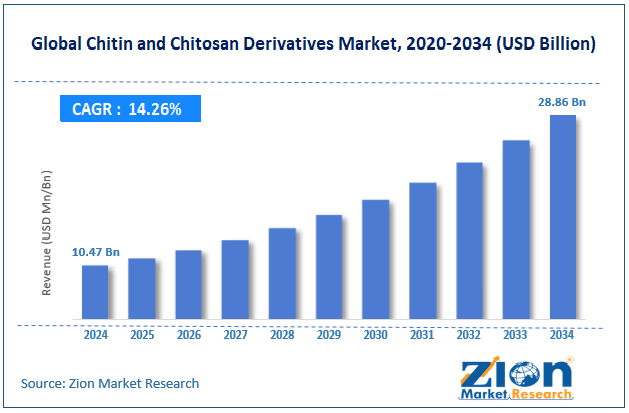
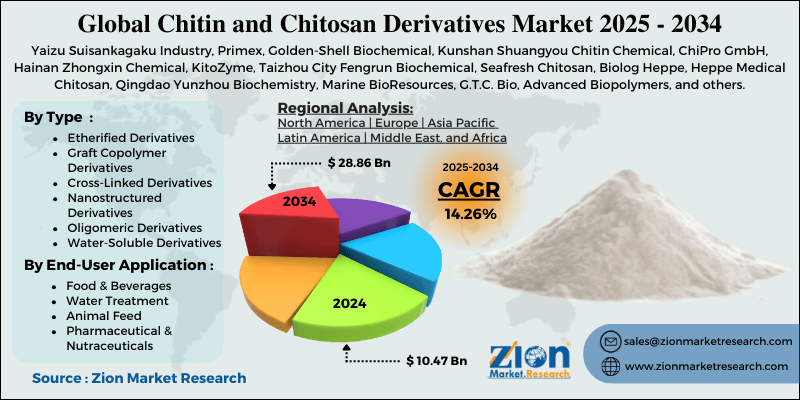
The global chitin and chitosan derivatives market size was worth around USD 10.47 billion in 2024 and is predicted to grow to around USD 28.86 billion by 2034, with a compound annual growth rate (CAGR) of roughly 14.26% between 2025 and 2034.
 Request Free SampleRequest Free Sample
Key Insights:
- As per the analysis shared by our research analyst, the global chitin and chitosan derivatives market is estimated to grow annually at a CAGR of around 14.26% over the forecast period (2025-2034)
- In terms of revenue, the global chitin and chitosan derivatives market size was valued at around USD 10.47 billion in 2024 and is projected to reach USD 28.86 billion by 2034.
- The global chitin and chitosan derivatives market is projected to grow at a significant rate due to the rising use of the materials in the production of chemical-free farming products such as soil conditioners and biopesticides.
- Based on the type, the water-soluble derivatives segment is growing at a high rate and will continue to dominate the global market, as per industry projections
- Based on the end-user application, the pharmaceutical & nutraceuticals segment is anticipated to command the largest market share
- Based on region, the Asia-Pacific is projected to dominate the global market during the forecast period
Chitin and Chitosan Derivatives Market: Overview
Chitin is the world’s most naturally abundant aminopolysaccharide polymer, while chitosan is its most popular derivative produced using chemical or enzymatic deacetylation. The common sources of chitin include shrimp and crab shells. Chitin and chitosan derivatives are non-toxic and biocompatible materials that have found widespread applications across prominent industries. Naturally available chitin and chitosan have limited real-life applications because they lack solubility. Hence, they are modified using chemical or enzyme-based ingredients to obtain more flexible and high-performance derivatives. The most common applications of chitin and chitosan derivatives are found in growing industries such as food & beverages (F&B), personal care & cosmetics, and waste & wastewater treatment. Global demand for chitin and chitosan derivatives is projected to continue to grow over the forecast period, driven by expanding applications across end-user industries.
Additionally, increasing demand for biocompatible materials in the medical sector may offer renewed expansion possibilities for industry players. A major drawback for the market may emerge in the form of the high cost of production and processing.
Chitin and Chitosan Derivatives Market: Dynamics
Growth Drivers
How will increased applications in the agricultural industry influence the growth rate of the chitin and chitosan derivatives market?
The global chitin and chitosan derivatives market is expected to be driven by the rising use of these materials in the production of chemical-free farming products, such as soil conditioners and biopesticides. According to industry analysis, chemical pesticides have a significant impact on soil quality after long-term use. They are known to reduce land fertility, promote erosion, and contaminate water around the land. In addition, long-term exposure of living organisms to chemical pesticides can lead to significant health impacts.
The presence of harmful chemicals in pesticides is linked to chronic issues such as infertility, cancer, and respiratory problems, along with acute poisoning in certain cases. The growing awareness of the significant disadvantages and health concerns associated with traditionally used agricultural products has worked in favor of biopesticides. The latter are prepared using biocompatible and eco-friendly ingredients, such as chitin & chitosan derivatives. The rising adoption of organic farming practices worldwide will work in favor of the industry players during the projection period.
Expansion of the nutraceutical industry to offer renewed growth momentum to the industry players
A major growth propeller for the chitin and chitosan derivatives is their rising applications in the nutraceutical industry. These materials are widely used in the production of organic and natural supplements. Additionally, research indicates that regular consumption of the solutions available in the global chitin and chitosan derivatives in the form of food supplements can help manage weight and reduce cholesterol levels. The growing demand for supplements prepared using natural ingredients will aid improved revenue for industry players in the coming years.
Restraints
Why will the high cost of production and processing limit the growth of the chitin and chitosan derivatives industry?
The global market for chitin and chitosan derivatives is constrained by high processing and production costs. Extracting and processing chitin and chitosan are highly complex, multi-step procedures. It requires specialized processing conditions and demands skilled labor. Additionally, the extensive length of chitin and chitosan derivatives makes the production of these materials highly resource-intensive, resulting in a limited number of market participants.
Opportunities
Ongoing research-based advancements in the industry offer growth opportunities to industry players
The global chitin and chitosan derivatives market is projected to present growth opportunities due to ongoing research and technological advancements in the industry. In the last few years, the development of eco-friendly polymers has received heightened attention from specialty material producers. Chitin and chitosan derivatives are biodegradable, biocompatible, and renewable. In addition, modification of chitosan and chitin further enhanced the overall characteristics of the material, making them available for greater applications.
Due to superior mechanical, biological, and physiochemical properties offered by derivatives of chitin & chitosan, they are increasingly being considered during the development of nanocomposites. Additionally, derivatives have found positive results in the healthcare sector concerning applications such as wound treatment and tissue regeneration. Ongoing innovations to broaden the use of derivatives across multiple industries will further support the industry's growth over the forecast period.
Challenges
How will raw material supply limitations challenge growth in the chitin and chitosan derivatives market?
The global chitin and chitosan derivatives industry is expected to be challenged by the raw material supply chain limitations faced by market players. The continuous supply of chitin and chitosan for modification depends on the volume of shellfish waste generated across the globe. However, factors such as geographical limitations and seasonal availability can create growth barriers for the market players.
 Request Free SampleRequest Free Sample
Chitin and Chitosan Derivatives Market: Report Scope
| Report Attributes | Report Details |
|---|---|
| Report Name | Chitin and Chitosan Derivatives Market |
| Market Size in 2024 | USD 10.47 Billion |
| Market Forecast in 2034 | USD 28.86 Billion |
| Growth Rate | CAGR of 14.26% |
| Number of Pages | 215 |
| Key Companies Covered | Yaizu Suisankagaku Industry, Primex, Golden-Shell Biochemical, Kunshan Shuangyou Chitin Chemical, ChiPro GmbH, Hainan Zhongxin Chemical, KitoZyme, Taizhou City Fengrun Biochemical, Seafresh Chitosan, Biolog Heppe, Heppe Medical Chitosan, Qingdao Yunzhou Biochemistry, Marine BioResources, G.T.C. Bio, Advanced Biopolymers, and others. |
| Segments Covered | By Type, By End-User Application, and By Region |
| Regions Covered | North America, Europe, Asia Pacific (APAC), Latin America, Middle East, and Africa (MEA) |
| Base Year | 2024 |
| Historical Year | 2019 to 2023 |
| Forecast Year | 2025 - 2034 |
| Customization Scope | Avail customized purchase options to meet your exact research needs. Request For Customization |
Chitin and Chitosan Derivatives Market: Segmentation
The global chitin and chitosan derivatives market is segmented based on type, end-user application, and region.
Why will the water-soluble derivatives segment lead the chitin and chitosan derivatives market?
Based on type, the global market segments are etherified derivatives, graft copolymer derivatives, cross-linked derivatives, nanostructured derivatives, oligomeric derivatives, water-soluble derivatives, and others. In 2024, the highest growth was observed in the water-soluble derivatives segment due to the broader applications of this type. Additionally, due to high solubility, they have exceptional demand in the agricultural and food & beverages industries. Similar trends are expected to emerge during the forecast period.
Why will the pharmaceuticals & nutraceuticals segment dominate the chitin and chitosan derivatives industry?
Based on end-user application, the global market divisions are food & beverage, water treatment, animal feed, pharmaceutical & nutraceuticals, and others. In 2024, the highest revenue-generating segment was pharmaceuticals & nutraceuticals. It will continue to dominate the market during the forecast period. The segmental prominence is attributable to increased use of derivatives in developing wound-healing medical products and in the formation of organic nutraceuticals.
Chitin and Chitosan Derivatives Market: Regional Analysis
Which factors will lead to the Asia-Pacific’s dominance in the chitin and chitosan derivatives market growth?
The global chitin and chitosan derivatives market is expected to be led by Asia-Pacific during the forecast period. In 2024, it accounted for nearly 40% of the global revenue and is anticipated to deliver a CAGR of over 12.75% in the coming years. The primary reason for higher regional revenue is the abundant presence of raw materials required for producing chitin and chitosan derivatives.
Countries such as China, India, Japan, and Thailand are among the largest contributors to the regional economy. In addition, the increasing use of derivatives in the region’s food & beverage sector, along with their growing adoption in the agricultural industry, will further support the region's growth.
What position will Europe hold in the chitin and chitosan derivatives industry?
Europe is projected to emerge as the second-highest revenue generator with a CAGR of 12.5% during the projection period. The region has a high demand for eco-friendly materials across growing industries. For instance, chitin and chitosan derivatives have seen increased use in the growing regional organic personal care and cosmetics industry.
Additionally, the growing regional shift toward sustainable solutions across food & beverages, water treatment, and agriculture will further support regional expansion. Moreover, increased research & development (R&D) toward the development of more effective chitin and chitosan derivatives will further aid regional expansion.
Chitin and Chitosan Derivatives Market: Competitive Analysis
The global chitin and chitosan derivatives market is led by players like:
- Yaizu Suisankagaku Industry
- Primex
- Golden-Shell Biochemical
- Kunshan Shuangyou Chitin Chemical
- ChiPro GmbH
- Hainan Zhongxin Chemical
- KitoZyme
- Taizhou City Fengrun Biochemical
- Seafresh Chitosan
- Biolog Heppe
- Heppe Medical Chitosan
- Qingdao Yunzhou Biochemistry
- Marine BioResources
- G.T.C. Bio
- Advanced Biopolymers
What are the key trends in the Chitin and Chitosan Derivatives Market?
Sustainable materials
A promising trend in the chitin and chitosan derivatives industry is the growing demand for sustainable materials. These non-toxic products are preferred in industries such as packaging and coatings, helping fuel market demand.
Lack of global standards
The lack of concrete, universally accepted standards for the production and application of chitin and chitosan derivatives is a concerning trend in the industry. This leads to substantial differences in the quality of products available on the market and in their end applications.
The global chitin and chitosan derivatives market is segmented as follows:
By Type
- Etherified Derivatives
- Graft Copolymer Derivatives
- Cross-Linked Derivatives
- Nanostructured Derivatives
- Oligomeric Derivatives
- Water-Soluble Derivatives
- Others
By End-User Application
- Food & Beverages
- Water Treatment
- Animal Feed
- Pharmaceutical & Nutraceuticals
- Others
By Region
- North America
- The U.S.
- Canada
- Europe
- France
- The UK
- Spain
- Germany
- Italy
- Rest of Europe
- Asia Pacific
- China
- Japan
- India
- South Korea
- Southeast Asia
- Rest of Asia Pacific
- Latin America
- Brazil
- Mexico
- Rest of Latin America
- Middle East & Africa
- GCC
- South Africa
- Rest of Middle East & Africa
Table Of Content
Methodology
FrequentlyAsked Questions

HappyClients

