
Global Cell Cycle Analysis Market Size, Share, Trends, Growth and Forecast 2032

Cell Cycle Analysis Market By Method (Software, Instruments, Consumables, and Others), By Application (Diagnosis, Research, Therapeutics, and Others), By End Users (Hospitals & Diagnostic Laboratories, Biotechnology Companies, Academics & Research Institutions, Contract Research Organization (CRO), and Others), and By Region - Global and Regional Industry Overview, Market Intelligence, Comprehensive Analysis, Historical Data, and Forecasts 2024 - 2032
| Market Size in 2023 | Market Forecast in 2032 | CAGR (in %) | Base Year |
|---|---|---|---|
| USD 20.42 Billion | USD 50.9 Billion | 10.68% | 2023 |
Cell Cycle Analysis Industry Perspective
What will be the global cell cycle analysis market size during the forecast period?
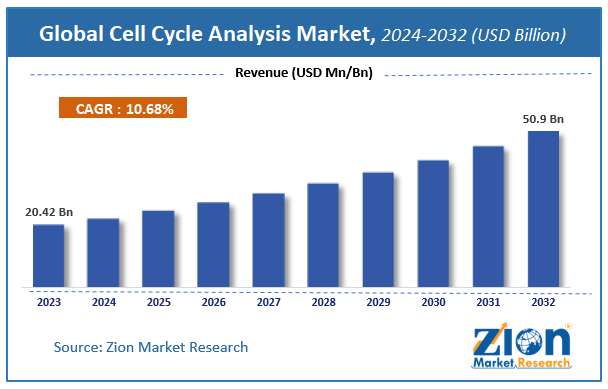
According to a report from Zion Market Research, the global cell cycle analysis market was valued at USD 20.42 billion in 2023 and is projected to hit USD 50.9 billion by 2032, with a compound annual growth rate (CAGR) of 10.68% during the forecast period 2024-2032.
This report provides a comprehensive analysis of the growth drivers, restraints, and challenges shaping demand across the global cell cycle analysis market throughout the forecast period, while highlighting high-potential emerging opportunities within the industry.
Key Insights
- As per the analysis shared by our research analyst, the global cell cycle analysis market is estimated to grow at a CAGR of approximately 10.68% during the forecast period from 2024 to 2032.
- In terms of revenue, the global cell cycle analysis market size was valued at around USD 20.42 billion in 2023 and is projected to reach USD 50.9 billion by 2032.
- The market is driven by increasing government and corporate support for cell-related research, rising prevalence of cancer and chronic genetic disorders, technological advancements in flow cytometry and fluorescence-based assays, and expanding healthcare investments.
- Based on the method, the consumables segment dominates the market, as reagents, kits, and assays are essential for routine cell cycle experiments and generate recurring revenue across research and clinical settings.
- Based on the application, the research segment holds the leading position because of extensive use in cancer biology, drug discovery, and fundamental cell biology studies that require detailed phase distribution insights.
- Based on the end users, the hospitals & diagnostic laboratories segment drives substantial demand through clinical diagnostics and advanced research applications, while academics & research institutions remain a core user base.
- Regionally, North America dominates the global market owing to advanced research infrastructure, high research funding, strong presence of leading instrument manufacturers, and widespread adoption of sophisticated cell analysis technologies.
Cell Cycle Analysis Market: Overview
Cell cycle analysis is a fundamental laboratory technique used to evaluate the distribution of cells across the distinct phases of the cell cycle, including G0/G1, S, G2, and M. It relies primarily on fluorescence-based assays that measure DNA content or specific molecular markers associated with each phase.
This approach enables researchers and clinicians to understand how cells respond to drugs, growth factors, environmental stimuli, or genetic modifications. The technique is widely applied in biomedical research, clinical diagnostics, and therapeutic development, particularly in oncology, where abnormal cell proliferation is a hallmark of disease.
Cell Cycle Analysis Market: Growth Factors
Why is demand for cell cycle analysis expanding across research and clinical settings?
The factor that attributes the secure growth rate of the international cell cycle analysis market is the increasing support from the corporate sectors and government for the researches that are related to the cells. The frequency of threatening diseases has increased, thus increasing the demand for cell cycle analysis. The greater popularity of cases of chronic genetic disorders and the increasing occurrences of cancer are the factors that are driving the market growth. Similarly, the growth of the healthcare sector, supported by substantial investments, has augmented the growth of the global market.
The technological developments that are made in this sector have pushed the growth of the market. The growing awareness and the increased adoption of the cell cycle analysis instruments expect to contribute to the market growth.
Cell Cycle Analysis Market: Restraints
What factors are limiting wider adoption of cell cycle analysis technologies?
The high capital cost of automated instruments and the ongoing expenses associated with reagents, maintenance, and calibration create significant barriers, particularly for smaller research groups and laboratories in emerging economies. These financial constraints often force institutions to limit the scale of their cell cycle studies or rely on shared core facilities.
Technical complexity and the requirement for skilled personnel further restrict market growth. Interpreting multiparameter data, optimizing staining protocols, and ensuring reproducible results demand specialized training that is not always available. These operational challenges slow the transition from traditional manual methods to more sophisticated platforms in many settings.
Cell Cycle Analysis Market: Report Scope
| Report Attributes | Report Details |
|---|---|
| Report Name | Cell Cycle Analysis Market |
| Market Size in 2023 | USD 20.42 Billion |
| Market Forecast in 2032 | USD 50.9 Billion |
| Growth Rate | CAGR of 10.68% |
| Number of Pages | 255 |
| Key Companies Covered | Agilent Technologies, Inc., Merck KGAA, Affymetrix, Inc., Danaher Corporation, Olympus Corporation, GE Healthcare, Miltenyi Biotech, PerkinElmer, Inc., Nexcelom Bioscience LLC, and Dickinson and Company |
| Segments Covered | By Method, By Applications, By End-Users, And By Region |
| Regions Covered | North America, Europe, Asia Pacific (APAC), Latin America, Middle East, and Africa (MEA) |
| Base Year | 2023 |
| Historical Year | 2018 - 2022 |
| Forecast Year | 2024 - 2032 |
| Customization Scope | Avail customized purchase options to meet your exact research needs. Request For Customization |
Cell Cycle Analysis Market: Segmentation
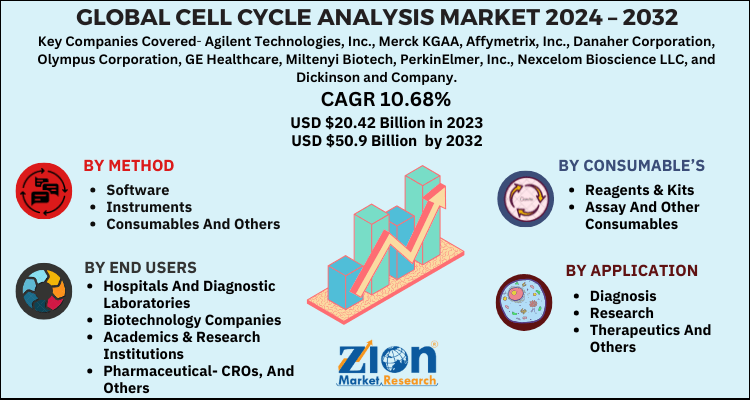
The cell cycle analysis market is segmented by method, application, end users, and region. All the segments of the cell cycle analysis market have been analyzed based on present and future trends and the market is estimated from 2024 to 2032.
Based on the method, the cell cycle analysis market is divided into software, instruments, consumables, and others. The consumables segment currently represents the most dominant category because reagents, kits, and related materials are required for every experiment and generate consistent recurring revenue. Their essential role in DNA staining, antibody labeling, and assay performance makes them indispensable across research and diagnostic workflows. Instruments form the second major category, encompassing flow cytometers, imaging systems, and related hardware that provide the analytical platform for data acquisition. Continuous innovation in instrument sensitivity, speed, and automation supports market growth by enabling higher-throughput and more sophisticated studies, while software solutions enhance data interpretation and visualization capabilities.
Based on Application, the cell cycle analysis market is divided into diagnosis, research, therapeutics, and others. The research segment dominates current demand because of the extensive application of cell cycle analysis in fundamental cell biology, cancer research, and preclinical drug discovery. Researchers rely on these techniques to understand proliferation dynamics, identify checkpoints, and evaluate compound effects. Diagnosis represents a growing secondary area as clinical laboratories increasingly incorporate cell cycle parameters into cancer diagnostics and monitoring. Therapeutic applications are expanding as insights from cell cycle studies inform the development of targeted agents and combination therapies, collectively advancing overall market expansion.
Based on End Users, the cell cycle analysis market is divided into hospitals & diagnostic laboratories, biotechnology companies, academics & research institutions, contract research organizations (CRO), and others. Hospitals & diagnostic laboratories segment drive significant demand through clinical testing and product development activities. Academics & research institutions form a foundational user base that sustains continuous innovation and method refinement. Contract research organizations are gaining importance as pharmaceutical sponsors outsource specialized cell-based assays, while other end users contribute to diversified market growth across the life sciences ecosystem.
Cell Cycle Analysis Market: Regional Analysis
Why will North America continue to dominate the global market during the projection period?
North America maintains its leading position in the global cell cycle analysis market through a combination of world-class research infrastructure, substantial public and private funding for life sciences, and the strong presence of major instrument and reagent manufacturers. The United States, in particular, drives regional performance with extensive academic, pharmaceutical, and biotechnology activity focused on cancer biology and drug discovery. High awareness of advanced analytical techniques, well-established core facilities, and continuous investment in next-generation flow cytometry and imaging platforms reinforce the region’s dominance. These factors collectively enable rapid adoption of innovative technologies and set global standards for experimental design and data quality that influence research practices worldwide.
Europe follows as a significant market, supported by robust research networks, collaborative funding programs, and growing emphasis on translational oncology studies. Countries such as Germany, the United Kingdom, and France contribute substantially through advanced academic centers and pharmaceutical research hubs.
Asia Pacific region has the fastest market growth in the cell cycle analysis market owing to factors such as increasing awareness about self-monitoring and the growing focus on cell cycle analysis. Another major factor that adds to the development of the Asia Pacific cell cycle analysis market includes the significant amount of investments that are made by prominent international companies. Japan, India, and China are the most influential countries of the Asia Pacific region.
Cell Cycle Analysis Market: Competitive Landscape
Some of the key market players that are involved in the cell analysis market include-
- Agilent Technologies
- Merck KGAA
- Affymetrix
- Danaher Corporation
- Olympus Corporation
- GE Healthcare
- Miltenyi Biotech
- PerkinElmer
- Nexcelom Bioscience LLC
- Dickinson and Company
Segments Covered
The global cell cycle analysis market is segmented as follows:
By Method
- Software
- Instruments
- Consumables
- Others
By Application
- Diagnosis
- Research
- Therapeutics
- Others
By End Users
- Hospitals & Diagnostic Laboratories
- Biotechnology Companies
- Academics & Research Institutions
- Contract Research Organization (CRO)
- Others
By Region
- North America
- The U.S.
- Canada
- Mexico
- Europe
- France
- The UK
- Spain
- Germany
- Italy
- Rest of Europe
- Asia Pacific
- China
- Japan
- India
- Australia
- South Korea
- Rest of Asia Pacific
- The Middle East & Africa
- Saudi Arabia
- UAE
- Egypt
- Kuwait
- South Africa
- Rest of the Middle East & Africa
- Latin America
- Brazil
- Argentina
- Rest of Latin America
What Reports Provides
- Full in-depth analysis of the parent market
- Important changes in market dynamics
- Segmentation details of the market
- Former, ongoing, and projected market analysis in terms of volume and value
- Assessment of niche industry developments
- Market share analysis
- Key strategies of major players
- Emerging segments and regional markets
- Testimonials to companies in order to fortify their foothold in the market.
Table Of Content
Methodology
FrequentlyAsked Questions
Cell cycle analysis is a technique used to study the stages of cell growth and division by measuring DNA content or phase-specific markers. It is widely applied in cancer research, drug development, and biomedical investigations to understand cellular responses to various stimuli.
The global cell cycle analysis market is driven by increasing cancer research activities, expanding drug discovery programs, advancements in flow cytometry and fluorescence-based methods, rising focus on cell-based studies, and growing government and corporate support for related research.
The global cell cycle analysis market size was valued at approximately USD 20.42 billion in 2023 and is expected to reach around USD 50.9 billion by 2032.
The global cell cycle analysis market is expected to grow at a compound annual growth rate (CAGR) of approximately 10.68% during the forecast period from 2024 to 2032.
Major challenges include technical complexity of multiparameter experiments, the need for skilled personnel, high instrument and reagent costs, and limited accessibility for smaller research groups.
Emerging trends include advanced spectral flow cytometry and imaging techniques, AI-driven data interpretation, growing applications in oncology and drug discovery, and increasing automation of sample preparation and analysis workflows.
The value chain typically includes manufacturers of instruments, reagents, and software, distributors and service providers, research institutions and core facilities, pharmaceutical and biotechnology companies, clinical laboratories, and end users who generate and apply the analytical data.
North America is expected to contribute notably and lead the global cell cycle analysis market during the forecast period due to its advanced research infrastructure and high adoption of sophisticated technologies.
Some of the major players leveraging the cell cycle analysis market growth are Agilent Technologies, Inc., Merck KGAA, Affymetrix, Inc., Danaher Corporation, Olympus Corporation, GE Healthcare, Miltenyi Biotech, PerkinElmer, Inc., Nexcelom Bioscience LLC, and Dickinson and Company.
The report provides a detailed examination of growth drivers, restraints, opportunities, and challenges, along with comprehensive segmentation analysis, regional insights, competitive landscape, and forward-looking forecasts that enable stakeholders to make informed strategic decisions.

HappyClients

