
Car Security System Market Size, Share, Trends, Growth and Forecast 2034

Car Security System Market By Type (Central Locking System, Immobilizer, Remote Keyless Entry, Car Alarm, and Others), By Vehicle Type (Passenger Car and Light Commercial Vehicle), By Sales Channel (OEM and Aftermarket), and By Region - Global and Regional Industry Overview, Market Intelligence, Comprehensive Analysis, Historical Data, and Forecasts 2026 - 2034
| Market Size in 2025 | Market Forecast in 2034 | CAGR (in %) | Base Year |
|---|---|---|---|
| USD 9.8 Billion | USD 18.8 Billion | 9.68% | 2025 |
Car Security System Industry Perspective:
What will be the size of the global car security system market during the forecast period?
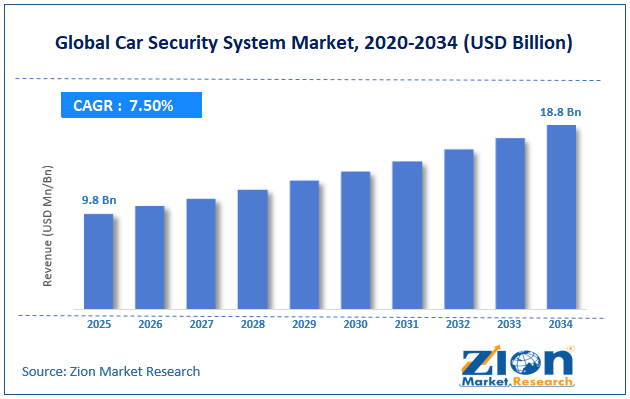
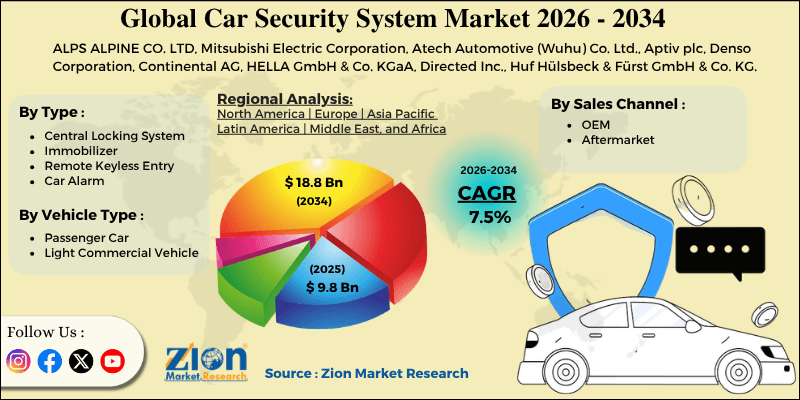
The global car security system market size was worth around USD 9.8 billion in 2025 and is predicted to grow to around USD 18.8 billion by 2034, with a compound annual growth rate (CAGR) of roughly 7.5% between 2026 and 2034.
Car Security System Market: Overview
The car security system is an interconnected network of electronic and mechanical components that protects vehicles against theft, unauthorized access, vandalism, burglary, and other threats, thereby enhancing vehicle safety. Such security systems may consist of many components, including but not limited to alarms, engine immobilizers, remote keyless entry systems, central locking, GPS tracking systems, intrusion detection, glass-break detectors, tilt sensors, and mobile phone-based monitoring and control systems. In recent years, innovations in connected vehicles, Artificial Intelligence (AI), IoT, biometric authentication, and telematics have been widely adopted in car security systems, increasing the efficiency of car protection by providing real-time notifications, remote vehicle tracking, geofencing, and car theft recovery. The widespread use of EVs, connected cars, and ADAS technologies, together with rising threat levels against cars, has driven the ongoing growth of the car security systems market.
Key Insights
- As per the analysis shared by our research analyst, the global car security system market is estimated to grow annually at a CAGR of around 7.5% over the forecast period (2026-2034).
- In terms of revenue, the global car security system market size was valued at around USD 9.8 billion in 2025 and is projected to reach USD 18.8 billion by 2034.
- Growing adoption of connected and smart vehicles is expected to propel the car security system market over the projected period.
- Based on the type, the immobilizer segment holds a significant market share in 2025.
- Based on the vehicle type, the passenger car segment held the largest revenue share in 2025 and is expected to continue the same pattern over the projected period.
- Based on the sales channel, the category of OEM is anticipated to hold a major proportion of the revenue generated in the car security system industry.
- Based on region, the North America region holds a prominent market share.
Impact of the USA-Israel War on Iran on the Car Security System Market
The increasing conflict between the U.S., Israel, and Iran will result in a positive-negative effect on the international market of car security systems. In the short term, the market will experience disruptions due to the rise in oil prices, as well as logistical issues resulting in increased expenses associated with the shipment of components used in the manufacturing of vehicles, due to the possible influence of the ongoing conflict on the Strait of Hormuz, which is vital for the international oil and electronics trade. Rising energy prices and logistics costs will increase production expenses, while shortages of semiconductors, sensors, ECUs, GPS systems, and communication chips will delay the production of security equipment.
Car Security System Market: Dynamics
Growth Drivers
How does the rising vehicle theft and break-in incidents drive the car security system market?
The rising number of car thefts and unauthorized vehicle access is a key driver of the global car security system market, compelling consumers and automakers to adopt technologically advanced anti-theft devices, including engine immobilizers, GPS, biometrics, artificial intelligence intrusion detection systems, and connected vehicle security. Despite a reduction in the theft rate in certain developed regions due to improved vehicle security measures, the number of thefts remains considerable.
According to the United States' National Highway Traffic Safety Administration (NHTSA), over 650,000 vehicles were stolen in 2025, while according to NICB, 659,880 vehicles were stolen in 2025, which means a vehicle was stolen once every 48 seconds. The high rate of thefts is compelling automobile manufacturers to install high-end security systems in their automobiles and also stimulating demand for aftermarket security systems for vehicles.
Restraints
Why does the availability of low-cost counterfeit products act as a major restraint to the growth of the car security system industry?
Counterfeit and substandard automobile security equipment, widely available at reduced cost, is a major constraint on the growth of the global car security system market. Counterfeit alarms, tracking systems, keyless entry systems, immobilizers, and surveillance systems are commonly sold through unauthorized websites and retail networks at prices well below those of authorized brands. Although they provide an appealing option for cost-sensitive customers, they usually do not have sufficient security features such as encryption, quality certification, longevity, and after-sales service, leading to their inefficient functioning and susceptibility to theft. They pose tough competition to legitimate manufacturers, erode consumer trust in vehicle safety technologies, and hamper the adoption of high-quality security systems.
In addition, these products can be non-compliant with safety standards in the automobile industry and electromagnetic interference regulations. Therefore, the proliferation of counterfeit vehicle security products continues to constrain revenue growth in the car security system market.
Opportunities
Does the increasing innovation in car security systems offer a lucrative opportunity for the car security system market?
Continual innovations in automobile security systems are opening up tremendous business opportunities for manufacturers and technologists. Integration of AI, IoT, telematics, biometric authentication, digital keys, GPS tracking, UWB technology, blockchain-based identity management, and cybersecurity will turn traditional car security into smart, connected security systems. These innovations enable real-time monitoring, remote disabling, theft prediction, geofencing, encryption, smartphone unlocking, and over-the-air updates, making car security better and more convenient.
Also, due to the rapid growth of EVs, connected cars, autonomous cars, and shared mobility solutions, demand for security systems that protect vehicles' physical and digital assets has increased. In view of the growing adoption of software-defined vehicles and connected car services by automobile manufacturers, innovation of automobile security solutions will create immense business opportunities in the global car security system market.
For instance, in August 2025, Panasonic Automotive Systems Co., Ltd. and VicOne Corporation, a subsidiary of Trend Micro Incorporated, further expanded the applicability of the security technology to the container-based system architecture for the future cockpit system and successfully completed the technical verification procedure. The security technology now includes xCarbon Vehicle Security Software supplied by VicOne, combined with Panasonic Automotive Systems’ VERZEUSE® for Virtualization Extensions Type-3 attack detection & protection technology, announced in October 2024. Consequently, it is possible to effectively manage communications between the containers within the Automotive Grade Linux (AGL*2).
Challenges
False alarms and system reliability issues pose a significant challenge to the industry's growth
The occurrence of false alarms and unreliability poses a significant risk to the future of the car security system market. Some of the issues that could make car security systems unreliable and create false alarms include malfunctioning of sensors, faulty installations, electronic interferences, severe weather conditions, and programming errors. Such issues can cause inconvenience for users and even lead them to deactivate some features of the car security system. Connected cars can have additional problems, such as communication issues that can affect features like remote monitoring, GPS tracking, and phone lock. To ensure continued growth in the car security system market, manufacturers need to focus on sensor accuracy and AI-based threat detection, properly validate software, and improve cybersecurity through OTA updates.
Car Security System Market: Report Scope
| Report Attributes | Report Details |
|---|---|
| Report Name | Car Security System Market |
| Market Size in 2025 | USD 9.8 Billion |
| Market Forecast in 2034 | USD 18.8 Billion |
| Growth Rate | CAGR of 7.5% |
| Number of Pages | 229 |
| Key Companies Covered | ALPS ALPINE CO. LTD, Mitsubishi Electric Corporation, Atech Automotive (Wuhu) Co. Ltd., Aptiv plc, Denso Corporation, Continental AG, HELLA GmbH & Co. KGaA, Directed Inc., Huf Hülsbeck & Fürst GmbH & Co. KG, I Car Srl, Marquardt GmbH, Stoneridge Inc., Robert Bosch GmbH, Tokai Rika Co. Ltd., Valeo S.A., and others. |
| Segments Covered | By Type, By Vehicle Type, By Sales Channel, and By Region |
| Regions Covered | North America, Europe, Asia Pacific (APAC), Latin America, Middle East, and Africa (MEA) |
| Base Year | 2025 |
| Historical Year | 2020 - 2024 |
| Forecast Year | 2026 - 2034 |
| Customization Scope | Avail customized purchase options to meet your exact research needs. Request For Customization |
Car Security System Market: Segmentation
Type Insights
Why does the immobilizer segment hold a prominent position in the car security system market?
The immobilizer segment holds a significant share of the car security system industry in 2025. This growth is fueled by the effectiveness of these systems in protecting cars from theft, as they can lock the engine in the absence of the correct key or digital authentication via encryption. The rising number of car thefts, growing customer demand for built-in anti-theft features in their cars, and strict automotive security laws are driving the increasing use of engine immobilizers in passenger and commercial vehicles. Modern engine immobilizer systems combine smart keys, keyless entry, biometric authentication, transponder encryption, and connected vehicles.
Vehicle Type Insights
Does the passenger car segment capture the largest share in the car security system market?
The passenger car segment held the largest revenue share of the car security system market in 2025 and is expected to maintain this trend over the projected period. The growth will be fueled by rising passenger car production, heightened consumer awareness of vehicle theft risk, and the increasing adoption of sophisticated electronic security technologies in new passenger cars. Auto manufacturers are now installing advanced technologies such as engine immobilizers, smart keys, alarms, GPS tracking, biometrics, digital keys, AI-enabled intrusion detection, and other technologies on their passenger cars in response to changing consumer needs and regulations. The rapid adoption of connected cars, EVs, and premium passenger cars is driving demand for sophisticated security technologies that enable remote monitoring, geofencing, cybersecurity, and OTA updates, among others. Growth in government and industry statistics also indicates that the passenger car market will continue to expand.
According to OICA, global auto sales grew from 95.3 million units in 2024 to 99.8 million units in 2025 at a YoY growth rate of 4.7%, while global auto production expanded from 92.7 million units to 96.4 million units (growth rate of 3.9%). This means there is greater potential for the automotive security solutions market due to the rising installed base. Besides, the BTS continues to record stable sales figures in the passenger car market, as shown in its official auto sales database. The increasing number of passenger cars, combined with the adoption of connected and software-defined passenger cars, is expected to boost revenue growth in the passenger car market over the forecast period.
Sales Channel Insights
What factor drives the OEM segment in the car security system market?
The OEM category is expected to account for a major share of revenue in the car security system industry. This growth is driven by the growing adoption of advanced security technology in vehicle manufacturing. Manufacturers have been installing security solutions such as engine immobilizers, smart and keyless entry systems, anti-theft alarms, GPS tracking, biometrics, digital keys, and AI-powered intrusion detection to protect their vehicles and meet evolving safety and security standards. These OEM-installed security solutions offer higher reliability, integration with the car's electronics, warranties, ADAS, connected vehicle platforms, and OTA upgrades. Increased production of passenger cars, electric vehicles, luxury vehicles, and connected vehicles is fueling demand for OEM-installed security solutions, as manufacturers differentiate their products with these solutions.
Regional Insights
What factors drive the North America region in the car security system market?
The North America region holds a prominent market share. Such growth is propelled by high vehicle penetration rates, widespread use of connected and premium vehicles, rising fears of vehicle theft, and the rapid development of modern automotive security technologies. Car manufacturers in the US and Canada have been increasingly deploying various security measures such as engine immobilizers, smart keys, GPS systems, biometrics, digital keys, AI-based intrusion detection systems, and OTA cybersecurity updates. North America is home to top OEMs and security technology vendors, as well as a highly developed aftermarket for car security systems.
Car Security System Market: Competitive Analysis
The global car security system market is dominated by players like:
- ALPS ALPINE CO. LTD
- Mitsubishi Electric Corporation
- Atech Automotive (Wuhu) Co. Ltd.
- Aptiv plc
- Denso Corporation
- Continental AG
- HELLA GmbH & Co. KGaA
- Directed Inc.
- Huf Hülsbeck & Fürst GmbH & Co. KG
- I Car Srl
- Marquardt GmbH
- Stoneridge Inc.
- Robert Bosch GmbH
- Tokai Rika Co. Ltd.
- Valeo S.A.
The global car security system market is segmented as follows:
By Type
- Central Locking System
- Immobilizer
- Remote Keyless Entry
- Car Alarm
- Others
By Vehicle Type
- Passenger Car
- Light Commercial Vehicle
By Sales Channel
- OEM
- Aftermarket
By Region
- North America
- The U.S.
- Canada
- Mexico
- Europe
- France
- The UK
- Spain
- Germany
- Italy
- Rest of Europe
- Asia Pacific
- China
- Japan
- India
- Australia
- South Korea
- Rest of Asia Pacific
- The Middle East & Africa
- Saudi Arabia
- UAE
- Egypt
- Kuwait
- South Africa
- Rest of the Middle East & Africa
- Latin America
- Brazil
- Argentina
- Rest of Latin America
Table Of Content
Methodology
FrequentlyAsked Questions
The car security system is an interconnected system of electronic and mechanical components used to secure vehicles against theft, unauthorized access, vandalism, burglary, and other threats, thereby increasing the car's safety.
The growth of the car security system market is primarily driven by the rising incidence of vehicle theft and break-ins, increasing production of passenger and electric vehicles (EVs), and the growing adoption of connected and software-defined vehicles. Advancements in artificial intelligence (AI), Internet of Things (IoT), GPS tracking, biometric authentication, digital keys, and over-the-air (OTA) software updates are enhancing vehicle security and user convenience.
The car security system market faces several challenges, including the high cost of advanced security technologies, cybersecurity risks associated with connected vehicles, and compatibility issues when retrofitting modern security systems into older vehicles. The market is also restrained by the availability of low-cost counterfeit products, which undermine consumer confidence and intensify price competition.
Based on the type, the immobilizer segment is expected to dominate the car security system market growth during the projected period.
Emerging trends in the car security system market include the integration of artificial intelligence (AI) for predictive threat detection, Internet of Things (IoT) connectivity for real-time vehicle monitoring, and digital key technology using smartphones and ultra-wideband (UWB) communication. Automakers are increasingly adopting biometric authentication, such as fingerprint and facial recognition, cloud-based telematics, GPS-enabled geofencing, and over-the-air (OTA) software updates to enhance both physical and cybersecurity protection.
According to the report, the global car security system market size was worth around USD 9.8 billion in 2025 and is predicted to grow to around USD 18.8 billion by 2034.
The global car security system market is expected to grow at a CAGR of 7.5% during the forecast period.
The global car security system industry growth is expected to be led by North America over the forecast period.
The global car security system market is dominated by players like ALPS ALPINE CO. LTD, Mitsubishi Electric Corporation, Atech Automotive (Wuhu) Co., Ltd., Aptiv plc, Denso Corporation, Continental AG, HELLA GmbH & Co. KGaA, Directed Inc., Huf Hülsbeck & Fürst GmbH & Co. KG, I Car Srl, Marquardt GmbH, Stoneridge Inc., Robert Bosch GmbH, Tokai Rika Co., Ltd., and Valeo S.A., among others.
The car security system market report covers the geographical market along with a comprehensive competitive landscape analysis. It also includes cash flow analysis, profit ratio analysis, market basket analysis, market attractiveness analysis, sentiment analysis, PESTLE analysis, trend analysis, SWOT analysis, trade area analysis, demand & supply analysis, Porter’s five forces analysis, and value chain analysis.

HappyClients

