
Capsule Endoscopy Market Size, Share, Trends, Growth & Forecast 2034

Capsule Endoscopy Market By Type (Small Bowel Capsule Endoscopy, Esophageal Capsule Endoscopy, Colon Capsule Endoscopy, Stomach Capsule Endoscopy), By Application (Hospital, Diagnostic Centers, Ambulatory Surgical Centers, Specialty Clinics), By End-User (Adults, Pediatrics, Geriatrics), By Technology (Wireless Capsule Endoscopy, Tethered Capsule Endoscopy, Magnetic Capsule Endoscopy), and By Region - Global and Regional Industry Overview, Market Intelligence, Comprehensive Analysis, Historical Data, and Forecasts 2025 - 2034
| Market Size in 2024 | Market Forecast in 2034 | CAGR (in %) | Base Year |
|---|---|---|---|
| USD 518.32 Million | USD 942.33 Million | 7.82% | 2024 |
Capsule Endoscopy Industry Perspective:
What will be the value of the global capsule endoscopy market during the forecast period?
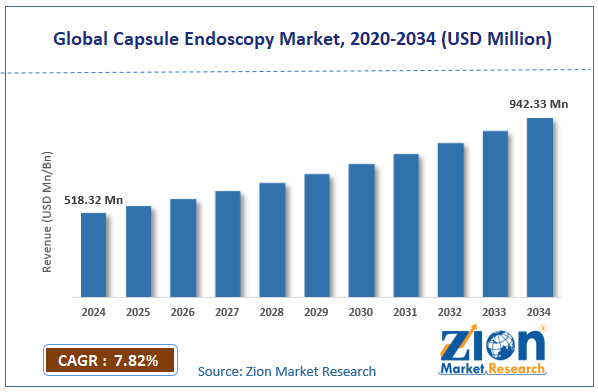
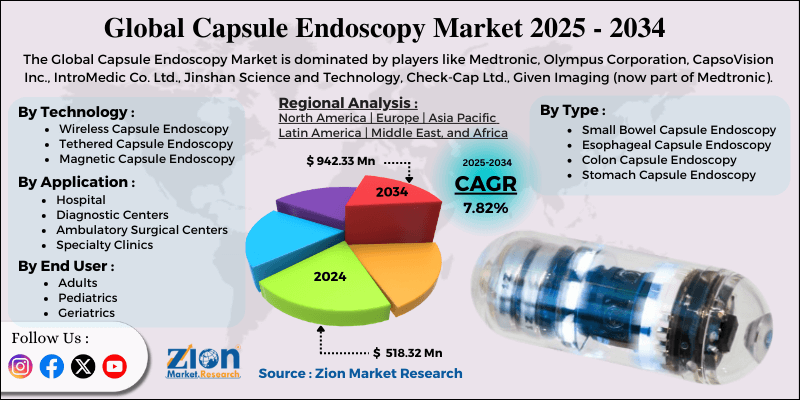
The global capsule endoscopy market size was worth approximately USD 518.32 million in 2024 and is projected to grow to around USD 942.33 million by 2034, with a compound annual growth rate (CAGR) of roughly 7.82% between 2025 and 2034.
 Request Free SampleRequest Free Sample
Key Insights
- As per the analysis shared by our research analyst, the global capsule endoscopy market is estimated to grow annually at a CAGR of around 7.82% over the forecast period (2025-2034).
- In terms of revenue, the global capsule endoscopy market size was valued at approximately USD 518.32 million in 2024 and is projected to reach USD 942.33 million by 2034.
- The capsule endoscopy market is projected to grow significantly due to increasing prevalence of gastrointestinal diseases, growing elderly populations, rising demand for non-invasive diagnostics, and technological advancements in medical imaging.
- Based on type, the small bowel capsule endoscopy segment is expected to lead the capsule endoscopy market, while the colon capsule endoscopy segment is anticipated to experience significant growth.
- Based on application, the hospital segment is expected to lead the capsule endoscopy market, while the diagnostic centers segment is anticipated to witness notable growth.
- Based on the end-user, the adults segment is the dominating segment, while the geriatrics segment is projected to witness sizeable revenue over the forecast period.
- Based on technology, the wireless capsule endoscopy segment is expected to lead the market, followed by magnetic capsule endoscopy.
- Based on region, North America is projected to dominate the global capsule endoscopy market during the estimated period, followed by Europe.
Capsule Endoscopy Market: Overview
Capsule endoscopy is a modern medical test that helps doctors check the digestive system without surgery or painful procedures. During capsule endoscopy, a patient swallows a small capsule containing a tiny camera. The capsule moves naturally through the stomach and intestines while taking thousands of clear images. These images are sent wirelessly to a recording device worn by the patient during daily activities. Doctors later review the images to find bleeding, inflammation, ulcers, tumors, or other digestive problems. Capsule endoscopy is useful for examining the small intestine, which is difficult to reach with traditional endoscopy. Specialized capsule versions also enable examination of the esophagus and colon when standard procedures are unsuitable. The procedure does not require anesthesia, sedation, or hospital stays, improving patient comfort and safety. Patients can walk, work, and eat lightly during the examination period. Single-use capsules reduce infection risk and ensure proper hygiene for every test. Capsule endoscopy helps diagnose Crohn's disease, celiac disease, unexplained bleeding, and intestinal growths. Doctors increasingly recommend capsule endoscopy for patients who cannot tolerate traditional endoscopy procedures due to anxiety or medical conditions. Growing patient awareness and acceptance of non-invasive testing continue to support wider use of capsule endoscopy worldwide.
The rising prevalence of gastrointestinal diseases and increasing preference for minimally invasive procedures are expected to drive growth in the capsule endoscopy market throughout the forecast period.
Capsule Endoscopy Market: Technology Roadmap 2025–2034
The capsule endoscopy market is entering a steady phase of advancement, driven by advances in imaging technology, longer battery life, support for artificial intelligence, improved patient comfort, and wider clinical adoption. The following is the technology roadmap divided into development phases expected to unfold through 2034.
2025–2027: Image Quality and Diagnostic Reliability Phase
- Higher-resolution cameras and improved lighting systems help doctors obtain clearer images and identify small digestive problems more accurately.
- Better battery performance allows capsules to travel longer through the digestive system, reducing incomplete examinations and improving diagnosis confidence.
2028–2031: Smart Analysis and Patient Comfort Phase
- Artificial intelligence software assists doctors by automatically highlighting bleeding, polyps, and abnormal areas, saving time and improving accuracy.
- Smaller capsule sizes and smoother designs make swallowing easier, improving patient comfort and acceptance of capsule endoscopy procedures.
- Real-time image viewing and better wireless transmission improve procedure monitoring and reduce data loss during examinations.
2032–2034: Controlled Navigation and Integrated Care Phase
- Advanced capsule control technologies enable precise positioning and movement, allowing focused examination of specific digestive areas.
- Full integration with hospital digital systems enables faster image sharing, remote diagnosis, telemedicine, and improved patient care outcomes across healthcare networks.
Capsule Endoscopy Market: Dynamics
Growth Drivers
How is the increasing prevalence of gastrointestinal diseases driving the growth of the capsule endoscopy market?
The capsule endoscopy market is expanding rapidly as digestive health issues affect millions of people worldwide, driving strong demand for accurate, patient-friendly diagnostic solutions. Inflammatory bowel diseases such as Crohn's disease and ulcerative colitis continue increasing across both developed and developing regions, requiring regular and detailed intestinal examinations. Gastrointestinal bleeding cases need timely diagnosis to locate bleeding sources and prevent serious complications that can worsen patient outcomes. Celiac disease diagnoses rise steadily as medical awareness improves and screening becomes more accessible for wider populations. Small intestine tumors require advanced imaging methods because traditional endoscopy tools often fail to reach these deep intestinal areas. Colorectal cancer screening guidelines now include younger age groups following higher incidence rates among people under fifty. Many patients experience unexplained abdominal pain and need a thorough evaluation to identify underlying digestive issues.
Food intolerances, obesity, stress, and modern dietary habits can lead to long-term digestive problems requiring medical attention. Aging populations face a natural decline in digestive function, increasing the need for regular monitoring. Capsule endoscopy offers a comfortable solution for repeated examinations, especially in hard-to-reach areas where conventional endoscopes cause discomfort or delay diagnosis.
Technological advancements are improving diagnostic capabilities.
The global capsule endoscopy market is growing rapidly as new technologies enhance the clarity, safety, and comfort of digestive testing for patients. Modern capsule endoscopy cameras capture very sharp images, helping doctors see small problems inside the digestive tract with greater accuracy. Improved lighting inside the capsule lights up intestinal walls evenly, making tissue details easier to view during diagnosis. A longer battery life allows the capsule to travel through the entire digestive system without stopping early. Faster image capture records more pictures, ensuring no areas are missed during the examination process.
Smart software reviews images automatically and highlights possible problem areas, reducing the time doctors spend analyzing results. Artificial intelligence helps identify bleeding, polyps, and lesions faster while improving diagnostic confidence. Some capsule models allow guided movement and real-time imaging, helping doctors focus on specific areas of the digestive tract more effectively. Improved wireless transmission and system integration support reliable data transfer, simple storage, easier sharing, and better collaboration across healthcare teams.
Restraints
High costs and limited reimbursement are affecting market adoption
A major challenge for the capsule endoscopy market is the high procedure cost, which reduces access for many patients and strains healthcare budgets. Capsule endoscopy tests usually cost more than traditional diagnostic methods, creating financial barriers for uninsured or underinsured patients. Each capsule is used only once, so each test incurs a new expense with no reuse or long-term cost recovery. Insurance coverage differs widely across countries, regions, and plans, leaving many patients responsible for high out-of-pocket payments.
Reimbursement policies in several healthcare systems provide limited support for capsule endoscopy compared to standard procedures. Public healthcare programs in developing regions rarely include capsule endoscopy among approved diagnostic services. Some private insurers require patients to try traditional endoscopy first before approving capsule-based testing. Pre-approval requirements increase paperwork for hospitals and delay timely patient diagnosis. Extra costs for image reading software and computer systems raise total setup expenses. Staff training requirements incur additional costs beyond the capsule purchase and the basic equipment investment. Smaller clinics and rural hospitals find it difficult to justify investments due to low patient volumes.
Opportunities
How is expansion into emerging markets creating new opportunities for the capsule endoscopy market?
The capsule endoscopy industry is experiencing strong growth opportunities as healthcare systems improve across developing countries with large, growing populations. Rising middle-class populations in Asia, Latin America, and Africa gain better access to advanced medical diagnosis services. Economic development allows governments to invest in modern hospitals equipped with advanced imaging and digital diagnostic technologies. Growing health insurance coverage helps make capsule endoscopy procedures more affordable for a wider population. Medical tourism brings international patients to emerging markets, where they seek quality care at lower treatment costs. Expanding medical education and training programs increases the number of doctors familiar with capsule endoscopy and its benefits. Global medical conferences and shared research increase awareness and acceptance of capsule endoscopy across regions.
Partnerships between international manufacturers and local distributors improve device availability, service support, and market reach. Telemedicine enables specialists in developed countries to review images from procedures done remotely. Mobile healthcare programs provide diagnostic services in rural areas with limited hospital infrastructure. Awareness of early cancer detection encourages governments to fund preventive screening initiatives.
Challenges
How are capsule retention issues and technical limitations creating challenges for the capsule endoscopy industry?
The capsule endoscopy industry faces significant challenges when capsules become stuck in the digestive system during routine medical testing. Capsule retention occurs when a device does not pass naturally through the intestines and remains trapped for an extended period. Narrow intestinal segments due to swelling, tumors, or scars from prior surgeries increase the risk of capsule blockage. Some patients face higher safety risks, which limits the number of people eligible for capsule endoscopy procedures.
A retained capsule can cause abdominal pain, blockage symptoms, discomfort, and anxiety for patients awaiting resolution. Surgical removal of adhered capsules entails additional medical risks, higher treatment costs, and emotional stress for patients. Special dissolvable test capsules help identify risks early, but add extra screening steps and added expenses. Battery life limits the duration for which the capsule records images while traveling through the digestive tract. Slow digestion in some patients prevents the capsule from reaching all target areas before power ends.
 Request Free SampleRequest Free Sample
Capsule Endoscopy Market: Report Scope
| Report Attributes | Report Details |
|---|---|
| Report Name | Capsule Endoscopy Market |
| Market Size in 2024 | USD 518.32 Million |
| Market Forecast in 2034 | USD 942.33 Million |
| Growth Rate | CAGR of 7.82% |
| Number of Pages | 215 |
| Key Companies Covered | Medtronic, Olympus Corporation, CapsoVision Inc., IntroMedic Co. Ltd., Jinshan Science and Technology, Check-Cap Ltd., Given Imaging (now part of Medtronic), and others. |
| Segments Covered | By Type, By Application, By End User, By Technology, and By Region |
| Regions Covered | North America, Europe, Asia Pacific (APAC), Latin America, Middle East, and Africa (MEA) |
| Base Year | 2024 |
| Historical Year | 2019 to 2023 |
| Forecast Year | 2025 - 2034 |
| Customization Scope | Avail customized purchase options to meet your exact research needs. Request For Customization |
Capsule Endoscopy Market: Segmentation
The global capsule endoscopy market is segmented based on type, application, end-user, technology, and region.
Based on type, the global capsule endoscopy industry is classified into small bowel, esophageal, colon, and stomach capsule endoscopy. Small bowel capsule endoscopy leads the market due to its ability to visualize areas unreachable by traditional endoscopy, its high diagnostic yield for obscure bleeding, and established clinical evidence supporting its effectiveness.
Based on application, the industry is segregated into hospitals, diagnostic centers, ambulatory surgical centers, and specialty clinics. Hospitals lead the market due to their comprehensive infrastructure, availability of gastroenterology specialists, emergency care capabilities, and favorable insurance reimbursement for facility-based procedures.
Based on end-user, the global capsule endoscopy market is divided into adults, pediatrics, and geriatrics. Adults are expected to lead the market during the forecast period due to higher disease prevalence, established reimbursement pathways, and larger patient populations seeking diagnostic services.
Based on technology, the global market is categorized into wireless capsule endoscopy, tethered capsule endoscopy, and magnetic capsule endoscopy. Wireless capsule endoscopy holds the largest market share due to patient comfort, freedom of movement during procedures, established clinical acceptance, and extensive regulatory approvals worldwide.
Capsule Endoscopy Market: Regional Analysis
What factors are contributing to North America's dominance in the global capsule endoscopy market?
North America is expected to grow at a 6.2% CAGR in the capsule endoscopy market during the forecast period, driven by rising rates of gastrointestinal diseases and increasing adoption of minimally invasive diagnostics. North America leads the capsule endoscopy market due to robust healthcare systems, high disease awareness, favorable insurance coverage, and early adoption of advanced medical technologies. The United States has well-equipped hospitals and diagnostic centers equipped with modern tools and staffed by trained doctors specializing in digestive health conditions. High healthcare spending per person allows many patients to access advanced diagnostic procedures when recommended by doctors.
Medicare and private insurance plans often cover capsule endoscopy for approved medical conditions, reducing patient financial burden. The region reports high cases of digestive disorders such as Crohn's disease, gastrointestinal bleeding, and colorectal cancer. Strong medical device and pharmaceutical industries support continuous innovation and faster technology improvement. Clear regulatory approval pathways help new capsule endoscopy products reach hospitals without long delays. Medical schools and training programs ensure doctors understand how to use and interpret capsule endoscopy results effectively. Research hospitals conduct clinical studies to expand approved uses and improve diagnostic accuracy. Patient support groups raise awareness about digestive diseases and promote timely diagnosis. Health education campaigns encourage people to seek medical help for digestive symptoms. Strong economic conditions allow hospitals to invest in advanced diagnostic equipment.
Academic medical centers often adopt new technology first, influencing wider regional adoption patterns. Telemedicine support improves image review efficiency across healthcare networks. North America also benefits from strong digital healthcare systems that support image storage, remote analysis, and smooth data sharing between hospitals and specialists. The growing demand for minimally invasive testing methods increases patient acceptance and supports the long-term expansion of capsule endoscopy across regional healthcare facilities.
Europe is experiencing significant growth.
Europe is projected to grow at an 8.6% CAGR, remaining the second-largest region in the global capsule endoscopy market. Europe is seeing strong growth in the capsule endoscopy market as healthcare providers increasingly adopt comfortable, minimally invasive diagnostic methods. Most European countries offer universal healthcare coverage, allowing patients to access important diagnostic tests without major financial barriers. National health systems carefully assess medical technologies based on clinical benefits, safety, and cost-effectiveness before widespread adoption. Germany plays a key role as a major center for medical device manufacturing and innovation in endoscopy technologies.
The United Kingdom's National Health Service continues to add capsule endoscopy to diagnostic pathways for selected digestive conditions. France benefits from a high number of gastroenterology specialists and advanced diagnostic facilities across both cities and rural regions. Scandinavian countries focus on preventive healthcare and early disease detection through national screening programs. Southern European nations face aging populations, which increases the need for routine monitoring of digestive health and for non-invasive diagnostic tools.
European medical associations develop shared clinical guidelines to support proper and consistent use of capsule endoscopy. Cross-border healthcare agreements allow patients to receive specialized procedures in neighboring countries when local access is limited. Strong regulatory oversight ensures approved capsule devices meet strict safety and performance standards. Medical tourism, collaborative research programs, and digital health record systems collectively reduce waiting times, support technological advancements, facilitate efficient image sharing, and expand the use of capsule endoscopy across Europe. High patient awareness and trust in public healthcare systems further strengthen acceptance of capsule-based diagnostics. These combined factors support long-term growth of the capsule endoscopy market across European healthcare systems.
Recent Market Developments
- In January 2025, CapsoVision, Inc. announced that its CapsoCam Plus capsule endoscopy system received U.S. FDA clearance for pediatric use, providing a non-invasive, child-friendly diagnostic option for young patients over 2 years old.
Capsule Endoscopy Market: Competitive Analysis
The leading players in the global capsule endoscopy market are:
- Medtronic
- Olympus Corporation
- CapsoVision Inc.
- IntroMedic Co. Ltd.
- Jinshan Science and Technology
- Check-Cap Ltd.
- Given Imaging (now part of Medtronic)
The global capsule endoscopy market is segmented as follows:
By Type
- Small Bowel Capsule Endoscopy
- Esophageal Capsule Endoscopy
- Colon Capsule Endoscopy
- Stomach Capsule Endoscopy
By Application
- Hospital
- Diagnostic Centers
- Ambulatory Surgical Centers
- Specialty Clinics
By End User
- Adults
- Pediatrics
- Geriatrics
By Technology
- Wireless Capsule Endoscopy
- Tethered Capsule Endoscopy
- Magnetic Capsule Endoscopy
By Region
- North America
- The U.S.
- Canada
- Europe
- France
- The UK
- Spain
- Germany
- Italy
- Rest of Europe
- Asia Pacific
- China
- Japan
- India
- South Korea
- Southeast Asia
- Rest of Asia Pacific
- Latin America
- Brazil
- Mexico
- Rest of Latin America
- Middle East & Africa
- GCC
- South Africa
- Rest of Middle East & Africa
Table Of Content
Methodology
FrequentlyAsked Questions

HappyClients