Global Blockchain in Insurance Market Size, Share, Growth Trends, and Forecast 2032

Blockchain in Insurance Market By Product (Health Insurance, Auto Insurance, Life Insurance), By Application Area (Underwriting, Claims Processing, Client Onboarding), By Component (Tools, Services), By Application (GRC Management, Identity Management and Fraud Detection, Death and Claims Management, Payments, Others), and By Region - Global and Regional Industry Overview, Market Intelligence, Comprehensive Analysis, Historical Data, and Forecasts 2024 - 2032
| Market Size in 2023 | Market Forecast in 2032 | CAGR (in %) | Base Year |
|---|---|---|---|
| USD 2.50 Billion | USD 611.53 Billion | 84.3% | 2023 |
Blockchain in Insurance Industry Perspective
What will be the global blockchain in insurance market size during the forecast period?
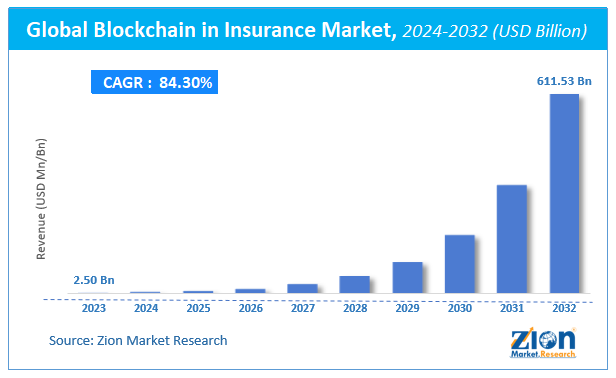
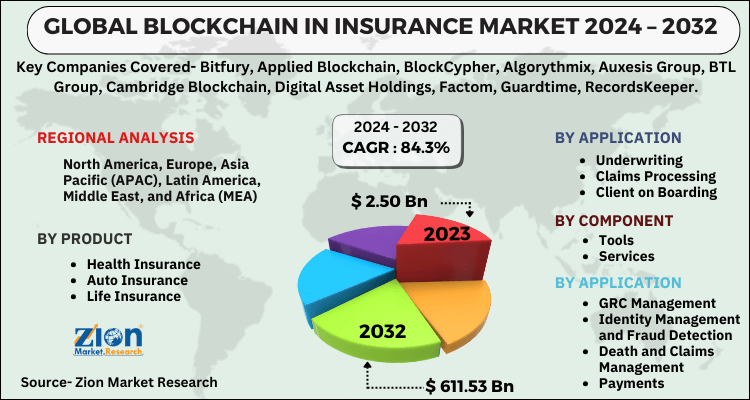
The global blockchain in insurance market size was valued at around USD 2.50 billion in 2023 and is projected to reach about USD 611.53 billion by 2032, with a compound annual growth rate (CAGR) of roughly 84.3% between 2024 and 2032.
This report provides a comprehensive analysis of the growth drivers, restraints, and challenges shaping demand across the global blockchain in insurance market throughout the forecast period, while highlighting high-potential emerging opportunities within the industry.
Key Insights
- As per the analysis shared by our research analyst, the global blockchain in insurance market is estimated to grow at a CAGR of approximately 84.3% during the forecast period from 2024 to 2032.
- In terms of revenue, the global blockchain in insurance market size was valued at around USD 2.50 billion in 2023 and is projected to reach USD 611.53 billion by 2032.
- The market is driven by the rising number of false insurance claims, the need for stronger fraud risk management, demand for transparency and trust, and the requirement to improve efficiency and claims processing across the insurance value chain.
- Based on the component, the services segment is anticipated to hold a massive share in the upcoming years due to the rising rate of consulting services in the insurance industry.
- Based on the application, identity management and fraud detection is strongly accelerated by the rising rate of insurance fraud claims, as blockchain enables rapid verification through a highly secured system.
- Regionally, North America is observed to significantly dominate the market due to the high rate of blockchain adoption in the region.
Blockchain in Insurance Market: Overview
Blockchain is an encrypted protocol designed to secure digitized data. It consists of an encrypted list of databases referred to as blocks. In the insurance industry, blockchain is applied for fraud detection, claims management, payment modeling, and reinsurance management. The technology supports secure, transparent, and tamper-resistant recording and sharing of data across multiple parties and provides a single source of truth that is updated and validated through consensus.
Blockchain in Insurance Market: Growth Drivers
What factors are accelerating the expansion of blockchain in insurance market?
The rising volume of false insurance claims and the associated cost burden on insurers and policyholders are primary growth drivers. Blockchain enables rapid verification of claims through a highly secure system and supports fraud detection with viable proofs, which addresses a core operational challenge in the industry.
Demand for greater transparency and trust across underwriting, claims, payments, and related processes further supports adoption. The continuous need to improve efficiency and claims processing creates additional momentum for blockchain solutions that streamline workflows and reduce friction among multiple parties.
Blockchain in Insurance Market: Restraints
What factors are limiting the growth of blockchain in insurance market?
The constant need for energy resources to run blockchain software for encryption and decryption restrains market growth to some extent. Energy intensity can affect operating costs and environmental considerations for large-scale deployments.
Integration complexity, regulatory uncertainty in some jurisdictions, and the need to align blockchain solutions with existing core insurance systems can also slow adoption among more conservative carriers.
Blockchain in Insurance Market: Report Scope
| Report Attributes | Report Details |
|---|---|
| Report Name | Blockchain in Insurance Market |
| Market Size in 2023 | USD 2.50 Billion |
| Market Forecast in 2032 | USD 611.53 Billion |
| Growth Rate | CAGR of 84.3% |
| Number of Pages | 265 |
| Key Companies Covered | Bitfury, Applied Blockchain, BlockCypher, Algorythmix, Auxesis Group, BTL Group, Cambridge Blockchain, Digital Asset Holdings, Factom, Guardtime, RecordsKeeper, Microsoft, IBM, Earthport, iXLedger, SAP, Symbiont and SafeShare |
| Segments Covered | By Product, By Application Area, By Component, By Application, and By Region |
| Regions Covered | North America, Europe, Asia Pacific (APAC), Latin America, Middle East, and Africa (MEA) |
| Base Year | 2023 |
| Historical Year | 2018 - 2022 |
| Forecast Year | 2024 - 2032 |
| Customization Scope | Avail customized purchase options to meet your exact research needs. Request For Customization |
Blockchain in Insurance Market: Segmentation
The blockchain in insurance market is segmented by product, application area, component, application, and region. All the segments of the blockchain in insurance market have been analyzed based on present and future trends and the market is estimated from 2024 to 2032.
Based on Product, the blockchain in insurance market is divided into health insurance, auto insurance, and life insurance. Blockchain applications across these product lines support fraud detection, claims integrity, and more efficient process flows. Health, auto, and life insurance each present distinct data and workflow requirements, and blockchain solutions that address identity verification, claims validation, and payment processes help insurers improve control and customer outcomes across these major lines of business.
Based on Application Area, the market is divided into underwriting, claims processing, and client onboarding. Claims processing and related integrity controls are particularly important given the impact of fraudulent claims on industry costs. Underwriting and client onboarding benefit from improved data quality, identity management, and shared, trusted records that reduce duplication and accelerate decision-making. Together these application areas drive practical use of blockchain across the insurance value chain.
Based on Component, the blockchain in insurance market is divided into tools and services. The services segment is anticipated to hold a massive share in the upcoming years due to the boosting rate of consulting services in the insurance industry. Implementation support, integration, and advisory services help insurers adopt and scale blockchain solutions effectively. Tools that enable smart contracts, data sharing, and process automation complement services and support end-to-end solution delivery.
Based on Application, the market is divided into GRC management, identity management and fraud detection, death and claims management, payments, and others. Rising insurance fraud claim rates immensely accelerate growth of the identity management and fraud detection segment. Blockchain supports rapid claim verification and helps build highly secured systems that reduce fraudulent activity. GRC management, death and claims management, payments, and related uses further expand the role of blockchain in improving transparency, efficiency, and control across insurance operations.
Blockchain in Insurance Market: Regional Analysis
Why will North America continue to dominate the global market during the projection period?
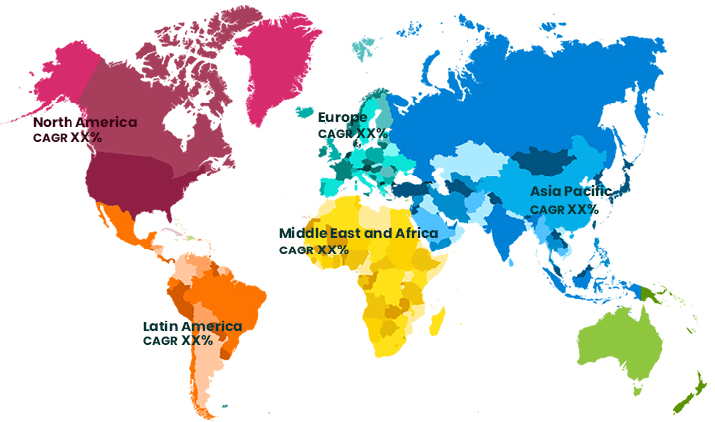
North America is observed to significantly dominate the blockchain in insurance market due to the high rate of blockchain adoption in the region. Strong technology infrastructure, active insurer and technology-provider ecosystems, and focus on fraud reduction and operational efficiency support sustained leadership. These conditions enable North America to drive innovation, pilot advanced use cases, and set practical benchmarks for blockchain deployment in insurance that influence global market development.
Europe maintains significant activity supported by regulatory interest in digital innovation and insurer efforts to improve transparency and process efficiency. Asia Pacific represents an important growth region as digital insurance models expand and carriers explore blockchain for fraud control and operational improvement. Latin America and the Middle East and Africa are emerging opportunities where selective adoption for claims integrity, payments, and identity-related use cases is expected to increase over the forecast period.
Blockchain in Insurance Market: Competitive Analysis
Some of the major players in the global blockchain in insurance market include;
- Bitfury
- Applied Blockchain
- BlockCypher
- Algorythmix
- Auxesis Group
- BTL Group
- Cambridge Blockchain
- Digital Asset Holdings
- Factom
- Guardtime
- RecordsKeeper
- Microsoft
- IBM
- Earthport
- iXLedger
- SAP
- Symbiont and SafeShare
Segments Covered
The report segments the global blockchain in insurance market as follows:
By Product
- Health Insurance
- Auto Insurance
- Life Insurance
By Application Area
- Underwriting
- Claims Processing
- Client Onboarding
By Component
- Tools
- Services
By Application
- GRC Management
- Identity Management and Fraud Detection
- Death and Claims Management
- Payments
- Others
By Region
- North America
- The U.S.
- Canada
- Mexico
- Europe
- France
- The UK
- Spain
- Germany
- Italy
- Rest of Europe
- Asia Pacific
- China
- Japan
- India
- Australia
- South Korea
- Rest of Asia Pacific
- The Middle East & Africa
- Saudi Arabia
- UAE
- Egypt
- Kuwait
- South Africa
- Rest of the Middle East & Africa
- Latin America
- Brazil
- Argentina
- Rest of Latin America
Table Of Content
Methodology
FrequentlyAsked Questions
Blockchain in insurance refers to the application of blockchain technology within the insurance industry to improve processes, enhance transparency, reduce fraud, and streamline operations. It is a distributed digital ledger that enables secure, transparent, and tamper-resistant recording and sharing of data across multiple parties.
The global blockchain in insurance market is driven by rising false insurance claims, the need for stronger fraud risk management, demand for transparency and trust, and the continuous need to improve efficiency and claims processing.
The global blockchain in insurance market size was valued at approximately USD 2.50 billion in 2023 and is expected to reach around USD 611.53 billion by 2032.
The global blockchain in insurance market is expected to grow at a compound annual growth rate (CAGR) of approximately 84.3% during the forecast period from 2024 to 2032.
North America is observed to significantly dominate the market due to the high rate of blockchain adoption and is expected to contribute notably to global market value.
Some of the major players leveraging the blockchain in insurance market growth are Bitfury, Applied Blockchain, BlockCypher, Algorythmix, Auxesis Group, BTL Group, Cambridge Blockchain, Digital Asset Holdings, Factom, Guardtime, RecordsKeeper, Microsoft, IBM, Earthport, iXLedger, SAP, Symbiont, and SafeShare.

HappyClients