Blister Packaging Machine Pharmaceutical Market Size Report 2034

Blister Packaging Machine Pharmaceutical Market By Type (Thermoform Blister Packaging Machines, Cold Form Blister Packaging Machines, Rotary Blister Packaging Machines), By Automation Level (Manual, Semi-Automatic, Fully Automatic), By Application (Tablets and Capsules, Ampoules and Vials, Medical Devices, Nutraceuticals), By End User (Pharmaceutical Manufacturers, Contract Packaging Organizations, Nutraceutical Companies, Medical Device Companies), and By Region - Global and Regional Industry Overview, Market Intelligence, Comprehensive Analysis, Historical Data, and Forecasts 2026 - 2034
| Market Size in 2025 | Market Forecast in 2034 | CAGR (in %) | Base Year |
|---|---|---|---|
| USD 2.56 Billion | USD 3.29 Billion | 2.79% | 2025 |
Blister Packaging Machine Pharmaceutical Industry Perspective:
What will be the size of the blister packaging machine pharmaceutical market during the forecast period?
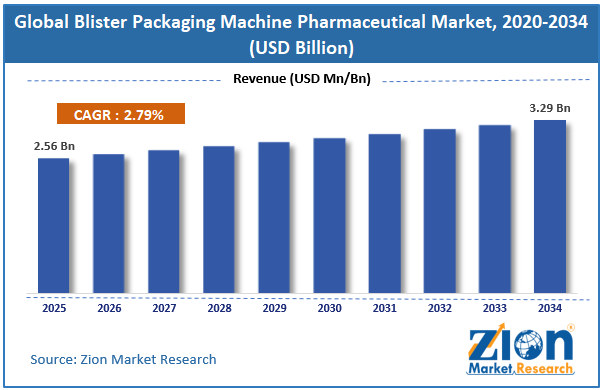
The global blister packaging machine pharmaceutical market size was valued at approximately USD 2.56 billion in 2025 and is projected to reach around USD 3.29 billion by 2034, growing at a compound annual growth rate of approximately 2.79% between 2026 and 2034.
Key Insights
- As per the analysis shared by our research team, the global blister packaging machine pharmaceutical market is estimated to grow at a compound annual growth rate of approximately 2.79% during the forecast period from 2026 to 2034.
- In terms of revenue, the global blister packaging machine pharmaceutical market was valued at approximately USD 2.56 billion in 2025 and is projected to reach USD 3.29 billion by 2034.
- The blister packaging machine pharmaceutical market is expected to grow strongly due to rising global pharmaceutical production, increasing demand for tamper-evident packaging, growing preference for automated manufacturing lines, and continuous innovation in packaging materials.
- Based on type, thermoform blister packaging machines lead the market because of their versatility and cost-effectiveness, while cold form blister packaging machines are gaining strong momentum as one of the fastest-growing segments due to their superior protection for moisture-sensitive medicines.
- Based on automation level, fully automatic machines lead the market due to their ability to handle high-volume production with minimal manual intervention. In contrast, semi-automatic machines remain popular among smaller manufacturers seeking flexible production options.
- Based on application, tablets and capsules lead the market due to their widespread use as the most common dosage form. At the same time, nutraceuticals are the fastest-growing segment as consumer demand for packaged supplements continues to rise.
- Based on end user, pharmaceutical manufacturers lead the market due to their large-scale production needs, while contract packaging organizations are steadily growing as more companies outsource their packaging operations to specialized providers.
- Based on region, North America leads the global blister packaging machine pharmaceutical market. At the same time, Asia Pacific is the fastest-growing region due to expanding pharmaceutical manufacturing capacity and rising generic drug production.
Blister Packaging Machine Pharmaceutical Market: Overview
A blister packaging machine is pharmaceutical packaging equipment that seals tablets, capsules, and other medicines into individual pockets made from plastic and foil, protecting each dose from moisture, contamination, light, and physical damage. The blister packaging machine market serves pharmaceutical manufacturers producing prescription medicines, generic drugs, vitamins, and other healthcare products. Blister packaging is widely used because it keeps doses separated, helps patients track their medication, improves portability, and can extend product shelf life. Growing medicine production, rising demand for generic drugs, and stronger focus on patient safety are encouraging pharmaceutical companies to invest in efficient blister packaging machinery. Regulatory requirements are also becoming stricter, increasing demand for tamper-evident, child-resistant, and anti-counterfeit packaging solutions. Modern blister packaging machines feature higher automation, faster production speeds, improved dosing accuracy, and better material handling, helping manufacturers increase output while reducing packaging waste and operating costs. Advanced machines can also support different package sizes and materials, giving pharmaceutical producers greater flexibility. As pharmaceutical manufacturing expands worldwide, demand for reliable, automated, and cost-efficient blister packaging machines is expected to continue increasing across established and emerging markets, supporting quality across high-volume pharmaceutical production lines worldwide.
The blister packaging machine pharmaceutical industry continues to grow as equipment manufacturers, pharmaceutical companies, and packaging engineers work together to create faster, safer, and more reliable ways to package lifesaving medicines.
Blister Packaging Machine Pharmaceutical Market: Strategic Perspective
Where is the blister packaging machine pharmaceutical market heading?
The blister packaging machine pharmaceutical market is evolving from basic sealing equipment toward integrated automated packaging lines, where speed, accuracy, inspection, and data tracking work together. Future growth is likely to favor flexible systems that handle different medicines and pack formats while reducing manual intervention during production.
Where should businesses invest in the blister packaging machine pharmaceutical market?
The strongest opportunities in the blister packaging machine pharmaceutical market are likely to center on faster changeovers, automated inspection, and production monitoring. As pharmaceutical manufacturers seek better efficiency, investments in flexible tooling, vision inspection, and digital controls can help reduce downtime, material waste, and packaging errors.
What will reshape competition in the blister packaging machine pharmaceutical market?
Competition in the blister packaging machine pharmaceutical market will depend increasingly on machine reliability, flexibility, and service support rather than speed alone. Suppliers offering easy maintenance, customized equipment, integrated inspection, and responsive technical assistance can gain an advantage as pharmaceutical manufacturers focus on productivity, operating costs, and long-term equipment performance.
Blister Packaging Machine Pharmaceutical Market: Technology Roadmap 2026–2034
What is the projected development roadmap of the blister packaging machine pharmaceutical market over the forecast period?
The blister packaging machine pharmaceutical market is advancing through improved automation technology, more precise quality inspection systems, expanded serialization capabilities, and growing use of sustainable packaging materials, making pharmaceutical packaging safer and more efficient for manufacturers. The market is expected to grow at a compound annual growth rate of approximately 2.79% over the forecast period, driven by accelerating investment in manufacturing automation, developing regulatory pathways, and continuous refinement of machine design.
The following roadmap outlines key development phases expected through 2034.
2026–2028: Automation Expansion and Compliance Phase
- Automated production: Manufacturers are expected to increase the use of fully automatic blister packaging lines to raise production speed and reduce manual labor.
- Serialization growth: Stricter serialization and track-and-trace requirements are expected to improve medicine safety and make counterfeit products harder to enter the supply chain.
- Industry partnerships: Machine makers, pharmaceutical companies, and packaging suppliers are expected to work more closely to improve machine design and develop better packaging solutions faster.
2029–2031: Smart Manufacturing and Wider Access Phase
- Vision inspection: Advanced camera-based inspection systems are expected to become more common, helping manufacturers find packaging defects quickly and reduce product quality issues.
- Flexible changeovers: Faster changeover systems are expected to help machines switch between blister formats quickly, making smaller production batches easier and more cost-effective.
- Software integration: Better connections with factory management software are expected to help manufacturers track machine performance in real time and improve production efficiency.
2032–2034: Next-Generation Intelligent Packaging Phase
- Predictive maintenance: Blister packaging machines are expected to predict maintenance needs before failures occur, helping reduce unplanned downtime and production interruptions.
- Sustainable materials: Greater use of recyclable and material-efficient packaging is expected to reduce plastic consumption while maintaining medicine protection and packaging performance.
- Real-time analytics: Advanced data analytics are expected to help manufacturers monitor production quality, quickly identify process problems, and improve packaging safety and efficiency.
Blister Packaging Machine Pharmaceutical Market: Dynamics
Growth Drivers
What factors are driving the blister packaging machine pharmaceutical market?
The blister packaging machine pharmaceutical market is growing as pharmaceutical manufacturers, contract packaging companies, and nutraceutical producers seek faster production and stronger product protection. Rising global medicine demand, particularly for generic drugs in developing countries, is increasing the need for efficient packaging equipment. Stricter requirements for tamper-evident and child-resistant packaging are also encouraging manufacturers to upgrade machinery. Companies can choose from thermoform, cold-form, and rotary blister packaging systems, allowing production lines to match different medicines, package sizes, and output levels. Ongoing engineering improvements are making these machines faster, more accurate, and easier to operate. Automated controls and quick-change systems are helping reduce production errors, shorten setup times, and improve overall efficiency. Pharmaceutical companies are also investing in integrated packaging lines that combine high-speed production with reliable quality checks. Increasing pharmaceutical manufacturing investment, government support for local drug production, and stronger export quality standards are further supporting demand for advanced blister packaging machines across global markets and strengthening supply chains worldwide.
The demand for automated packaging lines is driving the blister packaging machine pharmaceutical market.
The blister packaging machine pharmaceutical industry is creating strong growth opportunities as pharmaceutical manufacturers invest in automated, flexible, and high-capacity packaging systems. Fully automatic machines can increase production output, reduce labor requirements, and limit packaging errors caused by manual handling. Advanced inspection technologies, including camera-based vision systems and weight checks, are also gaining importance because they help identify damaged blisters, missing tablets, and sealing problems before products reach patients. Machine manufacturers are developing faster changeover systems that allow production lines to switch between different medicines and package sizes with less downtime. Combination packaging lines that perform multiple processes within one setup are creating additional opportunities for companies seeking better space and operating efficiency. Research into recyclable, lightweight packaging materials is also driving equipment upgrades that can handle changing material requirements. Growing investment in pharmaceutical production facilities and supportive government programs are further strengthening demand. The expansion of contract packaging services is creating opportunities for high-capacity machines that can efficiently handle multiple customer products and production volumes.
Restraints
High equipment costs are challenging the blister packaging machine pharmaceutical market.
The blister packaging machine pharmaceutical market faces several challenges that can slow adoption, especially among small and mid-sized pharmaceutical manufacturers. High purchase costs for fully automatic blister packaging lines, along with maintenance, spare parts, and servicing expenses, can make advanced equipment difficult to afford. Smaller companies may also struggle to invest in automated inspection systems and modern control technologies, widening the gap with larger manufacturers. In developing countries, limited access to skilled technicians, unreliable electricity, and weak manufacturing infrastructure can further delay machinery upgrades.
Strict regulatory requirements for equipment qualification and packaging process validation can increase installation time and overall project costs. A shortage of trained machine operators, maintenance engineers, and technical specialists may also affect equipment performance and production efficiency. However, expanding pharmaceutical manufacturing, increasing investment in production facilities, improving financing availability, and government support for domestic medicine production are expected to help overcome these barriers and sustain demand for advanced blister packaging machines across global pharmaceutical markets.
Opportunities
Will generic drug production drive growth opportunities in the blister packaging machine pharmaceutical market?
The blister packaging machine pharmaceutical industry presents significant growth opportunities as pharmaceutical manufacturers, contract packaging organizations, and equipment producers expand production capacity and improve packaging efficiency. Rising demand for generic medicines, cold-form blister packaging, and child-resistant packaging is encouraging manufacturers to upgrade equipment and improve production planning. Equipment manufacturers are developing high-speed machines, modular production lines, and advanced inspection systems that deliver higher output with fewer packaging defects. Growing demand for flexible manufacturing is also pushing pharmaceutical companies and contract packaging organizations to adopt machines that can handle multiple products, package sizes, and formats. Emerging economies such as India, China, Brazil, and Southeast Asian countries are increasing investment in pharmaceutical manufacturing infrastructure, generic drug production, and export-oriented packaging facilities, creating new opportunities for equipment suppliers. Advances in packaging materials are also expanding machinery requirements and supporting new blister formats. Faster equipment installation, improved automation, and better machine controls are helping manufacturers achieve greater efficiency. Rising pharmaceutical spending, government support for domestic drug production, growing focus on medicine safety, and continued investment in packaging technology are expected to strengthen demand for advanced blister packaging machines worldwide over the long term.
Challenges
What challenges are affecting the blister packaging machine pharmaceutical market?
The blister packaging machine pharmaceutical market faces several challenges that can slow technology adoption and increase equipment development costs. Developing advanced machines, automation systems, and inspection technologies requires significant investment, engineering expertise, and testing, making it difficult for smaller equipment manufacturers to compete. Strict regulatory validation and documentation requirements can also extend development timelines and delay new machine launches. Different packaging standards across countries create additional challenges for companies selling equipment internationally. A shortage of skilled mechanical engineers, packaging specialists, and maintenance technicians may affect machine development, installation, and servicing. Supply chain disruptions can also limit access to specialized components such as sensors, electronic controls, and precision parts. Smaller pharmaceutical manufacturers may hesitate to replace older equipment because of high financing costs and the expense of production upgrades. Limited awareness of newer packaging technologies can further slow adoption in developing markets.
Blister Packaging Machine Pharmaceutical Market: Report Scope
| Report Attributes | Report Details |
|---|---|
| Report Name | Blister Packaging Machine Pharmaceutical Market |
| Market Size in 2025 | USD 2.56 Billion |
| Market Forecast in 2034 | USD 3.29 Billion |
| Growth Rate | CAGR of 2.79% |
| Number of Pages | 227 |
| Key Companies Covered | Ullmann Group, Marchesini Group, IMA Group, Romaco Group, MULTIVAC, Bausch and Stroebel, Klockner Pentaplast, ACG Group, Fette Compacting, Korber Pharma, and others. |
| Segments Covered | By Type, By Automation Level, By Application, By End User, and By Region |
| Regions Covered | North America, Europe, Asia Pacific (APAC), Latin America, Middle East, and Africa (MEA) |
| Base Year | 2025 |
| Historical Year | 2020 - 2024 |
| Forecast Year | 2026 - 2034 |
| Customization Scope | Avail customized purchase options to meet your exact research needs. Request For Customization |
Blister Packaging Machine Pharmaceutical Market: Segmentation
The global blister packaging machine pharmaceutical market is segmented by type, automation level, application, end user, and region.
What drives thermoform machines in the blister packaging machine pharmaceutical market?
Based on type, the market is categorized into thermoform blister packaging machines, cold form blister packaging machines, and rotary blister packaging machines. Thermoform blister packaging machines hold about 52% of the market share, leading due to their lower cost, faster production speed, and suitability for a wide range of tablet and capsule shapes. Cold form blister packaging machines hold around 29% market share. They are the fastest-growing segment because demand is increasing for stronger moisture and light barrier protection for sensitive pharmaceutical products.
How does automation shape the blister packaging machine pharmaceutical market?
Based on automation level, the blister packaging machine pharmaceutical industry is classified into manual, semi-automatic, and fully automatic machines. Fully automatic machines account for approximately 48% of the global market share, driven by their widespread use among large pharmaceutical manufacturers that need to produce high volumes with consistent quality. Semi-automatic machines hold around 33% market share. They remain popular as a flexible middle ground for manufacturers who need reasonable output without the full investment required for fully automatic lines.
Which applications dominate the blister packaging machine pharmaceutical market?
Based on application, the market is divided into tablets and capsules, ampoules and vials, medical devices, and nutraceuticals. Tablets and capsules lead with about a 58% share because they remain the most commonly manufactured and consumed dosage form across the global pharmaceutical industry. Nutraceuticals hold around 19% market share. They are growing steadily as more consumers purchase packaged vitamins and dietary supplements that require similar blister protection.
How are pharmaceutical manufacturers shaping the blister packaging machine pharmaceutical market?
By end user, the blister packaging machine pharmaceutical market is segmented into pharmaceutical manufacturers, contract packaging organizations, nutraceutical companies, and medical device companies. Pharmaceutical manufacturers account for about 51% of the market, leading because they run the largest and most continuous production lines that require dedicated packaging equipment. Contract packaging organizations hold around 24% market share. Growing outsourcing trends among smaller pharmaceutical companies that prefer to avoid large equipment investments support them.
Blister Packaging Machine Pharmaceutical Market: Regional Analysis
Why is North America leading the global blister packaging machine pharmaceutical market?
North America holds a 39.1% market share of the global blister packaging machine market and is expected to maintain strong growth during the forecast period. The region benefits from advanced pharmaceutical manufacturing, strict packaging standards, high automation adoption, and continued investment in production technology. The United States accounts for the largest regional demand, supported by its extensive pharmaceutical industry and established packaging equipment suppliers. Growing use of automated blister packaging lines, serialization, track-and-trace systems, and quality inspection technology is encouraging manufacturers to modernize production facilities. Canada is also seeing increased investment in pharmaceutical manufacturing and advanced packaging equipment, while Mexico is gaining from expanding drug production and export-oriented manufacturing.
Rising demand for high-speed machines, flexible production lines, and tamper-evident packaging is further supporting market expansion. Strong collaboration among pharmaceutical companies, equipment manufacturers, and technology providers is helping introduce more efficient packaging systems. Increasing focus on domestic medicine production, production efficiency, and patient safety is expected to sustain demand for advanced blister packaging machines across North America throughout the forecast period. In addition, rising demand for unit-dose medicine packaging is supporting equipment upgrades, while manufacturers are adopting digital controls and automated material handling to improve production accuracy. Growing pharmaceutical exports are increasing demand for reliable blister packaging machinery across the region.
What makes Asia Pacific the fastest-growing region in the blister packaging machine pharmaceutical market?
Asia Pacific holds a 27.6% market share of the global blister packaging machine market and is expected to remain one of the fastest-growing regional markets during the forecast period. Growth is supported by expanding pharmaceutical production, rising generic drug manufacturing, and increasing investment in automated packaging equipment across the region. China leads due to its large pharmaceutical manufacturing base, growing packaging machinery industry, and expanding export-oriented production facilities. India is emerging as a major growth market, supported by its strong generic drug sector, increasing pharmaceutical exports, and investment in modern packaging infrastructure. Japan continues to demand precision packaging equipment because of its advanced manufacturing standards and strict quality requirements. South Korea is also increasing the use of automated packaging lines and advanced inspection systems.
Australia, Singapore, Thailand, and Malaysia are contributing through pharmaceutical investment and growing adoption of modern packaging technologies. Rising demand for high-speed blister machines, serialization, automated inspection, and flexible production systems is expected to further strengthen the Asia Pacific blister packaging machine pharmaceutical market throughout the forecast period. Regional pharmaceutical companies are expanding contract manufacturing operations, creating demand for versatile equipment that can handle multiple medicine formats and production volumes. A growing emphasis on local drug production and export quality standards is further driving machinery modernization across emerging markets.
Recent Market Developments
- In May 2026, Marchionni Group showcased the INTEGRA 520 servo-driven blister packaging machine, which can produce up to 520 blisters per minute and process conventional and mono-material packaging, including polypropylene, high-density polyethylene, polyethylene terephthalate, and PVC-free aluminum.
Blister Packaging Machine Pharmaceutical Market: Competitive Analysis
The leading players in the global blister packaging machine pharmaceutical market are:
- Ullmann Group
- Marchesini Group
- IMA Group
- Romaco Group
- MULTIVAC
- Bausch and Stroebel
- Klockner Pentaplast
- ACG Group
- Fette Compacting
- Korber Pharma
The global blister packaging machine pharmaceutical market is segmented as follows:
By Type
- Thermoform Blister Packaging Machines
- Cold Form Blister Packaging Machines
- Rotary Blister Packaging Machines
By Automation Level
- Manual
- Semi-Automatic
- Fully Automatic
By Application
- Tablets and Capsules
- Ampoules and Vials
- Medical Devices
- Nutraceuticals
By End User
- Pharmaceutical Manufacturers
- Contract Packaging Organizations
- Nutraceutical Companies
- Medical Device Companies
By Region
- North America
- The U.S.
- Canada
- Mexico
- Europe
- France
- The UK
- Spain
- Germany
- Italy
- Rest of Europe
- Asia Pacific
- China
- Japan
- India
- Australia
- South Korea
- Rest of Asia Pacific
- The Middle East & Africa
- Saudi Arabia
- UAE
- Egypt
- Kuwait
- South Africa
- Rest of the Middle East & Africa
- Latin America
- Brazil
- Argentina
- Rest of Latin America
Table Of Content
Methodology
FrequentlyAsked Questions
A blister packaging machine is pharmaceutical packaging equipment that seals tablets, capsules, and other medicines into individual pockets made from plastic and foil, protecting each dose from moisture, contamination, light, and physical damage.
The global blister packaging machine pharmaceutical market is expected to grow due to rising global pharmaceutical production, increasing demand for tamper-evident and child-resistant packaging, growing adoption of automation, and expanding generic drug manufacturing worldwide.
According to research, the global blister packaging machine pharmaceutical market was valued at approximately USD 2.56 billion in 2025 and is projected to reach approximately USD 3.29 billion by 2034.
The compound annual growth rate of the blister packaging machine pharmaceutical market is expected to be approximately 2.79% from 2026 to 2034.
North America is expected to lead the global blister packaging machine pharmaceutical market throughout the forecast period, driven by its strong pharmaceutical manufacturing base, strict packaging regulations, and significant investment in automation technology.
The major players in the global blister packaging machine pharmaceutical market include Ullmann Group, Marchesini Group, IMA Group, Romaco Group, MULTIVAC, Bausch and Stroebel, Klockner Pentaplast, ACG Group, Fette Compacting, and Korber Pharma.
The report examines key aspects of the blister packaging machine pharmaceutical market, including research and development drivers, adoption barriers, growth opportunities, competitive landscape dynamics, detailed regional market performance analysis, and a comprehensive forward-looking outlook across all major types, automation levels, applications, end-user segments, and geographic regions through 2034.
The blister packaging machine pharmaceutical market is becoming more focused on automation, flexible production, and smart machine technology. Manufacturers should invest in faster changeovers, automated inspection, serialization, predictive maintenance, and strong after-sales service to improve efficiency, meet regulatory requirements, and deliver greater long-term value.
The blister packaging machine pharmaceutical market is moving toward safer, more flexible, and sustainable packaging solutions. Pharmaceutical manufacturers increasingly prefer equipment that supports tamper-evident and child-resistant packaging, reduces material waste, handles different formats, and maintains high production quality while meeting changing patient safety and environmental expectations.
The blister packaging machine pharmaceutical market faces challenges from high equipment costs, complex regulatory validation, skilled labor shortages, and supply chain disruptions. Smaller manufacturers may find advanced automated systems difficult to afford, while differences in packaging standards across countries can increase compliance costs and slow equipment adoption.

List of Contents
Blister Packaging Machine PharmaceuticalIndustry Perspective:Key InsightsOverviewStrategic PerspectiveTechnology Roadmap 20262034DynamicsReport ScopeSegmentationRegional AnalysisRecent Market DevelopmentsCompetitive AnalysisThe global blister packaging machine pharmaceutical market is segmented as follows:HappyClients