Global Bearing Isolators Market Size, Share, Trends, Growth and Forecast 2032
Bearing Isolators Market By Material Type (Metallic and Non-Metallic), By End-Use Industry (Mining, Paper & Pulp, Oil & Gas, Chemical Processing, Metal Processing, Manufacturing & Processing), and By Region - Global and Regional Industry Overview, Market Intelligence, Comprehensive Analysis, Historical Data, and Forecasts 2024 - 2032
| Market Size in 2023 | Market Forecast in 2032 | CAGR (in %) | Base Year |
|---|---|---|---|
| USD 2.74 Billion | USD 4.90 Billion | 6.7% | 2023 |
Bearing Isolators Industry Perspective
What will be the global bearing isolators market size during the forecast period?
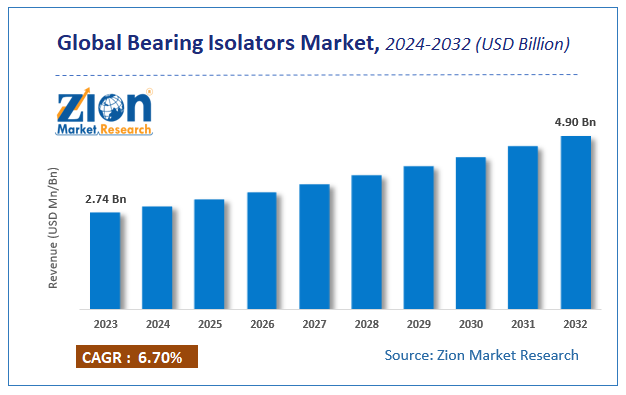
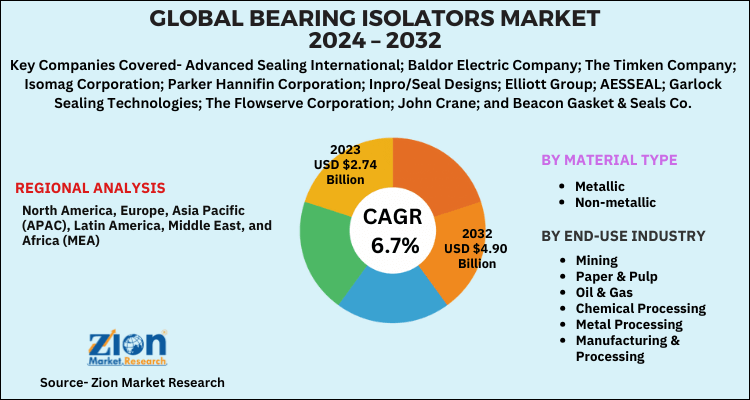
The global bearing isolators market size was valued at around USD 2.74 billion in 2023 and is projected to reach about USD 4.90 billion by 2032, with a compound annual growth rate (CAGR) of roughly 6.7% between 2024 and 2032.
This report provides a comprehensive analysis of the growth drivers, restraints, and challenges shaping demand across the global bearing isolators market throughout the forecast period, while highlighting high-potential emerging opportunities within the industry.
Key Insights
As per the analysis shared by our research analyst, the global bearing isolators market is estimated to grow at a CAGR of approximately 6.7% during the forecast period from 2024 to 2032.
In terms of revenue, the global bearing isolators market size was valued at around USD 2.74 billion in 2023 and is projected to reach USD 4.90 billion by 2032.
The market is driven by rising awareness of product benefits, growing demand across oil and gas, manufacturing and processing, mining, paper and pulp, and chemical processing industries, rapid industrialization, the need to minimize downtime and replacement costs, and the requirement to prevent contamination and extend bearing life.
Based on the material type, metallic bearing isolators hold a strong position due to durability and suitability for demanding industrial environments where corrosion resistance and mechanical strength are required.
Based on the end-use industry, oil and gas segment represents major demand areas, as rotating equipment in these sectors requires reliable protection against contaminants and lubricant loss.
Regionally, North America is expected to lead the bearing isolators market in terms of revenue, supported by strong product demand in mining, oil and gas, and manufacturing and processing industries, particularly in the United States, along with new product introductions and strategic activity by market participants.
Bearing Isolators Market: Overview
The bearing isolator is defined as non-wearing, non-contact, and permanent bearing protection equipment. Apparently, the equipment includes a stator and rotor that are bound together and inseparable during the device's operation. The product is also utilized in the process of lubrication and helps in keeping out contamination.
Moreover, the bearing isolators are made of bronze metals that use vapor-blocking characteristics while facilitating the transfer of vapor contamination during equipment rotation. These products are cost-effective substitutes for face seals and lip seals and can perform proficiently with respect to the enhancement of bearing protection ability. They offer two-way sealing protection to the rotating device that facilitates the extension of the bearing life span.
Bearing Isolators Market: Dynamics
Growth Drivers
What factors are accelerating the expansion of the bearing isolators market?
Rising awareness of the benefits of bearing isolators and their growing popularity across oil and gas, manufacturing and processing, mining, paper and pulp, and chemical processing are primary growth drivers. These industries operate large fleets of rotating equipment that benefit from reduced contamination ingress and lubricant retention. Rapid industrialization worldwide further increases the installed base of machinery that requires effective bearing protection.
Bearing isolators help minimize downtime, replacement, and repair costs while supporting efforts to prevent rust and extend equipment life. Increased industrial automation, demand for more reliable and lower-maintenance operations, expansion in heavy industries, emphasis on energy efficiency, and growth in renewable energy applications also contribute to stronger market demand over the forecast period.
Restraints
What factors are limiting the growth of the bearing isolators market?
Higher upfront costs compared with conventional seals can limit adoption in cost-sensitive applications. Fluctuating product costs and expenses associated with complementary technologies such as sensors may also act as hurdles. Limited awareness among some end users regarding the long-term reliability and total-cost benefits of bearing isolators can slow conversion from traditional sealing methods.
These factors require suppliers to demonstrate clear return on investment through reduced unplanned downtime and longer bearing life, particularly when competing against lower-priced contact seals in less demanding environments.
Opportunities
What emerging opportunities exist in the bearing isolators market?
Demand for extended equipment life, greater industrial reliability, and adoption in heavy machinery and rotating equipment create significant opportunities. Retrofitting existing equipment with modern bearing isolators and integrating them into predictive maintenance programs further expand the addressable market. Technological advances in non-metallic and corrosion-resistant materials, as well as improved labyrinth and magnetic designs, open new applications in harsh environments.
Growing industrialization in emerging markets and stricter environmental standards related to lubricant leakage also support broader use of effective sealing solutions that help operators meet compliance and sustainability goals.
Challenges
What challenges does the bearing isolators market face?
Balancing performance, cost, and ease of installation remains important. Competition from conventional seals and the need to educate end users about total cost of ownership influence sales cycles. Ensuring consistent performance across diverse operating conditions, including high contamination, moisture, and chemical exposure, continues to drive product development and application engineering requirements.
Bearing Isolators Market: Report Scope
| Report Attributes | Report Details |
|---|---|
| Report Name | Bearing Isolators Market |
| Market Size in 2023 | USD 2.74 Billion |
| Market Forecast in 2032 | USD 4.90 Billion |
| Growth Rate | CAGR of 6.7% |
| Number of Pages | 285 |
| Key Companies Covered | Advanced Sealing International; Baldor Electric Company; The Timken Company; Isomag Corporation; Parker Hannifin Corporation; Inpro/Seal Designs; Elliott Group; AESSEAL; Garlock Sealing Technologies; The Flowserve Corporation; John Crane; and Beacon Gasket & Seals Co |
| Segments Covered | By Material Type, By End-Use Industry, and By Region |
| Regions Covered | North America, Europe, Asia Pacific (APAC), Latin America, Middle East, and Africa (MEA) |
| Base Year | 2023 |
| Historical Year | 2018 - 2022 |
| Forecast Year | 2024 - 2032 |
| Customization Scope | Avail customized purchase options to meet your exact research needs. Request For Customization |
Bearing Isolators Market: Segmentation
The bearing isolators market is segmented by material type, end-use industry, and region. All the segments of the bearing isolators market have been analyzed based on present and future trends and the market is estimated from 2024 to 2032.
Based on Material Type, the bearing isolators market is divided into metallic and non-metallic. Metallic designs hold a strong position because of their durability, mechanical strength, and suitability for demanding industrial environments where corrosion resistance and long service life are required. Bronze and related alloys are commonly used for their vapor-blocking characteristics and proven performance on pumps, motors, and other rotating equipment. Non-metallic options address applications that benefit from lighter weight, specific chemical compatibility, or cost considerations, expanding the range of solutions available to equipment designers and maintenance teams.
Based on End-use Industry, the bearing isolators market is divided into mining, paper and pulp, oil and gas, chemical processing, metal processing, and manufacturing and processing. Oil and gas, mining, and manufacturing and processing represent major demand areas because rotating equipment in these sectors is frequently exposed to dust, moisture, chemicals, and continuous operation. Bearing isolators help protect bearings from contamination and lubricant loss, supporting higher reliability and lower maintenance costs. Chemical processing, paper and pulp, and metal processing also contribute steady demand as operators seek to improve uptime and comply with environmental and operational standards.
Bearing Isolators Market: Regional Analysis
Why will North America continue to dominate the global market during the projection period?
North America is expected to lead the bearing isolators market in terms of revenue. The region benefits from strong product demand in mining, oil and gas, and manufacturing and processing industries, particularly in the United States. New product launches by established players and the adoption of updated business strategies by market participants further support regional growth. These conditions enable North America to drive standards for reliability-focused sealing, influence technology development, and sustain a large share of global demand for permanent bearing protection solutions.
Europe maintains significant activity supported by industrial manufacturing, process industries, and emphasis on equipment reliability and environmental compliance. Asia Pacific is expected to grow as industrialization continues in countries such as China and India and as manufacturing and infrastructure activity expands. Latin America and the Middle East and Africa represent emerging opportunities where growth in mining, oil and gas, and processing industries is expected to support gradual increases in demand for bearing isolators.
Bearing Isolators MarkeT: Competitive Players
Some of the major players in the global bearing isolators market include;
- Advanced Sealing International
- Baldor Electric Company
- The Timken Company
- Isomag Corporation
- Parker Hannifin Corporation
- Inpro/Seal Designs
- Elliott Group
- AESSEAL
- Garlock Sealing Technologies
- The Flowserve Corporation
- John Crane
- Beacon Gasket & Seals Co.
Segments Covered
The global bearing isolators market is segmented as follows:
By Material Type
- Metallic
- Non-metallic
By End-Use Industry
- Mining
- Paper & Pulp
- Oil & Gas
- Chemical Processing
- Metal Processing
- Manufacturing & Processing
By Region
- North America
- The U.S.
- Canada
- Mexico
- Europe
- France
- The UK
- Spain
- Germany
- Italy
- Rest of Europe
- Asia Pacific
- China
- Japan
- India
- Australia
- South Korea
- Rest of Asia Pacific
- The Middle East & Africa
- Saudi Arabia
- UAE
- Egypt
- Kuwait
- South Africa
- Rest of the Middle East & Africa
- Latin America
- Brazil
- Argentina
- Rest of Latin America
Table Of Content
Methodology
FrequentlyAsked Questions
Bearing isolators are non-wearing, non-contact seals used to permanently protect bearings. They prevent contamination ingress and lubricant loss, thereby extending equipment life and improving reliability of rotating machinery such as pumps, motors, and gearboxes.
The global bearing isolators market is driven by demand for extended bearing life, reduced maintenance and downtime costs, industrial reliability requirements, rapid industrialization, and adoption across oil and gas, mining, manufacturing, chemical processing, and related industries.
The global bearing isolators market size was valued at approximately USD 2.74 billion in 2023 and is expected to reach around USD 4.90 billion by 2032.
The global bearing isolators market is expected to grow at a compound annual growth rate (CAGR) of approximately 6.7% during the forecast period from 2024 to 2032.
North America is expected to lead and contribute notably to the global bearing isolators market, supported by strong demand in mining, oil and gas, and manufacturing industries and ongoing product development by regional and global suppliers.
Some of the major players leveraging the bearing isolators market growth are Advanced Sealing International, Baldor Electric Company, The Timken Company, Isomag Corporation, Parker Hannifin Corporation, Inpro/Seal Designs, Elliott Group, AESSEAL, Garlock Sealing Technologies, The Flowserve Corporation, John Crane, and Beacon Gasket & Seals Co.
The report provides a detailed examination of growth drivers, restraints, opportunities, and challenges, along with comprehensive segmentation analysis, regional insights, competitive landscape, and forward-looking forecasts that enable stakeholders to make informed strategic decisions.

HappyClients