
Global Barrier Systems Market Size, Share, Trends by 2034

Barrier Systems Market By Product Type (Concrete Barriers, Steel Barriers, Plastic Barriers, Cable Barriers, Crash Cushions, Water-Filled Barriers, and Others), By Application (Road Safety, Construction Sites, Events and Crowd Control, Parking Facilities, Industrial Safety, Port and Airport Security, Perimeter Protection), By End-User (Government and Municipalities, Construction Companies, Event Management Firms, Transportation Authorities, Industrial Facilities, Private Organizations), By Material (Concrete, Steel, Plastic, Composite Materials), By Mobility (Permanent Barriers, Temporary Barriers, Portable Barriers), and By Region - Global and Regional Industry Overview, Market Intelligence, Comprehensive Analysis, Historical Data, and Forecasts 2025 - 2034
| Market Size in 2024 | Market Forecast in 2034 | CAGR (in %) | Base Year |
|---|---|---|---|
| USD 22.88 Billion | USD 34.11 Billion | 4.33% | 2024 |
Barrier Systems Industry Prospective:
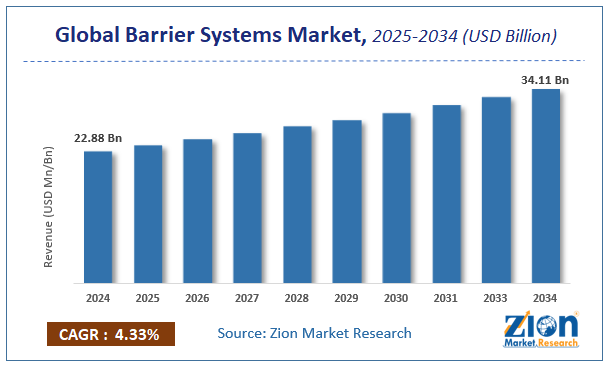
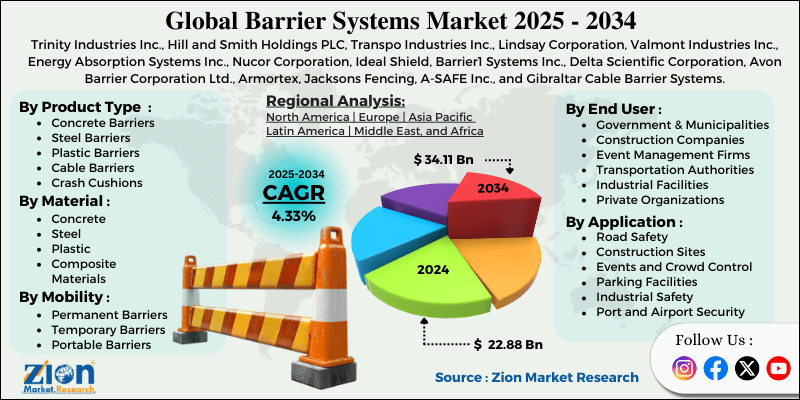
The global barrier systems market size was worth approximately USD 22.88 billion in 2024 and is projected to grow to around USD 34.11 billion by 2034, with a compound annual growth rate (CAGR) of roughly 4.33% between 2025 and 2034.
Key Insights:
- As per the analysis shared by our research analyst, the global barrier systems market is estimated to grow annually at a CAGR of around 4.33% over the forecast period (2025-2034).
- In terms of revenue, the global barrier systems market size was valued at approximately USD 22.88 billion in 2024 and is projected to reach USD 34.11 billion by 2034.
- The barrier systems market is projected to grow significantly due to increasing road safety regulations, rising traffic accidents, growing construction activities, and the expanding need for crowd management at public events.
- Based on product type, the concrete barriers segment is expected to lead the barrier systems market, while the water-filled barriers segment is anticipated to experience significant growth.
- Based on application, the road safety segment is expected to lead the barrier systems market, while the construction sites segment is anticipated to witness notable growth.
- Based on end-user, the government and municipalities segment is the dominating segment, while the construction companies segment is projected to witness sizeable revenue over the forecast period.
- Based on mobility, the permanent barriers segment is expected to lead the market compared to the portable barriers segment.
- Based on region, North America is projected to dominate the global barrier systems market during the estimated period, followed by Europe.
Barrier Systems Market: Overview
Barrier systems are safety structures used to protect people, vehicles, and property by guiding traffic, controlling access, and reducing impact during accidents. These systems appear on highways, construction sites, urban roads, event locations, and secure facilities to improve safety and order. Road safety barriers separate traffic lanes, protect roadside workers, and prevent vehicles from entering restricted or dangerous areas. Barrier systems reduce crash severity by absorbing impact energy and redirecting vehicles away from hazards. Concrete barriers provide strong long-term protection on highways with high-speed traffic and heavy vehicle movement.
Steel guardrails offer flexible protection by bending during collisions and guiding vehicles back onto the roadway. Plastic traffic barriers filled with water or sand support temporary traffic control during road construction and maintenance activities. Cable barrier systems placed along road medians stop vehicles from crossing into opposing traffic lanes. Crash cushions installed near exits, toll booths, and bridge ends slow vehicles gradually to reduce injury risk. Portable barrier systems support emergency response, crowd control, and short-term safety needs. Modern barrier systems use reflective surfaces, modular designs, and improved visibility features to enhance road safety performance.
The increasing focus on road safety and growing infrastructure development worldwide are expected to drive growth in the barrier systems market throughout the forecast period.
Barrier Systems Market Dynamics
Growth Drivers
Increasing road safety concerns and traffic accident rates
The barrier systems market is growing as rising road accident rates push governments and transport agencies to invest in proven traffic safety infrastructure. Head-on collisions across road medians cause severe fatalities, while median barrier systems effectively stop crossover crashes on divided highways. Run-off-road accidents kill many drivers yearly, with roadside barriers redirecting vehicles or slowing impacts before striking fixed hazards. Highway work zones expose crews to fast traffic, so temporary barrier systems create safe buffers protecting construction workers.
Urban pedestrian safety improves when barrier systems separate sidewalks from roads, thereby reducing injuries caused by distracted driving. Bridges, tunnels, curves, ramps, and toll areas require impact-resistant barriers preventing falls, rollovers, and structural damage incidents. School zones and wildlife crossing areas employ barrier systems to guide vehicles and pedestrians safely while reducing collision risk. These safety barriers support long-term road safety goals and drive steady barrier systems market demand worldwide growth. Increasing adoption of data-driven safety planning and stricter road safety regulations further accelerates barrier systems deployment across high-risk transportation routes.
How are infrastructure development and urbanization trends driving the barrier systems market growth?
The global barrier systems market is growing as large infrastructure projects and fast urban expansion increase demand for safety systems protecting workers, traffic, and public spaces. Smart city development integrates barrier systems into the planning stages to protect pedestrians, cyclists, and vehicles sharing busy urban roads. Metro rail construction in major cities uses temporary barrier systems to control traffic, protect people, and secure work zones during excavation. Highway expansion programs require long barrier installations to separate traffic during construction and to provide permanent roadside safety after project completion.
Growing urban density places buildings closer to roads, increasing the need for noise barriers offering both sound control and crash protection. Transit-oriented developments combine buses, cars, cyclists, and pedestrians, creating demand for well-designed barrier systems guiding movement and reducing conflicts. Airport, industrial, and stadium projects rely on barrier systems for perimeter security, crowd control, and safe separation of vehicles, pedestrians, and restricted areas.
Restraints
How are high installation and maintenance costs limiting adoption and restricting the barrier systems market growth?
The barrier systems market faces major challenges from high upfront costs for purchasing, transporting, installing, and maintaining safety barriers across infrastructure projects worldwide. Highway barrier installation needs heavy equipment, skilled labor, and complex foundation work, thereby increasing total project expenses beyond basic material pricing. Permanent barriers require excavation, drainage preparation, and concrete foundations, creating high early costs before any visible safety structure appears. Transporting large concrete or steel barriers to distant sites adds freight costs, especially for rural projects far from manufacturing plants.
Ongoing maintenance includes impact repairs, corrosion control, reflector replacement, and vegetation management, which steadily increase long-term ownership expenses. Weather exposure, snow removal activities, and soil movement can damage barriers, requiring frequent inspections, adjustments, and timely repairs. Limited government budgets force agencies to balance barrier spending against roads, bridges, utilities, and other essential public infrastructure needs. Wide rural road networks increase installation costs per kilometer, making full barrier coverage difficult despite clear safety benefits.
Opportunities
How is the growing event industry and temporary barrier demand creating new opportunities for the barrier systems industry?
The barrier systems industry is experiencing strong growth as global event management expands and demands reliable temporary safety barriers for large public gatherings. Music festivals, concerts, and sporting events attract massive crowds requiring barrier systems for perimeter security, crowd control, and the separation of restricted areas. City marathons, cycling races, and parades depend on temporary barriers to guide participants, protect spectators, and maintain safe movement routes. Political rallies, public demonstrations, and official ceremonies use barrier systems to manage access points and support security screening operations.
Street fairs, food festivals, and cultural events convert roads into pedestrian zones by installing barriers to block vehicular traffic and to organize visitor flow. Construction sites and film production locations rely on temporary barriers to prevent unauthorized access, protect equipment, and ensure public safety. Emergency situations, including disasters, accidents, and evacuations, require fast barrier deployment to create safe zones and control movement. Beach events, waterfront activities, and outdoor venues need durable, weather-resistant barrier systems supporting safety, crowd management, and smooth event operations worldwide.
Challenges
Design complexity and performance standards
The barrier systems industry faces major challenges from strict safety rules, complex design standards, and costly testing requirements, impacting manufacturers across infrastructure markets. Crash certification requires full-scale vehicle impact tests at specified speeds and angles, with procedures that cost hundreds of thousands of dollars per design. Different countries apply varying performance codes, creating complexity for international suppliers managing approvals, timelines, documentation, and repeated testing.
Engineering teams must balance impact absorption, vehicle redirection, occupant protection, installation ease, durability, aesthetics, and cost efficiency within constrained budgets. Liability risk encourages agencies to favor proven barriers, while environmental rules limit materials, coatings, and processes, thereby raising compliance costs. Urban goals and cyclist safety needs push customized solutions, increasing fabrication effort, planning, and coordination with traffic operations. Manufacturers manage delivery schedules, supply chains, and field support while meeting public sector procurement rules across highways, bridges, and urban projects.
Barrier Systems Market: Report Scope
| Report Attributes | Report Details |
|---|---|
| Report Name | Barrier Systems Market |
| Market Size in 2024 | USD 22.88 Billion |
| Market Forecast in 2034 | USD 34.11 Billion |
| Growth Rate | CAGR of 4.33% |
| Number of Pages | 280 |
| Key Companies Covered | Trinity Industries Inc., Hill and Smith Holdings PLC, Transpo Industries Inc., Lindsay Corporation, Valmont Industries Inc., Energy Absorption Systems Inc., Nucor Corporation, Ideal Shield, Barrier1 Systems Inc., Delta Scientific Corporation, Avon Barrier Corporation Ltd., Armortex, Jacksons Fencing, A-SAFE Inc., and Gibraltar Cable Barrier Systems. |
| Segments Covered | By Product Type, By Application, By Mobility, By Material, By End User and By Region |
| Regions Covered | North America, Europe, Asia Pacific (APAC), Latin America,The Middle East and Africa (MEA) |
| Base Year | 2024 |
| Historical Year | 2019 to 2023 |
| Forecast Year | 2025 - 2034 |
| Customization Scope | Avail customized purchase options to meet your exact research needs. Request For Customization |
Barrier Systems Market: Segmentation
The global barrier systems market is segmented based on product type, application, end-user, material, mobility, and region.
Based on product type, the global barrier systems market is classified into concrete barriers, steel barriers, plastic barriers, cable barriers, crash cushions, water-filled barriers, and others. Concrete barriers lead the market due to their superior strength, which provides maximum protection; long service life that requires minimal maintenance; proven performance in high-speed impacts; and cost-effectiveness over extended installations.
Based on application, the industry is divided into road safety, construction sites, events and crowd control, parking facilities, industrial safety, port and airport security, and perimeter protection. Road safety leads the market due to extensive highway networks requiring barrier protection, government mandates for safety infrastructure, proven effectiveness in reducing accident severity, and ongoing infrastructure investment worldwide.
Based on end-user, the global barrier systems industry is categorized into government and municipalities, construction companies, event management firms, transportation authorities, industrial facilities, and private organizations. Government and municipalities are expected to lead the market during the forecast period due to their responsibility for public infrastructure safety, substantial budget allocations for highway improvements, and regulatory authority mandating barrier installations.
Based on material, the global market is segmented into concrete, steel, plastic, and composite materials. Concrete holds the largest market share due to its excellent impact resistance, durability under harsh weather conditions, low maintenance requirements, and widespread availability from local suppliers, thereby reducing transportation costs.
Based on mobility, the global market is segregated into permanent barriers, temporary barriers, and portable barriers. Permanent barriers hold the largest market share due to extensive use along highways and roads, one-time installation costs, decades-long service life, and proven safety performance protecting millions of vehicles daily.
Barrier Systems Market: Regional Analysis
What factors are contributing to North America's dominance in the global barrier systems market?
North America is estimated to grow at a CAGR of around 6.2% during the forecast period, maintaining its position as the leading region in the barrier systems market. North America leads the barrier systems market due to large highway networks, strict safety rules, strong infrastructure spending, and a mature focus on road accident prevention. The United States manages millions of roadway miles where barrier systems protect drivers from median crossovers, roadside hazards, and active work zones. Federal Highway Administration guidelines define barrier performance testing, installation, and maintenance, ensuring consistent road safety standards nationwide.
State transportation departments allocate regular budgets for barrier upgrades at high-risk locations identified through detailed crash data analysis. Aging interstate highways require modern barrier replacements as traffic speeds, vehicle weights, and safety expectations continue to increase. Urban highways require advanced barrier systems that protect nearby buildings, pedestrians, and cyclists while accommodating heavy traffic within limited space. Road construction growth increases demand for temporary barriers shielding workers during maintenance, utility repairs, and infrastructure expansion projects. Large events, including sports, concerts, and festivals, rely on professional temporary barriers for safe crowd control and organized movement. Liability concerns encourage governments, property owners, and event organizers to install certified barrier systems, reducing legal and safety risks. Domestic manufacturers drive innovation by developing stronger materials, improved impact absorption, and cost-efficient barrier designs.
Canada supports regional leadership through extensive highway networks, harsh climatic conditions, high demand for durable barriers, and stringent national safety regulations. Advanced data-driven safety planning and continuous crash monitoring further support targeted barrier deployment across high-risk corridors and urban road networks. Long-term public funding commitments and private sector collaboration continue to strengthen barrier systems adoption across North American transportation infrastructure. Growing emphasis on smart infrastructure development and integration of advanced safety technologies is expected to further strengthen North America’s leadership in the barrier systems market over the long term.
Europe maintains a substantial market presence
Europe is projected to register a CAGR of approximately 5.8% over the forecast period, ranking as the second leading region in the global barrier systems market. Europe holds a leading position in the barrier systems market due to strict road safety rules, dense cities, and a focus on protecting vulnerable road users. European Union transport directives set minimum safety standards for funded roads requiring certified barrier installations at high-risk locations across member states. Cross-border highway networks carry heavy traffic volumes, including cars, trucks, and tourist vehicles, increasing accident exposure where barrier systems reduce crash severity. Many European cities redesign streets to improve pedestrian and cyclist safety using traffic calming, protected lanes, and physical barriers separating transport flows.
Temporary barrier systems support constant construction activity, upgrading bridges, tunnels, and utilities within historic urban areas, requiring careful traffic control and public protection. Europe hosts frequent international sports tournaments, music festivals, and cultural events, driving steady demand for professional temporary barrier systems and crowd management solutions. Public security planning increases the use of protective barriers around government buildings, transport hubs, and tourist sites in major European cities. Residential communities near highways support the installation of noise barriers, reducing traffic noise exposure while providing vehicle impact protection for nearby homes.
Climate variation across Europe requires durable barrier materials that withstand rain, snow, ice, and heat, and maintain safety performance over a long service life. Procurement systems emphasize certified designs, long life, cost efficiency, and maintenance access, supporting consistent barrier deployment across national road networks. Local authorities use crash data mapping to prioritize barrier upgrades at dangerous curves, bridges, tunnels, and urban intersections. Ongoing innovation in urban mobility and sustainable transport planning continues to support long-term demand for modern barrier systems across Europe.
Recent Market Developments:
- In March 2025, A-SAFE launched A-GUARD and an advanced workplace barrier system at LogiMAT 2025, offering enhanced impact protection and smart safety features for industrial environments and logistics facilities.
Barrier Systems Market: Competitive Analysis
The leading players in the global barrier systems market are-
- Trinity Industries Inc.
- Hill and Smith Holdings PLC
- Transpo Industries Inc.
- Lindsay Corporation
- Valmont Industries Inc.
- Energy Absorption Systems Inc.
- Nucor Corporation
- Ideal Shield
- Barrier1 Systems Inc.
- Delta Scientific Corporation
- Avon Barrier Corporation Ltd.
- Armortex
- Jacksons Fencing
- A-SAFE Inc.
- Gibraltar Cable Barrier Systems.
The global barrier systems market is segmented as follows:
By Product Type
- Concrete Barriers
- Steel Barriers
- Plastic Barriers
- Cable Barriers
- Crash Cushions
- Water-Filled Barriers
- Others
By Application
- Road Safety
- Construction Sites
- Events and Crowd Control
- Parking Facilities
- Industrial Safety
- Port and Airport Security
- Perimeter Protection
By End User
- Government and Municipalities
- Construction Companies
- Event Management Firms
- Transportation Authorities
- Industrial Facilities
- Private Organizations
By Material
- Concrete
- Steel
- Plastic
- Composite Materials
By Mobility
- Permanent Barriers
- Temporary Barriers
- Portable Barriers
By Region
- North America
- The U.S.
- Canada
- Europe
- France
- The UK
- Spain
- Germany
- Italy
- Rest of Europe
- Asia Pacific
- China
- Japan
- India
- South Korea
- Southeast Asia
- Rest of Asia Pacific
- Latin America
- Brazil
- Mexico
- Rest of Latin America
- Middle East & Africa
- GCC
- South Africa
- Rest of Middle East & Africa
Table Of Content
Methodology
FrequentlyAsked Questions

HappyClients

