
Global Atopic Dermatitis Drugs Market Size, Share, Growth And Forecast 2032

Atopic Dermatitis Drugs Market By Therapy (Phototherapy and Directed Therapy), By Route of Administration (Injectable, Oral, and Topical), By End-User (Hospitals, Clinics, and Research Labs), And By Region - Global Industry Perspective, Size, Trends, Comprehensive Analysis, And Forecast, 2024 - 2032
| Market Size in 2023 | Market Forecast in 2032 | CAGR (in %) | Base Year |
|---|---|---|---|
| USD 15.19 Billion | USD 32.50 Billion | 8.94% | 2023 |
Atopic Dermatitis Drugs Industry Perspective
What will be the global atopic dermatitis drugs market size during the forecast period?
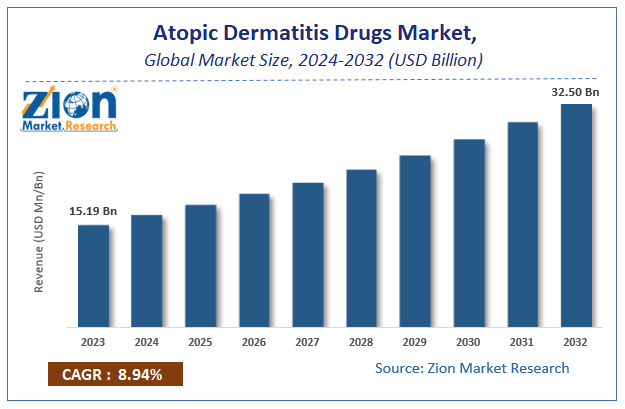
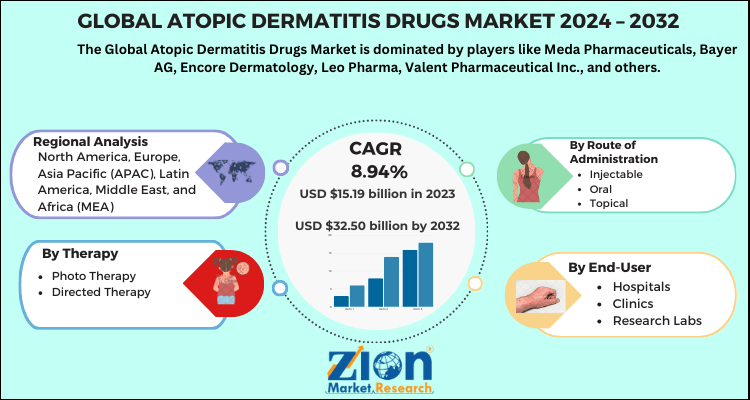
The global atopic dermatitis drugs market size was worth around USD 15.19 billion in 2023 and is predicted to grow to around USD 32.50 billion by 2032 with a compound annual growth rate (CAGR) of roughly 8.94% between 2024 and 2032.
This report provides a comprehensive analysis of the growth drivers, restraints, and challenges shaping demand across the global atopic dermatitis drugs market throughout the forecast period, while highlighting high-potential emerging opportunities within the industry.
Key Insights
- As per the analysis shared by our research analyst, the global atopic dermatitis drugs market is estimated to grow annually at a CAGR of around 8.94% over the forecast period (2024-2032).
- In terms of revenue, the global atopic dermatitis drugs market size was valued at around USD 15.19 billion in 2023 and is projected to reach USD 32.50 billion by 2032.
- The atopic dermatitis drugs market is projected to grow at a significant rate due to new concepts in disease pathogenesis driving R&D for novel medicines, the expanding spectrum of available treatments including biologics, and the high burden of the disease on patients and families.
- Based on the therapy segment, directed therapy holds a prominent position as targeted approaches, including biologics and advanced systemic options, address moderate-to-severe disease more effectively than traditional methods.
- Based on the route of administration segment, topical therapies remain widely used for mild-to-moderate cases while injectable biologics are gaining strong traction for moderate-to-severe atopic dermatitis due to superior efficacy and convenient dosing.
- Based on the end-user segment, hospitals represent a leading channel given the need for specialized management of moderate-to-severe cases and administration of advanced systemic and biologic therapies.
- Based on region, North America is expected to dominate the atopic dermatitis drugs market over the forecast period due to a surge in incidences of atopic dermatitis in children, rising frequency of skin allergies in adults, and the ongoing launch of new drugs.
Atopic Dermatitis Drugs Market: Overview
Atopic dermatitis is a common, serious, and inflammatory skin disorders that largely affect the child population. The inflammatory skin conditions include psoriasis, tinea, erythroderma, and dermatitis. According to NCBI, atopic dermatitis affects nearly twenty percent of children and ten percent of adults in developed nations. For the record, atopic dermatitis affects nearly 13% of children and 10% of adults in the U.S. Furthermore, patients and their families have felt a large impact on the quality of life as well as a fiscal burden.
The clinical characteristics of atopic dermatitis include excoriations, crusting, erythema, oozing, lichenification, and edema. Additionally, pruritus is the major property of atopic dermatitis and produces comorbidities like mental distress and sleep loss, thereby creating a huge affliction to parents as well as patients. Reportedly, genetic aspects and ecological factors strongly impact atopic dermatitis.
Additionally, there is a high prevalence of the disorder in emerging nations. The disease exemplifies massive heterogeneity in medical severity, disease phenotype, persistence, and response to treatment, and persistence. The key goals of treating the disease through drugs are to reduce inflammation of the skin as well as pruritus and flare prevention.
Atopic Dermatitis Drugs Market: Growth Dynamics
New concepts in disease pathogenesis have prompted research & development activities for creating novel medicines to treat the disease. Additionally, a large spectrum of medicines is utilized for treating skin disease and they include steroids, moisturizing creams, and calcineurin inhibitors. All these beneficial aspects are anticipated to drive the growth of the atopic dermatitis drugs market over the forecast timeline.
Apart from this, the introduction of biologic medicines has helped treat atopic dermatitis. Additionally, new biologic drugs including dupilumab and crisaborole are also used for treating atopic dermatitis. Reportedly, the former drug was first approved for treating atopic dermatitis in adults across regions such as Japan, North America, and Europe.
For the record, dupilumab is the only biologic medicine approved by the European Medicines Agency and the U.S. Food and Drug Administration for treating adult subjects. Moreover, biological medicines can treat adult patients as these drugs provide convenient dosing schedules and assist in effective lab monitoring as compared to other forms of systemic treatments, along with reduced side effects. All these factors are anticipated to bring a paradigm shift in the atopic dermatitis drugs industry over the forthcoming years.
Atopic Dermatitis Drugs Market: Report Scope
| Report Attributes | Report Details |
|---|---|
| Report Name | Atopic Dermatitis Drugs Market |
| Market Size in 2023 | USD 15.19 Billion |
| Market Forecast in 2032 | USD 32.50 Billion |
| Growth Rate | CAGR of 8.94% |
| Number of Pages | 235 |
| Key Companies Covered | Meda Pharmaceuticals, Bayer AG, Encore Dermatology, Leo Pharma, Valent Pharmaceutical Inc., and others. |
| Segments Covered | By Therapy, By Route of Administration, By End-User, and By Region |
| Regions Covered | North America, Europe, Asia Pacific (APAC), Latin America, The Middle East and Africa (MEA) |
| Base Year | 2023 |
| Historical Year | 2018 - 2022 |
| Forecast Year | 2024 - 2032 |
| Customization Scope | Avail customized purchase options to meet your exact research needs. Request For Customization |
Atopic Dermatitis Drugs Market: Segmentation
The atopic dermatitis drugs market is segmented by therapy, route of administration, end-user, and region. All the segments of the atopic dermatitis drugs market have been analyzed based on present and future trends and the market is estimated from 2024 to 2032.
Based on Therapy Segment, the atopic dermatitis drugs market is divided into phototherapy and directed therapy. Directed therapy holds a prominent position within the therapy segment. Targeted approaches, including biologics and other directed systemic options, address the underlying inflammatory pathways of moderate-to-severe atopic dermatitis more precisely than broader modalities. These therapies have demonstrated meaningful improvements in skin clearance, itch reduction, and quality of life, driving strong clinical adoption. Their growing role helps expand the overall market by enabling effective management of patients who respond inadequately to conventional treatments and by encouraging continued investment in precision immunology for dermatology.
Based on Route of Administration Segment, the atopic dermatitis drugs market is segmented into injectable, oral, and topical. Topical therapies continue to serve as a foundational approach for mild-to-moderate disease, offering localized anti-inflammatory and barrier-support effects with established safety profiles. Injectable biologics have gained substantial traction for moderate-to-severe atopic dermatitis because of their targeted efficacy, convenient dosing schedules, and ability to deliver sustained control with reduced systemic side-effect burdens relative to traditional immunosuppressants.
Based on End-User Segment, the atopic dermatitis drugs market is divided into hospitals, clinics, and research labs. Hospitals represent a leading end-user segment due to their role in managing moderate-to-severe cases, administering injectable biologics, and providing specialized dermatologic care. Clinics support ongoing outpatient management and follow-up for a large proportion of patients, while research labs contribute to clinical development and translational studies. The concentration of advanced therapy initiation and monitoring in hospital settings helps drive adoption of higher-value treatments and supports overall market expansion through specialist-driven prescribing and patient access programs.
Atopic Dermatitis Drugs Market: Regional Analysis
Why will North America continue to dominate the global market during the projection period?
North America is expected to dominate the atopic dermatitis drugs market over the forecast period. The growth of the regional market over the forecast period is subject to a surge in the incidence of atopic dermatitis in children, along with a rise in the frequency of skin allergies in the adult population in countries like the U.S. Apparently, the launch of new drugs in the foreseeable future will further enlarge the business scope over the ensuing years. Specialist dermatology networks and early adoption of biologics and other advanced therapies reinforce North America’s leadership, supporting overall market growth through high treatment rates, robust clinical research activity, and ongoing innovation in disease management.
Europe maintains a significant share supported by established dermatology practices, regulatory approvals of advanced therapies, and rising focus on quality-of-life outcomes for patients with chronic skin disease. Asia Pacific is anticipated to exhibit strong growth potential due to increasing disease recognition, expanding healthcare access, and a large pediatric population in countries such as China, Japan, and India. Latin America and the Middle East and Africa are expected to register gradual progress as awareness and treatment availability improve.
Recent Developments
- In September 2025, LEO Pharma presented late-breaking phase 2b results for temtokibart (LEO 138559), an investigational monoclonal antibody targeting IL22RA1, showing statistically significant reductions in EASI scores at week 16 for higher doses in adults with moderate-to-severe atopic dermatitis.
Atopic Dermatitis Drugs Market: Competitive Analysis
The global atopic dermatitis drugs market is dominated by players like:
- Meda Pharmaceuticals
- Bayer AG
- Encore Dermatology
- Leo Pharma
- Valent Pharmaceutical Inc.
The global atopic dermatitis drugs market is segmented as follows:
By Therapy
- Photo Therapy
- Directed Therapy
By Route of Administration
- Injectable
- Oral
- Topical
By End-User
- Hospitals
- Clinics
- Research Labs
By Region
- North America
- The U.S.
- Canada
- Mexico
- Europe
- France
- The UK
- Spain
- Germany
- Italy
- Rest of Europe
- Asia Pacific
- China
- Japan
- India
- Australia
- South Korea
- Rest of Asia Pacific
- The Middle East & Africa
- Saudi Arabia
- UAE
- Egypt
- Kuwait
- South Africa
- Rest of the Middle East & Africa
- Latin America
- Brazil
- Argentina
- Rest of Latin America
Table Of Content
Methodology
FrequentlyAsked Questions
Atopic dermatitis drugs are medications used to manage the symptoms of atopic dermatitis, also known as eczema. They can help reduce inflammation, itching, and flare-ups.
According to a study, the global atopic dermatitis drugs market size was worth around USD 15.19 billion in 2023 and is expected to reach USD 32.50 billion by 2032.
The global atopic dermatitis drugs market is expected to grow at a CAGR of 8.94% during the forecast period.
North America is expected to dominate the atopic dermatitis drugs market over the forecast period.
Leading players in the global atopic dermatitis drugs market include Meda Pharmaceuticals, Bayer AG, Encore Dermatology, Leo Pharma, and Valent Pharmaceutical Inc., among others.
Key growth drivers include new concepts in disease pathogenesis stimulating R&D for novel medicines, the expanding spectrum of treatments including biologics such as dupilumab, the high prevalence and quality-of-life burden of the disease, and ongoing regulatory approvals and product launches.
The atopic dermatitis drugs market report covers the geographical market along with a comprehensive competitive landscape analysis. It also includes cash flow analysis, profit ratio analysis, market basket analysis, market attractiveness analysis, sentiment analysis, PESTLE analysis, trend analysis, SWOT analysis, trade area analysis, demand & supply analysis, Porter’s five forces analysis, and value chain analysis.

HappyClients

