
Anal Cancer Market Size, Trend, Growth, Industry Analysis 2034

Anal Cancer Market By Type (Melanoma, Squamous Cell Carcinoma, Basal Cell Carcinoma, Adenocarcinoma, Carcinoma in Situ, and Others), By Treatment (Immunotherapy, Radiation Therapy, Surgery, and Chemotherapy), By End-User (Research & Academic Institutions, Hospitals & Clinics, and Others), and By Region - Global and Regional Industry Overview, Market Intelligence, Comprehensive Analysis, Historical Data, and Forecasts 2026 - 2034
| Market Size in 2025 | Market Forecast in 2034 | CAGR (in %) | Base Year |
|---|---|---|---|
| USD 1,286.41 Million | USD 2,168.53Million | 9.68% | 2025 |
Anal Cancer Industry Perspective:
What is the anticipated size of the anal cancer market during the projection period?
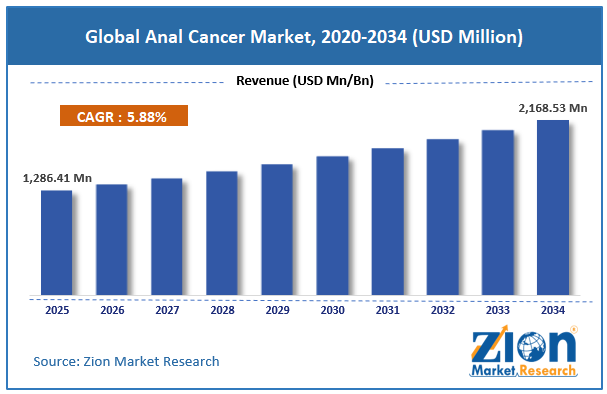
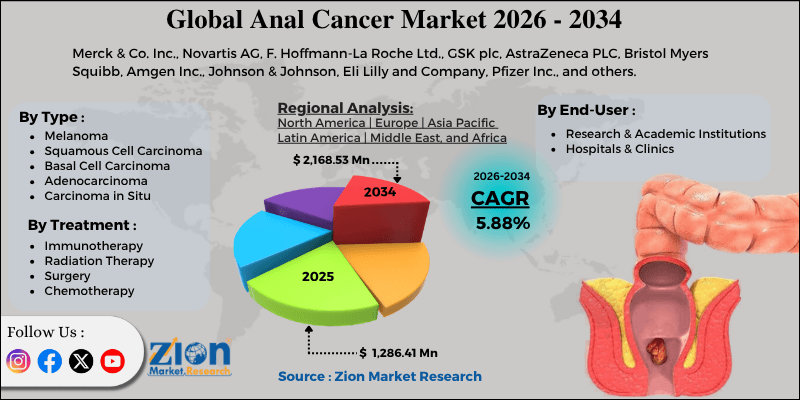
The global anal cancer market size was worth around USD 1,286.41 million in 2025 and is predicted to grow to around USD 2,168.53 million by 2034, with a compound annual growth rate (CAGR) of roughly 5.88% between 2026 and 2034.
Key Insights:
- As per the analysis shared by our research analyst, the global anal cancer market is estimated to grow annually at a CAGR of around 5.88% over the forecast period (2026-2034).
- In terms of revenue, the global anal cancer market size was valued at around USD 1,286.41 million in 2025 and is projected to reach USD 2,168.53 million by 2034.
- The anal cancer market is projected to grow at a significant rate due to the surge in human papillomavirus (HPV) prevalence.
- Based on the type, the squamous cell carcinoma segment is growing at a high rate and will continue to dominate the global market as per industry projections.
- Based on the treatment, the chemotherapy segment is anticipated to command the largest market share.
- Based on the end-user, the hospitals & clinics segment is expected to lead the market growth trends.
- Based on region, North America is projected to dominate the global market during the forecast period.
Anal Cancer Market: Overview
Anal cancer is a rare form of cancer. It results from abnormal growth in anal canal cells. According to market research, anal cancer may appear in the form of a wartlike area of the skin, bump, lump, or ulcer. Anal cancer generally develops in patients with a prolonged history of a high-risk type of human papillomavirus (HPV) in the anal region. Prominent symptoms associated with anal cancer include blood in the stool, rectal bleeding, and anal pain. Furthermore, several cases of anal cancer misdiagnosis have been reported worldwide, as it can be mistaken for hemorrhoids. As per estimates by the Mayo Clinic, the chances of people developing anal cancer in their lifetime are around 0.2%.
During the forecast period, the anal cancer market is expected to grow due to a surge in cancer patients worldwide, increasing HPV infections, and greater access to cancer care. However, concerns over misdiagnoses, the high cost of treatment, and limited healthcare facilities may affect market revenue in the long run.
Anal Cancer Market: Dynamics
Growth Drivers
How will the rising prevalence of HPV influence the anal cancer market growth?
The global anal cancer market is expected to be driven by the surge in human papillomavirus (HPV) prevalence. According to market analysis, HPV is passed through sexual contact and is a common virus. For some patients, HPV does not lead to serious problems. However, for certain patients, it may cause further complications. Prolonged exposure to HPV is associated with several forms of cancer, including anal cancer. According to the World Health Organization, around 70,000 new cases of HPV in men and 620,000 new cases of HPV in women were reported in 2019.
Surge in the number of patients with cancer and sexually transmitted diseases (STDs) is expected to promote demand for anal cancer care
Patients with certain forms of cancer, such as vaginal, vulvar, or penile cancer, are at a higher risk of anal cancer. In addition, sexually transmitted diseases such as anal warts are also considered risk factors. The growing number of patients suffering from cancer of the reproductive organs has led to increased demand for effective diagnosis and medical care of anal cancer. In addition, changing lifestyle and evolving sexual health behaviors among the general population will work in favor of market players.
Restraints
What are the leading factors limiting growth in the anal cancer market?
The global anal cancer market is expected to be limited due to the high cost of advanced treatment. Anal cancer is a rare disease. It affects a limited number of people worldwide as compared to other cancer forms. Subsequently, medical care and diagnosis associated with anal cancer are significantly more expensive, with limited availability.
Opportunities
Healthcare expansion projects to generate growth opportunities for the market players
The global anal cancer industry is anticipated to generate growth opportunities due to the accelerated expansion of the healthcare sector. Rising prevalence of diseases, increasing cancer-related mortality rate, and higher demand for quality care have resulted in increased private and government investment to expand medical care. Primary investment areas in modern healthcare include Artificial Intelligence (AI)-enabled diagnostic centers, advanced pharmaceutical manufacturing, and expansion of hospital networks.
What will be the impact of advancing research & development (R&D) on the anal cancer market?
Research & innovation in the global anal cancer market have gained momentum in the last few years. In March 2026, Europe approved first-line immunotherapy for advanced anal cancer. The European Commission has approved the use of retifanlimab in combination with standard chemotherapy (carboplatin + paclitaxel) for adults with metastatic or inoperable locally recurrent Squamous Cell Anal Carcinoma (SCAC). In June 2025, the US Food & Drug Administration (FDA) announced the approval of Zynyz, a PD-1 checkpoint inhibitor for anal cancer. Immunotherapy is the first-ever approved first-line treatment for people with anal cancer. It can also be used for patients with Human Immunodeficiency Virus (HIV). Growing patient awareness, improvements in diagnostic tools, and enhanced post-treatment care will promote market expansion in the coming years.
Challenges
Concerns over misdiagnosis and a lack of public awareness to challenge market growth
The global anal cancer industry is anticipated to be challenged due to rising cases of misdiagnosis. Anal cancer is associated with non-specific symptoms such as rectal bleeding or anal warts. These symptoms can be mistaken for other diseases that present similar symptoms, especially hemorrhoids and anal fissures. In addition, a lack of public awareness and access to effective diagnostic tools can further affect timely diagnosis and subsequent treatment of anal cancer.
Anal Cancer Market: Report Scope
| Report Attributes | Report Details |
|---|---|
| Report Name | Anal Cancer Market |
| Market Size in 2025 | USD 1,286.41 Million |
| Market Forecast in 2034 | USD 2,168.53 Million |
| Growth Rate | CAGR of 5.88% |
| Number of Pages | 230 |
| Key Companies Covered | Merck & Co. Inc., Novartis AG, F. Hoffmann-La Roche Ltd., GSK plc, AstraZeneca PLC, Bristol Myers Squibb, Amgen Inc., Johnson & Johnson, Eli Lilly and Company, Pfizer Inc., and others. |
| Segments Covered | By Type, By Treatment, By End-User, and By Region |
| Regions Covered | North America, Europe, Asia Pacific (APAC), Latin America, Middle East, and Africa (MEA) |
| Base Year | 2025 |
| Historical Year | 2020 - 2024 |
| Forecast Year | 2026 - 2034 |
| Customization Scope | Avail customized purchase options to meet your exact research needs. Request For Customization |
Anal Cancer Market: Segmentation
The global anal cancer market is segmented based on type, treatment, end-user, and region.
Why will the squamous cell carcinoma segment lead the anal cancer industry revenue during the forecast period?
Based on type, the global market divisions are melanoma, squamous cell carcinoma, basal cell carcinoma, adenocarcinoma, carcinoma in situ, and others. In 2025, the highest growth was listed in the squamous cell carcinoma segment. It accounted for 85% of global revenue and is projected to grow at a CAGR of 6.1% during the forecast period. Growing prevalence of squamous cell carcinoma due to its association with HPV is a leading segmental growth driver.
Which will be the fastest-growing treatment during the forecast period in the anal cancer market?
Based on treatment, the global anal cancer industry is divided into immunotherapy, radiation therapy, surgery, and chemotherapy. In 2025, the market was dominated by the chemotherapy segment. It contributed up to 40% of the global revenue. During the forecast period, immunotherapy is expected to emerge as the fastest-growing segment, with a CAGR of 8.91%. Immunotherapy has shown exceptional results in treating advanced cases of anal cancer and has become a popular choice among medical professionals.
Which factors drive demand in the hospitals & clinics segment in the anal cancer industry?
Based on end-user, the global market divisions are research & academic institutions, hospitals & clinics, and others. In 2025, the hospitals & clinics segment accounted for up to 77% of the global revenue. It is expected to continue leading the industry with a CAGR of 6.12% during the forecast period, driven by the expansion of the healthcare sector. Moreover, increasing use of advanced diagnostic tools and improved awareness will further help the segment thrive.
Anal Cancer Market: Regional Analysis
Which factors will influence the expansion of the anal cancer market in North America during the forecast period?
The global anal cancer market is anticipated to be led by North America during the forecast period. In 2025, it accounted for 45% of global revenue and will grow at a CAGR of 5.57% during the forecast period. Higher prevalence of anal cancer and heightened public awareness are some of the leading reasons for regional dominance. In recent years, regulatory approvals concerning medical treatments of anal cancer have improved further, helping the region thrive.
Why will Asia-Pacific generate the fastest CAGR in the anal cancer market during the forecast period?
Asia-Pacific is expected to emerge as the fastest-growing region in the anal cancer market with a CAGR of 7.32% during the forecast period. In 2025, it accounted for 20% of the global revenue. Growing HPV infections, expansion of diagnostic centers, and growing healthcare expenditure across prominent regional economies will aid growth in the Asia-Pacific. Countries such as Japan, India, and China are anticipated to emerge as leading contributors. However, public awareness across the Asia-Pacific remains relatively low, thus impacting regional market expansion.
Anal Cancer Market: Competitive Analysis
The global anal cancer market is led by players like:
- Merck & Co. Inc.
- Novartis AG
- F. Hoffmann-La Roche Ltd.
- GSK plc
- AstraZeneca PLC
- Bristol Myers Squibb
- Amgen Inc.
- Johnson & Johnson
- Eli Lilly and Company
- Pfizer Inc.
What are the latest key trends in the anal cancer market?
Precision medicine
Precision medicine and targeted therapies are emerging trends in the anal cancer market. These treatments are designed to improve patient outcomes as compared to standard procedures.
Surge in HPV screening and vaccination programs
The growing rate of HPV screening and vaccination programs can help improve early and accurate diagnosis of anal cancer. These initiatives will prove most effective in countries with high-risk populations.
The global anal cancer market is segmented as follows:
By Type
- Melanoma
- Squamous Cell Carcinoma
- Basal Cell Carcinoma
- Adenocarcinoma
- Carcinoma in Situ
- Others
By Treatment
- Immunotherapy
- Radiation Therapy
- Surgery
- Chemotherapy
By End-User
- Research & Academic Institutions
- Hospitals & Clinics
- Others
By Region
- North America
- The U.S.
- Canada
- Mexico
- Europe
- France
- The UK
- Spain
- Germany
- Italy
- Rest of Europe
- Asia Pacific
- China
- Japan
- India
- Australia
- South Korea
- Rest of Asia Pacific
- The Middle East & Africa
- Saudi Arabia
- UAE
- Egypt
- Kuwait
- South Africa
- Rest of the Middle East & Africa
- Latin America
- Brazil
- Argentina
- Rest of Latin America
Table Of Content
Methodology
FrequentlyAsked Questions
Anal cancer is a rare form of cancer. It results from abnormal growth in anal canal cells.
The global anal cancer market is expected to be driven by the surge in human papillomavirus (HPV) prevalence.
According to study, the global anal cancer market size was worth around USD 1,286.41 million in 2025 and is predicted to grow to around USD 2,168.53 million by 2034.
The CAGR value of the anal cancer market is expected to be around 5.88% during 2026-2034.
The global anal cancer industry is anticipated to be challenged due to rising cases of misdiagnosis.
Precision medicine and a surge in HPV screening and vaccination programs are the emerging trends and innovations impacting the anal cancer market.
How has the global anal cancer market performed so far, and how will it perform in the coming years?
The global anal cancer market has performed well so far and will offer similar trends in the coming years.
North America will contribute notably towards the anal cancer market value.
The global anal cancer market is led by players like Merck & Co., Inc., Novartis AG, F. Hoffmann-La Roche Ltd., GSK plc, AstraZeneca PLC, Bristol Myers Squibb, Amgen Inc., Johnson & Johnson, Eli Lilly and Company, and Pfizer Inc.
The report explores crucial aspects of the anal cancer market, including a detailed discussion of existing growth factors and restraints, while also browsing future growth opportunities and challenges that impact the market.

HappyClients

