
Air Charter Broker Market Size, Growth, Global Trends, Forecast 2034

Air Charter Broker Market By Type (Passenger Charter and Cargo Charter), By Application (Private Charter Services and Business Charter Services), By Broker Categories (Agent of the Customer, Indirect Air Carrier, and Agent of the Air Carrier), and Region - Global and Regional Industry Overview, Market Intelligence, Comprehensive Analysis, Historical Data, and Forecasts 2026 - 2034
| Market Size in 2025 | Market Forecast in 2034 | CAGR (in %) | Base Year |
|---|---|---|---|
| USD 23.4 Billion | USD 38.2 Billion | 5.6% | 2025 |
Air Charter Broker Industry Perspective:
What will be the size of the global air charter broker market during the forecast period?
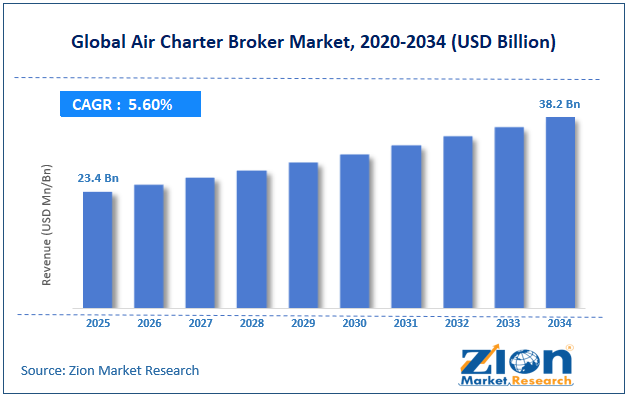
The global air charter broker market size was worth around USD 23.4 billion in 2025 and is predicted to grow to around USD 38.2 billion by 2034, with a compound annual growth rate (CAGR) of roughly 5.6% between 2026 and 2034.
Key Insights
- As per the analysis shared by our research analyst, the global air charter broker market is estimated to grow annually at a CAGR of around 5.6% over the forecast period (2026-2034).
- In terms of revenue, the global air charter broker market size was valued at around USD 23.4 billion in 2025 and is projected to reach USD 38.2 billion by 2034.
- The air charter broker market is benefiting from increased corporate travel, luxury tourism, group and sports-team transportation, and demand for direct flights to destinations with limited commercial connectivity.
- Based on the type, the passenger charter segment is expected to see exponential revenue growth in the air charter broker market.
- Based on the application, the business charter services segment holds a majority of market share in 2025 of 56%.
- Based on the broker categories, the agent of the customer is expected to see revenues grow over the projected period.
- Based on region, North America dominates the air charter broker market with a revenue share of 34% in 2025.
Air Charter Broker Market: Overview
The air charter broker market includes the firms and middlemen that facilitate aircraft-hiring services for both customers and aircraft owners. Air charter brokers usually do not own any aircraft; however, they meet customers’ needs by connecting them with aircraft of their choice, considering factors such as destination, number of passengers, aircraft type, trip schedule, and budget, among others. Thus, the air charter broker manages the entire process of aircraft searching, flight and route planning, pricing and negotiation, booking services, arranging ground transportation, and other travel-related services. The market provides its services to individuals, corporations, government agencies, sports clubs, entertainment industries, and other businesses looking to hire aircraft. The air charter industry is growing rapidly because of increased demand for business aviation flights, faster travel options, growing interest in on-demand charter services, and the digitalization of aircraft chartering and booking.
Impact of the USA-Israel War on Iran on the Air Charter Broker Market
The USA-Israel war with Iran has both positive and negative effects on the air charter broker market. The conflict's major impact stems from many canceled flights due to airspace closures and regional safety concerns. These circumstances increase demand for charter flights, as many wealthy passengers seek to organize private jet travel. As a result, the war increases demand for charter brokers, who help find alternative flight options. However, the conflict also drives up fuel prices, insurance costs, flight restrictions, and other challenges, making charter flights more expensive and less available than before. Thus, the current geopolitical situation affects the market by fueling the demand for emergency charter flights and negatively impacting leisure charter flights.
Air Charter Broker Market: Dynamics
Growth Drivers
How does the rising demand for private and on-demand air travel drive the air charter broker market?
Growing demand for private and on-demand air travel is driving the air charter broker market's value as the need for aircraft sourcing, customized itineraries, and flexible charter arrangements increases. According to government statistics released by the Federal Aviation Administration (FAA), the number of aircraft in the United States in general aviation was 214,222 as of 2023, up 2.2 percent from 2022. At the same time, the number of general aviation flight hours was 28.6 million in 2023, which reflects a 6 percent year-over-year increase and an 11.7 percent rise compared to 2019. The FAA also reported that general aviation aircraft deliveries in the United States reached 2,169 in 2024, up 3.1 percent from 2023, and business jet deliveries grew 4.1 percent.
All these statistics emphasize the growing importance of private aircraft and business jets. Because many private-aircraft travelers do not own their aircraft and rely on air charter brokers to find the best options, get price quotes, and arrange the flight, rising private-aircraft travel volumes will drive demand for aircraft charter brokers. In addition, the FAA processes on-demand Part 135 aircraft data and reports it separately, highlighting the special role of this type of charter aircraft in the United States.
Restraints
The high cost of charter flights acts as a major restraint on the growth of the air charter broker industry
The main limitation to developing the Air Charter Broker Market is the high cost of charter flights, as private and on-demand aviation is considerably more expensive than traditional commercial aircraft. Charter prices account for aircraft maintenance, fuel, crew, airport, and insurance costs. According to the United States Federal Aviation Administration (US FAA), legal charter operators “had steep overheads to cover the costs of aircraft maintenance, crew training and checks, and compliance with FAA and TSA regulations.” The report also states that air taxi operations rose by 4.3 percent in 2024, suggesting that on-demand aviation remains in demand, driven mainly by corporations, high-net-worth individuals, and travelers with specific needs. Thus, price-sensitive customers may choose commercial aircraft instead of charter flights, and prohibitively high prices may hinder the expansion of charter brokerage services among other customers.
Opportunities
How do the growing innovative services offer a lucrative opportunity for the air charter broker market?
The development of innovative air charter services and booking technologies is a growth opportunity for the air charter broker market, as it can improve accessibility, transparency, and cost-effectiveness of charter flights. Charter companies are developing booking engines, real-time aircraft availability tracking, instant quoting, mobile booking, personalization, empty-leg management, and other technologies enabling brokers to respond to customer demands faster and more efficiently.
For instance, AirCharter.com introduced an AI-based booking engine in 2025 that can automate customer interactions via voice and text and manage booking requests and quotations. Another company, VOO, has introduced a new empty-leg feature that lets brokers search for repositioning flights and offer customers cheaper charter flights. These technologies can help brokers respond faster to customer requests, optimize aircraft use, attract more clients by offering low-cost charters, and diversify sales channels to increase revenue.
Challenges
Why does the competition from commercial premium services pose a significant challenge to the growth of the air charter broker industry?
The threat of substitutes, particularly commercial premium services, significantly limits the air charter broker industry's growth potential. Contemporary business trends show that airlines are offering more comfort, privacy, personalized service, convenience, and more accessible prices, threatening to draw customers away from charter flights. This trend could reduce demand for private jet charters as they lose appeal compared with premium commercial options. The industry’s statistical growth illustrates the competitiveness of premium commercial services. According to the International Air Transport Association (IATA), “international business- and first-class passengers amounted to 109.7 million in 2025 – up 4.5 percent year-on-year,” showing the continued rise in demand for business- and first-class seats on commercial flights.
Furthermore, IATA reports that “premium fares were on average five times higher than economy fares,” underscoring that customers are willing to pay for the extra comfort airlines offer. In turn, companies began offering more comfort and convenience to economy-class passengers, such as lie-flat seats, private suites, and lounges; enhanced in-flight catering; priority boarding; improved entertainment systems; and better Wi-Fi. For instance, American Airlines announced an increase in the proportion of premium seats on its narrow-body aircraft from “approximately 25 percent to 40 percent.” As commercial airlines continue to invest in and improve premium services, some customers may find them more convenient and cost-efficient than private charter flights.
As a result, the air charter broker industry may see fewer potential customers, especially for domestic and international routes. Thus, the business’s growth prospects might be limited by the continuous development of the commercial airline industry and its emerging services.
Air Charter Broker Market: Report Scope
| Report Attributes | Report Details |
|---|---|
| Report Name | Air Charter Broker Market |
| Market Size in 2025 | USD 23.4 Billion |
| Market Forecast in 2034 | USD 38.2 Billion |
| Growth Rate | CAGR of 5.6% |
| Number of Pages | 227 |
| Key Companies Covered | Air Charter Service, LunaJets, Chapman Freeborn, VistaJet (via XO and Jet Edge), Victor, Flexjet (including FXAIR and Sentient Jet), PrivateFly, Jet Aviation (a General Dynamics company), GlobeAir, Le Bas International, Paramount Business Jets, Air Partner (a Wheels Up company), Jetex Flight Support, Avinode Group, ACS (Aviation Charter Services India), Fly Victor Ltd., Stratos Jet Charters, Villiers Jets, Solairus Aviation, Elit’Avia, and others. |
| Segments Covered | By Type, By Application, By Broker Categories, and By Region |
| Regions Covered | North America, Europe, Asia Pacific (APAC), Latin America, Middle East, and Africa (MEA) |
| Base Year | 2025 |
| Historical Year | 2020 - 2024 |
| Forecast Year | 2026 - 2034 |
| Customization Scope | Avail customized purchase options to meet your exact research needs. Request For Customization |
Air Charter Broker Market: Segmentation
Type Insights
Why does the passenger charter segment hold a prominent position in the air charter broker market?
The passenger charter segment is expected to see exponential revenue growth in the air charter broker market, driven by surging demand for flexible, private, and group travel. Passenger charters are considered an essential source of income for corporates, sports clubs, high-net-worth individuals, leisure groups, and customers flying to destinations with limited commercial airline availability.
Moreover, the market participants have voiced robust underlying demand in the region. For instance, Global Crossing Airlines, or GlobalX, reported that passenger charter was its cash cow for 2025, as the firm saw rising demand driven by aircraft shortages, fewer direct competitors, college sports teams, and overall increased customer demand.
Application Insights
How does the business charter services segment capture the largest share in the air charter broker market?
The business charter services segment holds a majority of the air charter broker market share in 2025, at 56%. The increase in revenues from business charter services can be explained by the benefits businesses get from using private aviation.
According to the National Business Aviation Association, business aviation lets companies reach destinations inaccessible to commercial airlines, make multiple trips in one day, and save time by eliminating layovers when transporting employees or specialized equipment. Moreover, general aviation, including business aviation, air charter services, and other aircraft-related services, contributed to 1.33 million jobs and $339.2 billion to the US economy in 2023.
Broker Categories Insights
What factor drives the agent of the customer segment in the air charter broker market?
The agent of the customer is expected to see revenues grow as more customers, companies, and other charter users seek brokers to help them find aircraft, compare carriers, negotiate payments, and more. As a customer's agent, a broker can carry out operations on behalf of other parties. Brokers can find suitable aircraft and operators for their clients and handle contracts, permissions, scheduling, and other details. The Air Charter Association notes that, to help customers save money, brokers may leverage their connections and market knowledge to secure lower prices.
Regional Insights
What factors drive the North America region in the air charter broker market?
North America dominates the global air charter broker market with a revenue share of 34% in 2025. Revenue growth in the region is driven by strong corporate travel demand, high-net-worth individuals, fractional ownership, private jet charters, and time-sensitive point-to-point transportation. In addition, the U.S. has a well-established on-demand aviation market; for instance, the FAA reported a 4.3% increase in air-taxi traffic and 3.6% overall in the agency’s 2024 traffic report.
As a result, the region’s large customer base and well-established broker-operator networks make it a good place for air charter brokers to position themselves, arrange aircraft, charter flights, and provide clients with customized travel solutions. Rising business aviation activity and growing transaction values and volumes across the U.S. are expected to drive North America’s revenue growth in the air charter broker market.
Air Charter Broker Market: Competitive Analysis
The global air charter broker market is dominated by players like:
- Air Charter Service
- LunaJets
- Chapman Freeborn
- VistaJet (via XO and Jet Edge)
- Victor
- Flexjet (including FXAIR and Sentient Jet)
- PrivateFly
- Jet Aviation (a General Dynamics company)
- GlobeAir
- Le Bas International
- Paramount Business Jets
- Air Partner (a Wheels Up company)
- Jetex Flight Support
- Avinode Group
- ACS (Aviation Charter Services India)
- Fly Victor Ltd.
- Stratos Jet Charters
- Villiers Jets
- Solairus Aviation
- Elit’Avia
The global air charter broker market is segmented as follows:
By Type
- Passenger Charter
- Cargo Charter
By Application
- Private Charter Services
- Business Charter Services
By Broker Categories
- Agent of the Customer
- Indirect Air Carrier
- Agent of the Air Carrier
By Region
- North America
- The U.S.
- Canada
- Mexico
- Europe
- France
- The UK
- Spain
- Germany
- Italy
- Rest of Europe
- Asia Pacific
- China
- Japan
- India
- Australia
- South Korea
- Rest of Asia Pacific
- The Middle East & Africa
- Saudi Arabia
- UAE
- Egypt
- Kuwait
- South Africa
- Rest of the Middle East & Africa
- Latin America
- Brazil
- Argentina
- Rest of Latin America
Table Of Content
Methodology
FrequentlyAsked Questions
The air charter broker market includes the firms and middlemen that facilitate aircraft-hiring services for both customers and aircraft owners. Air charter brokers usually do not own any aircraft; however, they meet customers’ needs by connecting them with aircraft of their choice, considering factors such as destination, number of passengers, aircraft type, trip schedule, and budget, among others.
The key growth drivers for the air charter broker market include rising demand for private and on-demand air travel, expansion of business aviation, increasing numbers of high-net-worth individuals, and growing demand for flexible and customized travel. The market is also benefiting from increased corporate travel, luxury tourism, group and sports-team transportation, and demand for direct flights to destinations with limited commercial connectivity.
The major challenges restraining the growth of the air charter broker market include the high cost of charter flights, regulatory complexity, limited aircraft availability, competition from premium commercial airlines, and safety and reputational risks. Charter operators face substantial costs for aircraft maintenance, crew training, and compliance with aviation and security regulations, which can increase prices for customers.
Based on the type, the passenger charter segment is expected to dominate the air charter broker market growth during the projected period.
The air charter broker market is being transformed by AI-powered aircraft matching, digital booking platforms, real-time availability, dynamic pricing, and automated quotation systems. Brokers are increasingly using AI to match customer requirements with available aircraft and optimize routes, reducing booking time and improving operational efficiency.
According to the report, the global air charter broker market size was worth around USD 23.4 billion in 2025 and is predicted to grow to around USD 38.2 billion by 2034.
The global air charter broker market is expected to grow at a CAGR of 5.6% during the forecast period.
The global air charter broker industry growth is expected to be led by North America over the forecast period.
The global air charter broker market is dominated by players like Air Charter Service, LunaJets, Chapman Freeborn, VistaJet (via XO and Jet Edge), Victor, Flexjet (including FXAIR and Sentient Jet), PrivateFly, Jet Aviation (a General Dynamics company), GlobeAir, Le Bas International, Paramount Business Jets, Air Partner (a Wheels Up company), Jetex Flight Support, Avinode Group, ACS (Aviation Charter Services India), Fly Victor Ltd., Stratos Jet Charters, Villiers Jets, Solairus Aviation, and Elit’Avia, among others.
The air charter broker market report covers the geographical market along with a comprehensive competitive landscape analysis. It also includes cash flow analysis, profit ratio analysis, market basket analysis, market attractiveness analysis, sentiment analysis, PESTLE analysis, trend analysis, SWOT analysis, trade area analysis, demand & supply analysis, Porter’s five forces analysis, and value chain analysis.

HappyClients

