
Global AI In Synthetic Biology Market Size, Growth, Trends, and Forecast 2034

AI In Synthetic Biology Market By Deployment Mode (Cloud-based Solutions and On-Premises Solutions), By Technology (Machine Learning, Computer Vision, Natural Language Processing (NLP), and Robotics and Automation), By Application (Drug Discovery and Development, Protein Engineering, Metabolic Engineering, Synthetic Genomics, and Genomic Analysis), and Region - Global and Regional Industry Overview, Market Intelligence, Comprehensive Analysis, Historical Data, and Forecasts 2026 - 2034
| Market Size in 2025 | Market Forecast in 2034 | CAGR (in %) | Base Year |
|---|---|---|---|
| USD 29.6 Billion | USD 282.7 Billion | 28.5% | 2025 |
AI In Synthetic Biology Industry Perspective:
What will be the size of the global AI in synthetic biology market during the forecast period?
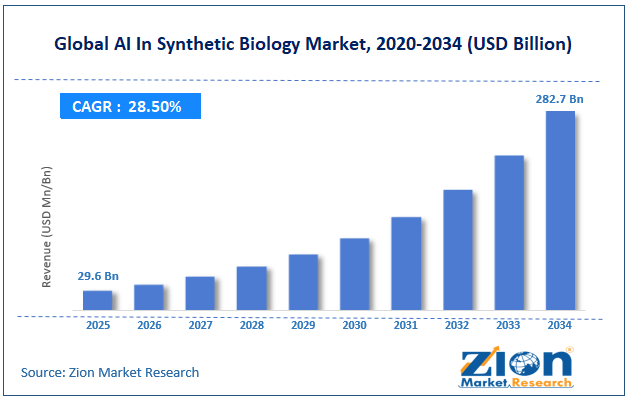
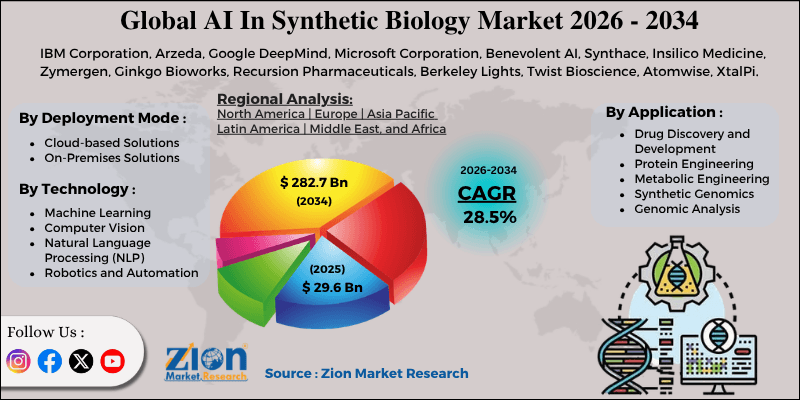
The global AI in synthetic biology market was valued at around USD 29.6 billion in 2025 and is predicted to grow to around USD 282.7 billion by 2034, with a compound annual growth rate (CAGR) of roughly 28.5% between 2026 and 2034.
This report provides a comprehensive analysis of the growth drivers, restraints, and challenges shaping demand across the global AI in synthetic biology market throughout the forecast period, while highlighting high-potential emerging opportunities within the industry.
Key Insights
- According to our research analyst, the global AI in synthetic biology market is estimated to grow at a CAGR of around 28.5% over the forecast period (2026-2034).
- In terms of revenue, the global AI in synthetic biology market size was valued at around USD 29.6 billion in 2025 and is projected to reach USD 282.7 billion by 2034.
- Rapid advancements in generative AI and protein design are expected to propel the AI in synthetic biology market over the projected period.
- By deployment mode, the on-premises solutions segment dominates the market.
- Based on the technology, the machine learning segment holds the largest market share in 2025.
- By application, the drug discovery and development segment holds a majority of market share in 2025.
- Based on region, North America dominates the AI in synthetic biology market in 2025, with 39%.
AI In Synthetic Biology Market: Overview
AI in synthetic biology means using machine learning, deep learning, generative AI, and other computational methods to create, study, and improve biological systems. AI can analyze large amounts of genetic, molecular, and biological data to find patterns and predict how genes, proteins, cells, and biological processes will behave. In biology, it is increasingly used for things like designing proteins and enzymes, improving DNA sequences, building metabolic pathways, creating gene circuits, finding new drugs, and improving engineered microorganisms. By making experiments faster and cheaper and improving predictions, AI helps speed up the creation of new medicines, chemicals made from living things, environmentally friendly materials, solutions for farming, and other products made using biology.
Impact of the USA-Israel War on Iran on the AI In Synthetic Biology Market
The war between the United States, Israel, and Iran is likely to negatively affect the AI in Synthetic Biology market in the short term. This is mainly because of higher energy, transportation, laboratory input, and research costs. Problems near the Strait of Hormuz can raise logistics costs and delay biotechnology companies that rely on lab materials and equipment from other countries. During periods of tension, countries may invest more in biotechnology, AI-powered biological research, and safer ways to make biological products. This could help the market grow over time
AI In Synthetic Biology Market: Dynamics
Growth Drivers
Why does the increasing adoption of AI for biological design and optimization drive the AI in synthetic biology market?
The growing use of AI to design and improve things is driving growth in the AI in synthetic biology market. This is because AI makes it faster and more data-driven to create proteins, enzymes, antibodies, and other biological parts. AI tools can analyze biological data, generate new sequences, predict what molecules will do, and identify promising options before lab testing. This helps cut down on the time and money needed for experiments. This trend showed up in new products in 2025. For instance, Ainnocence brought out BioSynthAI™ in June 2025. This AI tool is meant to help design and improve proteins and enzymes using computer-based methods, gene design, organism modification, and process control.
Also, Profluent released ProGen3 in April 2025. This group of AI models was trained on more than 3.4 billion protein sequences to create new proteins and help with things like making antibodies and gene editors. Biortus also introduced BiortusAI in August 2025. This combines AI and machine learning for designing proteins, improving antibody discovery, finding medicines, and testing them all in one research and development platform. These new products show that the industry is moving toward using AI in the design, build, test, and learn process. This is driving more interest in AI tools for drug discovery, drug development, and other areas of biology.
Restraints
High costs of AI and synthetic biology infrastructure act as a major restraint to market growth
The high costs of AI and synthetic biology infrastructure may hinder the AI in synthetic biology market, as effective AI-based approaches require substantial spending on engineering, laboratory, sequencing, robotics, storage, software, reagents, and personnel. Biofoundries that use AI/ML with robotics require significant upfront investment in equipment, software, and labor, plus recurring costs for consumables, equipment servicing, upgrades, and staffing. AI-based approaches in synthetic biology tend to cost more because they often require both sophisticated computational infrastructure and laboratory equipment to design and physically realize biological constructs. These costs can be a challenge, especially for smaller entities and bio startups, which may slow AI adoption in the life sciences industry. Shared facilities have emerged as a solution to this issue – for instance, in July 2026, Northwestern University secured a $20 million grant from the National Science Foundation to establish an AI-powered cloud laboratory that would enable researchers to design proteins and utilize connected remote equipment instead of owning and operating costly infrastructure in-house.
Opportunities
How does the growing product launch offer a lucrative opportunity for the AI in synthetic biology market?
The innovative product launch is expected to create opportunities for growth in the AI in synthetic biology market. For instance, in May 2025, Ribbon Bio GmbH, a DNA synthesis company, announced the launch of MiroSynth™ DNA, its first commercial product designed to meet the growing demand for complex, highly accurate synthetic DNA molecules. MiroSynth™ DNA is built on Ribbon’s proprietary algorithm-driven technology and precision enzymatic assembly process, delivering exceptional accuracy and performance for applications initially in biopharma, life sciences, and academic research. Customers and partners across the US, EU, UK, and Australia can now access MiroSynth™ DNA to accelerate their most ambitious scientific work.
Challenges
Why do the limited explainability and reliability of AI models pose a significant challenge to the growth of AI in synthetic biology industry?
Limited explainability and reliability of AI models present a major challenge to the development of AI in synthetic biology market. Advanced AI systems are often “black boxes,” making it difficult for researchers to understand how the AI produced a specific biological design or prediction. For instance, incorrect predictions or designs made by AI may stem from insufficient, erroneous, or biased bioinformatic data and lead to dysfunctional proteins, enzymes, genetic circuits, and other biomolecules under laboratory conditions. Additionally, applying AI in synthetic biology may reduce trust in an organization's products, processes, and findings among pharmaceutical companies, biotechnology firms, regulators, and researchers if the reliability of AI-designed biomolecules cannot be established experimentally. This may increase laboratory testing and verification, requiring additional resources and time before a product reaches the market and hindering the commercialization of AI in synthetic biology.
AI In Synthetic Biology Market: Report Scope
| Report Attributes | Report Details |
|---|---|
| Report Name | AI In Synthetic Biology Market |
| Market Size in 2025 | USD 29.6 Billion |
| Market Forecast in 2034 | USD 282.7 Billion |
| Growth Rate | CAGR of 28.5% |
| Number of Pages | 228 |
| Key Companies Covered | IBM Corporation, Arzeda, Google DeepMind, Microsoft Corporation, Benevolent AI, Synthace, Insilico Medicine, Zymergen, Ginkgo Bioworks, Recursion Pharmaceuticals, Berkeley Lights, Twist Bioscience, Atomwise, XtalPi, AbCellera, and others. |
| Segments Covered | By Deployment Mode, By Technology, By Application, and By Region |
| Regions Covered | North America, Europe, Asia Pacific (APAC), Latin America, Middle East, and Africa (MEA) |
| Base Year | 2025 |
| Historical Year | 2020 - 2024 |
| Forecast Year | 2026 - 2034 |
| Customization Scope | Avail customized purchase options to meet your exact research needs. Request For Customization |
AI In Synthetic Biology Market: Segmentation
Deployment Mode Insights
Why does the on-premises solutions segment hold a prominent position in the AI in synthetic biology market?
The on-premises solutions segment dominates the AI in synthetic biology market. Biotechnology and pharma companies are seeking greater control over their genomic, proteomic, clinical, and proprietary data. Having AI on-premises helps ensure data privacy, intellectual property (IP) security, regulatory compliance, and reduced reliance on third-party cloud providers. This trend is now driving the market - in March 2026, KALA BIO announced its entry into the secure on-premises AI space for the biotechnology industry. The company has developed a solution for biotech companies that want to retain control over their data and have an ongoing platform-as-a-service revenue stream called Researgency.
Technology Insights
How does the machine learning segment capture the largest share in the AI in synthetic biology market?
The machine learning segment holds the largest share of the AI in synthetic biology market in 2025. ML helps analyze biological datasets, predict protein structure and function, design sequences, and optimize biological systems faster and more accurately than humans. ML is now being coupled with laboratory robotics to form closed-loop design-build-test-learn systems that accelerate protein and enzyme engineering by reducing trials and iterations, making the design process more efficient.
According to a study published in Nature Communications in 2025, an ML-based computer system with large language models and biofoundry automation was used to design an autonomous enzyme engineering platform that could yield, after four iterations over four weeks, a 90-fold gain in preference for the target substrate and a 16-fold higher activity for one enzyme.
Application Insights
Why does the drug discovery and development segment capture the largest share in the AI in synthetic biology market?
The drug discovery and development segment holds a majority of the AI in synthetic biology market share in 2025 because AI helps with drug discovery, which is usually time-consuming and expensive; it makes it much easier to analyze large sets of genomic, proteomic, or molecular data and identify potential candidates faster, with fewer lab experiments.
AI In Synthetic Biology Market: Regional Insights
What factors drive the North America region in the AI in synthetic biology market?
North America held the largest share of the AI in synthetic biology market in 2025, at 39%. Growth is driven primarily by the region's mature biotechnology sector, especially in the United States, along with significant government investment. Other factors driving market proliferation and growth include advanced AI capabilities and pharmaceutical and biotechnology R&D. Government support is also driving convergence between AI and synthetic biology. For instance, in August 2025, the US National Science Foundation (NSF) announced allocation of nearly 32 million USD to five teams participating in the Use-Inspired Acceleration of Protein Design program. The initiative aims to bring novel AI-driven protein-design technologies to market to enable breakthroughs in biomanufacturing, advanced materials, and other fields.
Similarly, the NIH allocated $35.3 billion in competing and noncompeting grants in FY 2025, increasing overall biomedical research investment, while funding for research project grants increased by 3% from the previous year. In addition, the NIH's Bridge2AI program received $56.163 million in FY 2025 enacted funding to accelerate biomedical research, specifically to explore AI-driven approaches in the field. Together, these factors are driving drug discovery, pharmaceutical, biotechnology, academic, and start-up companies to harness AI for protein engineering and design, as well as gene and enzyme design, metabolic engineering, and automation of biological research.
AI In Synthetic Biology Market: Competitive Analysis
The global AI in synthetic biology market is dominated by players like:
- IBM Corporation
- Arzeda
- Google DeepMind
- Microsoft Corporation
- Benevolent AI
- Synthace
- Insilico Medicine
- Zymergen
- Ginkgo Bioworks
- Recursion Pharmaceuticals
- Berkeley Lights
- Twist Bioscience
- Atomwise
- XtalPi
- AbCellera
The global AI in synthetic biology market is segmented as follows:
By Deployment Mode
- Cloud-based Solutions
- On-Premises Solutions
By Technology
- Machine Learning
- Computer Vision
- Natural Language Processing (NLP)
- Robotics and Automation
By Application
- Drug Discovery and Development
- Protein Engineering
- Metabolic Engineering
- Synthetic Genomics
- Genomic Analysis
By Region
- North America
- The U.S.
- Canada
- Mexico
- Europe
- France
- The UK
- Spain
- Germany
- Italy
- Rest of Europe
- Asia Pacific
- China
- Japan
- India
- Australia
- South Korea
- Rest of Asia Pacific
- The Middle East & Africa
- Saudi Arabia
- UAE
- Egypt
- Kuwait
- South Africa
- Rest of the Middle East & Africa
- Latin America
- Brazil
- Argentina
- Rest of Latin America
Table Of Content
Methodology
FrequentlyAsked Questions
AI in synthetic biology means using machine learning, deep learning, generative AI, and other computational methods to create, study, and improve biological systems. AI can analyze large amounts of genetic, molecular, and biological data to find patterns and predict how genes, proteins, cells, and biological processes will behave.
The key growth drivers for the AI in synthetic biology market include the increasing adoption of AI for biological design and optimization, growing demand for faster drug discovery and development, rising investment in biotechnology and AI research, increasing availability of genomic and biological datasets, and the expansion of automated laboratories.
The major challenges restraining the growth of the AI in synthetic biology market include high infrastructure and computational costs, limited availability and quality of biological data, lack of explainability and reliability of AI models, regulatory uncertainty, data privacy and intellectual-property concerns, and biosecurity risks. AI models require large, standardized, high-quality datasets, while biological data remain fragmented across different sources, limiting model performance.
Based on the application, the drug discovery and development segment is expected to dominate the AI in synthetic biology market growth during the projected period.
Key emerging trends include the rapid adoption of generative AI and protein language models, which are enabling de novo protein design, protein optimization, and prediction of molecular structures and functions with greater speed and precision.
According to the report, the global AI in synthetic biology market size was worth around USD 29.6 billion in 2025 and is predicted to grow to around USD 282.7 billion by 2034.
The global AI in synthetic biology market is expected to grow at a CAGR of 28.5% during the forecast period.
The global AI in synthetic biology industry growth is expected to be led by North America over the forecast period.
The global AI in synthetic biology market is dominated by players like IBM Corporation, Arzeda, Google DeepMind, Microsoft Corporation, Benevolent AI, Synthace, Insilico Medicine, Zymergen, Ginkgo Bioworks, Recursion Pharmaceuticals, Berkeley Lights, Twist Bioscience, Atomwise, XtalPi, and AbCellera, among others.
The AI in synthetic biology market report covers the geographical market along with a comprehensive competitive landscape analysis. It also includes cash flow analysis, profit ratio analysis, market basket analysis, market attractiveness analysis, sentiment analysis, PESTLE analysis, trend analysis, SWOT analysis, trade area analysis, demand & supply analysis, Porter’s five forces analysis, and value chain analysis.

HappyClients

