
AEC Software Market Size, Share, Value and Forecast Report 2034

AEC Software Market By Solution Type (Building Information Modeling, Computer-Aided Design, Project Management Software, Estimation & Cost Management Software, Facility Management Software, and Collaboration & Communication Platforms), By Deployment Mode (On-Premise, Cloud-Based, and Hybrid), By End User (Architecture Firms, Engineering Consultancies, Construction Companies, Real Estate Developers, and Government & Public Sector), By Project Type (Residential Construction, Commercial Construction, Infrastructure & Civil Engineering, and Industrial Construction), and By Region - Global and Regional Industry Overview, Market Intelligence, Comprehensive Analysis, Historical Data, and Forecasts 2025 - 2034
| Market Size in 2024 | Market Forecast in 2034 | CAGR (in %) | Base Year |
|---|---|---|---|
| USD 11.30 Billion | USD 22.70 Billion | 8.06% | 2024 |
AEC Software Industry Perspective:
What are the expected growth rate and market size of the AEC software market during the forecast period?
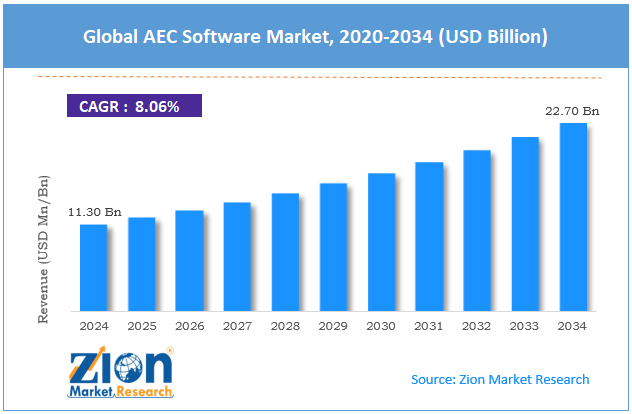
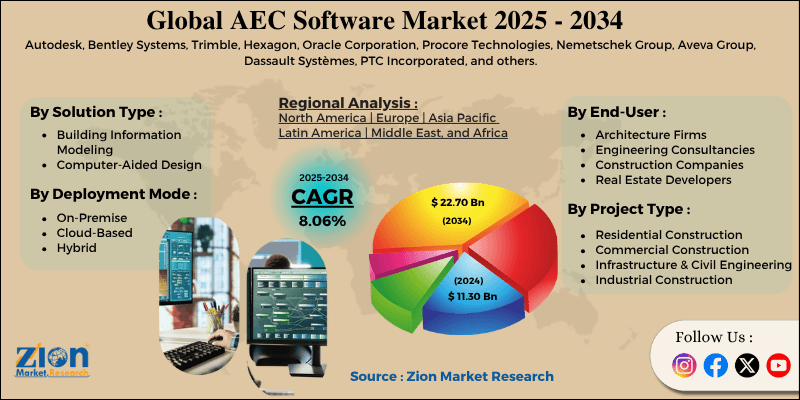
The global AEC software market size was worth approximately USD 11.30 billion in 2024 and is projected to grow to around USD 22.70 billion by 2034, with a compound annual growth rate of roughly 8.06% between 2025 and 2034.
AEC Software Market: Overview
AEC software (Architecture, Engineering, and Construction software) is a set of digital tools used to plan, design, manage, and build construction projects more efficiently. It is used for projects ranging from small houses to large airports, bridges, and smart cities. These tools help architects create designs, engineers perform calculations, and construction teams manage timelines, costs, and workers in one system. Earlier, most construction work was done manually or with simple tools, which was time-consuming and prone to errors. Today, AEC software simplifies complex tasks such as creating 3D building models, detecting design issues before construction begins, and managing project data across teams. It allows everyone involved to work with the same updated information, improving coordination.
AEC software is available in two main types: on premise and cloud-based. On-premises software is installed on company systems, offering greater control but requiring maintenance. Cloud-based software is accessed through the internet and allows real-time collaboration from anywhere. The AEC software market is growing due to rising construction demand, digital transformation, cost-control needs, and the growing use of smart technologies in infrastructure projects.
The AEC software market is evolving due to growing digital adoption, advanced 3D modeling and automation tools, increasing use of cloud-based platforms, stronger focus on cost and time efficiency, and rising demand for smart and sustainable construction projects.
Key Insights
- As per the analysis shared by our research analyst, the global AEC software market is estimated to grow annually at a compound annual growth rate of around 8.06% over the forecast period from 2025 to 2034.
- In terms of revenue, the global AEC software market size was valued at approximately USD 11.30 billion in 2024 and is projected to reach USD 22.70 billion by 2034.
- The AEC software market is expected to grow due to rising construction activity worldwide, the increasing adoption of Building Information Modeling technology, the growing demand for cloud-based project collaboration tools, government investment in infrastructure, and the ongoing digital transformation of the architecture, engineering, and construction sectors.
- Based on solution type, the Building Information Modeling segment is expected to lead growth in the AEC software market, while the project management software segment is anticipated to expand rapidly as construction firms seek better tools to control timelines, costs, and resources across complex projects.
- Based on deployment mode, the cloud-based segment is expected to lead the AEC software market in terms of new adoption, while on-premises solutions are anticipated to remain relevant for large firms with specific data security and compliance requirements.
- Based on end user, the construction companies segment is the largest, while the architecture firms segment is growing rapidly as design professionals increasingly adopt digital tools for visualization, collaboration, and client presentation.
- Based on project type, the infrastructure and civil engineering segment is expected to lead the AEC software market, while the commercial construction segment is anticipated to grow strongly as urban development and commercial real estate investment continue to rise globally.
- Based on region, North America is projected to dominate the global AEC software market during the estimated period, followed by Europe.
Impact of the USA-Israel War on Iran on the AEC Software Market
The conflict involving the United States and Israel against Iran is expected to have both short-term and long-term effects on the AEC software market. In the near term, rising fuel costs and supply chain disruptions caused by regional instability may slow construction activity in affected areas, which, in turn, reduces immediate software demand. However, in the longer term, reconstruction efforts and increased investment in infrastructure security across the Middle East region may actually drive greater adoption of advanced planning and project management software tools.
AEC Software Market: Technology Roadmap 2025 to 2034
What key trends and future developments will drive the AEC software market during the forecast period?
The digital transformation of the construction and design industry is shaping the AEC software market, driving advances in artificial intelligence, cloud collaboration, automation, and data-driven project management. The market is expected to grow at a compound annual growth rate of around 8.06% over the forecast period, supported by strong demand from construction firms, engineering consultancies, government infrastructure programs, and real estate developers who need smarter, faster, and more reliable digital tools to manage increasingly complex projects.
The following roadmap outlines the key development phases expected during the forecast period.
2025 to 2027: Cloud Adoption and Building Information Modeling Expansion Phase
- Cloud-based AEC platforms are expected to grow fast as companies shift from desktop tools to systems that allow teams to work together in real time from different locations.
- Building Information Modeling use is likely to increase as more governments make it mandatory for public infrastructure projects.
- Mobile applications for construction site management are expected to become standard, allowing site teams to access drawings, track issues, and update project records directly from the field.
2028 to 2031: Artificial Intelligence Integration and Automation Phase
- Artificial intelligence will be integrated into AEC software to detect design errors, predict delays, and automatically improve resource planning.
- Digital twin technology will become more popular. It will help teams create virtual models of buildings to track performance and plan maintenance.
- Generative design tools powered by artificial intelligence are expected to help architects and engineers explore thousands of design options quickly based on defined goals and constraints.
2032 to 2034: Fully Integrated Smart Construction Ecosystem Phase
- AEC software platforms are expected to become fully connected ecosystems in which design, construction, and operations data flow seamlessly between teams, tools, and systems without manual transfer.
- Augmented reality and virtual reality tools integrated into AEC platforms are expected to become mainstream for design review, client presentations, and on-site construction guidance.
- Sustainability analysis tools built into design software are expected to allow teams to measure and optimize the carbon footprint of buildings and infrastructure from the earliest stages of a project.
AEC Software Market: Dynamics
Growth Drivers
The rapid digital transformation of the global construction industry is driving the AEC software market.
The AEC software market is growing fast as the construction and design industry shifts from manual work and paper-based processes to digital tools. Construction is a large global industry, but it has been slow in adopting technology until now. Companies are realizing that AEC software helps reduce errors, improve team communication, and complete projects on time and within budget. One major driver is the growing adoption of Building Information Modeling, which enables all teams to work on a single, shared digital model rather than separate drawings. Governments in countries like the United Kingdom and Singapore are also making BIM mandatory for public projects, pushing more firms to adopt these tools.
In addition, project management software helps teams track tasks, costs, and schedules in real time, improving overall efficiency. Estimating tools also help companies plan budgets more accurately before starting projects. As buildings become more complex and deadlines become tighter, the need for faster, smarter, and more cost-effective solutions is increasing, making AEC software essential for staying competitive.
What role does rising global infrastructure investment play in driving the AEC software market?
The AEC software market is growing rapidly as global investment in infrastructure projects such as roads, railways, airports, bridges, hospitals, and water systems increases. Governments are spending heavily on large construction projects that require advanced planning, coordination, and management tools, thereby increasing demand for AEC software. In countries like the United States, major infrastructure programs are supporting large-scale developments that rely on digital engineering and project management solutions. Across Asia, rapid urban growth is driving strong demand for design and coordination software as cities expand rapidly.
In developing regions, the need for affordable housing and better public facilities is also driving software adoption. At the same time, private construction projects such as data centers, warehouses, and factories are increasing worldwide. This growing complexity and scale of projects are making AEC software essential for improving efficiency, reducing delays, and managing construction activities more effectively.
Restraints
How are the high implementation costs and resistance to change slowing growth in the AEC software market?
The AEC software industry faces several challenges that are slowing its adoption across the construction and design industry. One major issue is the high cost of software implementation, including purchasing licenses, training employees, upgrading systems, and migrating existing data. Small and medium-sized firms often find these costs difficult to manage. Another key challenge is resistance to change, as many professionals prefer traditional methods and are hesitant to adopt new technologies. This makes it harder for companies to switch to digital workflows fully.
Interoperability is also a concern, as different software tools used by teams do not always work well together, leading to data errors and repeated work. In addition, the growing use of cloud platforms has raised concerns about data security and privacy, especially for sensitive projects. These factors together are limiting the speed at which the AEC software market can expand.
Opportunities
What opportunities does the growing focus on sustainable construction and green building create for the AEC software market?
The AEC software market is creating significant opportunities as the construction industry focuses on sustainable, smart building practices. Governments and regulators are introducing stricter rules to reduce energy use and carbon emissions, which is increasing the need for advanced design tools. AEC software now helps architects and engineers assess energy performance, lighting, ventilation, and material impacts during the design stage. This allows better decisions before construction begins. Green building certification programs are also pushing companies to use software that can track and verify compliance with environmental standards.
At the same time, the rise of modular and prefabricated construction is increasing demand for tools that can coordinate factory production with on-site work smoothly and accurately. In addition, smart buildings are becoming more common, using automated systems to manage energy, lighting, and security. This is creating new demand for AEC software that integrates design, construction, and building operations into a single system.
Challenges
Workforce skill gaps and project data fragmentation create challenges in the AEC software market.
The AEC software market faces important challenges that slow down its full adoption across the construction and design industry. One major issue is the lack of skilled workers who can use advanced software tools effectively. While new professionals are comfortable with digital systems, many experienced workers still rely on traditional methods. Training teams takes time and adds extra costs for companies. Another challenge is data fragmentation, as construction projects generate large amounts of information that are often stored in different systems.
When data is not connected, it leads to confusion, errors, and delays in decision-making. Managing data across multiple teams, contractors, and agencies becomes even more difficult on large projects. In addition, delays in approvals and permits can slow construction timelines, reducing the need for software during those periods.
AEC Software Market: Report Scope
| Report Attributes | Report Details |
|---|---|
| Report Name | AEC Software Market |
| Market Size in 2024 | USD 11.30 Billion |
| Market Forecast in 2034 | USD 22.70 Billion |
| Growth Rate | CAGR of 8.06% |
| Number of Pages | 228 |
| Key Companies Covered | Autodesk, Bentley Systems, Trimble, Hexagon, Oracle Corporation, Procore Technologies, Nemetschek Group, Aveva Group, Dassault Systèmes, PTC Incorporated, and others. |
| Segments Covered | By Solution Type, By Deployment Mode, By End User, By Project Type, and By Region |
| Regions Covered | North America, Europe, Asia Pacific (APAC), Latin America, Middle East, and Africa (MEA) |
| Base Year | 2024 |
| Historical Year | 2019 - 2023 |
| Forecast Year | 2025 - 2034 |
| Customization Scope | Avail customized purchase options to meet your exact research needs. Request For Customization |
AEC Software Market: Segmentation
The global AEC software market is segmented based on solution type, deployment mode, end user, project type, and region.
What makes Building Information Modeling the leading solution type in the AEC software market?
Based on solution type, the global AEC software market is divided into Building Information Modeling, computer-aided design, project management software, estimation and cost management software, facility management software, and collaboration and communication platforms. The Building Information Modeling segment accounts for about 35% of the global market and leads by integrating design, engineering, and construction into a single, coordinated digital model. The project management software segment holds around 22% of the market share. It is growing steadily as firms seek better control over schedules, budgets, subcontractors, and documents in complex, multi-site projects.
Why does cloud-based deployment lead the AEC software market?
Based on deployment mode, the AEC software industry is divided into on-premise, cloud-based, and hybrid. The cloud-based segment accounts for approximately 48% of the market and leads because it allows project teams to collaborate in real time regardless of physical location, reduces the need for expensive local hardware, and enables faster software updates and scaling. The on-premise segment holds about 36% of the market share. It remains important for firms and agencies that need strict data control and cannot use external servers for sensitive projects.
What helps construction companies lead the end-user segment in the AEC software market?
Based on end user, the AEC software market is classified into architecture firms, engineering consultancies, construction companies, real estate developers, and government and public sector organizations. The construction companies segment holds around 41% of the global market and leads because firms handle complex operations that require tools for scheduling, procurement, site management, safety, and reporting. The architecture firms segment holds about 24% of the market. It is growing steadily as architects use advanced visualization, generative design, and BIM tools to improve designs and win more bids.
Why does the infrastructure and civil engineering project type lead the AEC software market?
Based on project type, the AEC software market is categorized into residential construction, commercial construction, infrastructure and civil engineering, and industrial construction. The infrastructure and civil engineering segment accounts for nearly 38% of the global market and leads because large public projects require highly advanced planning and coordination software. The commercial construction segment holds around 28% of the market. It is growing because urban development, retail, hospitality, and office construction projects are increasing globally.
AEC Software Market: Regional Analysis
What factors contribute to North America’s leadership position in the AEC software market?
The AEC software market in North America is expected to grow at a CAGR of around 11% during the forecast period, supported by strong adoption of digital tools across the United States construction and design industry. Companies widely use Building Information Modeling, cloud-based project management, and construction analytics to improve efficiency and reduce errors. The United States also has many leading AEC software providers, which support faster innovation and adoption. Government spending on infrastructure projects such as roads, bridges, and public facilities is further increasing the need for advanced software solutions. Canada is also contributing to regional growth with rising investments in housing and infrastructure, along with growing use of cloud-based construction tools by project teams. A highly skilled workforce and strong funding for construction technology startups support continued market expansion in the region. Clear regulations and standards are encouraging the adoption of digital project delivery methods across public and private projects.
In addition, the rising construction of data centers, commercial buildings, and industrial facilities in the United States is creating steady demand for design and management software. Mexico is also seeing growth in construction activities and gradually adopting digital tools as global partners require better data and project coordination. High awareness of productivity benefits and strong competition among firms are also encouraging faster adoption of advanced software tools. Continuous upgrades and integration of new technologies are further strengthening market growth and efficiency.
What supports Europe's strong position in the global AEC software market?
The AEC software market in Europe is projected to grow at a CAGR of approximately 10% over the forecast period, driven by the steady adoption of digital construction tools and the increasing use of advanced software solutions. Countries such as the United Kingdom, Germany, and the Netherlands are widely using Building Information Modeling to improve project planning and coordination. The United Kingdom played an important role by making BIM mandatory for government-funded infrastructure projects, which pushed companies to adopt digital methods quickly. Germany’s strong engineering and industrial construction sector also drives demand for advanced design and management software.
Nordic countries are known for using software focused on energy-efficient, sustainable building design, driven by strict environmental standards. Policy support from the European Union is further encouraging digital transformation and green construction practices across multiple countries. Growing construction activity in Eastern and Southern Europe is also driving software adoption. The increased focus on efficiency, cost control, and project transparency is encouraging wider adoption of digital tools across the industry. Strong collaboration between the public and private sectors is also supporting faster implementation of advanced AEC software solutions. Rising investments in smart infrastructure and renovation of aging buildings are further boosting demand for digital tools.
Recent Market Developments
- In February 2026, Autodesk announced a $200 million investment in World Labs, an AI-focused company, to strengthen its spatial intelligence capabilities and accelerate the integration of AI into AEC design and modeling workflows.
- In March 2026, Nemetschek Group announced a strategic partnership with Neilsoft to establish a global Center of Excellence to enhance BIM adoption, digital twin capabilities, and collaborative design solutions across the AEC sector.
- In April 2026, Autodesk announced a strategic partnership with Pinnacle Infotech to accelerate digital transformation in the AEC industry by combining cloud-based platforms with advanced engineering services to improve project lifecycle efficiency.
AEC Software Market: Competitive Analysis
The leading players in the global AEC software market are:
- Autodesk
- Bentley Systems
- Trimble
- Hexagon
- Oracle Corporation
- Procore Technologies
- Nemetschek Group
- Aveva Group
- Dassault Systèmes
- PTC Incorporated
The global AEC software market is segmented as follows:
By Solution Type
- Building Information Modeling
- Computer-Aided Design
- Project Management Software
- Estimation & Cost Management Software
- Facility Management Software
- Collaboration & Communication Platforms
By Deployment Mode
- On-Premise
- Cloud-Based
- Hybrid
By End User
- Architecture Firms
- Engineering Consultancies
- Construction Companies
- Real Estate Developers
- Government & Public Sector
By Project Type
- Residential Construction
- Commercial Construction
- Infrastructure & Civil Engineering
- Industrial Construction
By Region
- North America
- The U.S.
- Canada
- Mexico
- Europe
- France
- The UK
- Spain
- Germany
- Italy
- Rest of Europe
- Asia Pacific
- China
- Japan
- India
- Australia
- South Korea
- Rest of Asia Pacific
- The Middle East & Africa
- Saudi Arabia
- UAE
- Egypt
- Kuwait
- South Africa
- Rest of the Middle East & Africa
- Latin America
- Brazil
- Argentina
- Rest of Latin America
Table Of Content
Methodology
FrequentlyAsked Questions
AEC software (Architecture, Engineering, and Construction software) is a set of digital tools used to plan, design, manage, and build construction projects more efficiently. It is used for projects ranging from small houses to large airports, bridges, and smart cities. These tools help architects create designs, engineers perform calculations, and construction teams manage timelines, costs, and workers in one system.
The global AEC software market is expected to grow due to rising infrastructure investment, increasing adoption of Building Information Modeling, growing demand for cloud collaboration tools, digital transformation in the construction sector, government mandates for digital project delivery, and the growing complexity of modern construction projects that require advanced software solutions.
According to the study, the global AEC software market size was worth around USD 11.30 billion in 2024 and is predicted to grow to around USD 22.70 billion by 2034.
The compound annual growth rate value of the AEC software market is expected to be around 8.06% from 2025 to 2034.
North America is expected to lead the global AEC software market due to high technology adoption rates, strong government infrastructure investment, the presence of major software providers, and a construction industry that has been among the earliest to embrace digital project delivery methods.
The major players profiled in the global AEC software market include Autodesk, Bentley Systems, Trimble, Hexagon, Oracle Corporation, Procore Technologies, Nemetschek Group, Aveva Group, Dassault Systèmes, and PTC Incorporated.
The report provides a thorough analysis of the AEC software market, including a detailed review of key growth drivers and market restraints, technology development trends, digital transformation dynamics in the construction sector, regional market performance, competitive landscape analysis, and a forward-looking perspective covering all major solution types, deployment modes, end users, and project categories across every key geography.
The AEC software market is influenced by government mandates for Building Information Modeling on public projects, green building regulations that require environmental performance analysis tools, data protection and cybersecurity standards for cloud-based platforms, and procurement rules that increasingly require digital project documentation and reporting.
The AEC software market will be influenced by construction spending levels, interest rates that affect real estate and infrastructure investment, global supply chain conditions, currency fluctuations that impact software pricing in international markets, and overall economic growth, which determines how much companies and governments invest in new construction and infrastructure projects.
The AEC software market includes large, established technology companies with broad platform offerings, specialized niche software providers focused on specific tasks such as estimating or site safety management, cloud-native construction technology startups, and a growing number of artificial intelligence-focused firms developing tools to automate design, scheduling, and cost management.

HappyClients

