Acrylic Emulsions Market Trend, Share, Growth, Size Analysis and Forecast 2032

Acrylic Emulsions Market Analysis By Type (Pure Acrylic, Polymer & Copolymer) and By Application (Paper Coating, Construction Additives, Paints & Coatings, Adhesives & Sealant, and Others), and By Region: Global Industry Perspective, Comprehensive Analysis, and Forecast 2024-2032
| Market Size in 2023 | Market Forecast in 2032 | CAGR (in %) | Base Year |
|---|---|---|---|
| USD 11.56 Billion | USD 22.54 Billion | 7.9% | 2023 |
Acrylic Emulsions Market: Overview
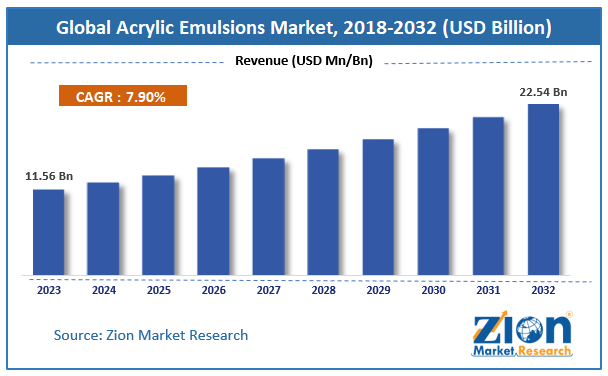
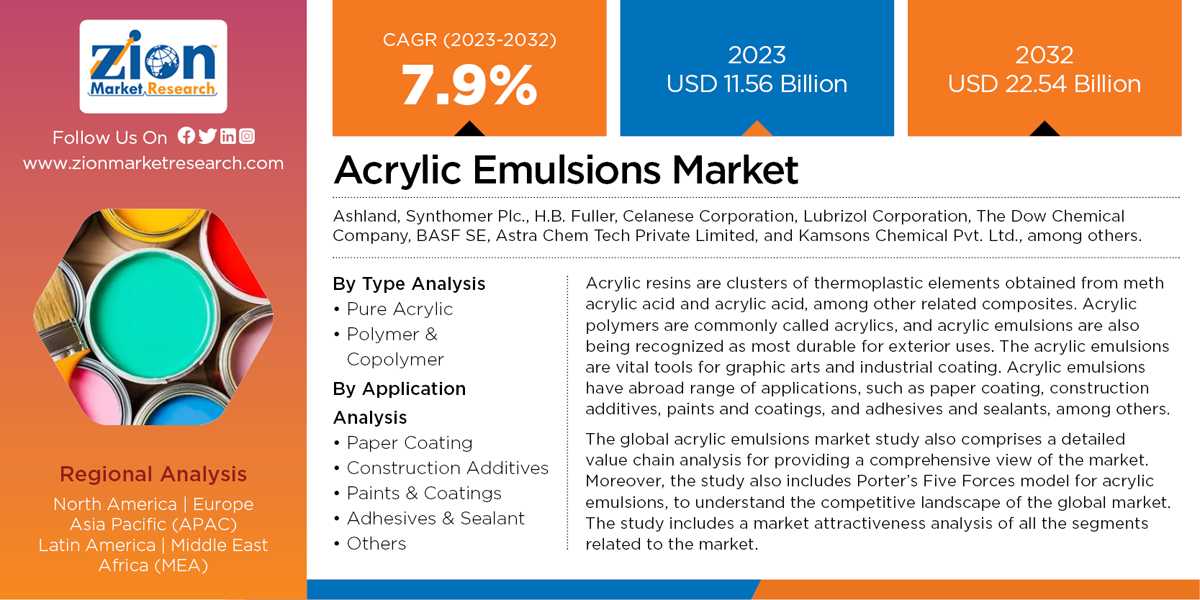
The global Acrylic Emulsions market size accrued earnings worth approximately USD 11.56 Billion in 2023 and is predicted to gain revenue of about USD 22.54 Billion by 2032, is set to record a CAGR of nearly 7.9% over the period from 2024 to 2032 based on revenue and volume.
 Request Free SampleRequest Free SampleRequest Free Sample
Acrylic Emulsions Market Outlook
Acrylic resins are clusters of thermoplastic elements obtained from meth acrylic acid and acrylic acid, among other related composites. Acrylic polymers are commonly called acrylics, and acrylic emulsions are also being recognized as most durable for exterior uses. The acrylic emulsions are vital tools for graphic arts and industrial coating. Acrylic emulsions have abroad range of applications, such as paper coating, construction additives, paints and coatings, and adhesives and sealants, among others.
The global acrylic emulsions market study also comprises a detailed value chain analysis for providing a comprehensive view of the market. Moreover, the study also includes Porter’s Five Forces model for acrylic emulsions, to understand the competitive landscape of the global market. The study includes a market attractiveness analysis of all the segments related to the market.
 Request Free SampleRequest Free SampleRequest Free Sample
Acrylic Emulsions Market Growth Analysis
The global acrylic emulsions market is experiencing a significant rate of growth, which is expected to continue in the upcoming years. The growing demand for paints from emerging economies is likely to act as the key driver for this market’s growth. There is increased usage of acrylic emulsions for paper coating, construction additives, paints and coatings, and adhesives and sealant industries across different regions. Acrylic emulsions have different properties, which includes enhancing visual appearance and performance and improving the processability of the end products.
The increased demand for acrylic emulsions paints and coatings industry segment is further anticipated to drive the growth of the global acrylic emulsions market in the forecast timeframe. Growing economies, infrastructural developments, increasing usage of acrylic emulsion across numerous end-user industries, and rising demand for construction additives are among other key factors fuelling the expansion of the global acrylic emulsions market. Government rules and regulations related to VOC content in emulsions also contributing toward the market growth of acrylic emulsions. However, the rising popularity of polyurethane dispersions across coating applications might be a restraining factor in the growth of the global acrylic emulsions market in the forecast timeframe. Nonetheless, it is product innovations and emerging markets in the Asia Pacific region that are probably expected to open new avenues for the major market players in the upcoming years.
Acrylic Emulsions Market: Report Scope
| Report Attributes | Report Details |
|---|---|
| Report Name | Acrylic Emulsions Market |
| Market Size in 2023 | USD 11.56 Billion |
| Market Forecast in 2032 | USD 22.54 Billion |
| Growth Rate | CAGR of 7.9% |
| Number of Pages | 196 |
| Key Companies Covered | Ashland, Synthomer Plc., H.B. Fuller, Celanese Corporation, Lubrizol Corporation, The Dow Chemical Company, BASF SE, Astra Chem Tech Private Limited, and Kamsons Chemical Pvt. Ltd., among others. |
| Segments Covered | By Type, By Application, and By Region |
| Regions Covered | North America, Europe, Asia Pacific (APAC), Latin America, Middle East, and Africa (MEA) |
| Base Year | 2023 |
| Historical Year | 2018 to 2022 |
| Forecast Year | 2024 - 2032 |
| Customization Scope | Avail customized purchase options to meet your exact research needs. Request For Customization |
Acrylic Emulsions Market Segmentation Analysis
The study provides a significant view of the global acrylic emulsions market by classifying it into type, application, and region segments. These segments have been estimated and forecasted with the future and past trends. Based on the type, the global acrylic emulsions market is mainly divided into pure acrylic and polymer, and copolymer. Based on applications, the global acrylic emulsions market is mainly segmented into the paper coating, construction additives, paints & coatings, adhesives and sealants, and others.
Acrylic Emulsions Market Regional Analysis
Based on geography, the global acrylic emulsions market is divided into North America, Europe, Asia Pacific, Latin America, and the Middle East and Africa. In 2023, North America was estimated to be the biggest market for acrylic emulsions. This growth was mainly due to the rising demand for coating applications, particularly in interior and furniture coating segment. The Asia Pacific region is anticipated to be the fastest growing market of acrylic emulsions the future, owing to the increasing demand from paper coatings, paints and coatings, and construction additives. The Asia Pacific was followed by North America and Europe in 2023. The market growth rates in North America and Europe are expected to stay higher during the forecast period as well.
The regional segmentation includes North America, Europe, Asia Pacific, Latin America, and the Middle East and Africa. Furthermore, it is divided into major countries, such as the U.S., India, Germany, France, UK, China, Japan, and Brazil.
Major vendors of the global acrylic emulsions market include
- Ashland
- Synthomer Plc.
- H.B. Fuller
- Celanese Corporation
- Lubrizol Corporation
- The Dow Chemical Company
- BASF SE
- Astra Chem Tech Private Limited
- and Kamsons Chemical Pvt. Ltd., among others.
This report segments the global acrylic emulsions market as follows:
By Type Analysis
- Pure Acrylic
- Polymer & Copolymer
By Application Analysis
- Paper Coating
- Construction Additives
- Paints & Coatings
- Adhesives & Sealant
- Others
By Regional Analysis
- North America
- The U.S.
- Europe
- UK
- France
- Germany
- Asia Pacific
- China
- Japan
- India
- Latin America
- Brazil
- The Middle East and Africa
Table Of Content
Methodology
FrequentlyAsked Questions
Which application areas will offer significant growth opportunities in the acrylic emulsions market?

HappyClients