
Global Wireless Fire Detection Systems Market Size, Share, Analysis, Trends, 2030

Wireless Fire Detection Systems Market - By Component (Call Point, Input/Output Module, Sensor, Fire Alarm Panels And Devices), By Product (Heat Detector, Multi-Sensor Detector, Gas Detector, And Smoke Detector), By Model (Fully Wireless And Hybrid), By Installation Type (Retrofit And New Installation), By Application (Industrial, Residential, Commercial, Manufacturing, And Others), And By Region: Global And Regional Industry Overview, Market Intelligence, Comprehensive Analysis, Historical Data, And Forecasts 2023 - 2030
| Market Size in 2022 | Market Forecast in 2030 | CAGR (in %) | Base Year |
|---|---|---|---|
| USD 2197.64 Million | USD 4236.58 Million | 8.74% | 2022 |
Description
What is Wireless Fire Detection Systems Market Size?
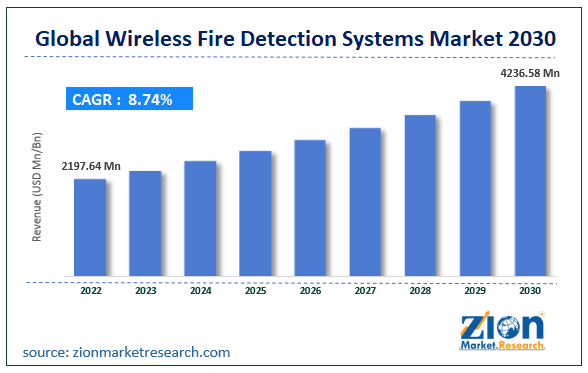
The global wireless fire detection systems market size was worth around USD 2197.64 Million in 2022 and is predicted to grow to around USD 4236.58 Million by 2030 with a compound annual growth rate (CAGR) of roughly 8.74% between 2023 and 2030.
The report analyzes the global wireless fire detection systems market drivers, restraints/challenges, and the effect they have on the demands during the projection period. In addition, the report explores emerging opportunities in the wireless fire detection systems industry.
Global Wireless Fire Detection Systems Market: Overview
The present-day wireless fire detection market aims at mixed wired and wireless systems. It is utilized for expanding or upgrading the existing installations and installing newer systems without affecting the wiring that is already installed in the building. The most common wireless fire detection system is star network, which is comprised of several wireless gadgets with a central wireless gateway or a repeater.
Global Wireless Fire Detection Systems Market: Growth Factors
As wireless technology ensures optimal safety as well as application flexibility, the global wireless fire detection systems market will benefit in the long run from the high detection capabilities of this technology. Wireless fire detection systems can be installed rapidly and conveniently and can be tweaked according to the requirements of a particular setting such as convention halls, hotel rooms, or government offices. This renders the system an ideal solution for multiple applications, ensuring highest safety. The emergence of new technologies such as the Advanced Signal Analysis (ASA) technology and Mesh technology has been spawning increasing demand for these solutions.
While conventional fire alarms fail to locate the exact area of activation, wireless fire detection systems feature alarm detectors that can easily pinpoint the source of the danger. Rising significance of aesthetics, design, and the simplicity in the utilization of these systems will also steer the growth of the global wireless fire detection systems market share during the forthcoming timeline.
However, the high capital and investments needed for the initial installation of wireless fire detection systems is a factor expected to hamper the expansion of the global wireless fire detection systems market forecast during the projected timeframe. Also, these devices are perceived by people to be less reliable when an actual fire accident occurs. This will further impact the growth of the global wireless fire detection systems market negatively.

Global Wireless Fire Detection Systems Market: Segmentation
The global wireless fire detection systems market has been segregated based on component, by product, by model, by installation type, by application, and by region.
On the basis of component, the global market can be differentiated as call point, input/output module, sensor, fire alarm panels and devices, and others.
Based on product, the global wireless fire detection systems market can be categorized as heat detector, multi-sensor detector, gas detector, and smoke detector. Smoke detector is further sub-segmented into ionization, photoelectric, dual sensor, and others.
By model, the global wireless fire detection systems market share can be segmented as fully wireless and hybrid.
On the basis of installation type, the market has been divided into retrofit and new installation.
On the basis of application, the global wireless fire detection systems market is bifurcated into industrial, residential, commercial, manufacturing, and others. The commercial segment has been sub-categorized into academia & institutional, BFSI (banking, financial services, and insurance), government, hospitality, healthcare, retail, and others.
Global Wireless Fire Detection Systems Market: Regional Analysis
North America accounted for a dominant share in the global wireless fire detection systems market in the past, whereas Europe is slated to exhibit highest CAGR through the upcoming timeframe. The wireless fire detection systems market trends in the region are likely to gain momentum due to the implementation of stringent fire safety regulations across the region. The integration of cutting-edge technologies such as IoT and AI with wireless fire detection systems has been boosting the performance of these solutions.
Asia Pacific is anticipated to witness spiraling demand for these systems due to the high penetration of smartphones & smart home appliances, the spike in the number of construction projects across the residential & commercial sectors, and the pervasiveness of wireless technologies. Lucrative expansion opportunities await for exploitation across countries such as South Korea, Japan, India, and China and they might surface as leading contributors in the wireless fire detection systems market outlook.
Wireless Fire Detection Systems Market: Report Scope
| Report Attributes | Report Details |
|---|---|
| Report Name | Wireless Fire Detection Systems Market Research Report |
| Market Size in 2022 | USD 2197.64 Million |
| Market Forecast in 2030 | USD 4236.58 Million |
| Growth Rate | CAGR of 8.74% |
| Number of Pages | 214 |
| Key Companies Covered | Ceasefire Industries Pvt. Ltd., Detectomat GmbH, EMS Wireless Fire & Security Ltd., Halma PLC, Eurofyre ltd., Honeywell International Inc. (Esser), Napco Security Technologies Inc., Siemens AG, Zeta Alarm Systems, CWSI Systems, Electro Detectors Ltd., Hochiki Corporation, Johnson Controls (Tyco), Raytheon Technologies Corporation, and Robert Bosch GmbH. |
| Segments Covered | By Component, By Product, By Model, By Installation Type, By Application, And By Region |
| Regions Covered | North America, Europe, Asia Pacific (APAC), Latin America, Middle East, and Africa (MEA) |
| Base Year | 2022 |
| Historical Year | 2017 - 2021 |
| Forecast Year | 2023 - 2030 |
| Customization Scope | Avail customized purchase options to meet your exact research needs. Request For Customization |
Global Wireless Fire Detection Systems Market: Competitive Players
The leading market participants are increasingly emphasizing on implementing growth strategies such as innovation & product development, mergers & acquisitions, collaborations, partnerships, and expansion to meet the rising requirements of the multiple end-users.
- Ceasefire Industries Pvt. Ltd.
- Detectomat GmbH
- EMS Wireless Fire & Security Ltd.
- Halma PLC
- Eurofyre ltd.
- Honeywell International Inc. (Esser)
- Napco Security Technologies Inc.
- Siemens AG
- Zeta Alarm Systems
- CWSI Systems
- Electro Detectors Ltd.
- Hochiki Corporation
- Johnson Controls (Tyco)
- Raytheon Technologies Corporation
- Robert Bosch GmbH.
Global Wireless Fire Detection Systems Market: Segment Analysis
By Component
- Call Point
- Input/Output Module
- Sensor
- Fire Alarm Panels And Devices
By Product
- Heat Detector
- Multi-Sensor Detector
- Gas Detector
- Smoke Detector
By Model
- Fully Wireless
- Hybrid
By Installation Type
- Retrofit
- New Installation
By Application
- Industrial
- Residential
- Commercial
- Manufacturing
- Others
By Region
- North America
- The U.S.
- Canada
- Mexico
- Europe
- France
- The UK
- Spain
- Germany
- Italy
- Rest of Europe
- Asia Pacific
- China
- Japan
- India
- Australia
- South Korea
- Rest of Asia Pacific
- The Middle East & Africa
- Saudi Arabia
- UAE
- Egypt
- Kuwait
- South Africa
- Rest of the Middle East & Africa
- Latin America
- Brazil
- Argentina
- Rest of Latin America
What Reports Provides
- Full in-depth analysis of the parent market
- Important changes in market dynamics
- Segmentation details of the market
- Former, on-going, and projected market analysis in terms of volume and value
- Assessment of niche industry developments
- Market share analysis
- Key strategies of major players
- Emerging segments and regional markets
- Testimonials to companies in order to fortify their foothold in the market.
Table Of Content

FrequentlyAsked Questions
These systems detect fire hazards using wireless sensors. They enable flexible and fast installation
The global Wireless Fire Detection Systems market is expected to be driven by the building safety regulations and smart infrastructure adoption. Demand for flexible, easy-to-install systems supports market growth.
According to study, the global Wireless Fire Detection Systems market size was worth around USD 2197.64 Million in 2022 and is predicted to grow to around USD 4236.58 Million by 2030.
The global Wireless Fire Detection Systems market is expected to grow at a Compound Annual Growth Rate (CAGR) of around CAGR 8.74% during the forecast period from 2023-2030.
The global Wireless Fire Detection Systems industry is projected to be challenged by Challenges include signal reliability and battery maintenance.
The Opportunities include smart buildings, retrofit demand, industrial safety regulations, and IoT integration will offer significant growth opportunities in the Wireless Fire Detection Systems market.
Mesh networking and long-range connectivity; battery-efficient sensors; integration with smart building platforms are the emerging trends and innovations impacting the Wireless Fire Detection Systems market.
The global Wireless Fire Detection Systems market is expected to be led by Europe during the forecast period.
Some of the prominent players operating in the global Wireless Fire Detection Systems market are; Ceasefire Industries Pvt. Ltd., Detectomat GmbH, EMS Wireless Fire & Security Ltd., Halma PLC, Eurofyre ltd., Honeywell International Inc. (Esser), Napco Security Technologies Inc., Siemens AG, Zeta Alarm Systems, CWSI Systems, Electro Detectors Ltd., Hochiki Corporation, Johnson Controls (Tyco), Raytheon Technologies Corporation, and Robert Bosch GmbH. and others.
The report explores crucial aspects of the Wireless Fire Detection Systems market, including a detailed discussion of existing growth factors and restraints, while also browsing future growth opportunities and challenges that impact the market.
HappyClients

