
Global Winglets Market Size, Share, Trends, Growth and Forecast 2032

Winglets Market By Winglet Type (Sharklets, Raked Wingtip, Advanced Technology Winglets, Blended Winglets, Split Scimitar Winglets, Wingtip Fence, and Others), By Aircraft Type (Business Jets, Commercial Aircraft, Military Aircraft, and Regional Jets), By Platform Type (A380, A330, A350XWB, A320 Family, B787, B777, B767, B747, B737 Max, B737, and Others), By Fit (Retrofit and Line Fit), and By Region: Global and Regional Industry Overview, Market Intelligence, Comprehensive Analysis, Historical Data, and Forecasts 2024 - 2032
| Market Size in 2023 | Market Forecast in 2032 | CAGR (in %) | Base Year |
|---|---|---|---|
| USD 2.67 Billion | USD 5.41 Billion | 7.3% | 2023 |
Winglets Industry Perspective
What will be the global winglets market size during the forecast period?
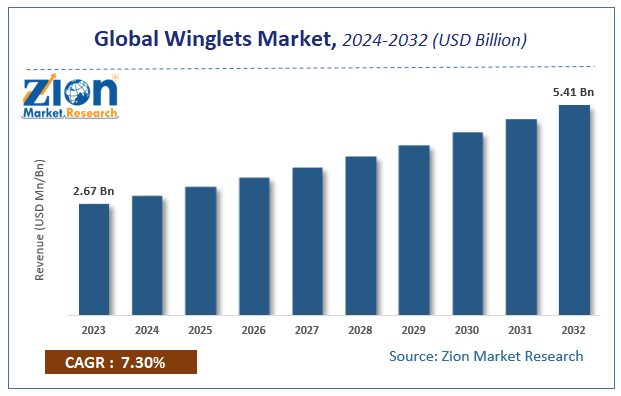
According to a report from Zion Market Research, the global winglets market was valued at USD 2.67 billion in 2023 and is projected to hit USD 5.41 billion by 2032, with a compound annual growth rate (CAGR) of 7.30% during the forecast period 2024-2032. The winglets market is driven by rising demand for fuel efficiency, reduced aircraft emissions, growth in commercial aviation, and fleet retrofitting activities.
The report examines the primary drivers, challenges, and restraints shaping global demand for the winglets market throughout the forecast period and identifies high-growth opportunities across the industry.
Winglets Market: Overview
Winglets are specialized aerodynamic extensions attached to the tips of aircraft wings. These structures reduce induced drag generated by wingtip vortices, improve lift-to-drag ratios, enhance overall aerodynamic efficiency, lower fuel consumption, and contribute to reduced greenhouse gas emissions. Available in multiple designs including blended, sharklet, raked, split-scimitar, and wingtip fence configurations, winglets are applied across commercial airliners, business jets, military aircraft, and regional jets for both new production (line-fit) and aftermarket upgrades (retrofit).
Key Insights
- As per the analysis shared by our research analyst, the global Winglets market is estimated to grow annually at a CAGR of around 7.30% over the forecast period (2024-2032).
- In terms of revenue, the global Winglets market size was valued at around USD 2.67 billion in 2023 and is projected to reach USD 5.41 billion by 2032.
- The market is driven by demand for fuel efficiency and reduced aircraft emissions, growth in commercial aviation, fleet retrofitting, and airline cost-optimization initiatives.
- Based on the Winglet Type, the Blended Winglets segment dominated the market with a substantial share of approximately 28%
- Based on the Aircraft Type, the Commercial Aircraft segment dominated the market owing to the large global fleet base
- Based on the Platform Type, platforms such as the A320 Family and B737 series held leading positions because of their high production volumes
- Based on the Fit, the Line Fit segment maintained a strong position as new aircraft deliveries increasingly incorporate advanced winglets as standard equipment
- Based on region, North America dominated the global Winglets market with a major revenue and production share, driven by the presence of leading aircraft manufacturers, high aircraft production rates, and sustained investment in aerodynamic efficiency and emissions-reduction technologies.
Winglets Market: Dynamics
Growth Drivers
What factors are accelerating the expansion of the Winglets market?
Rising demand for improved fuel efficiency and lower operating costs remains the central growth catalyst. Airlines continuously seek technologies that reduce drag and fuel burn, and winglets deliver measurable savings that directly improve profitability on both short- and long-haul routes. Concurrent growth in commercial aviation traffic and the expansion of global aircraft fleets create sustained demand for both line-fit installations on new aircraft and retrofit solutions for existing fleets.
Emission-reduction commitments and regulatory pressure further reinforce adoption. Airlines and operators increasingly view winglets as a practical, proven pathway to lower carbon footprints while meeting sustainability targets. Advances in composite materials and aerodynamic design continue to improve performance and durability, encouraging broader deployment across commercial, business, military, and regional platforms.
Restraints
What factors are limiting the growth of the Winglets market?
Retrofit costs and associated aircraft downtime represent significant barriers, particularly for operators managing large legacy fleets or operating under tight financial constraints. Certification processes for new winglet designs or installations on specific airframes are rigorous, time-consuming, and capital-intensive, which can delay market entry and raise overall project costs.
Supply-chain complexity for advanced composite materials and specialized manufacturing capabilities can also constrain rapid scaling. Smaller operators may find the upfront investment and operational disruption difficult to justify without clear, near-term return-on-investment visibility.
Winglets Market: Segmentation Analysis
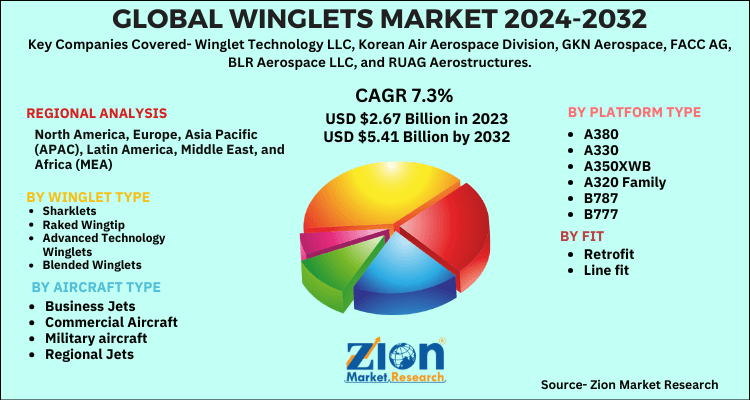
The winglets market is segmented by winglet type, aircraft type, platform type, fit, and region.
Based on Winglet Type Segment, the winglets market is divided into Sharklets, Raked Wingtip, Advanced Technology Winglets, Blended Winglets, Split Scimitar Winglets, Wingtip Fence, and others. Blended Winglets constitute the most dominant subsegment because their smooth, upward-swept geometry minimizes wingtip vortices, delivers substantial fuel savings, and has been widely validated across commercial and business aircraft fleets. This dominance drives overall market growth by establishing a proven, high-volume reference design that encourages both line-fit adoption on new aircraft and retrofit programs on in-service fleets. Sharklets rank as the second-most prominent design, particularly on Airbus narrow-body platforms, where their aerodynamic efficiency and standardized production support strong volume demand and reinforce the broader shift toward advanced wingtip devices.
Based on Aircraft Type Segment, the winglets market is divided into Business Jets, Commercial Aircraft, Military Aircraft, Regional Jets, and others. Commercial Aircraft form the most dominant subsegment owing to the sheer size of the global commercial fleet, high annual utilization rates, intense focus on fuel-cost reduction, and continuous new-aircraft production coupled with extensive retrofit activity. This segment anchors market volume and revenue, enabling suppliers to achieve economies of scale and invest in further design refinements that benefit the entire industry. Business Jets represent the second-most significant category, driven by performance-oriented owners seeking range, efficiency, and resale-value improvements through advanced winglet installations.
Based on Platform Type Segment, the winglets market is divided into A380, A330, A350 XWB, A320 Family, B787, B777, B767, B747, B737 Max, B737, and others. High-volume narrow-body platforms such as the A320 Family and B737 series dominate because of their large in-service populations, ongoing production rates, and the availability of both factory-standard and aftermarket winglet solutions. Their dominance sustains steady demand and provides a reliable base for technology validation and continuous improvement. Wide-body platforms including the B787, A350 XWB, and B777 contribute significant value through larger, more complex winglet installations that deliver proportionally greater efficiency gains on long-haul routes.
Based on Fit Segment, the winglets market is divided into Retrofit, Line Fit, and others. Line Fit holds a leading position as new-generation aircraft increasingly incorporate advanced winglets as standard equipment during production, ensuring aerodynamic efficiency from entry into service. This approach supports predictable volume for manufacturers and aligns with airline preferences for optimized new fleets. Retrofit remains a critical complementary segment, enabling operators of older aircraft to capture efficiency and emissions benefits without full fleet replacement, thereby extending the addressable market and supporting aftermarket revenue streams.
Winglets Market: Report Scope
| Report Attributes | Report Details |
|---|---|
| Report Name | Winglets Market |
| Market Size in 2023 | USD 2.67 Billion |
| Market Forecast in 2032 | USD 5.41 Billion |
| Growth Rate | CAGR of 7.3% |
| Number of Pages | 210 |
| Key Companies Covered | Winglet Technology LLC, Korean Air Aerospace Division, GKN Aerospace, FACC AG, BLR Aerospace LLC, and RUAG Aerostructures |
| Segments Covered | By Winglet Type, By Aircraft Type, By Platform Type, By Fit, and By Region |
| Regions Covered | North America, Europe, Asia Pacific (APAC), Latin America, Middle East, and Africa (MEA) |
| Base Year | 2023 |
| Historical Year | 2018 - 2022 |
| Forecast Year | 2024 - 2032 |
| Customization Scope | Avail customized purchase options to meet your exact research needs. Request For Customization |
Winglets Market: Regional Analysis
Why will North America continue to dominate the global market during the projection period?
North America holds the major revenue and production share of the global Winglets market. The region benefits from the headquarters and primary manufacturing bases of leading aircraft producers, high rates of commercial and business aircraft production, a large installed fleet requiring both new and retrofit solutions, and strong industry emphasis on fuel efficiency and emissions reduction. Continuous investment in aerodynamic research, advanced composites, and certification infrastructure further reinforces North America’s leadership and drives global technology standards and market expansion.
Europe maintains a significant position supported by major airframe manufacturers, a dense network of aerospace suppliers, and progressive regulatory frameworks focused on sustainable aviation. Key countries including France, Germany, and the United Kingdom contribute through production of advanced winglet components and ongoing fleet modernization programs that stimulate both line-fit and retrofit demand.
Asia Pacific is characterized by rapid growth in air travel, expanding commercial fleets, and increasing aircraft production and assembly activity. Countries such as China, Japan, India, and South Korea are investing in domestic aerospace capabilities and modernizing airline fleets, creating rising demand for efficient wingtip devices and supporting the region’s emergence as a high-growth market.
Winglets Market: Competitive Analysis
Some of the essential players in the global winglets market;
- Winglet Technology LLC
- Korean Air Aerospace Division
- GKN Aerospace
- FACC AG
- BLR Aerospace LLC
- RUAG Aerostructures
The global winglets market is segmented as:
By Winglet Type
- Sharklets
- Raked Wingtip
- Advanced Technology Winglets
- Blended Winglets
- Split Scimitar Winglets
- Wingtip Fence
- Others
By Aircraft Type
- Business Jets
- Commercial Aircraft
- Wide-Body Aircraft
- Narrow-Body Aircraft
- Military Aircraft
- Regional Jets
By Platform Type
- A380
- A330
- A350 XWB
- A320 Family
- B787
- B777
- B767
- B747
- B737 Max
- B737
- Others
By Fit
- Retrofit
- Line fit
By Region
- North America
- The U.S.
- Canada
- Mexico
- Europe
- France
- The UK
- Spain
- Germany
- Italy
- Rest of Europe
- Asia Pacific
- China
- Japan
- India
- Australia
- South Korea
- Rest of Asia Pacific
- The Middle East & Africa
- Saudi Arabia
- UAE
- Egypt
- Kuwait
- South Africa
- Rest of the Middle East & Africa
- Latin America
- Brazil
- Argentina
- Rest of Latin America
Table Of Content
Methodology
FrequentlyAsked Questions
Winglets are small extensions on aircraft wings. They improve fuel efficiency and reduce drag
The global Global Winglets market is expected to be driven by the demand for fuel efficiency and reduced aircraft emissions. Growth in commercial aviation and fleet retrofitting supports market expansion.
According to study, the global Global Winglets market size was worth around USD 2.67 Billion in 2023 and is predicted to grow to around USD 5.41 Billion By 2032.
The global Global Winglets market is expected to grow at a Compound Annual Growth Rate (CAGR) of around CAGR 7.30% during the forecast period from 2024-2032.
The global Global Winglets industry is projected to be challenged by Challenges include retrofit costs, certification requirements, and aircraft downtime.
The Opportunities include fuel efficiency demand, airline cost optimization, fleet modernization, and emission reduction initiatives will offer significant growth opportunities in the Global Winglets market.
Advanced aerodynamic designs for fuel efficiency; retrofitting and lightweight materials; demand driven by aviation decarbonization are the emerging trends and innovations impacting the Global Winglets market.
The global Global Winglets market is expected to be led by North America during the forecast period.
Some of the prominent players operating in the global Global Winglets market are; Winglet Technology LLC, Korean Air Aerospace Division, GKN Aerospace, FACC AG, BLR Aerospace LLC, and RUAG Aerostructures and others.
The report explores crucial aspects of the Global Winglets market, including a detailed discussion of existing growth factors and restraints, while also browsing future growth opportunities and challenges that impact the market.

HappyClients

