
Warehouse Robotics Market Size, Share & Industry Report 2032

Warehouse Robotics Market By Type (Mobile Robots, Articulated Robots, Cylindrical Robots, SCARA Robots, Parallel Robots, and Cartesian Robots), By Software (Warehouse Management System, Warehouse Control System, and Warehouse Execution System), By Function (Pick and Place, Palletizing and Depalletizing, Transportation, and Packaging), By Payload Capacity (0.5 kg to 10 kg, 11 kg to 80 kg, 81 kg to 180 kg, 181 kg to 300 kg, 301 kg to 900 kg, and More Than 900 kg), By Industry (E-Commerce, Automotive, Electrical and Electronics, Metal and Machinery, Chemical, Rubber, and Plastic, Food and Beverages, Pharmaceuticals, and Others), and By Region: Global and Regional Industry Overview, Market Intelligence, Comprehensive Analysis, Historical Data, and Forecasts 2024 - 2032
| Market Size in 2023 | Market Forecast in 2032 | CAGR (in %) | Base Year |
|---|---|---|---|
| USD 6.23 Billion | USD 18.49 Billion | 12.84% | 2023 |
Warehouse Robotics Industry Perspective
What will be the global Warehouse Robotics market size during the forecast period?
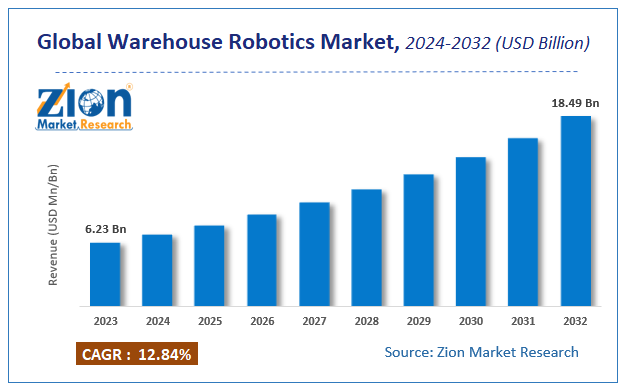
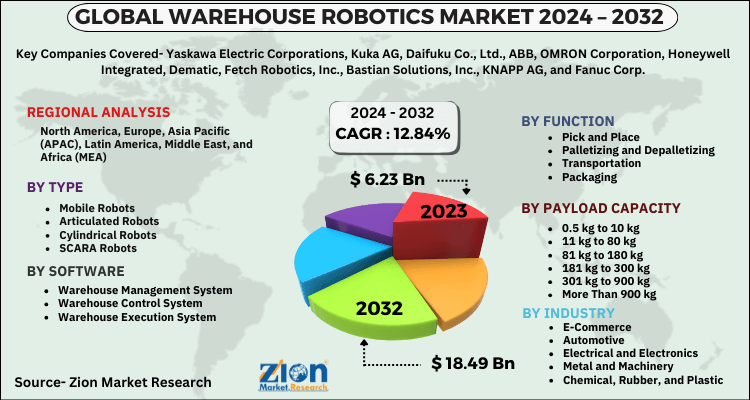
The global Warehouse Robotics market size was worth around USD 6.23 billion in 2023 and is predicted to grow to around USD 18.49 billion by 2032, with a compound annual growth rate (CAGR) of roughly 12.84% between 2024 and 2032. The Warehouse Robotics Market is driven by the rapid expansion of e-commerce, labor shortages, rising demand for operational efficiency, and increasing adoption of automation in warehouses and distribution centers.
Warehouse Robotics Market: Overview
Warehouse robotics refers to the utilization of mechanized systems, robots, and special software for transporting materials & logistics, along with performing myriad jobs & automating warehouse methods. With a surge in the requirement for new technologies in warehouses, it is necessary to use self-driven robots. The ability of warehouse robotics to enhance operational efficiency, rise in the material handling output, and increase consumer satisfaction will result in the expansion of the warehouse robotics industry over the assessment period.
The primary uses of warehouse robotics are goods-to-person picking systems. Traditionally, warehouse personnel would go through the aisles of a warehouse to find and acquire items for order fulfilment. However, with goods-to-person picking systems, robots roam the warehouse floor independently, transporting storage units (such as bins or shelves) containing things to designated picking stations where human operators may quickly fulfill orders. This collaborative approach speeds the picking process, decreases workers' walking time, and improves order correctness and throughput.
Key Insights
- As per the analysis shared by our research analyst, the global Warehouse Robotics market is estimated to grow annually at a CAGR of around 12.84% over the forecast period (2024-2032).
- In terms of revenue, the global Warehouse Robotics market size was valued at around USD 6.23 billion in 2023 and is projected to reach USD 18.49 billion by 2032.
- The market is driven by rapid e-commerce growth, labor shortages, demand for faster order processing, warehouse cost optimization, and advances in AI and autonomous navigation technologies.
- Based on the Type segment, the Mobile Robots segment dominated the market due to their flexibility and ability to navigate dynamic warehouse environments without fixed infrastructure
- Based on the Software segment, the Warehouse Management System and Warehouse Execution System segments held leading positions
- Based on the Function segment, the Pick and Place segment is growing at a high rate and is projected to dominate the global market
- Based on the Payload Capacity segment, the lower to mid-range capacities (0.5 kg to 80 kg) held significant shares as they align with the majority of piece-picking
- Based on the Industry segment, the E-Commerce segment held the largest market share in 2023 and is expected to grow at a significant rate over the forecast period
- Based on region, Asia Pacific and North America held substantial shares, with Asia Pacific benefiting from large-scale manufacturing and e-commerce expansion, while North America is supported by advanced logistics infrastructure and high automation adoption.
Warehouse Robotics Market: Growth Drivers
Thriving eCommerce Sector and escalating requirements for proficient warehousing & inventory management are anticipated to steer the expansion of the warehouse robotics industry over the forecast timeline. Furthermore, automation in warehouses provides convenience to the owner as it reduces overhaul costs as well as reduces errors during product delivery. Substantial technological breakthroughs in the form of sensor techniques will facilitate accurate object perception & perfect positioning tools, thereby creating new growth avenues for the warehouse robotics industry in the ensuing years. With the outbreak of the COVID pandemic, robots are expected to play a key role in warehouse operations, and this will further expand the business scope in the years to come.
Furthermore, a surge in the number of warehouses, along with large-scale allocation of funds for warehouse automation, will accelerate the expansion of the warehouse robotics industry over the assessment period. Apart from this, a massive surge in labor charges and easy availability of scalable tech solutions will accelerate the expansion of the warehouse robotics industry over the ensuing years. Additionally, escalating awareness pertaining to product safety and high product quality output will pave the way for expansion of the warehouse robotics industry over the assessment period. With integration of big data, IoT, AI, and machine learning tools in the warehouse sector, the market for warehouse robotics is anticipated to gain traction over the forthcoming years. The thriving retail industry will further contribute to the expansion of the warehouse robotics market over the years ahead.
Moreover, the use of robots for lifting huge loads, along with the need for proficiently placing, transporting, palletizing, and packing goods, will culminate in huge business expansion over the years ahead. Many of the firms, such as Amazon, have deployed robots in their warehouses in the last few years. Such moves will further proliferate the industry size within the next couple of years.
Warehouse Robotics Market: Segmentation
The Warehouse Robotics market is segmented by type, software, function, payload capacity, industry, and region.
Based on Type Segment, the Warehouse Robotics market is divided into Mobile Robots, Articulated Robots, Cylindrical Robots, SCARA Robots, Parallel Robots, and Cartesian Robots. Mobile Robots form the most dominant subsegment due to their flexibility, autonomous navigation capabilities, and ability to operate without fixed infrastructure in dynamic warehouse environments. This dominance drives overall market growth by enabling rapid deployment and scalability in e-commerce and high-throughput fulfillment centers. Articulated Robots represent a strong secondary category, particularly valued for complex handling, palletizing, and tasks requiring multi-axis dexterity in automotive and industrial settings.
Based on Software Segment, the Warehouse Robotics market is divided into Warehouse Management System, Warehouse Control System, and Warehouse Execution System. Warehouse Management and Execution Systems hold leading positions because they provide the orchestration layer that coordinates robot fleets, optimizes task allocation, and integrates with broader supply-chain systems. Their dominance supports market expansion by maximizing the utilization and efficiency of robotic hardware investments. Warehouse Control Systems complement these platforms by managing real-time equipment coordination and process execution.
Based on Function Segment, the Warehouse Robotics market is divided into Pick and Place, Palletizing and Depalletizing, Transportation, and Packaging. Pick and Place is the most dominant function owing to its central role in order fulfillment accuracy and speed, especially in e-commerce environments with high SKU diversity. This leadership anchors market demand and encourages continuous innovation in vision-guided grasping and adaptive picking technologies. Transportation and Palletizing & Depalletizing form important secondary functions that support end-to-end material flow and load handling efficiency.
Based on Payload Capacity Segment, the Warehouse Robotics market is divided into 0.5 kg to 10 kg, 11 kg to 80 kg, 81 kg to 180 kg, 181 kg to 300 kg, 301 kg to 900 kg, and More Than 900 kg. The lower and mid-range payload categories (particularly 0.5 kg to 80 kg) dominate because they align with the majority of piece-picking, tote handling, and light-to-medium material movement tasks common in modern warehouses. These capacities drive volume growth by addressing the highest-frequency warehouse activities. Higher payload systems serve specialized heavy-load applications in automotive, metal, and bulk handling environments.
Based on Industry Segment, the Warehouse Robotics market is divided into E-Commerce, Automotive, Electrical and Electronics, Metal and Machinery, Chemical, Rubber, and Plastic, Food and Beverages, Pharmaceuticals, and others. E-Commerce is the most dominant industry segment due to exceptionally high order volumes, intense pressure for rapid and accurate fulfillment, and substantial capital investment by major retailers and logistics providers in automation. This dominance sustains overall market momentum and sets performance benchmarks for other industries. Automotive and Electrical & Electronics represent significant secondary segments driven by the need for precision handling, just-in-time logistics, and high reliability.
Warehouse Robotics Market: Report Scope
| Report Attributes | Report Details |
|---|---|
| Report Name | Warehouse Robotics Market |
| Market Size in 2023 | USD 6.23 Billion |
| Market Forecast in 2032 | USD 18.49 Billion |
| Growth Rate | CAGR of 12.84% |
| Number of Pages | 215 |
| Key Companies Covered | Yaskawa Electric Corporation, Kuka AG, Daifuku Co., Ltd., ABB, OMRON Corporation, Honeywell Integrated, Dematic, Fetch Robotics, Inc., Bastian Solutions, Inc., KNAPP AG, and Fanuc Corp |
| Segments Covered | By Type, By Software, By Function, By Payload Capacity, By Industry and By Region |
| Regions Covered | North America, Europe, Asia Pacific (APAC), Latin America, Middle East, and Africa (MEA) |
| Base Year | 2023 |
| Historical Year | 2018 - 2022 |
| Forecast Year | 2024 - 2032 |
| Customization Scope | Avail customized purchase options to meet your exact research needs. Request For Customization |
Warehouse Robotics Market: Regional Analysis
Why will Asia Pacific continue to dominate the global market during the projection period?
Asia Pacific is expected to contribute substantially to the global Warehouse Robotics market, supported by rapid e-commerce expansion, large-scale manufacturing activity, and significant investments in logistics infrastructure across China, Japan, India, and Southeast Asia. High installation volumes, government support for automation, and the presence of major domestic robotics suppliers reinforce the region’s leadership. Continuous growth in online retail and the modernization of distribution networks further drive adoption and influence global technology trends and market expansion.
North America holds a major share driven by advanced logistics infrastructure, high labor costs, strong e-commerce penetration, and aggressive automation investments by leading retailers and third-party logistics providers. The United States remains the primary market, with continuous deployment of mobile robots, piece-picking systems, and integrated software platforms.
The acceleration in the growth of the warehouse robotics industry in the sub-continent over the forecast timeline is credited to the rapid use of novel techniques in warehouses by many giant firms in the U.S. Apart from this, the onset of IIoT and connected system networking solutions in firms across Canada and the U.S. will revolutionize the warehouse robotics industry in North America over the assessment period. With the view of resolving the issues of long-term labor shortages in the U.S., firms in the country are deploying robots in their warehouses to carry out the packaging, transport, and palletizing activities, thereby further accentuating the size of warehouse robotics market in North America over the ensuing years.
Warehouse Robotics Market: Competitive Analysis
The global Warehouse Robotics market is dominated by players:
- Yaskawa Electric Corporations
- Kuka AG
- Daifuku Co., Ltd.
- ABB
- OMRON Corporation
- Honeywell Integrated
- Dematic
- Fetch Robotics, Inc.
- Bastian Solutions, Inc.
- KNAPP AG
- Fanuc Corp.
The global warehouse robotics market is segmented as follows:
By Type
- Mobile Robots
- Articulated Robots
- Cylindrical Robots
- SCARA Robots
- Parallel Robots
- Cartesian Robots
By Software
- Warehouse Management System
- Warehouse Control System
- Warehouse Execution System
By Function
- Pick and Place
- Palletizing and Depalletizing
- Transportation
- Packaging
By Payload Capacity
- 0.5 kg to 10 kg
- 11 kg to 80 kg
- 81 kg to 180 kg
- 181 kg to 300 kg
- 301 kg to 900 kg
- More than 900 kg
By Industry
- E-Commerce
- Automotive
- Electrical and Electronics
- Metal and Machinery
- Chemical, Rubber, and Plastic
- Food and Beverages
- Pharmaceuticals
- Others (Paper & Printing And Textile & Clothing)
By Region
- North America
- The U.S.
- Canada
- Mexico
- Europe
- France
- The UK
- Spain
- Germany
- Italy
- Rest of Europe
- Asia Pacific
- China
- Japan
- India
- Australia
- South Korea
- Rest of Asia Pacific
- The Middle East & Africa
- Saudi Arabia
- UAE
- Egypt
- Kuwait
- South Africa
- Rest of the Middle East & Africa
- Latin America
- Brazil
- Argentina
- Rest of Latin America
Table Of Content
Methodology
FrequentlyAsked Questions
Warehouse robotics use automated robots for material handling. They improve speed, accuracy, and efficiency in warehouses
The global Warehouse Robotics market is expected to be driven by the e-commerce expansion, labor shortages, and need for faster order fulfillment. Automation in logistics and warehousing supports adoption.
According to study, the global Warehouse Robotics market size was worth around USD 6.23 Billion in 2023 and is predicted to grow to around USD 18.49 Billion By 2032.
The global Warehouse Robotics market is expected to grow at a Compound Annual Growth Rate (CAGR) of around CAGR 12.84% during the forecast period from 2024-2032.
The global Warehouse Robotics industry is projected to be challenged by Challenges include high upfront costs, system integration complexity, and workforce adaptation.
The Opportunities include e-commerce growth, labor shortages, faster order fulfillment, and autonomous warehouse operations will offer significant growth opportunities in the Warehouse Robotics market.
Autonomous mobile robots and robotic picking; AI-driven fleet orchestration; scalability for e-commerce fulfillment are the emerging trends and innovations impacting the Warehouse Robotics market.
The global Warehouse Robotics market is expected to be led by APAC during the forecast period.
Some of the prominent players operating in the global Warehouse Robotics market are; Yaskawa Electric Corporations, Kuka AG, Daifuku Co., Ltd., ABB, OMRON Corporation, Honeywell Integrated, Dematic, Fetch Robotics, Inc., Bastian Solutions, Inc., KNAPP AG, and Fanuc Corp and others.
The report explores crucial aspects of the Warehouse Robotics market, including a detailed discussion of existing growth factors and restraints, while also browsing future growth opportunities and challenges that impact the market.

HappyClients

