
U.S. Jams and Preserves Market Size, Share, Growth, Opportunities 2034

U.S. Jams and Preserves Market By Type (Jam and Preserves), By Flavor Type (Strawberry, Raspberry, Grape, Apricot, and Blackberry) - Country Specific Industry Overview, Market Intelligence, Comprehensive Analysis, Historical Data, and Forecasts 2025 - 2034
| Market Size in 2024 | Market Forecast in 2034 | CAGR (in %) | Base Year |
|---|---|---|---|
| USD 9.1 Billion | USD 12.8 Billion | 3.5% | 2024 |
U.S. Jams and Preserves Industry Perspective:
What will be the size of the U.S. jams and preserves market during the forecast period?
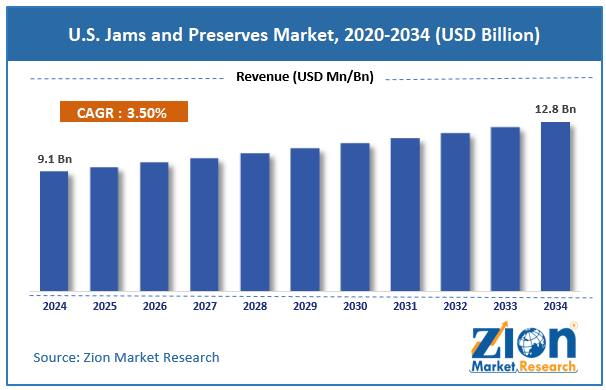
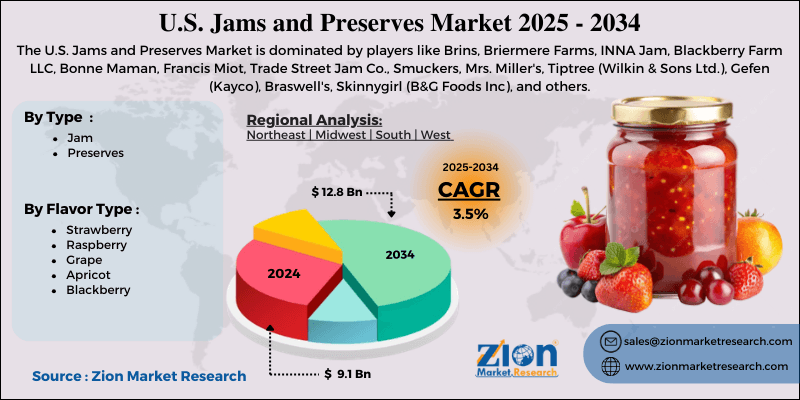
The U.S. jams and preserves market size was worth around USD 9.1 billion in 2024 and is predicted to grow to around USD 12.8 billion by 2034, with a compound annual growth rate (CAGR) of roughly 3.5% between 2025 and 2034.
Key Insights
- As per the analysis shared by our research analyst, the U.S. jams and preserves market is estimated to grow annually at a CAGR of around 3.5% over the forecast period (2025-2034).
- In terms of revenue, the U.S. jams and preserves market size was valued at around USD 9.1 billion in 2024 and is projected to reach USD 12.8 billion by 2034.
- Product innovation & flavor diversity are expected to drive the U.S. jams and preserves market over the forecast period.
- Based on the type, the jam segment captures the largest revenue share in 2024.
- Based on the flavor type, the strawberry segment dominates the market.
U.S. Jams and Preserves Market: Overview
Jams & preserves are delicacies primarily based on fruit and are spreadable foods produced by heating whole fruit, fruit pulp, or finely cut fruit pieces with sugar, and, in the case of jams, sometimes with added pectin, to produce a thick, semi-solid product. Jams are usually prepared by pre-crushing or puréeing the intact fruit before cooking, whereas preserves are made with larger pieces of cut-up intact fruit that are preserved in a gelled syrup, thus producing a semi-solid with a thicker consistency. Jams and preserves are generally spread on bread and bakery products, used as fillings for bakery or cake products, or added to various food products as flavoring agents. The composition, presentation, and labeling of jams & preserves are regulated by many countries to maintain consistency. They are produced and sold by various retail and foodservice institutions worldwide.
U.S. Jams and Preserves Market: Dynamics
Growth Drivers
Does rising demand for convenient & ready-to-use foods drive the U.S. jams and preserves market growth?
The convenience and ready-to-eat aspects are key drivers of growth for the US jams and preserves market. As consumers become more time-crunched and increasingly seek convenient solutions, especially for breakfast and snacking occasions, ready-to-eat items are experiencing strong growth momentum. Jams and preserves are an ideal fit with this trend as they are conveniently pre-made, readily stored in the cupboard, and consumed immediately on toast, bread, bakery items, yogurt, and even desserts. The convenience is also complemented by the on-the-go trend, which is inspiring more people to eat away from home. The growing number of two-income households, coupled with the emphasis on time-saving convenience in meal choices, is also contributing to the category's growth. The long shelf life of jams and preserves makes them a convenient store cupboard ingredient, with the added advantage of versatility as accompaniments. This, in turn, ensures steady current consumption levels.
Restraints
Health concerns about sugar content act as a major restraint on the market growth
Concerns about the health implications of high sugar content are a major barrier to market growth in the U.S. jams and preserves sector. As consumers become more aware of a link between excess intake of sugar and obesity, diabetes, and coronary heart disease, demand for traditional high-sugar fruit spreads is in decline. Many consumers are aware of the preservative qualities of sugar and the ubiquitous food labeling, and so are actively seeking low/no-added-sugar or naturally sweetened alternatives. The public health guidance to reduce sugar consumption (Mouthwise Campaigns 2004) is also a driver toward reformulation. Naturally sweet alternative sugars are also likely to enter the common formats, but formulating without degrading quality, texture, appearance, and shelf life poses formulation challenges and is costly.
Opportunities
Does the rising number of product launches offer a potential opportunity for the U.S. jams and preserves industry?
The growing product launch is expected to present an opportunity for the U.S. jams and preserves market over the projected period. For instance, in January 2025, Stonewall Kitchen, a top producer of specialty food and home goods, announced more than 200 new products and line extensions to its product assortment. Pioneering gourmet foods consumer and top retailers in mind, this announcement reflects the quality and creativity the company embodies in creating new and exciting food options to please the culinary enthusiast within the home chef or future retailer. Offering a wide array of flavors and food choices,
Stonewall Kitchen offers a variety of classic salad dressings such as ranch, blue cheese, thousand island and French, as well as cheese toppers, new drink mixers, a melody of flavor with a new Cherry Berry Quartet Jam, new tillen farms stuffed peppers, new Urban Accents brine kits for chicken and pork, new microwave popcorn flavors as well as even more convenience to the kitchen with the new Charcuterie Board Starter Set.
Challenges
Why does the competition from substitutes and category erosion pose a significant challenge to the U.S. jams and preserves industry?
Substitutes and ongoing category erosion each represent a major risk to the industry, as they directly limit category demand, growth potential, and long-term relevance. A broad class of categories competes with traditional fruit-based spreads across various consumption occasions, notably spreads for snacking and breakfast, encompassing nut-based butters, chocolate spreads, honey, syrups, and even protein-fortified spreads. Such categories cannibalize existing demand within the category (rather than generate incremental growth) and give consumers other means of satisfying their demand for convenient, high-energy foods than traditional sweet spreads.
Moreover, some substitutes are positioned as healthier (e.g., higher protein, lower sugar) than traditional sweet spreads and are more in line with overall healthy-eating trends. Concurrently, the general consumption of sweet spreads is declining amid trends toward smoothies, snack bars, and other savory breakfast options. This structural shift in habits suppresses brand margins, intensifies pricing pressure, and forces companies to spend significantly on innovation and differentiation as a means of growth.
U.S. Jams and Preserves Market: Report Scope
| Report Attributes | Report Details |
|---|---|
| Report Name | U.S. Jams and Preserves Market |
| Market Size in 2024 | 9.1 Billion |
| Market Forecast in 2034 | 12.8 Billion |
| Growth Rate | CAGR of 3.5% |
| Number of Pages | 222 |
| Key Companies Covered | Brins, Briermere Farms, INNA Jam, Blackberry Farm LLC, Bonne Maman, Francis Miot, Trade Street Jam Co., Smuckers, Mrs. Miller's, Tiptree (Wilkin & Sons Ltd.), Gefen (Kayco), Braswell's, Skinnygirl (B&G Foods Inc), and others. |
| Segments Covered | By Type, By Flavor Type, and By Region |
| Regions Covered in U.S. | Northeast, Midwest, South, and West |
| Base Year | 2024 |
| Historical Year | 2019 to 2023 |
| Forecast Year | 2025 - 2034 |
| Customization Scope | Avail customized purchase options to meet your exact research needs. Request For Customization |
U.S. Jams and Preserves Market: Segmentation
By Type Insights
Why does jam hold the dominant position in the U.S. jams and preserves market?
The jam segment holds the largest market share over the forecast period. The category is growing due to changing consumer trends, innovation, and wider retail distribution. Growth is mainly being driven by increased consumption of convenient, ready-to-eat breakfast and snack applications, as jam remains the key spread in the home for bread, toast, pastries, and bakery applications. Growth is also being sustained by increased interest in premium, artisan, and organic fruit jams, which have driven higher-value sales as consumers are happy to pay a premium for ‘clean-label’, natural, and artisanal fruit varieties.
By Flavor Type Insights
Is the strawberry flavor type growing substantially in the U.S. jams and preserves market?
The strawberry segment dominates the market. The category's growth has been, and will continue to be, led by broad consumer demand and high household penetration. Strawberry jam is America's most popular and most recognizable flavor, and consumers have it on hand for breakfast and snacking occasions. Each retail channel, from supermarkets to private-label to online, provides a stable, foreseeable growth in sales.
U.S. Jams and Preserves Market: Competitive Analysis
The U.S. jams and preserves market is dominated by players like:
- Brins
- Briermere Farms
- INNA Jam
- Blackberry Farm LLC
- Bonne Maman
- Francis Miot
- Trade Street Jam Co.
- Smuckers
- Mrs. Miller's
- Tiptree (Wilkin & Sons Ltd.)
- Gefen (Kayco)
- Braswell's
- Skinnygirl (B&G Foods Inc)
The U.S. jams and preserves market is segmented as follows:
By Type
- Jam
- Preserves
By Flavor Type
- Strawberry
- Raspberry
- Grape
- Apricot
- Blackberry
By Region
-
The U.S.
- Northeast
- Midwest
- South
- West
Table Of Content
Methodology
FrequentlyAsked Questions

HappyClients

