
United States E-Commerce Payment Market Size, Share, Growth & Forecast 2032

United States E-Commerce Payment Market By bank (HSBC Holdings plc’s, Bank of America, Citi Group, Wells Fargo, and JP Morgan), By category (household goods, consumers electronic, groceries, health & beauty, clothes & apparel, travel, and others), By payment method (credit & debit cards, bank transfer, cash, digital wallets, and others) And By Region: - Global And Regional Industry Overview, Market Intelligence, Comprehensive Analysis, Historical Data, And Forecasts, 2024-2032-
| Market Size in 2023 | Market Forecast in 2032 | CAGR (in %) | Base Year |
|---|---|---|---|
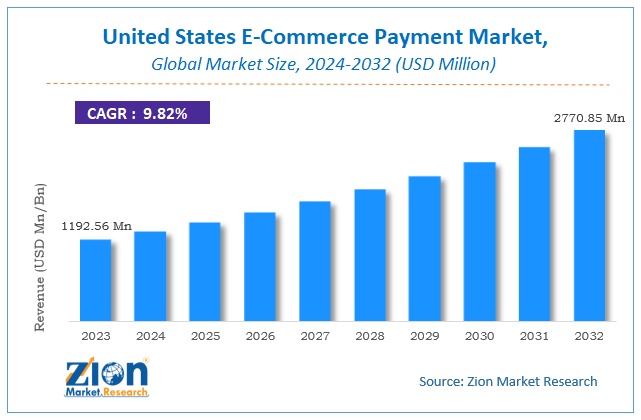
| USD 1192.56 Million | USD 2770.85 Million | 9.82% | 2023 |
Description
What is the Market size of the United States E-Commerce Payment Industry?
According to the report published by Zion Market Research, the global United States E-Commerce Payment Market size was valued at USD 1192.56 Million in 2023 and is predicted to reach USD 2770.85 Million by the end of 2032. The market is expected to grow with a CAGR of 9.82% during the forecast period. The report analyzes the global United States E-Commerce Payment Market's growth drivers, restraints, and impact on demand during the forecast period. It will also help navigate and explore the arising opportunities in the United States E-Commerce Payment industry.
United States E-Commerce Payment Market: Overview
Online purchase of goods and services with the use of electronic medium for the payment is known as e-commerce payment. Such payment mode without using cheque or cash is referred as e-commerce payment system or online payment system. Several types of e-commerce payments are used in day-to-day life. This includes debit cards, credit cards, smart cards, mobile payment, net banking, Amazon pay, and e-wallet. E-commerce payments can be made for household goods, electronics, traveling, and many more, making the process of payments easier to the consumers.
United States E-Commerce Payment Market: Growth Factors
The United States e-commerce payment market is growing at a significant rate. The rise in penetration of internet in banking sector, availability of several options for e-commerce payments, and growing use of e-commerce payment systems form the millennials are the major factors that are boosting the growth of the United States e-commerce payment market. In terms of sales, the United States holds the second position in the global e-commerce market. There is substantial rise in online shopping and e-commerce payment is considered to be the best mode of payments in the US. In addition to this, the consumer can avail numerous benefits with the use of e-commerce payments such as more efficient & effective transactions, expenses control for customers, convenient use, and much more.
Additionally, the payment providers and payment gateways offer anti-fraud and security tools which makes the transactions highly reliable. All such factors are equally contributing to the growth of the market in the US region. Moreover, the rise in use of smartphones & tablets, renowned banks such as JP Morgan & Bank of America offering special offers, and digital wallets are also the factors that are spurring the growth of the market. Furthermore, the rapid expansion of domestic online giants including eBay & Amazon and rise in use of digital shopping & grocery apps may lead to ample opportunities for the growth of the United States e-commerce payment market during the forecast period. However, factors such as lack of anonymity and increase in the rate of e-commerce frauds are likely to hinder the growth of the United States e-commerce payment market.
The Covid-19 pandemic has severely hit the United States. Almost one quarter of the confirmed cases of Covid-19 across the world were reported from the US. National emergency was been declared by the government and enforced stay-at-home orders, quarantine, and closure of schools & universities. In such case, e-commerce payment became a convenient and essential tool for the Americans. The Covid-19 outbreak accelerated the rate of online transactions as the consumers highly depended on e-commerce payments for ordering medical, groceries, and other household essential goods. Owing to all such factors, a substantial growth in the United States e-commerce payment market is been witnessed during the pandemic.
United States E-Commerce Payment Market: Segmentation
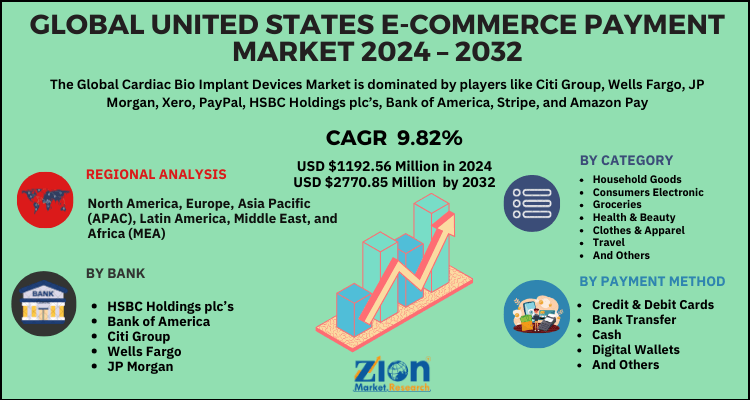
The United States e-commerce payment market is divided into bank, category, payment method.
Based on the bank, the United States e-commerce payment market is bifurcated into HSBC Holdings plc’s, Bank of America, Citi Group, Wells Fargo, and JP Morgan.
Based on the category, the market is split into household goods, consumers electronic, groceries, health & beauty, clothes & apparel, travel, and others.
The payment method is classified into credit & debit cards, bank transfer, cash, digital wallets, and others.
United States E-Commerce Payment Market: Report Scope
| Report Attributes | Report Details |
|---|---|
| Report Name | United States E-Commerce Payment Market |
| Market Size in 2023 | USD 1192.56 Million |
| Market Forecast in 2032 | USD 2770.85 Million |
| Growth Rate | CAGR of 9.82% |
| Number of Pages | 204 |
| Key Companies Covered | Citi Group, Wells Fargo, JP Morgan, Xero, PayPal, HSBC Holdings plc’s, Bank of America, Stripe, and Amazon Pay |
| Segments Covered | By bank, By category, By payment method and By Region |
| Regions Covered | North America, Europe, Asia Pacific (APAC), Latin America, Middle East, and Africa (MEA) |
| Base Year | 2023 |
| Historical Year | 2018 - 2022 |
| Forecast Year | 2024 - 2032 |
| Customization Scope | Avail customized purchase options to meet your exact research needs. Request For Customization |
United States E-Commerce Payment Market: Country Analysis
The E-commerce payment market in the United States is growing at a significant rate. The rapid growth of digitalization in the US has connected the majority of the business under digital payment gateway. The US e-commerce payment sector possesses significant growth opportunities, particularly through app-based sales. E-commerce payment gateway continues to transform the retail industry in the United States, which led to growth in consumer confidence for online shopping and mobile e-commerce. E-commerce payment is continuing to offer new ways to shop for and buy goods and services in the US. With all these and many more factors E-commerce payment market is expected to experience healthy growth over the forecast period.
United States E-Commerce Payment Market: Competitive Players
- Citi Group
- Wells Fargo
- JP Morgan
- Xero
- PayPal
- HSBC Holdings plc’s
- Bank of America
- Stripe
- Amazon Pay
are some of the giant players that are operating in the United States e-commerce payment market.
The Global United States E-Commerce Payment Market is segmented as follows:
By bank
- HSBC Holdings plc’s
- Bank of America
- Citi Group
- Wells Fargo
- JP Morgan
By category
- household goods
- consumers electronic
- groceries
- health & beauty
- clothes & apparel
- travel
- and others
By payment method
- credit & debit cards
- bank transfer
- cash
- digital wallets
- and others
By Region
- North America
- The U.S.
- Canada
- Mexico
- Europe
- France
- The UK
- Spain
- Germany
- Italy
- Rest of Europe
- Asia Pacific
- China
- Japan
- India
- Australia
- South Korea
- Rest of Asia Pacific
- The Middle East & Africa
- Saudi Arabia
- UAE
- Egypt
- Kuwait
- South Africa
- Rest of the Middle East & Africa
- Latin America
- Brazil
- Argentina
- Rest of Latin America
What Reports Provides
- Full in-depth analysis of the parent market
- Important changes in market dynamics
- Segmentation details of the market
- Former, on-going, and projected market analysis in terms of volume and value
- Assessment of niche industry developments
- Market share analysis
- Key strategies of major players
- Emerging segments and regional markets
- Testimonials to companies in order to fortify their foothold in the market.
Table Of Content

FrequentlyAsked Questions
E-commerce payment refers to digital methods used to pay for goods and services online. It includes cards, digital wallets, net banking, and online payment gateways.
The global United States E-Commerce Payment market is expected to be driven by the Driven by rapid growth of online shopping, rising adoption of digital wallets and BNPL solutions, and increasing preference for contactless and mobile payments. Strong fintech innovation and secure payment infrastructure further support market growth.
According to study, the global United States E-Commerce Payment market size was worth around USD 1192.56 Million in 2023 and is predicted to grow to around USD 2770.85 Million By 2032.
The global United States E-Commerce Payment market is expected to grow at a Compound Annual Growth Rate (CAGR) of around CAGR 9.82% during the forecast period from 2024-2032.
What are the major challenges restraining the growth of the United States E-Commerce Payment market?
The global United States E-Commerce Payment industry is projected to be challenged by High fraud and cybersecurity risks increase compliance and mitigation costs; fragmented regulations across regions complicate cross-border transactions; integration complexity with legacy banking and merchant systems slows adoption.
The Rapid growth of online and mobile commerce boosts digital payment volumes; rising adoption of wallets, BNPL, and real-time payments creates new revenue streams; AI-driven fraud detection and open banking enable safer, faster, and more personalized payments will offer significant growth opportunities in the United States E-Commerce Payment market.
Rise of real-time payments and A2A (account-to-account) options; stronger fraud prevention using AI + behavioral biometrics; wider adoption of tokenization, network tokens, and passkeys for faster checkout are the emerging trends and innovations impacting the United States E-Commerce Payment market.
The global United States E-Commerce Payment market is expected to be led by North America during the forecast period.
Some of the prominent players operating in the global United States E-Commerce Payment market are; Citi Group, Wells Fargo, JP Morgan, Xero, PayPal, HSBC Holdings plc’s, Bank of America, Stripe, and Amazon Pay and others.
The report explores crucial aspects of the United States E-Commerce Payment market, including a detailed discussion of existing growth factors and restraints, while also browsing future growth opportunities and challenges that impact the market.
HappyClients

