
Global Ultrasound Probe Disinfection Market Size, Share, Demand, Trends, Growth 2032

Ultrasound Probe Disinfection Market By Product (Consumables, Instruments, and Services), By Disinfection Process (Intermediate/Low-Level Disinfection and High-Level Disinfection), By Probe Type (Linear Transducers, Convex Transducers, Phased Array Transducers, Endocavitary Transducers, Transesophageal Echocardiography Transducers, and Other Probes (Pencil Transducers, Concave Transducers, and Sector Transducers)), and By End-User (Hospitals and Clinics, Diagnostic Imaging Centers, and Others), and By Region - Global and Regional Industry Overview, Market Intelligence, Comprehensive Analysis, Historical Data, and Forecasts 2025 - 2034
| Market Size in 2024 | Market Forecast in 2032 | CAGR (in %) | Base Year |
|---|---|---|---|
| USD 573.97 Million | USD 1,655.44 Million | 12.49% | 2023 |
Ultrasound Probe Disinfection Market: Industry Perspective
What will be the global ultrasound probe disinfection market size during the forecast period?
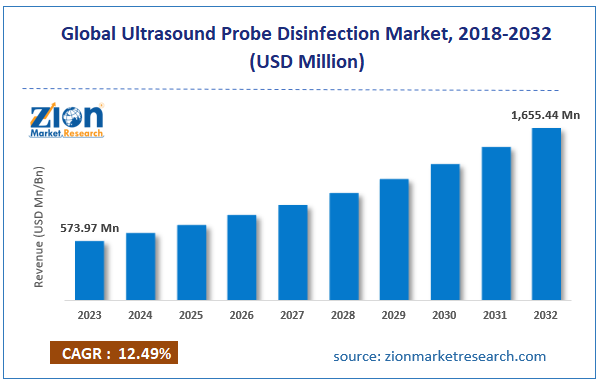
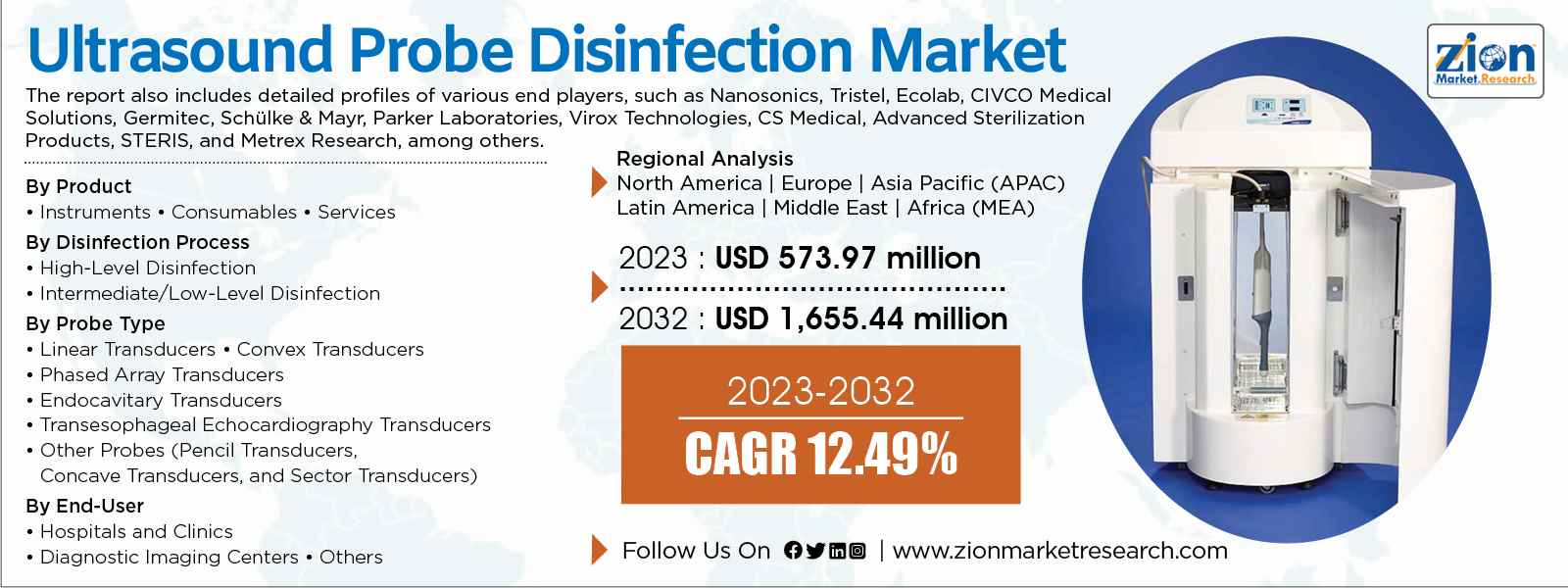
The global ultrasound probe disinfection market size was worth around USD 573.97 million in 2023 and is predicted to reach around USD 1,655.44 million by 2032, with a compound annual growth rate (CAGR) of roughly 12.49% between 2024 and 2032.
The report examines the primary drivers, challenges, and restraints shaping global demand for the ultrasound probe disinfection market throughout the forecast period and identifies high-growth opportunities across the industry.
 Request Free Sample
Key Insights
- As per the analysis shared by our research analyst, the global ultrasound probe disinfection market is estimated to grow annually at a CAGR of roughly 12.49% over the forecast period (2025–2034).
- In terms of revenue, the global ultrasound probe disinfection market size was valued at approximately USD 573.97 million in 2024 and is projected to reach USD 1,655.44 million by 2034.
- The global ultrasound probe disinfection market is driven by the growing volume of ultrasound imaging examinations across primary clinical settings, coupled with escalating concerns regarding hospital-acquired infections (HAIs) and the implementation of stringent government infection control guidelines.
- By product segment, the consumables category dominated the global ultrasound probe disinfection market in 2024 with a market share of about 52.4%, driven by the recurring need for single-use disinfectant wipes, specialized enzymatic solutions, and high-level chemical sterilants for routine probe reprocessing.
- In the disinfection process segment, high-level disinfection dominated the global market in 2024 with a revenue share of around 58.6%, driven by strict regulatory mandates requiring rigorous decontamination of semi-critical transducers that contact mucous membranes or non-intact tissue.
- By probe type segment, the linear transducers category dominated the global market in 2024 with an estimated revenue share of roughly 31.8% driven by extensive usage in routine point-of-care, vascular examinations, musculoskeletal assessments, and breast imaging procedures.
- By end-user segment, the hospitals and clinics category dominated the global market in 2024 with an approximate share of 54.7%, driven by elevated patient admission rates, high surgical procedural volumes, and strict institutional adherence to standardized hospital infection prevention protocols.
- North America dominated the global ultrasound probe disinfection market with an approximate revenue share of 41.5% in 2024, underpinned by highly developed healthcare infrastructure, rigorous CDC and FDA infection control guidelines, and rapid clinical adoption of automated probe reprocessing systems.
Ultrasound Probe Disinfection Market: Overview
Ultrasound technique is widely used for diagnostic imaging procedures to visualize internal organs and body structures, such as lungs, kidneys, liver, female reproductive system, vascular system, tendons, muscles, joints, etc. In ultrasound imaging (also called sonography), the probe transmits high-frequency sound-wave pulses into tissues. Ultrasound is considered safe, with no or very low risk, and is widely used for disease diagnosis. Both internal and external probes need proper cleaning and disinfection to avoid infection or disease transmission. Ultrasound probe disinfection has become standard practice among healthcare practitioners because of the risk of disease transmission and to comply with government guidelines.
To give readers a comprehensive view of the ultrasound probe disinfection market, we include a competitive landscape and an analysis of Porter’s Five Forces Model. The study includes a market attractiveness analysis, benchmarking product type, disinfection process, probe type, and end-user segments based on market size, growth rate, and overall attractiveness.
Ultrasound Probe Disinfection Market: Growth Drivers
What factors are primarily accelerating demand in the ultrasound probe disinfection market?
Ultrasound imaging is minimally invasive and low-risk, offering advantages over other imaging procedures such as X-ray imaging and MRI. Demand for minimally invasive imaging procedures is growing worldwide, driven by patients' preference for such procedures. Thus, ultrasound imaging examinations are surging and are likely to continue to rise in the coming years. Increasing number of ultrasound imaging examinations, in turn, is projected to drive the ultrasound probe disinfection market. Other factors contributing to this market’s growth include rising hospital-acquired infections (HAI), a growing need for better hygiene practices in developed countries under government guidelines, and increasing acceptance of automated disinfection systems.
Ultrasound Probe Disinfection Market: Restraints
What factors are limiting the expansion of the ultrasound probe disinfection market?
Although automated disinfection systems are widely adopted, high costs might hinder this market’s growth. Additionally, reluctance to shift from manual to automated disinfection systems may further restrain this market. The surge in the birth rate, driven by better healthcare facilities, may create an opportunity for the ultrasound probe disinfection market.
Ultrasound Probe Disinfection Market: Opportunities
Where do significant growth opportunities lie for the ultrasound probe disinfection market?
The surge in the birth rate, supported by better healthcare facilities, may act as an opportunity for the ultrasound probe disinfection market through increased obstetric and related ultrasound use.
Expansion of diagnostic ultrasound across clinical specialties and stricter infection-control expectations continue to support demand for both consumables and automated instruments in hospitals, clinics, and imaging centers.
Ultrasound Probe Disinfection Market: Challenges
What key challenges confront participants in the ultrasound probe disinfection market?
Balancing the cost of automated reprocessors and high-level disinfectants with budget constraints in smaller facilities remains a challenge. Ensuring consistent compliance with disinfection protocols across different probe types and clinical settings requires ongoing training and process control.
Integration of new systems into existing clinical workflows without disrupting patient throughput is an additional operational consideration for end users and suppliers.
 Request Free SampleUltrasound Probe Disinfection Market: Report Scope
| Report Attributes | Report Details |
|---|---|
| Report Name | Ultrasound Probe Disinfection Market Research Report |
| Market Size in 2024 | USD 573.97 Million |
| Market Forecast in 2032 | USD 1,655.44 Million |
| Growth Rate | CAGR of 12.49% |
| Number of Pages | 215 |
| Key Companies Covered | Nanosonics, Tristel, Ecolab, CIVCO Medical Solutions, Germitec, Schülke & Mayr, Parker Laboratories, Virox Technologies, CS Medical, Advanced Sterilization Products, STERIS, and Metrex Research, among others. |
| Segments Covered | By Product, By Disinfection Process, By Probe Type, By End-User, and By Region |
| Regions Covered | North America, Europe, Asia Pacific (APAC), Latin America, Middle East, and Africa (MEA) |
| Base Year | 2023 |
| Historical Year | 2018 - 2022 |
| Forecast Year | 2024 - 2032 |
| Customization Scope | Avail customized purchase options to meet your exact research needs. Request For Customization |
Ultrasound Probe Disinfection Market: Segmentation
The ultrasound probe disinfection market is segmented by product, disinfection process, probe type, end-user, and region. All the segments of the ultrasound probe disinfection market have been analyzed based on present and future trends and the market is estimated from 2025 to 2034.
Based on Product Segment, the ultrasound probe disinfection market is divided into consumables, instruments, and services. Within this segment, consumables are the dominant category, driven by the indispensable and recurring need for specialized chemical consumables, single-use high-level disinfectant wipes, and dedicated cleaning detergents across daily diagnostic sessions. Constant procedural turnover of diagnostic probes in ambulatory and inpatient departments ensures continuous procurement of single-use chemical formulations, creating a highly resilient recurring revenue stream. Instruments are the second-largest product category, driven by rising capital acquisitions of automated probe reprocessors and UV-C disinfection devices that standardize reprocessing workflows and minimize operator error. The transition toward automated machinery expands the overall footprint of institutional reprocessing systems, thereby accelerating market growth, technological automation, and operational standardization worldwide.
Based on Disinfection Process Segment, the ultrasound probe disinfection market is divided into high-level disinfection and intermediate/low-level disinfection. High-level disinfection is the dominant category because national and international infection control authorities strictly mandate high-level germicidal processing for all semi-critical ultrasound transducers that contact mucous membranes, bodily fluids, or non-intact tissue surfaces. The clinical necessity to completely eradicate resistant viruses, mycobacteria, and vegetative spores in transvaginal, transrectal, and transesophageal procedures drives heavy reliance on high-level disinfection protocols. Intermediate/low-level disinfection is the second most common category, driven by the high daily volume of non-critical external ultrasound scans, such as abdominal and musculoskeletal assessments performed on intact patient skin. This method provides an economical, fast decontamination solution that balances basic infection-prevention standards with rapid patient throughput across high-volume diagnostic centers.
Based on Probe Type Segment, the ultrasound probe disinfection market is divided into linear transducers, convex transducers, phased array transducers, endocavitary transducers, transesophageal echocardiography transducers, and other probes (pencil transducers, concave transducers, and sector transducers). Linear transducers hold the largest market share, driven by their versatility and primary clinical use in superficial imaging, vascular flow assessments, small-parts sonography, and bedside point-of-care emergency procedures. Because linear probes are utilized in high daily volumes across virtually every hospital department and private imaging clinic, they represent the largest aggregate pool of equipment requiring regular, validated decontamination. Convex transducers are the second-largest category, driven by their universal use in routine abdominal, obstetrical, and pelvic examinations. Sustained global volumes of prenatal checkups and internal organ screenings ensure steady demand for validated convex transducer disinfection workflows across major healthcare delivery networks.
Based on End-User Segment, the ultrasound probe disinfection market is divided into hospitals and clinics, diagnostic imaging centers, and others. Hospitals and clinics constitute the most dominant end-user category, owing to their high inpatient intake rates, expansive outpatient clinics, multi-specialty surgical units, and strict adherence to centralized institutional hygiene protocols. Hospitals manage substantial inventories of specialized ultrasound systems across radiology, cardiology, and emergency suites, requiring ongoing investment in high-capacity automated probe-reprocessing infrastructure. Diagnostic imaging centers are the second-largest end-user category, driven by the expanding privatization of specialized medical imaging and outpatient scanning facilities globally. These dedicated imaging facilities focus on rapid diagnostic turnaround and high equipment utilization, driving substantial demand for streamlined, time-efficient probe disinfection consumables and automated reprocessors.
Ultrasound Probe Disinfection Market: Regional Analysis
Why will North America continue to dominate the global market during the projection period?
North America dominated this market in terms of revenue. Advanced healthcare infrastructure and increased healthcare spending promoted growth in the region. Strong emphasis on infection prevention, guideline compliance, and adoption of automated disinfection systems further supports demand for probe reprocessors and consumables. High volumes of diagnostic ultrasound across hospitals and imaging centers sustain recurring use of disinfectants and detergents. This leadership drives overall market expansion by establishing strong product uptake, encouraging technology development, and setting practice standards that influence global infection-control and reprocessing trends.
Europe is likely to be the second largest market during the forecast period, supported by established healthcare systems and infection-control requirements. Asia Pacific is projected to grow at the highest CAGR, driven by a growing number of diagnostic ultrasound imaging procedures and rising hospital-acquired infections. Moderate growth is anticipated in Latin America. The Middle East and Africa region is expected to show slower growth, owing in part to limited awareness in some markets.
Recent Developments
-
In September 2024, Germitec announced it received U.S. Food and Drug Administration (FDA) De Novo clearance for its Chronos automated high-level disinfection system, which uses high-intensity ultraviolet (UV-C) radiation to disinfect medical ultrasound probes without chemical consumables.
-
In November 2024, Nanosonics expanded its commercial infection prevention portfolio by launching the trophon Wireless Ultrasound Probe Holder across the United States and Canadian markets, an accessory specifically engineered to integrate wireless ultrasound transducers into standardized automated trophon reprocessing cycles.
-
In October 2024, Tristel announced significant revenue expansion in its annual financial statements, highlighting double-digit commercial growth driven by increased international hospital adoption of its proprietary chlorine dioxide disinfectant foam and wipe systems for medical transducers.
Ultrasound Probe Disinfection Market: Competitive Analysis
The global ultrasound probe disinfection market is dominated by players:
- Nanosonics
- Tristel
- Ecolab
- CIVCO Medical Solutions
- Germitec
- Schülke & Mayr
- Parker Laboratories
- Virox Technologies
- CS Medical
- Advanced Sterilization Products
- STERIS
- Metrex Research
Segments Covered
The global ultrasound probe disinfection market is segmented as follows:
By Product
- Instruments
- Automated Probe Reprocessors
- UV-C Disinfectors
- Manual Reprocessors/Soaking Stations
- Others
- Consumables
- Disinfectants: By type
- High-Level Disinfectants
- Intermediate/Low-Level Disinfectants
- Disinfectants: By formulation
- Disinfectant Wipes
- Disinfectant Liquids
- Disinfectant Sprays
- Detergents
- Enzymatic Detergents
- Non-Enzymatic Detergents
- Disinfectants: By type
- Services
By Disinfection Process
- High-Level Disinfection
- Intermediate/Low-Level Disinfection
By Probe Type
- Linear Transducers
- Convex Transducers
- Phased Array Transducers
- Endocavitary Transducers
- Transesophageal Echocardiography Transducers
- Other Probes (Pencil Transducers, Concave Transducers, and Sector Transducers)
By End-User
- Hospitals and Clinics
- Diagnostic Imaging Centers
- Others
By Region
- North America
- The U.S.
- Canada
- Mexico
- Europe
- France
- The UK
- Spain
- Germany
- Italy
- Rest of Europe
- Asia Pacific
- China
- Japan
- India
- Australia
- South Korea
- Rest of Asia Pacific
- The Middle East & Africa
- Saudi Arabia
- UAE
- Egypt
- Kuwait
- South Africa
- Rest of the Middle East & Africa
- Latin America
- Brazil
- Argentina
- Rest of Latin America
Table Of Content
Methodology
FrequentlyAsked Questions
Ultrasound probe disinfection refers to the systematic procedure for cleaning and sterilizing the transducers or probes used in medical ultrasound procedures. During imaging examinations, ultrasound probes come into direct contact with patients' bodies; therefore, adequate disinfection is essential to prevent the spread of infections among patients and maintain a sanitary healthcare setting.
The growing use of ultrasound imaging across diverse medical disciplines—obstetrics, gynecology, cardiology, general diagnostics, among others—is a major driver of the ultrasound probe disinfection industry. The need for efficient disinfection solutions increases in tandem with the volume of ultrasound procedures. Healthcare facilities increasingly expect to comply with rigorous infection control protocols and standards. As the importance of preventing healthcare-associated infections (HAIs) grows, appropriate disinfection procedures, including those for ultrasound probes, are increasingly emphasized.
The global ultrasound probe disinfection market size was worth around USD 573.97 million in 2023 and is predicted to grow to around USD 1,655.44 million by 2032.
The global ultrasound probe disinfection market with a compound annual growth rate (CAGR) of roughly 12.49% between 2024 and 2032.
North America will continue to contribute notably towards the global ultrasound probe disinfection market value, maintaining the largest revenue share throughout the forecast timeframe due to advanced hospital infrastructure, extensive diagnostic procedural volumes, and rigorous enforcement of infection control guidelines by the CDC and FDA.
The report also includes detailed profiles of various end players, such as Nanosonics, Tristel, Ecolab, CIVCO Medical Solutions, Germitec, Schülke & Mayr, Parker Laboratories, Virox Technologies, CS Medical, Advanced Sterilization Products, STERIS, and Metrex Research, among others.

HappyClients

