
Global TV White Space Spectrum Market Size, Share, Trends, and Forecast 2032

TV White Space Spectrum Market By Component (backhaul and services, antennas, power supplies, radios, and cables.), By Application (IoT and M2M, emergency and public safety, transportation and logistics, rural internet access, vehicle broadband access, urban connectivity, and smart grid networks.), By Devices (portable white space devices and fixed white space devices.), And By Region:- Global Industry Analysis, Size, Share, Growth, Trends, and Forecast, 2024-2032
| Market Size in 2023 | Market Forecast in 2032 | Growth Rate (in %) | Base Year |
|---|---|---|---|
| USD 75.5 Million | USD 1803.70 Million | CAGR at 42.40% | 2023 |
Description
What is the projected value for the TV White Space Spectrum Market during 2024 to 2032?
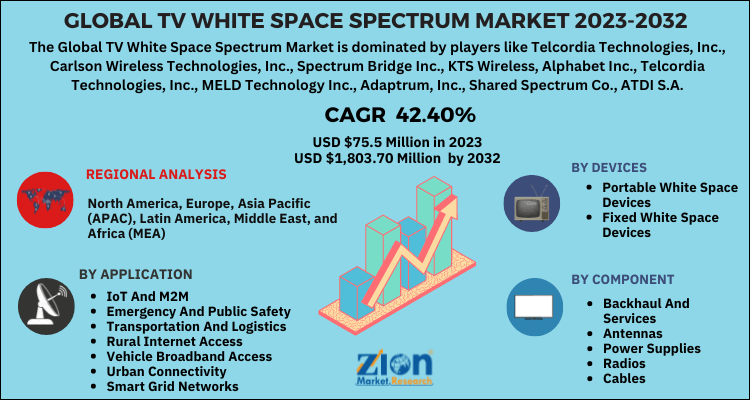
According to the report published by Zion Market Research, The Global TV White Space Spectrum Market size was valued at USD 75.5 Million in 2023 and is predicted to reach USD 1,803.70 Million by the end of 2032. The market is expected to grow with a CAGR of 42.40% during the forecast period.
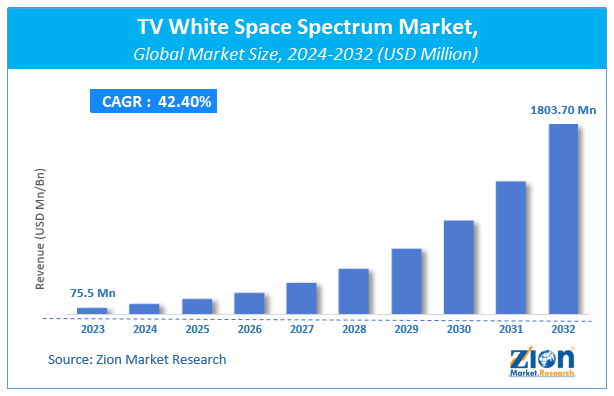
This study provides an analysis of the growth drivers, growth restrictions, and influence on demand that are associated with the Global TV White Space Spectrum Market over the time of forecasting. Additionally, it will assist in navigating and investigating the possibilities that are becoming available in the TV White Space Spectrum Market.
Global TV White Space Spectrum Market: Overview
Frequencies that are made available for unlawful usage of the spectrum in areas where licensed services are not being used are known as TV white spaces spectrum, such as television broadcasting. This spectrum can be located in the UHF and VHF bands.
Global TV White Space Spectrum Market: Segmentation
The global TV white space spectrum market is bifurcated
Based on component segments such as backhaul and services, antennas, power supplies, radios, and cables,.
Based on the application, the global market is classified as IoT and M2M, emergency and public safety, transportation and logistics, rural internet access, vehicle broadband access, urban connectivity, and smart grid networks.
The global market is further categorized based on devices such as, portable white space devices and fixed white space devices.
Of these, portable white space devices are the dominant device segment in the global TV white space spectrum market. However, increasing usage of laptops, smartphones, personal digital assistance devices, and tablets, may influence global market growth positively. These devices operate worldwide on high power.
Global TV White Space Spectrum Market: Growth Factors
To improve rural broadband connectivity, the TV white space spectrum is extensively adopted in rural areas, which enhances the overall market growth of the global TV white space spectrum market. TV white space spectrum is very cost-effective, and remote areas are served with rural broadband, which may fuel global market growth. Many innovations are carried out in developing and developed countries, which may positively impact the global market. Conversely, poor regulations and standards adopted for TV white space spectrum may hamper the global TV white space spectrum growth of the market.
TV White Space Spectrum Market: Report Scope
| Report Attributes | Report Details |
|---|---|
| Report Name | TV White Space Spectrum Market Research Report |
| Market Size in 2023 | USD 75.5 Million |
| Market Forecast in 2032 | USD 1,803.70 Million |
| Growth Rate | CAGR of 42.40% |
| Number of Pages | 201 |
| Key Companies Covered | Telcordia Technologies, Inc., Carlson Wireless Technologies, Inc., Spectrum Bridge Inc., KTS Wireless, Alphabet Inc., Telcordia Technologies, Inc., MELD Technology Inc., Adaptrum, Inc., Shared Spectrum Co., ATDI S.A., Metric Systems Corp., Key Bridge LLC, Aviacomm Inc., and Microsoft Corp. |
| Segments Covered | By Product Type, By Application, By Compound and By Region |
| Regions Covered | Latin America, North America, Asia Pacific, Europe, The Middle East, And Africa |
| Base Year | 2023 |
| Historical Year | 2018 - 2022 |
| Forecast Year | 2024 - 2032 |
| Customization Scope | Customized purchase options are available to meet your exact research needs. Request For Customization |
Global TV White Space Spectrum Market: Regional Analysis
The global TV white space spectrum market is categorized based on geography as North America, Europe, Asia-Pacific, Latin America, and the Middle East & Africa. North America holds the largest market share in the global market owing to the widespread network of TV white space spectrum technologies. The Middle East & Africa is emerging as a new niche market; however, the reach of broadband Internet connectivity in remote areas is anticipated to witness growth in the future. In addition, it is widely spread in African countries such as Tanzania, Mozambique, Botswana, South Africa, Kenya, Namibia, Malawi, and Ghana. The TV white space spectrum trail aims to provide broadband Internet connectivity to those areas that are underdeveloped or witness the lack of proper infrastructure.
Global TV White Space Spectrum Market: Competitive Players
Key players in the global TV white space spectrum market are
- Telcordia Technologies, Inc.
- Carlson Wireless Technologies, Inc.
- Spectrum Bridge Inc.
- KTS Wireless
- Alphabet Inc.
- Telcordia Technologies, Inc.
- MELD Technology Inc
- Other
players influencing the global market are
- Adaptrum, Inc.
- Shared Spectrum Co.
- ATDI S.A.
- Metric Systems Corp.
- Key Bridge LLC
- Aviacomm Inc.
- Microsoft Corp.
The Global TV White Space Spectrum Market is segmented as follows:
By Component
- backhaul and services
- antennas
- power supplies
- radios
- cables.
By Application
- IoT and M2M
- emergency and public safety
- transportation and logistics
- Rural internet access
- vehicle broadband access
- urban connectivity
- smart grid networks.
By Devices
- Portable white space devices
- fixed white space devices
By Region
- North America
- The U.S.
- Canada
- Mexico
- Europe
- France
- The UK
- Spain
- Germany
- Italy
- Rest of Europe
- Asia Pacific
- China
- Japan
- India
- Australia
- South Korea
- Rest of Asia Pacific
- The Middle East & Africa
- Saudi Arabia
- UAE
- Egypt
- Kuwait
- South Africa
- Rest of the Middle East & Africa
- Latin America
- Brazil
- Argentina
- Rest of Latin America
What Report Provides
- Full in-depth analysis of the parent market
- Important changes in market dynamics
- Segmentation details of the market
- Former, ongoing, and projected market analysis in terms of volume and value
- Assessment of niche industry developments
- Market share analysis
- Key strategies of major players
- Emerging segments and regional markets
- Testimonials to companies to fortify their foothold in the market.
Table Of Content

FrequentlyAsked Questions
TV white space spectrum refers to unused broadcast television frequencies that can be repurposed for wireless communication and broadband services.
The global TV white space spectrum market is expected to be driven by the Increasing demand for affordable broadband connectivity. Use of unused TV spectrum supports rural and remote area network expansion.
According to study, the global TV white space spectrum market size was worth around USD 75.5 Million in 2023 and is predicted to grow to around USD 1,803.70 Million By 2032.
The global TV white space spectrum market is expected to grow at a Compound Annual Growth Rate (CAGR) of around CAGR 42.40% during the forecast period from 2024-2032.
The global TV white space spectrum industry is projected to be challenged by Major challenges include regulatory uncertainty, limited device ecosystem, and interference management across licensed and unlicensed spectrum users.
The Opportunities lie in rural broadband deployment, low-cost connectivity for remote areas, and IoT networks leveraging unused spectrum with improved regulatory frameworks will offer significant growth opportunities in the TV white space spectrum market.
Expansion of long-range wireless connectivity, rural broadband deployment, and dynamic spectrum access technologies are the emerging trends and innovations impacting the TV white space spectrum market.
The global TV white space spectrum market is expected to be led by North America during the forecast period.
Some of the prominent players operating in the global TV white space spectrum market are; Telcordia Technologies, Inc., Carlson Wireless Technologies, Inc., Spectrum Bridge Inc., KTS Wireless, Alphabet Inc., Telcordia Technologies, Inc., MELD Technology Inc., Adaptrum, Inc., Shared Spectrum Co., ATDI S.A., Metric Systems Corp., Key Bridge LLC, Aviacomm Inc., and Microsoft Corp. and others.
The report explores crucial aspects of the TV white space spectrum market, including a detailed discussion of existing growth factors and restraints, while also browsing future growth opportunities and challenges that impact the market.
HappyClients

