
Thermoelectric Modules Market Size, Share, Trends, Growth and Forecast 2032

Thermoelectric Modules Market: by Type (Bulk Thermoelectric, Micro Thermoelectric and Thin-film Thermoelectric), by Mode (Single-stage and Multi-stage), by Functionality (General-purpose Modules and Deep Cooling Modules), by End-use (Consumer Electronics, Telecommunications, Automotive, Industrial, Medical & Laboratories, Aerospace & Defense, Oil & Gas Global Industry Perspective, Comprehensive Analysis and Forecast, 2024-2032
| Market Size in 2023 | Market Forecast in 2032 | CAGR (in %) | Base Year |
|---|---|---|---|
| USD 542.32 Million | USD 1494.5 Million | 11.92% | 2023 |
How big is the Thermoelectric Modules Market?
The global Thermoelectric Modules Market size was worth around USD 542.32 Billion in 2023 and is predicted to grow to around USD 1494.5 Billion by 2032 with a compound annual growth rate (CAGR) of roughly 11.92% between 2024 and 2032. Thermoelectric Modules is also known as thermoelectric cooler. This is commonly used in consumer electronics. These pumps operate on Peltier effect, which functions as heat pump transferring heat from one side to another side of the device.
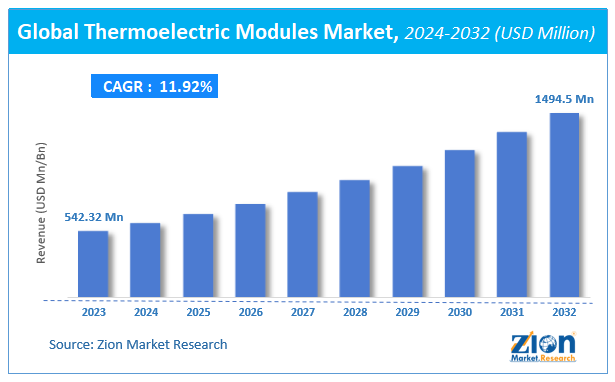
Global Thermoelectric Modules Market Dynamics
The key market dynamics that are shaping the global thermoelectric modules market include:
Key Market Drivers
- High Durability and Reliability: Thermoelectric modules (TEMs) are renowned for their durability, with operational lifespans extending up to 100,000 hours. Their compact size, precise temperature control, rapid response times, and reliability make them highly desirable across various applications. TEMs offer noise-free operation and a fully reversible switch in polarity, enhancing their versatility. Additionally, their environmentally friendly nature—free from chlorofluorocarbons—positions them as a sustainable choice in various industries.
- Diverse Applications Across Industries: Thermoelectric modules find applications in a wide array of fields including consumer products, electrical and industrial equipment, laboratory settings, semiconductor technologies, automotive systems, and medical devices. Available in three main types—micro, thin, and bulk thermoelectric modules these devices are tailored to specific needs. Micro modules are used in lasers and LEDs, thin film modules in sensors and consumer electronics, and single-stage modules in general heating and cooling applications. This broad range of applications underscores the significant role TEMs play in diverse sectors, propelling market growth.
- Rising Demand in Electric Vehicles (EVs): The rapid expansion of the electric vehicle market has heightened the demand for thermoelectric modules. These modules are instrumental in managing battery thermal systems (BTMS), which is crucial for maintaining battery efficiency and preventing overheating. The increased focus on battery capacity, charging rates, and thermal management within EVs has led to advancements in thermoelectric technology. For instance, Ferrotec’s expansion into the electric and hybrid vehicle market highlights the growing integration of TEMs in automotive applications. This trend reflects the broader movement towards enhancing vehicle performance and safety through advanced thermal management solutions.
- Need for Renewable Energy Generation: The shift towards renewable energy sources is driving interest in thermoelectric technology. Unlike traditional energy generation methods that rely on burning fossil fuels, thermoelectric modules can convert heat directly into electricity. This capability is especially valuable in the context of decreasing availability and increasing costs of conventional energy sources, alongside their environmental impact. By harnessing waste heat or temperature differences, thermoelectric modules provide a sustainable alternative for energy generation, aligning with global efforts to reduce carbon footprints and embrace cleaner technologies.
- Increasing Demand for Precise Temperature Control in Healthcare: In the healthcare sector, thermoelectric modules are crucial for maintaining precise temperature control in various applications, including medical diagnostics, imaging systems, and point-of-care testing (POCT). For instance, TEMs help control temperatures in medical storage chambers and radiation therapy equipment, ensuring accuracy in critical procedures. Their role in cooling systems for polymerase chain reaction (PCR) machines further illustrates their importance in enhancing the reliability and efficiency of medical devices. The expansive range of medical devices estimated at 2 million globally demonstrates a significant market for TEMs in healthcare.
- Enhanced Thermal Management for Autonomous Vehicles: The development of autonomous vehicle systems, including heads-up displays (HUDs) and infotainment systems, has intensified the need for effective thermal management. Thermoelectric Peltier modules address these challenges by providing robust thermal protection for sensitive electronics, optimizing performance, and managing heat flux density. As autonomous systems become more complex and miniaturized, the demand for advanced thermal management solutions grows, driving further adoption of TEMs.
Key Challenges
- High Initial Prices: The primary constraint facing the thermoelectric modules market is the high initial cost of these devices. Thermoelectric coolers (TECs) are manufactured using costly materials such as germanium, bismuth, and tellurium. These materials are significantly more expensive than those used in conventional refrigeration and HVAC systems. Additionally, the manufacturing process for thermoelectric modules is intricate and involves several high-cost steps, including precise material handling and complex assembly procedures. This leads to elevated operational costs, which are reflected in the high price of the final product. For example, a basic thermoelectric module can cost around US$ 3,000, which is substantially higher than traditional cooling systems. This high capital expenditure deters small and medium-sized enterprises from adopting these advanced technologies, hindering market growth.
- Expensive Replacement and Maintenance: Replacing existing cooling and energy generation systems with thermoelectric modules is both time-consuming and costly. The transition involves significant investments in terms of both time and money, which can be a substantial barrier for many organizations. Moreover, thermoelectric modules require frequent maintenance and repairs, adding to the overall cost of ownership. These ongoing expenses can further deter potential buyers, particularly those with limited budgets or those operating in cost-sensitive industries.
- Complex Manufacturing and Design Requirements: The design and production of thermoelectric modules necessitate complex planning and robust infrastructure. The process involves precise engineering and sophisticated machinery, which requires skilled professionals to operate effectively. The complexity of designing and manufacturing these modules can be challenging and demands a high level of expertise and infrastructure. This complexity limits the number of manufacturers who can produce these devices efficiently and can slow down market growth by restricting competition and innovation.
- High Capital Investment and Operational Costs: The high capital investment required to establish facilities capable of manufacturing thermoelectric modules can be a significant hurdle. Setting up such facilities involves considerable expenditure on specialized equipment and technology. Furthermore, the operational costs associated with maintaining and running these facilities are also high. These factors contribute to the overall high cost of thermoelectric modules and can limit their adoption, particularly in price-sensitive markets.
- Limited Adoption by Smaller Companies: Due to the high costs associated with thermoelectric modules, many small and medium-sized companies are hesitant to invest in these advanced technologies. The significant financial outlay required for procurement and maintenance can be prohibitive for smaller enterprises, which may not have the resources to justify such an investment. This reluctance from smaller players in the market can stifle overall market growth and reduce the rate of adoption of thermoelectric modules.
Thermoelectric Modules are anticipated to grow in the forecast period. Thermoelectric modules market is likely to increase owing to its benefits over conventional systems. The heating & cooling of thermoelectric modules cater the demand of numerous applications. Rising electronic vehicle market, escalating government focus along with adoption of renewable energy sources is expected to boost growth for thermoelectric modules industry. Moreover, the market will also unfold new avenue in this space with the development of thermoelectric modules for new application along with the notion of converting heat into electricity.
Additionally, bulk thermoelectric is anticipated to boost market growth and is likely to hold significant share in the market during forecast period, due to the benefits it offers, such as highest power voltage and output compared with thin and micro -film thermoelectric modules.
Furthermore, these thermoelectric modules are most commonly used for end-use applications which include medical & laboratories, telecommunications, consumer electronics, aerospace & defense and industrial. Also, such modules can rapidly cool or warman object by producing a temperature differential through the induction of an electric current; they also have the capacity can provide power ranging between mill watts to some kilowatts. The key manufacturers of these products are LAIRD (UK), Ferrotec (US), TEC Microsystems (Germany and RMT ltd. (Russia).
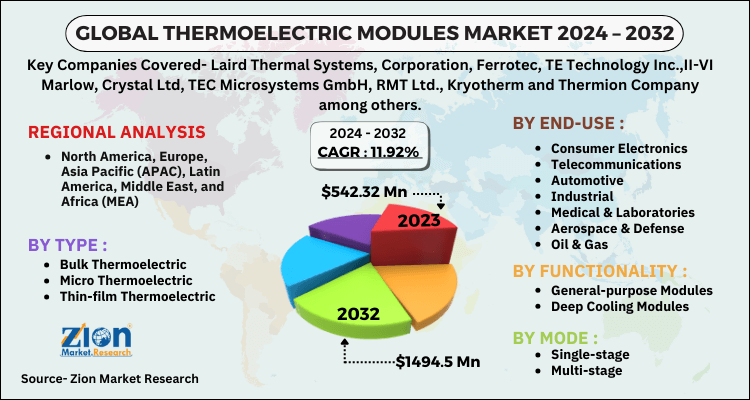
Global Thermoelectric Modules Market: Segmentation
The thermoelectric modules market is segmented into type, mode, functionality and end-use. The end-use segment is anticipated to support market growth for thermoelectric modules in the predicted period.
The End-Use segment is bifurcated into consumer electronics, telecommunications, automotive, industrial, medical & laboratories, aerospace & defense and oil & gas.
By Type Segment, the Thermoelectric Modules Market is segmented into Bulk Thermoelectric, Micro, Thermoelectric, Thin-film Thermoelectric.
The Mode Segment includes Single-stageand Multi-stage.
By Type Segment includes Non-invasive and Invasive.
The Functionality segment includes General-purpose Modules and Deep Cooling Modules.
Consumer electronics is anticipated to boost the demand for thermoelectric modules. Owing to the environmental concern related to point of use dispensers and bottled water has appeared as an advantage for residential and commercial space. Consequently, to attain the demand for appropriate temperature effect, the growth for thermoelectric modules market will boost in the years ahead. Certain companies such as LAIRD, II-VI Marlow and Ferrotec provide thermoelectric modules for consumer application.
Global Thermoelectric Modules Market: Regional Analysis
Thermoelectric modules market on the basis of Asia Pacific is likely to witness growth in the projected years. Asia Pacific is considered to be the fasted growing region for most of the application such as consumer electronics, automotive, oil& gas and industrial. This is expected to drive market growth in the forecast period.
Thermoelectric Modules Market: Report Scope
| Report Attributes | Report Details |
|---|---|
| Report Name | Thermoelectric Modules Market |
| Market Size in 2023 | USD 542.32 Million |
| Market Forecast in 2032 | USD 1494.5 Million |
| Growth Rate | CAGR of 11.92% |
| Number of Pages | 150 |
| Key Companies Covered | Laird Thermal Systems, Corporation, Ferrotec, TE Technology Inc.,II-VI Marlow, Crystal Ltd, TEC Microsystems GmbH, RMT Ltd., Kryotherm and Thermion Company among others |
| Segments Covered | By Product Type, By Application and By Region |
| Regions Covered | North America, Europe, Asia Pacific (APAC), Latin America, Middle East, and Africa (MEA) |
| Base Year | 2023 |
| Historical Year | 2018 - 2022 |
| Forecast Year | 2024 - 2032 |
| Customization Scope | Avail customized purchase options to meet your exact research needs. Request For Customization |
Global Thermoelectric Modules Market: Competitive Players
Major players in the market are opting organic and inorganic strategies to stay in the competition. Noticeable players included in thermoelectric modules market report are
- Laird Thermal Systems
- Corporation
- Ferrotec
- TE Technology
- II-VI Marlow
- Crystal
- TEC Microsystems GmbH
- RMT Ltd.
- Kryotherm
- Thermion Company among others
The report segment of global thermoelectric modules market as follows:
By Type
- Bulk Thermoelectric
- Micro Thermoelectric
- Thin-film Thermoelectric
By Mode
- Single-stage
- Multi-stage
By Functionality
- General-purpose Modules
- Deep Cooling Modules
By End-Use
- Consumer Electronics
- Telecommunications
- Automotive
- Industrial
- Medical & Laboratories
- Aerospace & Defense
- Oil & Gas
By Region
- North America
- The U.S.
- Canada
- Mexico
- Europe
- France
- The UK
- Spain
- Germany
- Italy
- Rest of Europe
- Asia Pacific
- China
- Japan
- India
- Australia
- South Korea
- Rest of Asia Pacific
- The Middle East & Africa
- Saudi Arabia
- UAE
- Egypt
- Kuwait
- South Africa
- Rest of the Middle East & Africa
- Latin America
- Brazil
- Argentina
- Rest of Latin America
Table Of Content
Methodology
FrequentlyAsked Questions
Thermoelectric Modules is also known as thermoelectric cooler. This is commonly used in consumer electronics. These pumps operate on Peltier effect, which functions as heat pump transferring heat from one side to another side of the device.
The Thermoelectric Modules Market was valued at USD 542.32 Million in 2023.
The Thermoelectric Modules Market is expected to reach USD 1494.5 Million by 2032, growing at a CAGR of 11.92% between 2024 to 2032.
Thermoelectric Modules are anticipated to grow in the forecast period. Thermoelectric modules market is likely to increase owing to its benefits over conventional systems. The heating & cooling of thermoelectric modules cater the demand of numerous applications. Rising electronic vehicle market, escalating government focus along with adoption of renewable energy sources is expected to boost growth for thermoelectric modules industry.
Global Thermoelectric Modules Market players such as Laird Thermal Systems, Corporation, Ferrotec, TE Technology Inc.,II-VI Marlow, Crystal Ltd, TEC Microsystems GmbH, RMT Ltd., Kryotherm and Thermion Company among others.
The Regional segment includes the current and forecast demand for North America, Europe, Asia Pacific, Latin America, and the Middle East and Africa.

HappyClients

