Global Thalassemia Market Trend, Share, Growth, Size, Analysis and Forecast 2032
Thalassemia Market By Type (Hemoglobin Bart Hydrops Fetalis Syndrome, Silent Carrier State, HBH Disease, and Trait), By Diagnosis (Prenatal Testing, Perinatal Testing, and Pre-implantation), By Treatment (Iron Chelation, Blood Transfusions, Stem Cell Transplant Or Bone Marrow, and Gene Therapy And Surgery), By End-user (Pharmaceutical Industries, Biotechnological Laboratories, Hospitals, Educational Research Institutes, Diagnostic Laboratories, and Others), and By Region - Global and Regional Industry Overview, Market Intelligence, Comprehensive Analysis, Historical Data, and Forecasts 2024 - 2032
| Market Size in 2023 | Market Forecast in 2032 | CAGR (in %) | Base Year |
|---|---|---|---|
| USD 2844.63 million | USD 4,412.95 million | 5.0% | 2023 |
Thalassemia Industry Perspective
What will be the global thalassemia market size during the forecast period?
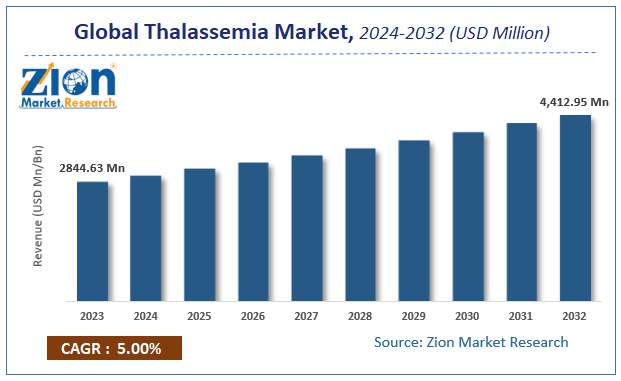
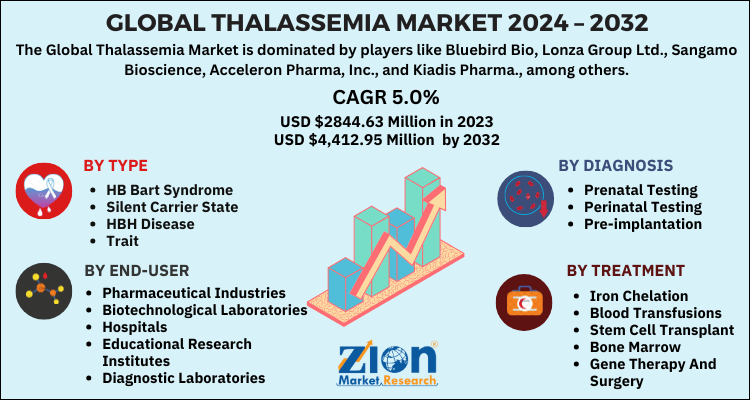
The global thalassemia market size was valued at around USD 2844.63 million in 2023 and is projected to reach about USD 4,412.95 million by 2032, with a compound annual growth rate (CAGR) of roughly 5.0% between 2024 and 2032.
This report provides a comprehensive analysis of the growth drivers, restraints, and challenges shaping demand across the global thalassemia market throughout the forecast period, while highlighting high-potential emerging opportunities within the industry.
Key Insights
- As per the analysis shared by our research analyst, the global thalassemia market is estimated to grow annually at a CAGR of around 5.0% over the forecast period (2024-2032).
- In terms of revenue, the global thalassemia market size was valued at around USD 2844.63 million in 2023 and is projected to reach USD 4,412.95 million by 2032.
- Based on the type segment, beta thalassemia is the most dominant disease type, accounting for 71.2% of revenue share in 2023, driven by its higher global prevalence especially in the Mediterranean, Middle East, South Asia, and Southeast Asia, along with the severity of clinical manifestations that often require intensive treatments such as regular blood transfusions and iron chelation therapy.
- Based on the treatment segment, blood transfusions are the most utilized treatment modality holding a 41.7% market share in 2023 as they remain essential for managing chronic anemia, while iron chelating drugs held the largest revenue share of 52.7% in 2023 due to their critical role in managing iron overload resulting from frequent transfusions.
- Based on the end-user segment, hospitals are the primary end-users, representing about 45% of the total market share because of their comprehensive facilities and multidisciplinary teams capable of delivering the complex care required for thalassemia patients, including diagnostics, transfusions, and advanced therapies.
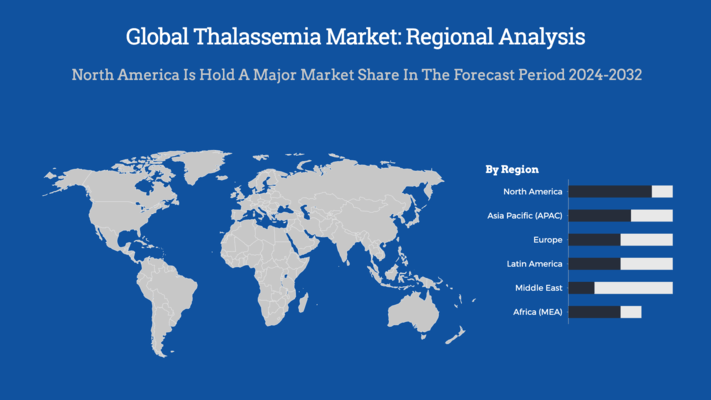
- Based on the region, North America leads the thalassemia market, contributing approximately 42.8% of the total revenue in 2023, driven by advanced healthcare infrastructure, technological advancements, research initiatives, government support, and awareness programs focused on this genetic blood disorder.
Thalassemia Market: Overview
Thalassemia is an exceptional genetic blood disorder primarily characterized by the generation of abnormal hemoglobin, which is responsible for damage to red blood cells, mainly leading to anemia. Iron chelation therapy and blood transfusion are the only cure alternatives accessible at present. This gives rise to abundant opportunities and prospects in the market for expansion of worldwide curative treatments for thalassemia.
Thalassemia Market: Dynamics
Growth Drivers
What factors are primarily propelling expansion of the thalassemia market?
The rising global occurrence of thalassemia, driven by population migration, environmental influences, genetic predispositions, and intermarriage patterns, continues to enlarge the diagnosed patient population and sustain demand for diagnostic services, blood products, and supportive therapies. Technological progress in gene therapy, stem cell transplantation, and refined iron chelation agents has opened new therapeutic avenues for a condition previously managed only through symptomatic care, thereby attracting investment and accelerating clinical adoption of innovative solutions.
Growing awareness among patients, clinicians, and policymakers has prompted higher healthcare spending and the establishment of specialized treatment centers, while government initiatives supporting rare disease research and screening programs further amplify market momentum. These combined elements create a supportive environment for both conventional management tools and next-generation curative approaches throughout the forecast period.
Restraints
What limitations currently hinder broader market expansion?
Despite scientific advances, a consistent and universally accessible curative treatment remains limited, leaving the majority of patients dependent on lifelong blood transfusions and iron chelation that carry significant clinical and economic burdens. High costs associated with advanced therapies, particularly gene therapy and stem cell transplantation, restrict uptake in many regions and create disparities in access between high-income and resource-limited settings.
Additionally, the complexity of disease management, potential complications such as iron overload and transfusion-related risks, and the need for specialized multidisciplinary care infrastructure constrain rapid market penetration of newer modalities in areas lacking adequate healthcare systems.
Opportunities
Where do the most promising growth opportunities lie?
The emergence of gene therapy and gene-editing platforms that can deliver durable transfusion independence represents a transformative opportunity, attracting substantial research investment and potential for premium pricing in eligible patient populations. Expansion of prenatal, perinatal, and pre-implantation genetic testing programs enables earlier intervention and prevention strategies, generating demand for diagnostic tools and related laboratory services across both developed and emerging markets.
Increasing collaboration between biotechnology firms, academic institutions, and healthcare providers, coupled with rising governmental focus on rare genetic disorders, is expected to accelerate product pipelines, improve reimbursement pathways, and support geographic expansion of specialized care centers.
Challenges
What key challenges must the industry address?
Ensuring equitable global access to high-cost curative therapies remains a central challenge, as manufacturing complexity, stringent regulatory requirements, and limited treatment center capacity currently restrict availability primarily to select high-resource environments. Long-term safety monitoring, management of potential adverse events associated with gene therapies, and the need for myeloablative conditioning in many protocols continue to demand rigorous clinical oversight and may slow broader adoption.
Furthermore, gaps in disease awareness and diagnostic capabilities in certain endemic regions lead to delayed identification and suboptimal management, underscoring the necessity for sustained education, infrastructure development, and affordable diagnostic solutions to fully realize market potential.
Global Thalassemia Market: Report Scope
| Report Attributes | Report Details |
|---|---|
| Report Name | Thalassemia Market |
| Market Size in 2023 | USD 2844.63 Million |
| Market Forecast in 2032 | USD 4,412.95 Million |
| Growth Rate | CAGR of 5.0% |
| Number of Pages | 265 |
| Key Companies Covered | Bluebird Bio, Lonza Group Ltd., Sangamo Bioscience, Acceleron Pharma, Inc., and Kiadis Pharma, among others. |
| Segments Covered | By Type, By Diagnosis, By Treatment, By End-User, and By Region |
| Regions Covered | North America, Europe, Asia Pacific (APAC), Latin America, Middle East, and Africa (MEA) |
| Base Year | 2023 |
| Historical Year | 2018 - 2022 |
| Forecast Year | 2024 - 2032 |
| Customization Scope | Avail customized purchase options to meet your exact research needs. Request For Customization |
Thalassemia Market: Segmentation
The thalassemia market is segmented by type, diagnosis, treatment, end-user, and region. All segments of the thalassemia market have been analyzed based on present and future trends and the market is estimated from 2024 to 2032.
Based on Type, the thalassemia market is divided into hemoglobin bart hydrops fetalis syndrome, silent carrier state, HBH disease, and trait. Beta thalassemia forms dominate the market with a substantial revenue share owing to their higher prevalence across Mediterranean, Middle Eastern, South Asian, and Southeast Asian populations and the greater clinical severity that necessitates intensive, ongoing medical intervention, including regular transfusions and chelation. This dominance drives overall market growth by sustaining consistent demand for both supportive care products and advanced therapies while stimulating research focused on more severe genotypes. The trait and silent carrier categories, though larger in absolute numbers, typically require less intensive treatment and therefore contribute comparatively lower revenue, yet they remain important for screening and prevention programs that support long-term market expansion through earlier detection and family counseling.
Based on Diagnosis, the market is divided into prenatal testing, perinatal testing, and pre-implantation. Prenatal and genetic testing approaches hold significant importance because early detection allows timely clinical decision-making, reduces disease burden through informed reproductive choices, and supports the growing emphasis on preventive strategies. Advancements in chorionic villus sampling, prenatal genetic testing, DNA analysis, and complete blood count evaluation have improved diagnostic accuracy and expanded testing volumes, particularly in regions with established screening mandates. These diagnostic modalities help drive market growth by enabling earlier intervention, increasing demand for laboratory services, and facilitating the identification of candidates for advanced therapies, while pre-implantation genetic diagnosis further contributes by supporting assisted reproductive technologies aimed at preventing transmission of severe forms of the disorder.
Based on Treatment, the thalassemia market is divided into iron chelation, blood transfusions, stem cell transplant or bone marrow, and gene therapy and surgery. Blood transfusions remain a cornerstone treatment modality because they effectively address chronic anemia in transfusion-dependent patients and continue to account for a major share of clinical utilization. Iron chelation therapy holds a leading revenue position due to the necessity of managing secondary iron overload that inevitably accompanies repeated transfusions, making chelating agents indispensable for long-term patient survival and quality of life. Stem cell transplantation and emerging gene therapies represent the fastest-evolving and highest-potential areas, offering the prospect of transfusion independence and driving innovation, investment, and premium pricing that collectively accelerate overall market value and shift treatment paradigms toward curative intent.
Based on End-user, the market is divided into pharmaceutical industries, biotechnological laboratories, hospitals, educational research institutes, diagnostic laboratories, and others. Hospitals constitute the dominant end-user segment because they provide the integrated multidisciplinary infrastructure required for complex patient management encompassing diagnosis, transfusion services, chelation monitoring, and administration of advanced therapies. This concentration of care in hospital settings sustains high procedure volumes and product consumption while serving as the primary channel for introducing innovative treatments. Pharmaceutical and biotechnology organizations, together with diagnostic laboratories and research institutes, support the broader ecosystem through drug development, genetic testing services, and clinical research activities that collectively expand treatment options and diagnostic reach, thereby reinforcing market growth across the care continuum.
Thalassemia Market: Regional Analysis
Why will North America continue to dominate the global market during the projection period?
North America maintains its leading position through a combination of advanced healthcare infrastructure, robust research and development ecosystems, supportive regulatory frameworks, and high levels of disease awareness that facilitate early diagnosis and adoption of innovative therapies. The United States in particular, drives regional strength via substantial investment in gene therapy platforms, well-established transfusion and transplant centers, and favorable reimbursement environments that enable access to high-cost curative treatments. Continuous clinical trial activity, government-backed rare disease initiatives, and the presence of key biotechnology innovators further reinforce the region’s capacity to introduce and scale next-generation solutions, setting treatment standards that influence global practice and sustain market leadership.
Europe is anticipated to hold a substantial position, supported by established healthcare systems and screening programs in relevant populations. Asia Pacific and regions with higher ethnic prevalence, including parts of the Mediterranean, Middle East, and South and Southeast Asia, experience growing demand linked to disease burden and improving access to diagnosis and care. Migration patterns also contribute to rising case numbers in developed markets. Latin America and the Middle East and Africa present opportunities as awareness, screening, and treatment infrastructure expand.
Recent Developments
- In August 2022, the U.S. Food and Drug Administration approved Bluebird Bio’s Zynteglo (betibeglogene autotemcel), a gene therapy for transfusion-dependent beta-thalassemia, marking a major milestone in curative treatment options.
- In November 2023, the UK Medicines and Healthcare products Regulatory Agency granted marketing authorization for Casgevy (exagamglogene autotemcel) for patients aged 12 and older with transfusion-dependent beta-thalassemia, later expanding eligibility.
Thalassemia Market: Competitive Players
Some of the most important market players in the global thalassemia market are:
- Bluebird Bio
- Lonza Group Ltd.
- Sangamo Bioscience
- Acceleron Pharma, Inc.
- Kiadis Pharma
Thalassemia Market: Key Trends
Continued reliance on transfusions and iron chelation alongside emerging curative options
Blood transfusions held a 41.7% market share in 2023, and iron chelating drugs accounted for 52.7% of revenue, reflecting their central role in managing chronic anemia and iron overload. At the same time, gene therapy and stem cell approaches are expanding the potential for more definitive treatment.
Hospital-centered care and North American leadership
Hospitals represent about 45% of the market as primary sites for complex multidisciplinary care. North America’s 42.8% revenue share is supported by advanced infrastructure, research activity, and awareness programs that shape standards of diagnosis and treatment.
Segments Covered
The global thalassemia market is segmented as follows:
By Type
- Hemoglobin Bart Hydrops Fetalis Syndrome
- Silent Carrier State
- HBH Disease
- Trait
By Diagnosis
- Prenatal Testing
- Chorionic Villus Sampling
- Prenatal Genetic Testing
- Perinatal Testing
- DNA Testing
- Complete Blood Count (CBC)
- Pre-implantation
By Treatment
- Iron Chelation
- Blood Transfusions
- Stem Cell Transplant Or Bone Marrow
- Gene Therapy And Surgery
By End-user
- Pharmaceutical Industries
- Biotechnological Laboratories
- Hospitals
- Educational Research Institutes
- Diagnostic Laboratories
- Others
By Region
- North America
- The U.S.
- Canada
- Mexico
- Europe
- France
- The UK
- Spain
- Germany
- Italy
- Rest of Europe
- Asia Pacific
- China
- Japan
- India
- Australia
- South Korea
- Rest of Asia Pacific
- The Middle East & Africa
- Saudi Arabia
- UAE
- Egypt
- Kuwait
- South Africa
- Rest of the Middle East & Africa
- Latin America
- Brazil
- Argentina
- Rest of Latin America
Table Of Content
Methodology
FrequentlyAsked Questions
Thalassemia is an exceptional genetic blood disorder majorly characterized by the generation of abnormal hemoglobin, which is accountable for the damage of red blood cells, which mainly lead to anemia. Iron chelation therapies and blood transfusion are the only cure alternatives accessible at present. This gives augment to abundant opportunities and prospects in the market for expansion of the worldwide curative cure for thalassemia.
An increase in the occurrence of thalassemia is projected to propel market development. Despite technological advancements, the unmet need for a consistent treatment alternative still exists. Treatment is mainly limited to standard iron chelation and blood transfusions, while gene therapy is emerging as a consistent treatment choice. The occurrence of thalassemia is expected to increase steadily due to population migration, environmental and genetic factors, and intermarriage, all of which are expected to boost the global thalassemia market.
The global thalassemia market size was valued at approximately USD 2844.63 million in 2023 and is expected to reach around USD 4,412.95 million by 2032.
The global thalassemia market is set to record a CAGR of nearly 5.0% over the period from 2024 to 2032.
North America is anticipated to hold the highest market share, followed by Europe, driven by advanced infrastructure, research activity, and early adoption of innovative therapies.
Bluebird Bio, Lonza Group Ltd., Sangamo Bioscience, Acceleron Pharma, Inc., and Kiadis Pharma, among others.
The report delivers comprehensive analysis of market size, growth drivers, restraints, opportunities, challenges, detailed segmentation by type, diagnosis, treatment, end-user and region, competitive landscape, recent developments, and forward-looking insights covering the period 2024-2032.

HappyClients