
Team Collaboration Software Market Size, Growth, Share, Demand Analysis 2024-2032

Team Collaboration Software Market By end-user industry vertical (media and entertainment, ITES and telecommunication, banking financial systems & insurance, consumer goods and retail, life sciences education healthcare and others), By solution (collaboration and unified communication (video & web conferencing, existence information, audio, instant messaging, IP telephony, and others), project and team management, enterprise social collaboration, and document management system) And By Region: - Global And Regional Industry Overview, Market Intelligence, Comprehensive Analysis, Historical Data, And Forecasts, 2024-2032
| Market Size in 2023 | Market Forecast in 2032 | CAGR (in %) | Base Year |
|---|---|---|---|
| USD 1.73 Billion | USD 6.21 Billion | 13.6% | 2023 |
Description
How big is the Team Collaboration Software Market?
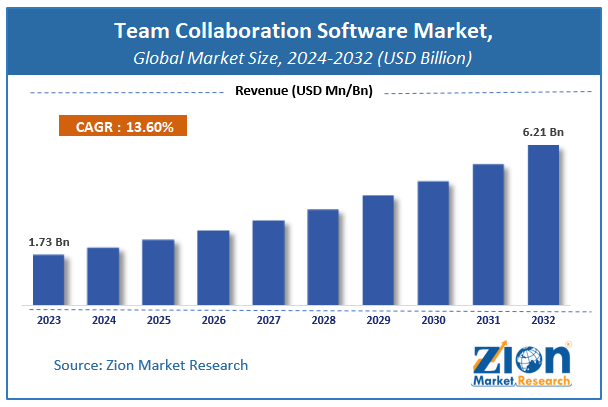
According to the report published by Zion Market Research, the global Team Collaboration Software Market size was valued at USD 1.73 Billion in 2023 and is predicted to reach USD 6.21 Billion by the end of 2032. The market is expected to grow with a CAGR of 13.6% during the forecast period. The report analyzes the global Team Collaboration Software Market's growth drivers, restraints, and impact on demand during the forecast period. It will also help navigate and explore the arising opportunities in the Team Collaboration Software industry.
Team Collaboration Software Market: Overview
In 1990, collaboration software was described as “planned group processes plus software to maintain them.” At present, collaboration software leverages obtainable technologies to enable groups to commune, share, manage, collaborate, solve setbacks, bargain, or even participate for the purpose of finishing a task. Collaboration software also called as groupware or collaborative software, allows the running, sharing and dispensation of files, documents and other kinds of data among numerous users and systems anywhere and anytime.
The main reason for collaboration software is to improve the efficiency of individuals in a team or group within an organization in order to attain a particular aim. With this kind of program, users can organize tasks and make individual workstation then have workflows and information added to it. The chief user who created the workstation can allow others to contact view and create changes and whatever alterations are made on files and data or information are synced for all users. This makes sure that everybody implicated is on the “similar page” and has the most modern edition of the existing project.
Team Collaboration Software Market: Growth Factors
Coming out of unified communication as a service and rising smartphone penetration on a universal level are anticipated to be the main factors which are fueling the team collaboration software market growth in the coming years. Additionally, rising uptake of BYOD (bring your own device) advancement across associations and the appearance of new team collaboration equipment, and related practices are also anticipated to drive market growth. Growing internet usage, developing labor force demographics, virtualization of devices & devices, expansion of Software as a Service (SaaS) and expertise developments are anticipated to further fuel the global team collaboration software market development. Associations focus on moving from a paper document focused work style to a public focused work style, which is also anticipated to positively influence the global team collaboration market growth in the coming years.
Organizations concentrate on adopting the team collaboration software in order to build developments, services, and products that distinguish the company from the opposition. Expansion of new technologies that facilitate statement over a wider range of end points is anticipated to offer the prospect for the team collaboration market development in the coming days. Growing popularity of social networking websites is also anticipated to offer avenues for market expansion in the coming future.

Team Collaboration Software Market: Segmentation
The research study on the global team collaboration market can be divided based on the following criteria: deployment type, end-user industry vertical, solution, service, and geography.
Based on the collaboration solutions, the market is divided into collaboration and unified communication (video & web conferencing, existence information, audio, instant messaging, IP telephony, and others), project and team management, enterprise social collaboration, and document management system. Social and enterprise collaboration is anticipated to develop with maximum rate and unified communication and collaboration are anticipated to hold the foremost share of the market in the coming years.
On the basis of the end user industry, the market is divided into media and entertainment, ITES and telecommunication, banking financial systems & insurance, consumer goods and retail, life sciences education healthcare and others.
Recent Development
- In November 2025, Atlassian acquired DX, a developer intelligence platform, to enhance AI-driven engineering insights and productivity analytics. It integrated DX’s capabilities into Atlassian’s collaboration tools, such as Jira and Bitbucket, to strengthen software team performance and engineering intelligence across its platform.
- In August 2025, Anthropic released a major update to its developer platform for the Claude 3.7 Sonnet AI model. The Anthropic Console enables cross-functional teams to co-develop prompts, manage extended reasoning modes, and control costs, promoting broader access to AI development for both technical and non-technical enterprise users.
- In April 2025, AT&T, Inc. enhanced its Network Edge Collaboration service by integrating private 5G technology, enabling ultra-low-latency video conferencing and secure field-site file sharing. The upgrade provides faster, more reliable connections for remote teams, supporting industries with improved security, efficiency, and real-time collaboration.
- In March 2025, Adobe entered into a strategic collaboration with Amazon Web Services (AWS) to enhance its customer experience offerings. The partnership integrates Adobe’s Customer Experience Orchestration capabilities with AWS cloud services, enabling marketing and creative teams to deliver faster, more precise, and scalable customer experiences.
- In March 2025, Cisco Systems, Inc. launched Webex Huddle, a persistent virtual workspace that automatically syncs whiteboard sketches, files, and chat threads across meetings and channels. The solution enhances collaboration by providing real-time updates and seamless integration, streamlining communication and workflow for hybrid teams.
- In March 2025, Zoho launched Projects Plus, an AI-enhanced, data-driven project management platform for mid-sized and enterprise organizations. Integrating Zoho Projects, WorkDrive, Sprints, and Analytics, the platform supports hybrid workflows, team collaboration, and predictive insights, improving efficiency, resource planning, and cross-department visibility for complex projects.
Team Collaboration Software Market: Report Scope
| Report Attributes | Report Details |
|---|---|
| Report Name | Team Collaboration Software Market |
| Market Size in 2023 | USD 1.73 Billion |
| Market Forecast in 2032 | USD 6.21 Billion |
| Growth Rate | CAGR of 13.6% |
| Number of Pages | 214 |
| Key Companies Covered | Microsoft, Cisco System, Citrix, Oracle, IBM, Box incorporation, Google, Intralinks Holdings Incorporations and Survey Monkey, Slack, Dropbox, and Box |
| Segments Covered | By Deployment Type, By End-User Industry Vertical, By Solution, By Service And By Region |
| Regions Covered | North America, Europe, Asia Pacific (APAC), Latin America, Middle East, and Africa (MEA) |
| Base Year | 2023 |
| Historical Year | 2018 - 2022 |
| Forecast Year | 2024 - 2032 |
| Customization Scope | Avail customized purchase options to meet your exact research needs. Request For Customization |
Team Collaboration Software Market: Regional Analysis
The U.S. team collaboration software market size is anticipated to control the market in the coming years owing to the existence of several vendors. Latin America provides prospective growth opportunities as there are technical innovation and association are concentrating on better consumer experience to gain viable advantage.
Team Collaboration Software Market: Competitive players
The key players of the global team collaboration software market are :
- Microsoft
- Cisco System
- Citrix
- Oracle
- IBM
- Box incorporation
- Intralinks Holdings Incorporations and Survey Monkey
- Slack
- Dropbox
- Box.
The Global Team Collaboration Software Market is segmented as follows:
By end-user industry vertical
- media and entertainment
- ITES and telecommunication
- banking financial systems & insurance
- consumer goods and retail
- life sciences education healthcare and others
By solution
- collaboration and unified communication (video & web conferencing, existence information, audio, instant messaging, IP telephony, and others)
- project and team management
- enterprise social collaboration
- document management system
By Region
- North America
- The U.S.
- Canada
- Mexico
- Europe
- France
- The UK
- Spain
- Germany
- Italy
- Rest of Europe
- Asia Pacific
- China
- Japan
- India
- Australia
- South Korea
- Rest of Asia Pacific
- The Middle East & Africa
- Saudi Arabia
- UAE
- Egypt
- Kuwait
- South Africa
- Rest of the Middle East & Africa
- Latin America
- Brazil
- Argentina
- Rest of Latin America
What Reports Provides
- Full in-depth analysis of the parent market
- Important changes in market dynamics
- Segmentation details of the market
- Former, on-going, and projected market analysis in terms of volume and value
- Assessment of niche industry developments
- Market share analysis
- Key strategies of major players
- Emerging segments and regional markets
- Testimonials to companies in order to fortify their foothold in the market.
Table Of Content

FrequentlyAsked Questions
Team collaboration software allows employees to communicate, share files, and manage tasks in one platform. It improves teamwork, productivity, and coordination across teams.
The global team collaboration software market is expected to be driven by the Growth is supported by remote work adoption, digital workplace transformation, and demand for real-time communication and productivity tools.
According to study, the global team collaboration software market size was worth around USD 1.73 Billion in 2023 and is predicted to grow to around USD 6.21 Billion By 2032.
The global team collaboration software market is expected to grow at a Compound Annual Growth Rate (CAGR) of around CAGR 13.6% during the forecast period from 2024-2032.
The global team collaboration software industry is projected to be challenged by Challenges involve data security, user adoption resistance, and feature saturation. Differentiation in a crowded market is difficult.
The Opportunities include hybrid work adoption, workflow automation, and integration with security/compliance tools. AI assistants, unified communications, and vertical-specific solutions drive growth will offer significant growth opportunities in the team collaboration software market.
AI-enhanced task automation and virtual assistants; unified platforms merging chat, docs, video and workflows; immersive/async collaboration with analytics and enhanced security are the emerging trends and innovations impacting the team collaboration software market.
The global team collaboration software market is expected to be led by North America during the forecast period.
Some of the prominent players operating in the global team collaboration software market are; Microsoft, Cisco System, Citrix, Oracle, IBM, Box incorporation, Google, Intralinks Holdings Incorporations and Survey Monkey, Slack, Dropbox, and Box and others.
The report explores crucial aspects of the team collaboration software market, including a detailed discussion of existing growth factors and restraints, while also browsing future growth opportunities and challenges that impact the market.
HappyClients

