
Global Tackifier Market Size, Share, Growth Analysis Report - Forecast 2034

Tackifier Market By From (Liquid, Solid, and Others), By Type (Synthetic and Natural), By End-User (Building & Construction, Packaging, Paints & Coatings, Pulp & Paper, and Rubber), By Application (Hot-Melt Adhesives and Pressure-Sensitive Adhesives (PSAs)), and By Region - Global and Regional Industry Overview, Market Intelligence, Comprehensive Analysis, Historical Data, and Forecasts 2025 - 2034
| Market Size in 2024 | Market Forecast in 2034 | CAGR (in %) | Base Year |
|---|---|---|---|
| USD 681.2 Million | USD 965.96 Million | 3.7% | 2024 |
Tackifier Market: Industry Perspective
What will be the global tackifier market size during the forecast period?
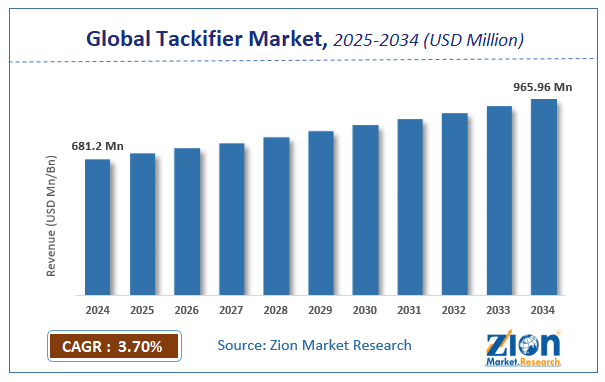
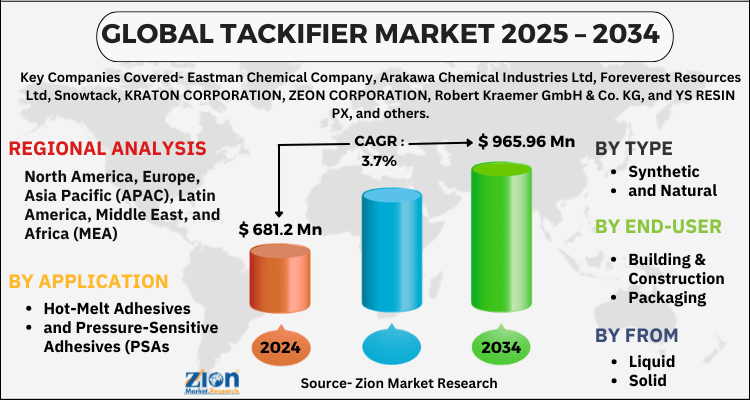
The global tackifier market size was worth around USD 681.2 million in 2024 and is predicted to reach around USD 965.96 million by 2034, with a compound annual growth rate (CAGR) of roughly 3.7% between 2025 and 2034.
This report provides a comprehensive analysis of the growth drivers, restraints, and challenges shaping demand across the global tackifier market throughout the forecast period, while highlighting high-potential emerging opportunities within the industry.
Key Insights
- As per the analysis shared by our research analyst, the global tackifier market is estimated to grow annually at a CAGR of around 3.7% over the forecast period (2025-2034).
- Regarding revenue, the global tackifier market size was valued at around USD 681.2 Million in 2024 and is projected to reach USD 965.96 Million by 2034.
- The tackifier market is projected to grow at a significant rate due to rising demand in adhesives, rubber, and road marking applications.
- Based on From, the Liquid segment is expected to lead the global market.
- Based on Type, the Synthetic segment is growing at a high rate and will continue to dominate the global market.
- Based on the End-User, the Building & Construction segment is projected to swipe the largest market share.
- By Application, the Hot-Melt Adhesives segment is expected to dominate the global market.
- Based on region, Asia-Pacific is predicted to dominate the global market during the forecast period.
Tackifier Market: Overview
Tackifiers are chemical compounds widely used in adhesive manufacturing processes, where they act as tackiness-increasing agents. This property determines the adhesive's surface stickiness.
The compound has a low molecular weight, measured in Daltons, and a high glass transition temperature, which involves the reversible, slow process of converting hard or brittle material into a rubbery or viscous state by increasing temperature. This change is mostly observed in amorphous materials. At lower strain rates, tackifiers show high stress tolerance and compliance, but become stiff at higher strain rates.
Tackifier Market: Growth Drivers
What factors are primarily accelerating demand in the tackifier market?
The global tackifier market is projected to grow due to increasing tackifier use in the automotive segment. Adhesion sealants are widely used at joints and welded areas between structures, including civil work vehicles, auto bodies, and construction vehicles. Growth in the automotive segment is projected to drive demand for tackifiers.
An increasing number of players in the automobile segment offering a variety of products ranging from affordable segments to premium segments, catering to a large section of the consumer segment, is propelling the automotive industry, which was valued at USD 2.9 trillion in 2021 and may grow further due to a rise in the number of high-income groups, along with increasing financial assistance creating a friendlier market for low- or medium-income groups. For instance, according to Statista, Ford Motor Company, a leading global automobile player, sold more than 3.9 million vehicles in 2021, including sales through distributors and dealers.
Tackifier Market: Restraints
What factors are limiting the expansion of the tackifier market?
Synthetic tackifiers are highly regulated in various nations under different regulatory bodies. Because tackifiers are widely used in the building & construction and automobile industries, the production and composition of synthetic tackifiers fall under various national regulatory bodies in the countries where they are used or manufactured. These factors, along with the rising inclination toward limonene components, may restrict the global market growth in the coming years.
Tackifier Market: Opportunities
Where do significant growth opportunities lie for the tackifier market?
Tackifiers are currently used extensively in the agricultural sector to immobilize or bind straw, pine needles, cellulose products, or other mulch products applied in seeded areas. Tackifiers help prevent soil erosion by keeping the product on the soil surface. Such increased utilization of tackifiers in other segments may create strong growth opportunities.
Tackifier Market: Challenges
What key challenges confront participants in the tackifier market?
Fluctuating prices of raw materials like hydrocarbon resins are a major challenge for global tackifier market players, which may be further fueled by political dynamics worldwide. Aspects like procurement of raw materials cost associated with transportation, and final goods prices are projected to be affected in the coming years, causing a disruption in the global market growth trend.
Tackifier Market: Report Scope
| Report Attributes | Report Details |
|---|---|
| Report Name | Tackifier Market |
| Market Size in 2024 | USD 681.2 Million |
| Market Forecast in 2034 | USD 965.96 Million |
| Growth Rate | CAGR of 3.7% |
| Number of Pages | 228 |
| Key Companies Covered | Eastman Chemical Company, Arakawa Chemical Industries Ltd, Foreverest Resources Ltd, Snowtack, KRATON CORPORATION, ZEON CORPORATION, Robert Kraemer GmbH & Co. KG, YS RESIN PX, and others. |
| Segments Covered | By Form, By Type, By End-User, By Application, and By Region |
| Regions Covered | North America, Europe, Asia Pacific (APAC), Latin America, The Middle East and Africa (MEA) |
| Base Year | 2024 |
| Historical Year | 2020 - 2023 |
| Forecast Year | 2025 - 2034 |
| Customization Scope | Avail customized purchase options to meet your exact research needs. Request For Customization |
Tackifier Market: Segmentation
The tackifier market is segmented by form, type, end-user, application, and region. All the segments of the tackifier market have been analyzed based on present and future trends and the market is estimated from 2025 to 2034.
Based on Form Segment, the tackifier market is divided into liquid, solid, and others. The liquid segment is expected to lead the global market because liquid forms integrate readily into many adhesive and coating formulations and support efficient processing. This leadership drives overall market growth by aligning with high-volume hot-melt and pressure-sensitive adhesive production, while solid forms serve applications that require different handling, storage, or performance profiles.
Based on Type Segment, the tackifier market is divided into synthetic and natural. The synthetic segment is growing rapidly and will continue to dominate the global market because of consistent performance, broad availability, and established use in industrial adhesives and construction-related products. This dominance supports market expansion through scalable supply for packaging, labels, tapes, and building applications, while natural tackifiers gain attention where regulatory or sustainability preferences favor bio-based options.
Based on End-User Segment, the tackifier market is divided into building and construction, packaging, paints and coatings, pulp & paper, and rubber. The building and construction segment is projected to hold the largest market share as adhesives and sealants are widely used in structural joints, finishes, and related applications. This focus drives demand for tackifiers that improve bond performance, while packaging, paints and coatings, pulp and paper, and rubber sustain additional volume across labels, tapes, and industrial products.
Based on Application Segment, the tackifier market is divided into hot-melt adhesives and pressure-sensitive adhesives (PSAs). The hot-melt adhesives segment is expected to dominate the global market because of extensive use in packaging, product assembly, and related industrial bonding. This leadership drives market growth by linking tackifier demand to high-throughput adhesive systems, while PSAs support labels, tapes, and other applications that require controlled tack and peel performance.
Tackifier Market: Regional Analysis
Why will Asia-Pacific continue to dominate the global market during the projection period?
The global tackifier market is projected to remain dominated by Asia-Pacific in the coming years due to increased demand for synthetic and natural tackifiers for label and tape production, along with rising applications in the packaging and bookbinding sectors. Growth in the regional packaging industry could be attributed to population growth and the subsequent rise in the food & beverages sector, along with strong product innovation. In 2018, Asia-Pacific held more than 50% of the global market share. China's highly acclaimed chemical industry is a major growth driver. In 2019, the Chinese chemical industry was worth USD 1.49 trillion, accounting for over 39% of the global market share. In Europe, the growing adoption of natural tackifiers may lead to higher revenues in the regional market.
Recent Developments:
-
In January 2026, Eastman Chemical Company expanded its commercial production of light-colored, hydrogenated hydrocarbon tackifying resins to address escalating global demand for ultra-low-odor hot-melt adhesives in consumer packaging and personal hygiene applications.
Tackifier Market: Competitive Analysis
The global tackifier market is dominated by players like:
- Eastman Chemical Company
- Arakawa Chemical Industries Ltd
- Foreverest Resources Ltd
- Snowtack
- KRATON CORPORATION
- ZEON CORPORATION
- Robert Kraemer GmbH & Co. KG
- YS RESIN PX
Tackifier Market: Key Trends
What are the key trends in the tackifier market?
Liquid form and synthetic type leadership
Liquid tackifiers are expected to lead form demand through ease of incorporation into adhesive systems, while synthetic types continue to dominate on performance consistency and scale for industrial and construction-related uses.
Hot-melt adhesives and building and construction demand
Hot-melt adhesives are expected to dominate application demand, and building and construction is projected to hold the largest end-user share, linking tackifier consumption to packaging, assembly, and structural bonding needs.
Segments Covered
The global tackifier market is segmented as follows:
By Form
- Liquid
- Solid
- Others
By Type
- Synthetic
- Natural
By End-User
- Building & Construction
- Packaging
- Paints & Coatings
- Pulp & Paper
- Rubber
By Application
- Hot-Melt Adhesives
- Pressure-Sensitive Adhesives (PSAs)
By Region
- North America
- The U.S.
- Canada
- Mexico
- Europe
- France
- The UK
- Spain
- Germany
- Italy
- Rest of Europe
- Asia Pacific
- China
- Japan
- India
- Australia
- South Korea
- Rest of Asia Pacific
- The Middle East & Africa
- Saudi Arabia
- UAE
- Egypt
- Kuwait
- South Africa
- Rest of the Middle East & Africa
- Latin America
- Brazil
- Argentina
- Rest of Latin America
Table Of Content
Methodology
FrequentlyAsked Questions
A tackifier is a chemical compound added to adhesives, sealants, or coatings to increase their stickiness (tack). It helps improve bonding strength, especially in pressure-sensitive adhesives used in tapes, labels, and packaging.
The global tackifier market is expected to grow due to expanding applications in adhesives, rubber, and packaging industries, along with growing demand in automotive and construction sectors.
According to a study, the global tackifier market size was worth around USD 681.2 Million in 2024 and is expected to reach USD 965.96 Million by 2034.
The global tackifier market is expected to grow at a CAGR of 3.7% during the forecast period.
Asia-Pacific is expected to dominate the tackifier market over the forecast period.
Leading players in the global tackifier market include Eastman Chemical Company, Arakawa Chemical Industries Ltd, Foreverest Resources Ltd, Snowtack, KRATON CORPORATION, ZEON CORPORATION, Robert Kraemer GmbH & Co. KG, YS RESIN PX, among others.
The report explores crucial aspects of the tackifier market, including a detailed discussion of existing growth factors and restraints, while also examining future growth opportunities and challenges that impact the market.

HappyClients

