
Global Sulfur Bentonite Market Size, Share, Growth Analysis Report - Forecast 2034

Sulfur Bentonite Market By Form (Pastilles, Granules, and Powder), By Crop Type (Cereals & Grains, Oilseeds & Pulses, Fruits & Vegetables), By Application (Agriculture (Soil Conditioner & Fertilizer) and Industrial (Construction, Drilling Mud, and Iron Ore Pelletizing)), By End-user (Farmers, Agrochemical Companies, and Industrial Manufacturers), and By Region: Global and Regional Industry Overview, Market Intelligence, Comprehensive Analysis, Historical Data, and Forecasts 2025 - 2034
| Market Size in 2024 | Market Forecast in 2034 | CAGR (in %) | Base Year |
|---|---|---|---|
| USD 8.99 Billion | USD 13.95 Billion | 4.5% | 2024 |
Sulfur Bentonite Market: Industry Perspective
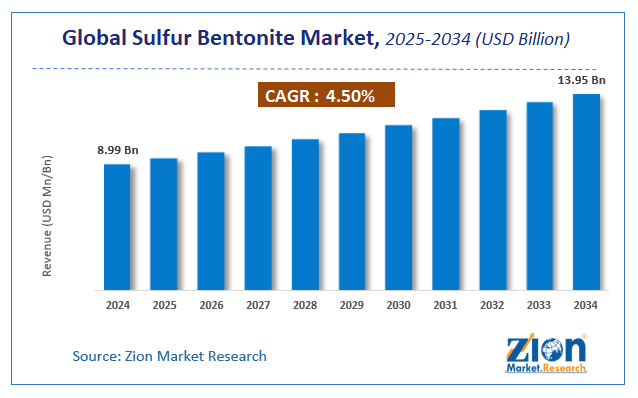
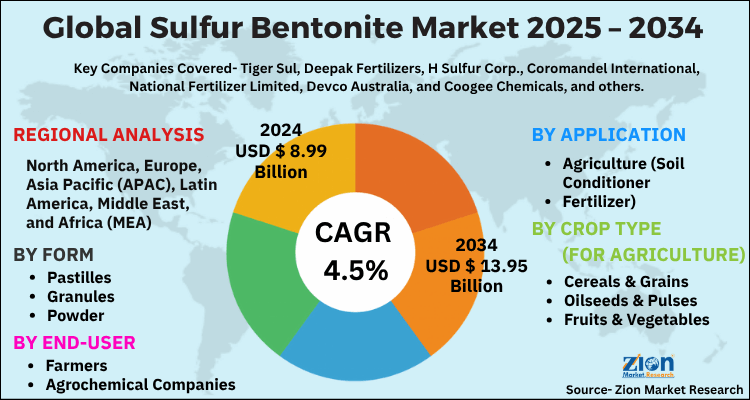
The global sulfur bentonite market size was worth around USD 8.99 billion in 2024 and is predicted to grow to around USD 13.95 billion by 2034 with a compound annual growth rate (CAGR) of roughly 4.5% between 2025 and 2034. The sulfur bentonite market is driven by the increasing global demand for high-yield agricultural practices and the rising prevalence of sulphur deficiency in cultivable soils.
The report examines the primary drivers, challenges, and restraints shaping global demand for the sulfur bentonite market throughout the forecast period and identifies high-growth opportunities across the industry.
Sulfur Bentonite Market Overview:
Sulfur Bentonite is one of the key concentrated sulphur sources. Reportedly, Sulfur deficiency is witnessed mainly in Indian soils. For the record, Sulfur Bentonite consists of ninety percent sulphur and ten percent of Bentonite clay. Moreover, the product acts as a dispersing agent after being added to soils. According to NCBI, sulfur bentonite-based organic fertilizers are utilized as tools for enhancing the antioxidant activity in red onions.
Furthermore, the compound is used in fertilizers for raising crop output and improving soil quality, along with maintaining land arability. Apparently, sulfur plays a major role in the synthesis of chlorophyll and enhances plant metabolism. In addition to this, Sulfur Bentonite fertilizers are utilized as flame retardants, in oil & gas drilling applications, and as organic intermediates.
Key Insights
- As per the analysis shared by our research analyst, the global sulfur bentonite market is estimated to grow annually at a CAGR of around 4.5% over the forecast period (2025-2034).
- Regarding revenue, the global sulfur bentonite market size was valued at around USD 8.99 billion in 2024 and is projected to reach USD 13.95 billion by 2034.
- The sulfur bentonite market is projected to grow at a significant rate due to rising demand for high-efficiency sulfur fertilizers and increasing focus on crop yield and soil health.
- Based on Form, the Pastilles segment is expected to lead the global market.
- On the basis of Crop Type, the Cereals & Grains segment is growing at a high rate and will continue to dominate the global market.
- Based on the Application, the Agriculture segment is projected to capture the largest market share.
- By End-user, the Farmers segment is expected to dominate the global market.
- Based on region, North America is predicted to dominate the global market during the forecast period.
Sulfur Bentonite Market: Growth Dynamics
The market's growth over the forecast period is attributed to the need to remove sulfur deficiency from soil to increase the yield of corn, apples, potatoes, oranges, soybeans, tea, and coffee. Large-scale use of the compound in wastewater treatment, desalination, and food and beverages will boost market trends. Additionally, the escalating need for fertilizers fortified with sulfur for increasing crop cultivation will provide new growth avenues for the sulfur bentonite market over the ensuing years. Apparently, the oxidative feature of the compound helps in controlling the nutrient loss of the soil without creating any environmental hazards, and this will steer the market's growth over the forecast timeframe.
Furthermore, easy availability of raw substances, commercialization of products, and huge business avenues will facilitate market growth over 2025–2034. Moreover, low sulfur content in the soil can cause poor water drainage, soil runoff, pollution, and bacterial proliferation. Hence, in order to prevent soil damage as well as retain its arability, it is necessary to add Sulfur Bentonite to soil. Such moves are anticipated to boost market demand in the near future. However, a large amount of subsidies provided to conventional fertilizers in developing countries will decimate market expansion.
Sulfur Bentonite Market: Segmentation Analysis
The global sulfur bentonite market is segmented based on form, crop type, application, end-user, and region.
Based on Form, the global sulfur bentonite market is divided into Pastilles, Granules, and Powder. The Pastilles segment unequivocally leads the global market, securing the maximum market share. This overwhelming dominance is primarily fueled by their exceptional physical handling characteristics. Pastilles are specifically engineered into a uniform, hemispherical shape that dramatically reduces hazardous dust generation during transport and application, vastly improving workplace safety and environmental compliance.
On the basis of Crop Type, the global sulfur bentonite market is bifurcated into Cereals & Grains, Oilseeds & Pulses, and Fruits & Vegetables. The Oilseeds & Pulses segment clearly dominates the global market landscape with a substantial share. This immense growth is directly credited to the extraordinarily high biological sulphur requirement inherent to these specific crops. Plants like canola, soybean, and mustard rely heavily on sulphur to synthesize vital amino acids and high-quality vegetable oils; without adequate sulphur, both the yield and the commercial quality of the oilseed are severely compromised, making specialized supplementation an absolute necessity.
By Application, the global sulfur bentonite market is split into Agriculture and Industrial. The Agriculture segment holds the highly dominant market position and is expected to lead the landscape significantly. This phenomenal growth is heavily driven by the massive, indispensable reliance on sulphur bentonite as a highly efficient, slow-release soil amendment and fertilizer globally. It is the primary vehicle utilized by modern agronomy to systematically correct widespread soil sulphur deficiencies, actively lower soil pH in highly alkaline regions, and decisively enhance overarching crop productivity.
In terms of End-users, the global sulfur bentonite market is categorized into Farmers, Agrochemical Companies, and Industrial Manufacturers. The Farmers segment dominates the global market with a massive revenue share. This immense dominance is naturally attributed to the millions of commercial and independent agricultural practitioners worldwide who personally bear the direct responsibility for soil fertility management and crop yield optimization.
Sulfur Bentonite Market: Report Scope
| Report Attributes | Report Details |
|---|---|
| Report Name | Sulfur Bentonite Market |
| Market Size in 2024 | USD 8.99 Billion |
| Market Forecast in 2034 | USD 13.95 Billion |
| Growth Rate | CAGR of 4.5% |
| Number of Pages | 210 |
| Key Companies Covered | Tiger Sul, Deepak Fertilizers, H Sulfur Corp., Coromandel International, National Fertilizer Limited, Devco Australia, Coogee Chemicals, and others. |
| Segments Covered | By Form, By Crop Type, By Application, By End-user, and By Region |
| Regions Covered | North America, Europe, Asia Pacific (APAC), Latin America, The Middle East and Africa (MEA) |
| Base Year | 2024 |
| Historical Year | 2020 to 2023 |
| Forecast Year | 2025 - 2034 |
| Customization Scope | Avail customized purchase options to meet your exact research needs. Request For Customization |
Sulfur Bentonite Market: Regional Analysis
North America To Make Remarkable Contributions Towards Overall Market Revenue By 2034
The market growth in the region over the estimated time span can be credited to the huge demand for the product because of the huge crop yield. Furthermore, its use has been found to benefit the enhancement of crop health in countries like Canada. Apart from this, the subcontinent is the major manufacturer and consumer of the compound, with Canada being the leading canola producer. In addition to this, the U.S. is predicted to generate high demand for soybeans and corn, which will boost product penetration in the country. All these aforementioned factors are predicted to enhance business growth in the region over the ensuing years.
Asia Pacific holds a commanding structural position in the global sulphur bentonite market and is thoroughly poised to sustain its aggressive dominance throughout the projection timeframe. This profound regional growth is fundamentally driven by the sheer scale of its agrarian economies, particularly in massive agricultural powerhouses like India, China, and Southeast Asia. The region sustains a significant portion of the global population, which places extraordinary, continuous pressure on its arable land to maximize food production.
Sulfur Bentonite Market: Competitive Analysis
The report provides a company market share analysis to give a broader overview of the key market players. In addition, the report also covers key strategic developments of the market, including acquisitions & mergers, new product launches, agreements, partnerships, collaborations & joint ventures, research & development, and regional expansion of major participants involved in the sulfur bentonite market on a global and regional basis.
The global sulfur bentonite market is dominated by players like:
- Tiger Sul
- Deepak Fertilizers
- H Sulfur Corp.
- Coromandel International
- National Fertilizer Limited
- Devco Australia
- Coogee Chemicals
The global sulfur bentonite market is segmented as follows;
By Form
- Pastilles
- Granules
- Powder
By Crop Type
- Cereals & Grains
- Oilseeds & Pulses
- Fruits & Vegetables
By Application
- Agriculture
- Industrial
By End-user
- Farmers
- Agrochemical Companies
- Industrial Manufacturers
By Region
- North America
- The U.S.
- Canada
- Mexico
- Europe
- France
- The UK
- Spain
- Germany
- Italy
- Rest of Europe
- Asia Pacific
- China
- Japan
- India
- Australia
- South Korea
- Rest of Asia Pacific
- The Middle East & Africa
- Saudi Arabia
- UAE
- Egypt
- Kuwait
- South Africa
- Rest of the Middle East & Africa
- Latin America
- Brazil
- Argentina
- Rest of Latin America
Table Of Content
Methodology
FrequentlyAsked Questions
Sulphur bentonite encompasses a highly specialized, advanced agricultural fertilizer formulated by combining pure elemental sulphur with swelling bentonite clay. When applied to the soil, the clay rapidly absorbs moisture and shatters the pellet, accelerating the microbial conversion of elemental sulphur into plant-available sulphate, actively serving as a highly efficient, slow-release nutrient source.
The global sulfur bentonite market is expected to grow due to rising demand for high-efficiency sulfur fertilizers and increasing focus on crop yield and soil health.
According to a study, the global sulfur bentonite market size was worth around USD 8.99 billion in 2024 and is expected to reach USD 13.95 billion by 2034.
The global sulfur bentonite market is expected to grow at a CAGR of 4.5% during the forecast period.
North America is expected to dominate the sulfur bentonite market over the forecast period.
Leading players in the global sulfur bentonite market include Tiger Sul, Deepak Fertilizers, H Sulfur Corp., Coromandel International, National Fertilizer Limited, Devco Australia, and Coogee Chemicals, among others.
Major restraining factors heavily impacting market growth encompass the extreme price volatility of raw elemental sulphur tied to global oil markets, the high capital costs of establishing safe, explosion-proof manufacturing facilities, and a severe lack of foundational agronomic knowledge regarding secondary nutrients among smallholder farmers.
Significant emerging innovations include the robust development of micronutrient-fortified pastilles that deliver zinc and boron alongside sulphur, and the massive deployment of precision agriculture techniques that demand highly customized, dry-blend compatible slow-release nutrient solutions.
The industry's value chain intrinsically begins with the extensive procurement of raw elemental sulphur from petroleum refineries, transitions into highly specialized, safety-controlled pastillation and manufacturing processes, proceeds to complex bulk agricultural distribution, and concludes with professional farmer application across diverse commercial crops.

HappyClients

