
Sterility Testing Market Growth, Size, Share, Trends, and Forecast 2032

Sterility Testing Market By Type (Kits & Reagents, Consumables, Biomedical Instruments), By Application (Pharmaceutical Companies, Hospitals, Pathological Laboratories), and By Region: Global Industry Analysis, Size, Share, Growth, Trends, and Forecasts 2024-2032
| Market Size in 2023 | Market Forecast in 2032 | CAGR (in %) | Base Year |
|---|---|---|---|
| USD 1548.12 million | USD 3,827.31 million | 10.58% | 2023 |
Description
How big is the Sterility Testing Market?
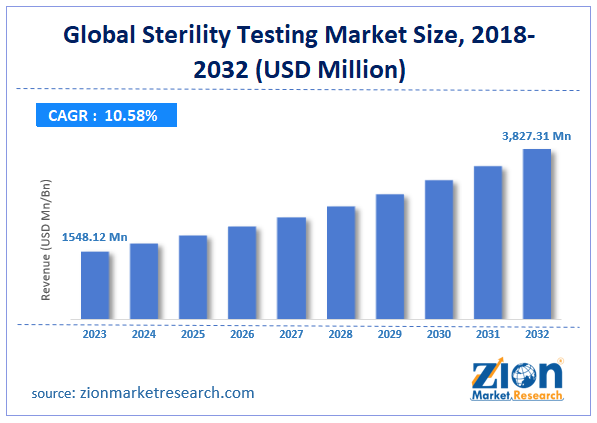
The global Sterility Testing market size accrued earnings worth approximately USD 1548.12 Million in 2023 and is predicted to gain revenue of about USD 3,827.31 Million by 2032, is set to record a CAGR of nearly 10.58% over the period from 2024 to 2032
Global Sterility Testing Market: Overview
Absence of viable microorganisms is known as sterility. The conditions which guarantee the condition of being sterile are very harsh for the active ingredients. The determination of a sterility test being valid is done with the help of fungistasis and bacteriostasis testing. Sterility testing helps to confirm the presence of anitimicrobial property within a test article that would obstruct the detection of the microbial organisms during a sterility examination. The sterility tests can be conducted in cleanroom environment or by direct inoculation method or by an isolator using membrane filtration method.
Key Insights
- As per the analysis shared by our research analyst, the global Sterility Testing Market is estimated to grow annually at a CAGR of around 10.58% over the forecast period (2024-2032).
- In terms of revenue, the global Sterility Testing Market size was valued at around USD 1548.12 Million in 2023 and is projected to reach USD 3,827.31 Million by 2032.
- Based on the type, in the sterility testing market, the membrane filtration segment holds the dominant share, as it is widely preferred for products that can be filtered, including pharmaceutical solutions, beverages, and other liquid-based formulations. Its ability to test larger sample volumes, deliver accurate results, and comply with regulatory requirements makes it the most reliable and commonly adopted method over direct inoculation or other testing techniques.
- Based on the application, the pharmaceutical and biotechnology segment is the largest contributor to the sterility testing market. This dominance is driven by the high demand for stringent quality control and regulatory compliance in drug development, biologics production, and vaccine manufacturing. The rising prevalence of chronic diseases, along with the rapid expansion of biopharmaceuticals, has significantly increased the need for sterility testing in this segment.
- Based on the Geographically, North America leads the sterility testing market, attributed to its advanced healthcare infrastructure, strong presence of pharmaceutical and biotechnology companies, and strict regulatory standards. The region benefits from extensive R&D investments, rising adoption of biologics, and the increasing production of innovative drugs, which collectively fuel the demand for sterility testing solutions.
Global Sterility Testing Market: Growth Factors
The major factors that are responsible for driving the growth of the global sterility testing market is the surge in the introduction of the new drugs, increasing activities in the research and development of the life science vertical, and substantial enlargement of the biotechnology and pharmaceutical sectors. In the recent years, an impressive growth was witnessed in the pharma and biotech sectors, by application; thus, the pharmaceutical and biological manufacturing market had acquired a good market share globally. The membrane filtration market by test has also contributed a major share in the pharmaceutical and biotechnology end-use sectors thus increasing the demand of the sterility testing market. The advanced penetration of the kit-based testing and repeat purchase requirement in the sterility testing market will open up new lucrative opportunities in the global market.
Sterility Testing Market: Report Scope
| Report Attributes | Report Details |
|---|---|
| Report Name | Sterility Testing Market |
| Market Size in 2023 | USD 1548.12 Million |
| Market Forecast in 2032 | USD 3,827.31 Million |
| Growth Rate | CAGR of 10.58% |
| Number of Pages | 201 |
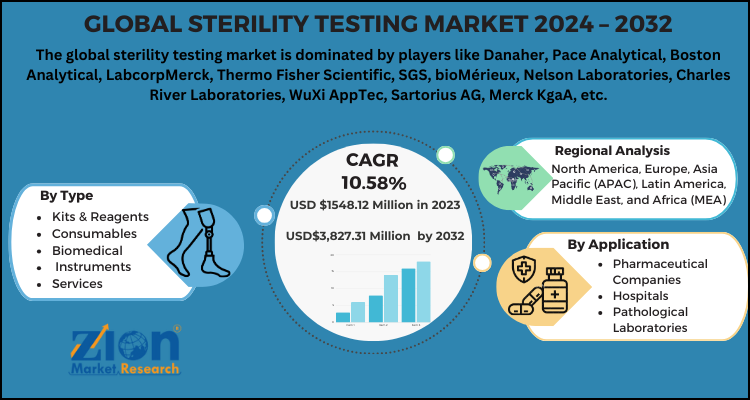
| Key Companies Covered | Danaher, Pace Analytical, Boston Analytical, LabcorpMerck, Thermo Fisher Scientific, SGS, bioMérieux, Nelson Laboratories, Charles River Laboratories, WuXi AppTec, Sartorius AG, Merck KgaA, etc. |
| Segments Covered | By Type, By Application, and By Region |
| Regions Covered | North America, Europe, Asia Pacific (APAC), Latin America, Middle East, and Africa (MEA) |
| Base Year | 2023 |
| Historical Year | 2018 - 2022 |
| Forecast Year | 2024 - 2032 |
| Customization Scope | Avail customized purchase options to meet your exact research needs. Request For Customization |
Global Sterility Testing Market: Segmentation
The sterility testing market is globally segmented into its product, test, and application.
On the basis of product, the global market is segregated into services, kits and reagents, and instruments.
Based on the test, the market is categorized into direct inoculation, membrane filtration, and other sterility tests.
Depending on the application, the market is divided into medical devices manufacturing, pharmaceutical and biological manufacturing, and other applications.
Global Sterility Testing Market: Regional Analysis
The sterility testing market is geographically segmented into Asia Pacific, Europe, North America, and Rest of the World. The region that dominates the sterility testing market is North America which is followed by Europe. The factor that contributes to this growth is the increasing approvals of the drug in the North American region predict to set the regional market for sterility testing. The region that is growing fast in the global sterility testing market is Asia Pacific region. The reason for this market growth is the growing trend of the outsourcing of the pharmaceuticals to the nations such as China and India. The growth of the market in the Asia Pacific region is also owing to the multiplying expenditure on the researches of life science.
Global Sterility Testing Market: Competitive Players
Some of the key market players that are involved in the sterility testing market include
- Danaher
- Pace Analytical
- Boston Analytical
- LabcorpMerck
- Thermo Fisher Scientific
- SGS
- bioMérieux
- Nelson Laboratories
- Charles River Laboratories
- WuXi AppTec
- Sartorius AG
- Merck KgaA, Others
Global Sterility Testing Market: Segment Analysis
By Type
- Kits & Reagents
- Consumables
- Biomedical Instruments
- Services
By Application
- Pharmaceutical Companies
- Hospitals
- Pathological Laboratories
- Academic Laboratories
- Others
By Region
What Reports Provides
- Full in-depth analysis of the parent market
- Important changes in market dynamics
- Segmentation details of the market
- Former, on-going, and projected market analysis in terms of volume and value
- Assessment of niche industry developments
- Market share analysis
- Key strategies of major players
- Emerging segments and regional markets
- Testimonials to companies in order to fortify their foothold in the market.
Table Of Content

FrequentlyAsked Questions
Sterility testing is a laboratory process used to verify that pharmaceutical products, medical devices, and biologics are free from viable microorganisms.
The global sterility testing market is expected to be driven by the Market growth is driven by strict regulatory requirements, increasing pharmaceutical and biologics production, and rising focus on quality control and contamination prevention.
According to study, the global sterility testing market size was worth around USD 1548.12 Million in 2023 and is predicted to grow to around USD 3,827.31 Million By 2032.
The global sterility testing market is expected to grow at a Compound Annual Growth Rate (CAGR) of around CAGR 10.58% during the forecast period from 2024-2032.
The global sterility testing industry is projected to be challenged by Challenges include long testing timelines, high compliance requirements, and contamination risks. Automation adoption is capital intensive.
Which application areas will offer significant growth opportunities in the sterility testing market?
The Opportunities are driven by biologics and cell & gene therapy growth, rapid microbiological methods adoption, outsourcing to contract labs, and stricter regulatory compliance requirements will offer significant growth opportunities in the sterility testing market.
Rapid microbiological methods, automation with AI analysis, and non-destructive testing platforms are the emerging trends and innovations impacting the sterility testing market.
The global sterility testing market is expected to be led by North America during the forecast period.
Some of the prominent players operating in the global sterility testing market are; Danaher, Pace Analytical, Boston Analytical, LabcorpMerck, Thermo Fisher Scientific, SGS, bioMérieux, Nelson Laboratories, Charles River Laboratories, WuXi AppTec, Sartorius AG, Merck KgaA, etc. and others.
The report explores crucial aspects of the sterility testing market, including a detailed discussion of existing growth factors and restraints, while also browsing future growth opportunities and challenges that impact the market.
HappyClients

